The phone call that finally severed the fraying threads of my familial illusions arrived on a thoroughly unremarkable Tuesday morning. I was standing in my corner office on the twenty-third floor, staring out through floor-to-ceiling glass at the jagged, imposing skyline of the financial district, meticulously reviewing a quarterly projection matrix. The city below was a chaotic symphony of commerce, a stark contrast to the absolute, climate-controlled silence of my suite.
“Ethan, it’s your mother.”
Her voice carried that distinct, practiced cadence—the one she specifically reserved for delivering emotional blows she felt were entirely justified by societal standards.
“I’m calling about Jessica’s wedding next month.”
I slowly set my coffee mug on the edge of my sprawling mahogany desk. Jessica. My father’s brother’s daughter. The undisputed golden child of our generation. Once, we had been inseparable, spending endless sun-drenched summers at the lake house, building haphazard fortresses out of driftwood and dreaming of the future. That was before the collective family tribunal decided I was the resident disappointment and she was the ultimate triumph.
“The seating chart is getting impossibly complicated,” Mom sighed, the auditory equivalent of a pearl clutch. “Jessica is marrying Marcus Wellington. His family is… well, they are profoundly successful. Old money, Ethan. The kind of money that builds library wings. His father directs a massive, globally recognized hedge fund, and Marcus personally manages a four-hundred-million-dollar portfolio.”
“That’s fantastic for Jessica,” I replied, carefully keeping my tone as neutral and smooth as polished glass.
“Yes. Well…” A calculated, heavy pause hung on the line. “Here is the thing, Ethan. Given your situation, your father and I believe it might be best if you didn’t attend the ceremony or the reception.”
A familiar, hollow tightness constricted my chest—the ghost of a younger Ethan who still craved their validation—but I kept my voice perfectly steady. “What situation exactly?”
“You know perfectly well what I mean. You are still doing that… coding thing. Living in that little apartment. Jessica’s wedding is going to be an exceptionally high-profile, exclusive event. The Wellingtons are inviting state senators, tech CEOs, major venture capitalists. If you show up in whatever you usually wear, talking about computer games or whatever it is you do, it would just be so awkward for everyone involved.”
“Awkward.” I tested the word on my tongue, feeling its sharp edges.
“Please don’t take it personally,” she whispered conspiratorially, as if letting me in on a state secret. “Between you and me, Jessica is a bit embarrassed by the family’s varied levels of success. She wants the aesthetic to be flawless. You understand.”
I understood with crystal, agonizing clarity. I understood that my family had formally and decisively written me off five years prior, the moment I withdrew from a prestigious Ivy League business school to launch a software startup. I understood they had interpreted my choice to live modestly—pouring every available cent into server space, data acquisition, and elite engineering talent—as a permanent, irreversible state of failure. They had no conception of the empire I had actually engineered.
“Your father agrees with me,” she added definitively, bringing the gavel down. “We will simply tell Jessica you had a mandatory work obligation. It is the most elegant solution.”
“Sure,” I murmured. My eyes drifted to the Bloomberg terminal glowing on my secondary monitor. It displayed real-time, ultra-high-definition data feeds being relentlessly ingested by my company’s proprietary architecture. Sixty-three major institutional clients. A conservatively projected annual recurring revenue of forty-seven million dollars. “A work obligation.”
When the line clicked dead, I remained motionless for a long time, watching the digital tickers bleed green and red.
My business partner, Raj, leaned against the heavy oak doorframe. We had shared a claustrophobic, perpetually damp dorm room years ago, surviving on instant ramen, black coffee, and blind ambition. He had been there when my father told me I was obliterating my future. He had been there when my mother stopped returning my calls for six months.
“You look like you just watched your dog get run over,” Raj noted, stepping onto the plush carpet and sinking into one of the leather visitor chairs.
“Family logistics,” I said, finally turning away from the window. “I’ve just been uninvited from the wedding of the decade so I don’t embarrass my cousin in front of her hedge fund manager fiancé and his aristocratic parents.”
Raj let out a sharp, incredulous laugh that bounced off the glass walls. “You know, a normal, well-adjusted person would just tell their family the truth. You pick up the phone and say, ‘Hey Mom, remember that little coding project you mocked? It’s currently being valued at two hundred and eighty million dollars.’ Why don’t you?”
It was a question I had wrestled with in the dark hours of the morning. Part of it was primal protection. When you possess sudden, massive wealth, the dynamics of every relationship instantly mutate. Everyone suddenly needs a favor, an investment, a loan. But the deeper, more painful truth was an ongoing sociological experiment. I wanted to see who they were when they thought I was nothing. I wanted to know if their love was unconditional, or strictly tied to traditional metrics of prestige. The data, unfortunately, was conclusively bleak.
“The Series C valuation closes next week,” I said, abruptly pivoting the conversation to safe, mathematical territory. “Goldman Sachs is leading the round.”
“Two hundred and eighty million,” Raj repeated softly, shaking his head in disbelief. “Do you remember when we thought a ten-million-dollar buyout would change the fundamental fabric of our lives?”
“We were idiots,” I said affectionately.
“We were twenty-three.”
Our enterprise, Fintech Solutions, was born from a singular, terrifyingly ambitious premise. We sought to deploy advanced, neural-network-driven machine learning models to synthesize global market data, macroeconomic indicators, and the microscopic psychological hooks of real-time social media sentiment. By processing these disparate data streams simultaneously, we generated predictive trading algorithms with unprecedented, surgical accuracy.
The ascent had been a grueling, isolating crusade. Year one yielded a mere $180,000 in revenue. I reinvested every single penny, eating generic pasta and hiring three quantitative mathematical PhDs who believed in the vision. Year two brought $4.3 million. My parents still offered unsolicited, patronizing advice about going back to school to secure a “real job.” Year three hit $18 million, landing contracts with six major hedge funds. I purchased a beautiful, understated three-bedroom house in a prime neighborhood in cash. Over the holidays, I accidentally overheard my sister, Amanda, loudly whispering to our aunt that I was desperately underwater on a mortgage, crippling myself with debt just to fake the appearance of success.
By year five, the reality was staggering. We occupied three sprawling floors of a Class-A building in the financial district, employing 127 of the most brilliant minds in the tech sector. Our algorithms discreetly dictated the flow of fifty billion dollars in daily trading volume. And still, to the people who shared my DNA, I was a struggling anomaly, a cautionary tale whispered at family gatherings.
A week before the wedding, Margaret Chin, our razor-sharp CFO who had navigated three previous tech IPOs, dropped the final, heavy stack of valuation documents on my desk. “Goldman wants to officially announce Monday morning. New York opening bell. Maximum market visibility. CNBC, Bloomberg, the Journal—a coordinated blitz.”
Monday. Barely forty-eight hours after Jessica’s wedding.
“Sign here,” Margaret instructed, tapping the heavy parchment with a gold Montblanc pen. She studied my face for a long, quiet moment. “They still don’t know, do they? Your family.”
“Nope.”
“That is going to be a hell of a psychological shockwave.”
“Yep.”
She smiled softly. “You could tell them right now. Pre-empt the press. Give them a chance to process it privately.”
“I could. But I won’t.”
“I respect your restraint,” she said, gathering the signed documents.
Saturday arrived with a mocking, cinematic brilliance. While the city’s social elite converged on the Fairmont Grand Hotel—a sprawling, historic monument to old-world opulence where the floral arrangements alone reportedly cost three hundred thousand dollars—I sat at my desk reviewing press release copy with Goldman’s communications team.
At noon, Raj materialized in my doorway, looking scandalized. “Dude. You are reviewing copy on a Saturday? Isn’t there a spectacular societal event happening right now that you are conspicuously excluded from?”
“The ceremony starts at two,” I replied without looking up. “Reception at five.”
“Let’s crash it,” Raj declared. “We show up in matching custom t-shirts that say: Embarrassing Coder. Net Worth $280 Million.”
“Absolutely not.”
“Fine. We don’t crash. We simply, coincidentally, patronize the Fairmont’s bar during the exact hours of the reception. It’s a free country. We wear our best suits, drink aggressively overpriced scotch, and exist in their general vicinity. A silent protest.”
I looked at him. It was incredibly petty. It was profoundly childish. It was a flawless, irresistible dramatic narrative. I thought about my mother’s condescending sigh. I thought about five years of dismissive smirks.
“Let’s go,” I said.
The Fairmont Grand Hotel was aggressively grandiose, practically vibrating with wealth. Marble columns stretched toward domed ceilings dripping with elaborate crystal chandeliers. The bar, a dim, leather-bound sanctuary of mahogany and brass, sat adjacent to the main lobby, offering massive glass windows with a clear, cinematic vantage point of the manicured gardens where the ceremony had just concluded.
Raj and I commandeered a corner booth. I wore my charcoal Tom Ford suit, tailored to a fraction of an inch; Raj was impeccably draped in deep navy Armani. We looked like the executives they desperately wanted on their guest list.
“Macallan 25,” I told the waiter, leaning back into the leather.
“There’s your mother,” Raj nodded subtly toward the sprawling glass windows.
She stood near the garden exit, draped in a tasteful navy gown, laughing brightly with a woman dripping in Chanel pearls—likely Marcus’s mother. My father lingered nearby in a stiff, uncomfortable tuxedo. Soon, the bridal party swept past the glass. Jessica looked undeniably stunning in custom Vera Wang, clutching a cascade of white orchids. Marcus walked beside her, radiating the specific, unearned confidence of a man whose trajectory had been guaranteed since birth.
“They are moving to the grand ballroom,” Raj noted as the gardens emptied. “We could stay here at a safe distance. Or, we could stretch our legs. Walk past the corridor.”
I stood up, smoothing the lapels of my jacket. We strolled down the gilded hallway, two quiet specters of immense success in a sea of inherited wealth. The reception was in full swing; the muffled, elegant thumping of an expensive live band echoed through the corridor.
“Ethan?”
I turned slowly. My sister, Amanda, stood frozen near the ballroom entrance, her lilac bridesmaid gown rustling softly. Confusion, followed rapidly by deep suspicion, contorted her features. “What are you doing here? Did you crash the wedding?”
“Just grabbing a drink at the hotel bar,” I said smoothly, my voice calm. “Raj and I have an early meeting here tomorrow morning.”
“A meeting? On a Sunday? In suits?” She eyed Raj, who offered a devastatingly polite, practiced nod. “Mom said you weren’t coming because… well, she thought it would be best.”
“Because I’d be an embarrassment,” I finished for her gently. “I received the memo. It’s fine, Amanda.”
Amanda flushed a deep, uncomfortable crimson. “That wasn’t fair of her. I’m sorry, Ethan. I really am. You are family. You should be in there with us. Even if you’re just doing your coding stuff.”
It was a microscopic concession, steeped in ignorance, but the sentiment behind it was genuine. Something in my chest softened slightly. “Thanks, Amanda. Go enjoy the champagne.”
We retreated to the dim sanctuary of the bar. Through the grand arched entrance, we watched the steady flow of guests moving between the ballroom and the lobby. The bar’s television, mounted high above the top-shelf liquors, had been silently broadcasting CNN all afternoon, a muted stream of global politics.
At exactly 6:47 PM, the visual landscape shifted.
A crimson ‘BREAKING NEWS’ banner violently interrupted the broadcast.
FINTECH STARTUP VALUED AT $280M.
My professional headshot—a crisp, high-resolution, intimidatingly confident portrait taken during the Goldman Sachs pitch—dominated the eighty-inch screen.
Raj froze, his scotch halfway to his mouth. “Ethan.”
The closed captions scrolled beneath my face with merciless efficiency: Goldman Sachs announces monumental Series C investment in Fintech Solutions… Founder and CEO Ethan Morrison, 28, builds empire from dorm room to $280M valuation in five record-breaking years…
“They leaked the embargo,” I breathed, staring at the screen. “They announced early.”
On-screen, sleek B-roll footage of our glass-fronted headquarters transitioned into aggressive graphics charting our explosive, hockey-stick revenue growth.
“We need to leave,” I said, pulling my wallet out.
It was entirely too late.
My mother had stepped into the bar’s entrance, presumably seeking a quiet moment away from the band. She was staring at the massive television screen, her jaw visibly slackening. The blood drained from her face in a matter of seconds, leaving her pale against the dark silk of her dress. My father bumped into her from behind, followed quickly by my aunt, my uncle, and a sudden influx of curious wedding guests.
Amanda pushed through the growing crowd, looked at the television, looked at me sitting in the leather booth in my Tom Ford suit, and gasped out loud.
The bartender, possessing an impeccable sense of dramatic timing, reached up and unmuted the television. The anchor’s crisp, professional voice flooded the suddenly silent room.
“…a truly remarkable American narrative. Morrison abandoned an elite Ivy League business program to pursue this venture, reportedly facing immense family opposition. Today, his architecture powers sixty of the world’s major financial institutions, processing over fifty billion dollars in daily trading volume.”
“Ethan,” my mother whispered. The sound barely cleared her constricted throat. “Is that you?”
I stood up slowly, buttoning my jacket with deliberate precision. “Yes.”
“But… you’re… we thought you were…”
“Morrison’s proprietary algorithms have achieved an unprecedented ninety-four percent accuracy rate,” the television boasted loudly, “generating an estimated twelve billion in client returns over the last thirty-six months.”
My father stepped forward, his eyes darting frantically between my tailored suit and the broadcast. “You are worth two hundred and eighty million dollars.”
“The corporate valuation is two hundred and eighty,” I corrected, my voice ringing clear and authoritative in the deadened silence of the bar. “I maintain a sixty-two percent equity stake. Factoring in my commercial real estate portfolio and diverse investments, my personal net worth is currently closer to one hundred and ninety million.”
“Real estate holdings,” my mother repeated, swaying slightly on her heels.
“The house you gleefully told everyone I was underwater on? I bought it in cash.”
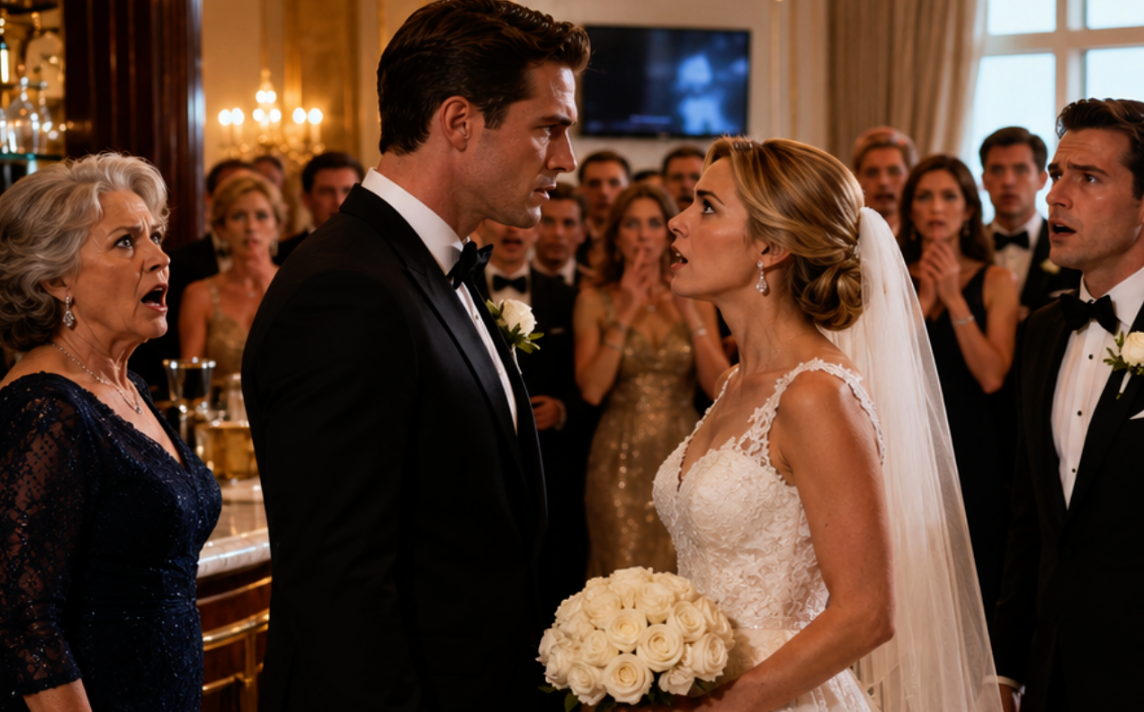
The crowd at the doorway was swelling. Jessica, the bride, pushed to the front, her Vera Wang gown pooling magnificently around her. Marcus was right behind her. The bridal bouquet slipped from her fingers, hitting the polished marble floor with a soft, tragic thud.
“Ethan,” Jessica stammered, her eyes wide with shock. “You’re the Fintech Solutions guy?”
Marcus’s eyes widened in sudden, profound professional recognition. “Morrison? Good God. My fund uses your predictive models. Your software literally saved our portfolio forty million dollars during the Q3 tech contraction.”
“Always happy to help a client optimize their returns,” I said coolly.
Jessica turned slowly to her mother. “You uninvited him because you thought he was poor? Because you thought he’d embarrass us in front of Marcus’s family?”
“We didn’t know!” my mother cried, her voice pitching up as defensive anger rose to mask her absolute humiliation. “How could we possibly know? He never told us!”
The raw, visceral sting of the past half-decade flared violently in my chest. “I did tell you,” I said, the absolute, chilling stillness of my voice cutting through the murmurs of the gathered socialites. “Five years ago, I explicitly told you I was building a foundational technology. You told me I was throwing my life away. When Forbes wrote a feature on my company last year, I told you. You patronizingly asked if I could get an entry-level job there. I bought a house, and you assumed I was drowning in debt. You didn’t want to know me. You only wanted a version of me that fit your rigid, superficial narrative.”
“Ethan—” my father began, stepping forward with his hand outstretched.
“You uninvited me to a family wedding because my presence would be awkward,” I continued mercilessly, locking eyes with my parents. “Mission accomplished. I am not at the wedding. Enjoy the reception.”
Marcus stepped forward, eagerly extending a hand. “Mr. Morrison. Ethan. I would be incredibly honored to schedule a sit-down to discuss your architecture in more detail—”
“He’s not taking meetings today,” Raj intercepted flawlessly, his voice dripping with aristocratic frost. “Especially not with people who evaluate a man’s worth strictly by his proximity to a hedge fund.”
I turned and walked toward the grand exit. The crowd—state senators, elite investors, terrified socialites, and my profoundly stunned family—parted like the Red Sea. We were halfway down the grand, sweeping driveway when I heard the frantic rustling of heavy silk.
“Ethan! Wait!”
Amanda sprinted toward us, her bridesmaid dress hiked up past her knees, her heels discarded somewhere in the marble lobby. She stopped, her chest heaving, and looked up at me.
“I just… I needed to say it,” she breathed. “I am so incredibly proud of you. I should have defended you years ago, but I am saying it now. You did it.”
A microscopic fraction of the ice around my heart fractured. “Thank you, Amanda. I appreciate that.”
By Monday morning, the global financial world had officially erupted. The Wall Street Journal ran a massive front-page profile: The Quarter-Billion Dollar Outcast. Someone at the wedding had talked to the press. The article painted a devastatingly accurate, cinematic portrait of a technological visionary shunned by his status-obsessed family, only to eclipse them entirely on live television.
My phone rang incessantly. At 9:47 AM, I finally answered my mother’s call.
“They made us sound like monsters,” she wept into the receiver.
“They printed the objective truth,” I replied softly. “Listen to me carefully, Mom. I spent five agonizing years trying to earn your respect. I am entirely done. If we are going to have any semblance of a relationship moving forward, it will be because you value Ethan the son, not Ethan the CEO. If you cannot make that distinction, lose my number.”
Three months later, I sat in a bespoke leather chair in our newly expanded headquarters, posing for the cover of the highly coveted Forbes 30 Under 30 issue. The photographer positioned me in the massive server room, bathed in the cool, futuristic blue light of the machines that processed billions of dollars of global wealth every single day.
When the glossy issue hit international newsstands in October, my mother called. This time, there was no defensiveness. There was only a quiet, profoundly fractured humility.
“We desperately want you to come to Thanksgiving,” she said softly. “And I want to apologize. Properly. We were shallow, we were snobs, and we were profoundly wrong. I am incredibly proud of your courage, Ethan. Not your money.”
I ultimately attended the dinner. I laid down a strict, non-negotiable embargo on any business discussions. They treated me with a fragile, terrified reverence, like I was made of spun glass. It wasn’t a total, magical reconciliation, but it was a solid foundation. Amanda and I started taking a terrible, messy pottery class on weekends, a therapeutic activity completely divorced from the hyper-digital world I inhabited.
A year later, Fintech Solutions officially launched its Initial Public Offering.
I stood on the frenetic, chaotic floor of the New York Stock Exchange, surrounded by Raj, Margaret, and the two hundred brilliant minds who had built the empire from the ground up. The opening bell echoed through the cavernous, historic hall. Our ticker symbol, FNGS, flashed brilliantly across the massive LED displays.
By the closing bell, our market capitalization had surged past 1.2 billion dollars. My personal net worth comfortably crossed the half-billion threshold. The champagne flowed like a river. Journalists shouted questions over the roar of the trading floor.
My phone vibrated in my pocket. A text from my father: Watched the bell ring. Incredibly proud of the man you are. A text from Amanda: You look so handsome on TV! I’m telling everyone in the office you’re my brother.
Raj handed me a flute of crystal-clear champagne. “To the outcast who dropped out of business school.”
“To the vision that proved them wrong,” I replied, the delicate glass chiming sharply against his.
I had built something undeniable out of nothing. I had forcefully controlled the narrative, engineered my own reality, and forced the world—and my bloodline—to witness it on my exact terms. The vindication was sweet, but the absolute, unshakable autonomy was infinitely sweeter. I was exactly the man I had meticulously designed myself to be, and finally, that was entirely enough.