At My Johns Hopkins Graduation, The Parents Who Left Me In A Hospital Took Reserved Seats And Whispered, “She Owes Us This.” I Just Smoothed My White Coat—Then The Dean Read The Name They Had Not Expected
The first time I saw my biological parents after fifteen years, they were sitting in section A, row three, under the bright lights of Royal Farms Arena in Baltimore, pretending they belonged there.
My mother had both hands folded over her purse like she was in church. My father kept checking the program, dragging his thumb down the printed names as if the answer he wanted might appear if he pressed hard enough.
Two seats away from them sat Rachel, wearing a navy dress she had bought on clearance and clutching grocery-store flowers like they were roses from a royal garden.
She was crying before the ceremony even started.
My father looked at her once, then looked away.
He had no idea the woman beside him had done what he refused to do.
My name is Sarah Torres now. I was born Sarah Mitchell, but that name stopped feeling like mine in a hospital room when I was thirteen years old.
Back then, I was small for my age, sitting on an exam table in a paper gown that would not close in the back, while Dr. Patterson explained that I had acute lymphoblastic leukemia.
He said it was serious. He also said it was treatable.
Eighty-five to ninety percent, he told my parents. Good odds.
My mother stared at the wall.
My older sister, Jessica, kept texting.
My father asked one question.
“How much?”
Not “Will she live?”
Not “What does she need?”
Just that.
When Dr. Patterson explained the cost, the payment plans, the assistance programs, my father’s face tightened like someone had handed him a bill for a vacation he did not want to take.
Jessica had a college fund. Jessica had a 1520 SAT score. Jessica was going to Yale or Princeton, depending on which bumper sticker my parents wanted on their car first.
I had cancer.
Apparently, in my family, that made me a bad investment.
My mother finally looked at me when I whispered that I was scared.
“You’ll be fine,” she said. “The doctor said the odds are good.”
Then my father said the sentence that did more damage than any needle ever could.
“We’re not destroying a promising future for an average one.”
Average.
That was what they called me while I sat there sick, thirteen, and trying not to shake.
I had spent my whole childhood trying to take up less space in that house. I ate last. I kept my grades quiet because Jessica’s were always discussed first. I clapped at her award ceremonies, carried her shopping bags, smiled in family photos where I was placed on the edge like furniture that happened to breathe.
I knew they preferred her.
I did not know they would leave me.
But within hours, papers were signed. Social services came. My parents walked out of St. Mary’s Hospital without saying goodbye.
Jessica left with them.
Still holding her phone.
That night, I lay in a pediatric oncology room listening to machines beep around me, not afraid of dying as much as afraid that nobody would notice if I did.
Then Rachel Torres walked in.
She was my night nurse. Thirty-four, divorced, tired eyes, dark curls pulled back, the kind of woman who did not make a room louder when she entered but somehow made it safer.
She checked my chart. Then she sat beside me instead of standing over me.
“Yeah,” she said quietly after hearing what happened. “There aren’t really words for how messed up that is.”
That was the first honest thing an adult had said to me all day.
Rachel did not tell me everything would magically be okay. She did not give me a speech about forgiveness. She handed me tissues, stayed past the end of her shift, and came back with a deck of cards.
We played Go Fish until two in the morning.
That was how my real life began.
When I finished the first phase of treatment and needed somewhere to go, Rachel said, “I want to take her.”
Not because it was easy.
Not because she had money.
Because she meant it.
Her house on Maple Street had three bedrooms, one old cat named Pancake, and a small room upstairs painted lavender because I had mentioned once, in passing, that it was my favorite color.
There was a new bed.
A desk by the window.
A bookshelf with novels I had never owned.
On the desk was a framed photo of me and Rachel in the hospital, both of us smiling like we had already survived something.
“Welcome home, Sarah,” she said.
I cried into her shoulder so hard I could barely breathe.
She adopted me when I was fourteen.
She became the person who held the bowl when chemo made me sick. The person who learned which foods I could keep down. The person who bought soft hats when I lost my hair. The person who came into my room every morning and said, “Good morning, beautiful girl. It’s a gift to see your face.”
Every morning.
Even when she had worked twelve hours.
Even when I knew she was exhausted.
Even when I later learned she had taken extra shifts and a second mortgage just to keep my life steady.
My biological parents had once decided my future was too expensive.
Rachel treated it like it was priceless.
When I fell behind in school, she hired a tutor she could not comfortably afford. When I said maybe I was not smart enough, she opened my textbook and sat beside me with coffee she had reheated three times.
“Your parents called you average,” she said. “We’re going to prove them wrong.”
By sixteen, I had caught up.
By seventeen, I was ahead.
By eighteen, I had the five-year all-clear and a silver ring from Rachel with both our birthstones, a reminder that I was never alone.
I wore it through undergrad at Johns Hopkins.
I wore it through organic chemistry, anatomy labs, clinical rotations, sleepless nights, and every exam I took with her voice in my head.
You beat cancer. You can beat anything.
I specialized in pediatric oncology because I knew what it felt like to be the child in the bed, watching adults decide whether you were worth the trouble.
Then, in April of my fourth year of medical school, the dean’s office called.
I had been selected as valedictorian.
The first person I called was Rachel.
“Mom,” I said, because that was who she was. “I have news.”
She screamed so loudly I had to pull the phone away from my ear.
Two weeks later, the university emailed me about reserved seating. As valedictorian, I could submit extra names.
I listed Rachel first.
Then the people who had become my aunts and uncles, the family that had shown up with casseroles, rides, birthday cakes, and hospital blankets.
The coordinator replied less than an hour later.
Linda and Robert Mitchell have contacted us claiming to be your parents and requesting seats. Should we add them?
I stared at the screen until the words blurred.
Fifteen years of silence.
No birthday cards.
No apology.
No hospital visits.
Nothing.
And now, when my name was attached to honors, white coats, photographs, and a stage, they wanted seats close enough to be seen.
I called Rachel.
“Let them come,” she said after a long pause. “Let them see exactly what they gave away.”
So I did.
Now, sitting behind the curtain at commencement, I watched them from the side of the stage.
My mother kept smoothing her skirt.
My father leaned toward her and whispered something I could not hear, but I recognized the look on his face.
Calculation.
He had worn the same expression in room 314 when he turned my diagnosis into a math problem.
A coordinator touched my elbow.
“Dr. Torres, you’re next.”
Dr. Torres.
Not Mitchell.
Torres.
I looked down at my white coat, at the ring on my finger, at the necklace Rachel had given me when the adoption became final.
Then the dean stepped to the podium.
“It is my tremendous honor,” he began, “to introduce the valedictorian of the Johns Hopkins School of Medicine class of 2026…”
My mother lifted her program.
My father stopped moving.
Rachel pressed both hands to her mouth.
And when the dean said my name, the room changed.
“Dr. Sarah Torres.”
My father looked up too late.
The Echoes of Room 314
The scent of room 314 at St. Mary’s Hospital remains permanently etched into my memory—a sterile, unforgiving amalgamation of sharp antiseptic and a cloying, artificial floral air freshener that failed to mask the underlying scent of sickness. I was thirteen years old, perched on an examination table with my legs dangling helplessly, wrapped in a papery gown that rustled with every anxious breath. It was a Tuesday afternoon in October, the day the world as I knew it effectively ended.
Dr. Patterson, a man whose professional composure could not entirely hide his underlying sorrow, had just delivered the verdict: Acute Lymphoblastic Leukemia. He offered the term gently, padding it with immediate reassurances. It was the most common childhood cancer, he emphasized, and highly treatable. With an aggressive regimen of chemotherapy, the survival rate hovered promisingly between 85 and 90 percent. Good odds. Excellent odds, he repeated, almost like a prayer to a god he hoped was listening.
Yet, the atmosphere in the room did not reflect his clinical optimism. My mother, Linda, sat rigidly in a plastic chair, her gaze fixed with vacant intensity on a blank patch of wall, entirely avoiding my eyes. My father, Robert, stood towering over the scene, arms tightly crossed, his complexion darkening with a rising, indignant flush. In the corner, my sixteen-year-old sister, Jessica, tapped away on her phone, utterly detached from the tragedy unfolding mere feet away from her.
“The treatment protocol will be intensive,” Dr. Patterson continued, his finger swiping across a digital chart. “We’re looking at two to three years of chemotherapy. The initial induction phase requires a month of hospitalization, followed by outpatient consolidation and maintenance.”
My father’s first response was not a breathless inquiry about my pain, nor a desperate plea for my life. It was a cold, calculated transaction. “How much?”
Dr. Patterson visibly swallowed, taken aback by the sheer lack of emotional resonance. “With your current insurance, your out-of-pocket responsibility will be roughly twenty percent. We are looking at a range of $60,000 to $100,000. However, there are financial assistance programs, payment plans—”
A harsh, humorless laugh erupted from my father. “You’re telling me we have to pay a hundred grand because she got sick?”
“Robert,” my mother murmured, a weak protest that still lacked the warmth of a maternal glance.
“Sir, I understand this is overwhelming,” the doctor pressed, his voice steadying with forced patience. “But Sarah’s prognosis is excellent. With treatment, she has every chance of beating this and living a completely normal life.”
My father dismissed him with a wave of his hand, pivoting to his true priority. “Jessica is applying to colleges next year. Yale, Princeton. She got a 1520 on her SAT. We’ve been saving for her education since she was born. We have $180,000 in the college fund. That’s for your sister’s education, her future. We’re not throwing that away on medical bills.”
The silence that followed was suffocating. I felt a profound, irreparable fracture within my chest—a break that no chemotherapy protocol could ever mend.
When Dr. Patterson desperately suggested state programs, charity care, or Medicaid, my mother finally animated, fueled not by love, but by bourgeois pride. “We are not taking charity. What would people think then?”
Then came the killing blow. My father, looking at me with eyes devoid of any paternal warmth or protective instinct, proposed a solution so grotesque it took a moment to comprehend. “She’s thirteen. She can be emancipated, become a ward of the state. Then she qualifies for full Medicaid coverage, and it doesn’t touch our finances.”
“You cannot be serious,” Dr. Patterson breathed, the disbelief shattering his professional demeanor.
“We have another child to think about,” my mother defended, her tone taking on a victimized edge. “Jessica has a future. She’s going to do great things. We can’t let this destroy everything we’ve built.”
“Mom,” I whispered, my voice trembling with the fragile pitch of a frightened child. “I’m scared.”
She finally looked at me, offering a chillingly pragmatic farewell. “You’ll be fine, Sarah. The doctor said the survival rate is good. You’ll get treated. You’ll get better. And when you’re eighteen, you can figure out your own life. But we can’t sacrifice Jessica’s future for this.”
“I’m your daughter,” I pleaded, a final, desperate grasp at a bond that was rapidly dissolving.
“And so is Jessica,” my father snapped, stepping closer, his judgment absolute. “And she actually has potential. She’s going to be a doctor or a lawyer. She’s brilliant. You’ve always been average. Average grades, average everything. We’re not destroying a promising future for an average one.”
Dr. Patterson stood abruptly, demanding they leave his office immediately or face security and social services. They complied without a backward glance. The door clicked shut, and the absolute finality of my abandonment crashed over me in a wave of gasping, violent sobs. Within three hours, my parents had signed emergency temporary custody papers, cleanly and legally excising me from their lives.
A Light in the Ward
My first night in the pediatric oncology ward was an abyss. Surrounded by the rhythmic, mechanical hums and beeps of life-saving machinery, hooked to intravenous lines delivering toxic salvation, I was consumed not by the fear of cancer, but by the terrifying realization that I was entirely untethered from the world. I was terrified that no one would care if I lived or died.
Then, the door opened, and Rachel Torres walked in for the night shift.
Rachel was a thirty-four-year-old pediatric oncology nurse who had roamed the halls of St. Mary’s for eight years. She possessed dark, curly hair secured in a practical ponytail and warm, deeply empathetic brown eyes. She wasn’t conventionally glamorous, but there was an immediate, gravitational safety in her presence.
“Hey there, Sarah,” she said softly, reviewing my chart. “I’m Rachel, and I’m going to be your night nurse. How are you feeling?”
“Terrible,” I confessed honestly.
She pulled up a chair, abandoning the clinical distance most medical professionals maintain, and gave me her undivided attention. “Yeah, I heard what happened with your parents. That’s… there aren’t really words for how messed up that is.”
I wept again. I seemed to do nothing but cry that day. Rachel did not offer empty platitudes. She did not tell me everything happened for a reason or command me to stop crying. She simply sat with me, handing me tissues, anchoring me in the present. When the storm of tears passed, she looked at me with fierce conviction.
“I’m not going to lie to you, Sarah. The next few years are going to be hard. Cancer treatment is rough. But you know what? You’re tougher than cancer. You’re tougher than parents who don’t deserve you. And you’re not alone. I’m going to be here every step of the way.”
True to her word, Rachel became my sanctuary. She returned after her rounds with a deck of cards, staying to play Go Fish until two in the morning. She shared stories of her own life—her divorce, her cat named Pancake, her obsession with murder mystery podcasts, and her brother who had survived leukemia a decade prior. She explained that her family had gone broke paying for things insurance didn’t cover to save her brother, never uttering a single complaint.
“That’s what parents do, Sarah. Real parents.”
Over the next month of brutal induction chemotherapy, Rachel transformed from my night nurse to my fiercest advocate, protector, and friend. When the nausea was unbearable, she distracted me with stories. When my hair fell out in clumps, she showed me tragic photos of her own teenage hairstyles until I managed a laugh. My biological parents never visited. Jessica was busy with SAT prep and college applications. But I was not alone because Rachel was there.
On the twenty-eighth day, Dr. Patterson announced I was in remission and ready for outpatient care. The social worker mentioned a foster family.
“I want to take her,” Rachel declared immediately, her voice steady and resolute in the middle of the hospital room. She had been approved as a foster parent two years prior but had never taken a placement. Despite warnings of the immense emotional and financial commitment of a pediatric oncology patient, Rachel looked at me with a profound, unshakeable promise in her eyes.
“Yes,” I answered. “Please.”
The Architecture of a Real Family
On November 15th, exactly one month after my diagnosis, Rachel brought me to her modest three-bedroom house on Maple Street. Carrying my single bag of belongings—the entirety of my worldly possessions—she led me to a bedroom on the second floor.
I stepped inside and stopped. The walls were painted a soft lavender, my favorite color, which I’d mentioned only once in passing. A new bed with a purple comforter awaited me, alongside a bookshelf stocked with young adult novels and a framed photograph of the two of us smiling in the hospital.
“Welcome home, Sarah,” she whispered softly.
I broke down, but these were tears of an entirely different chemical composition. They were tears of profound relief, gratitude, and unexpected grace. Rachel wrapped her arms around me, promising she wasn’t going anywhere.
The ensuing two years of chemotherapy were a brutal crucible. There is no sugarcoating the devastation of those chemicals. Yet, Rachel’s unwavering devotion made the unbearable survivable. She drove me to every appointment, held my hand through every infusion, and learned to cook the few bland foods I could stomach. She took out a second mortgage on her home to cover the co-pays, medications, and special dietary needs—a fact she kept carefully hidden from me. She just made sure I had everything I needed.
Six months into my treatment, we sat at the kitchen table. Rachel looked at me with an intensity that initially sparked a familiar dread in my chest. Was she sending me back to foster care?
“I want to adopt you legally, permanently,” she said, her voice serious. “Not just foster care. I want you to be my daughter. My real daughter. Would that be okay with you?”
I could only nod, tears streaming down my face as we held each other tightly in that kitchen. On my fourteenth birthday, the adoption was finalized. I officially became Sarah Torres. Rachel gifted me a silver necklace with our initials intricately intertwined. “You’re mine now,” she said. “Forever.”
As I entered the maintenance phase of my treatment, Rachel shifted her focus to my academic resurrection. I was two years behind, but she saw a spark in me that my biological parents had willfully ignored.
“You’re brilliant, Sarah,” she told me one evening. “You have so much potential, and I’m not going to let cancer or your biological parents’ cruelty steal that from you. Because your biological parents told you that you were average, that you had no potential… I’m going to prove them wrong. We’re going to prove them wrong. You’re going to do extraordinary things, Sarah Torres, and the whole world is going to know it.”
She enrolled me in advanced online curricula, hired tutors, and stayed up until midnight agonizing over calculus problems she barely understood. By sixteen, I was caught up; by seventeen, I was taking college-level courses. My high school career concluded with a 4.0 GPA, perfect AP scores, and a fiery ambition to become a pediatric oncologist—to be the person Dr. Patterson and Rachel had been for me.
When it came time to apply to universities, I aimed for the zenith: Johns Hopkins University. The tuition was astronomical, a daunting prospect even with financial aid.
“Then that’s where you’re applying,” Rachel insisted, refusing to entertain my doubts. “We’ll figure out the money. You focus on school. I’ve got this. You’re going to be a doctor. You’re going to save lives. You’re going to be extraordinary. That’s worth every penny.”
The Crucible of Medicine
I was accepted to Johns Hopkins with a substantial scholarship. Rachel insisted on covering all my living expenses, working brutal fifty-to-sixty-hour weeks, picking up endless extra nursing shifts to ensure I never had to worry about money. I spent four years immersed in the grueling world of pre-med—organic chemistry, physics, biology, and endless hours in the library. Whenever the pressure threatened to crush me, I would call her, sometimes just to cry.
“You can do this,” she would remind me through the phone, her voice a steady beacon in the dark. “You’re Sarah Torres. You beat cancer. You can beat anything.”
My hard work paid off. I graduated at the top of my class and was accepted into the Johns Hopkins School of Medicine. The next four years were a blur of relentless coursework, exhausting clinical rotations, and the heavy, beautiful burden of learning how to heal the human body. Through every milestone—my white coat ceremony, my first day of clinical rotations, my residency match day—Rachel was there, her pride a tangible, glowing aura.
In all those thirteen years, across hundreds of miles and countless stressful nights, I never received a single communication from Linda or Robert Mitchell. They had excised me like a tumor and moved on with their lives. Or so I believed.
In April of my final year of medical school, I was named valedictorian of my graduating class. I was selected to deliver the student address at commencement. When I called Rachel to share the news, her joyful screams forced me to hold the phone at arm’s length.
Two weeks before the graduation ceremony, I received an email from the university’s events coordinator. “We actually have one additional request for your reserved section. Linda and Robert Mitchell have contacted us claiming to be your parents and requesting seats. Should we add them to your list?”
I stared at the screen for a full five minutes, the blood roaring in my ears. After fifteen years of absolute silence, the people who had discarded me to protect their savings account wanted a front-row seat to my triumph.
I called Rachel. “Mom, my biological parents want to come to graduation. Part of me wants to tell them to go to hell. Part of me wants them to see what I became despite them.”
“It’s your day, honey,” Rachel advised gently. “But if you ask my opinion, let them come. Let them see exactly what they threw away. Let them see the woman you became with a real mother by your side.”
I emailed back and confirmed the seats. I wanted them there. The stage was set for a reckoning.
The Reckoning at Royal Farms Arena
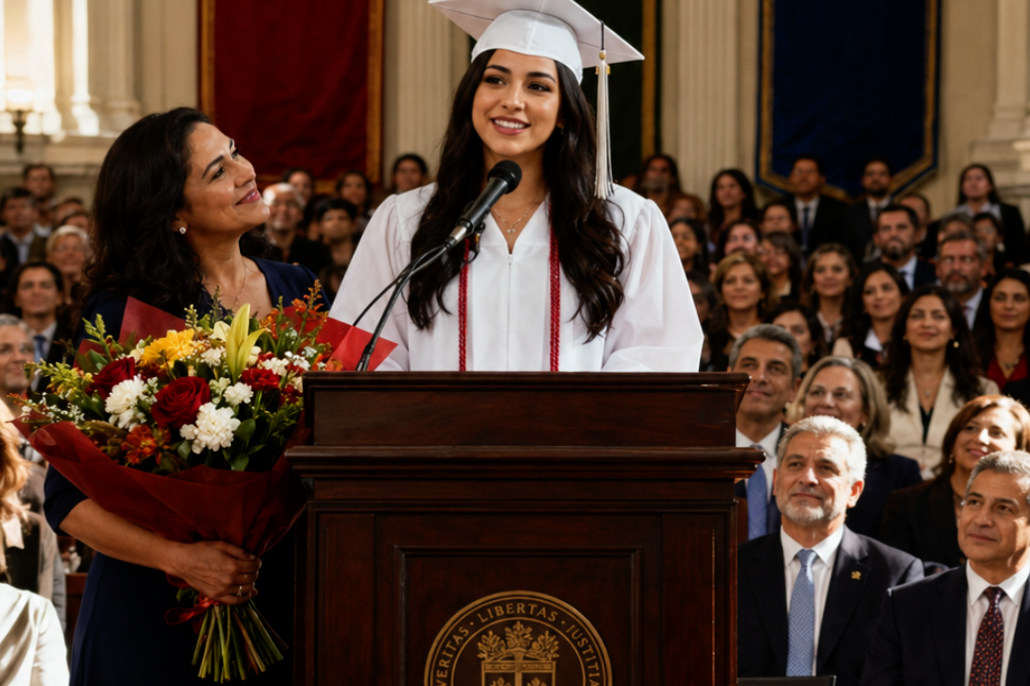
May 20th dawned bright and clear. The Johns Hopkins commencement was held at the Royal Farms Arena in Baltimore, a cavernous space packed with over ten thousand graduates, faculty, and family members. I stood in the lineup, my pressed white coat over my dress, wearing the intertwined initial necklace and the silver ring Rachel had given me on my eighteenth birthday.
As I marched into the arena to the swelling chords of ‘Pomp and Circumstance’, I located my reserved section. Rachel sat in the front row, clutching a bouquet, tears already streaming down her face, surrounded by the aunts, uncles, and friends who constituted my chosen family.
Two seats down, stiff and uncomfortable, sat Linda and Robert Mitchell. They looked older, grayer, diminished, and remarkably ordinary. They scanned the program, oblivious to the fact that their reserved seats were for me, likely looking for their golden child, Jessica.
When the dean introduced me as the valedictorian, highlighting my academic standing and research in pediatric oncology, the arena erupted in applause. I walked to the podium, the weight of a hundred and twenty brilliant peers and ten thousand spectators pressing down on me. I saw Rachel on her feet. I also saw my biological parents freeze, their faces draining of color as realization struck them with the force of a physical blow.
I adjusted the microphone. Ten thousand people looked at me. I took a deep breath.
“When I was thirteen years old, I was diagnosed with acute lymphoblastic leukemia,” I began, my voice echoing through the massive space. I recounted the terror of the hospital room, the clinical explanation of survival rates, and the devastating moment of abandonment.
“My biological parents made a choice that day. They decided that my life wasn’t worth saving, that the cost of treatment was too high, that their other daughter’s college education was more important than my survival. They abandoned me in that hospital room, and I never saw them again.”
A profound, heavy silence fell over the arena. I watched my biological mother press a trembling hand over her mouth, entirely pale. My father stared rigidly at his lap. Whispers began to ripple through the rows around them as the surrounding crowd deduced their identity.
“But I wasn’t alone for long,” I continued, my voice steadying as I locked eyes with Rachel, who was openly sobbing. “Because a pediatric oncology nurse named Rachel Torres saw a scared child who needed a family. She didn’t just treat me as her patient. She brought me into her home. She held my hand through chemotherapy. She taught me that family isn’t about biology. It’s about showing up.”
I detailed Rachel’s immense sacrifices—the double shifts, the late nights, the unwavering belief in my potential. I spoke of the high school honors, the early undergraduate completion, and the medical degree, attributing every ounce of that success to the woman weeping in the front row.
“This degree belongs to Rachel Torres,” I declared, pulling off my cap, breaking protocol without a shred of regret. “She saved my life, not just from cancer, but from believing I was worthless. She taught me that I deserve to take up space in this world, that I deserve to dream big, that I deserve to be loved.”
Then, I turned my gaze directly to the Mitchells, letting the silence stretch to ensure everyone in that arena knew exactly who I was addressing.
“To my biological parents who are here today: Thank you for teaching me what not to be. Thank you for showing me that titles don’t make family. Thank you for giving me up so that I could find my real mother.”
The silence was absolute, a suffocating vacuum of public judgment descending upon them.
“And to Mom,” I concluded, looking back at Rachel, who stood with her hand over her heart. “Thank you for every sacrifice. Thank you for choosing me when no one else did. You are the reason I am standing here today. I love you. This is for you.”
The arena exploded. A standing ovation roared through the cavernous hall. I walked off the stage, leaving the Mitchells drowning in a sea of public shame and the disgusted glares of everyone seated around them. They had come to see their abandoned daughter graduate; instead, they had been publicly identified as the people who valued money over their child’s life.
In the days that followed, the pathetic truth behind their sudden reappearance unraveled via desperate voicemails and emails. Jessica, the child for whom I was sacrificed, had married a wealthy investment banker. My parents had lived comfortably off their largesse, having drained their own savings and retirement to fund her elite life. But six months prior, the husband was imprisoned for an insider trading scheme. Jessica lost everything and cut off her parents. Destitute and facing foreclosure, the Mitchells had searched my name, discovered my impending graduation as a doctor, and arrived hoping to extract financial salvation from the child they had left to die.
Their voicemails were frantic, pathetic symphonies of guilt-tripping and thinly veiled requests for money.
On the fifteenth day, I sent a single, final email:
“You told me when I was 13 that you couldn’t afford a sick child. You said Jessica had potential and I didn’t. You abandoned me when I needed you most. Rachel Torres became my mother, my family, my everything. I owe you nothing. Do not contact me again.”
I blocked them entirely, severing the dead flesh of my past once and for all.
Three years have passed since that day. I am thirty-one years old, completing a prestigious fellowship in pediatric oncology at the Children’s Hospital of Philadelphia. I am exactly where I am meant to be, doing exactly what I am meant to do. Rachel remains my mother, my best friend, and my hero.
I occasionally hear rumors through mutual acquaintances that my biological parents lost their home and now live in a small apartment on social security, entirely estranged from Jessica. I feel no sorrow, no triumph, no guilt. They are phantoms to me.
People sometimes ask if my speech was too harsh, a calculated act of vengeance. It was never about revenge; it was an uncompromising declaration of truth. It was a monument erected to honor the woman who forged me from the ashes of abandonment, and a message to every discarded child that they can thrive despite the people who gave up on them.
Family is not an accident of blood; it is a conscious, daily act of devotion. Love is not a title; it is the courage to stay when walking away is easier. I am Dr. Sarah Torres. I survived the cancer, I survived the abandonment, and I built a magnificent life entirely without the people who insisted I was not worth saving.
That is not revenge. That is justice.