In the economy of our family’s attention, my sister Brooke possessed a monopoly that bordered on the absolute. The engagement party at the Riverside Ballroom was merely her latest, most heavily orchestrated acquisition. Beneath the floating crystal chandeliers, which scattered fractured light over two hundred impeccably tailored guests, the evening had been choreographed down to the very last sparkling detail. A string quartet played unobtrusively in a shadowed corner, weaving familiar, sweeping classical melodies through the low, ambient hum of corporate networking and clinking crystal. Waiters glided like phantoms in stark black and white, moving with liquid grace to replenish champagne flutes long before they were ever in danger of being empty.
And perfectly positioned at the epicenter of it all, bathed in the brightest light and the undivided attention of the room, stood Brooke.
She had mastered the exact geometry of the newly engaged. Her left hand was held at an angle calculated for maximum refractive impact—fingers slightly splayed, wrist elegantly relaxed. The movement was engineered to appear entirely casual, an unpracticed afterthought, yet it was deliberate enough that the two-carat diamond on her finger caught every conceivable shard of illumination. The stone flashed and winked aggressively as she tossed her head in laughter, as she covered her mouth in an exhibition of mock embarrassment, and as she touched her fiancé’s arm at the precise narrative beat where he “got down on one knee and completely surprised” her.
I had listened to this exact rendition of the story fifteen times within the hour. I knew the rhythmic pacing of it: exactly when the collective, breathless “awww” would ripple outward through the concentric circles of guests, when my mother would gracefully dab at the corner of her eye to catch an entirely theatrical tear, and when my father’s chest would expand with a fresh, visible wave of paternal vindication.
I also knew, with the cold certainty of empirical data, that not a single person in that rapt semicircle would pivot to ask how my life was unfolding.
I stood anchored against the mahogany bar, nursing a single glass of pinot noir. I watched the spectacle unfold like a meticulously rehearsed stage play where I had already attended the table read, the dress rehearsal, and the opening night. Somewhere between the presentation of the miniature crab cakes and the pending toasts, I had seamlessly dissolved into the architecture of the room. I was decorative, unobtrusive, and functional only when a relative required an extra pair of hands to manage gift bags or a structurally neutral third party to frame a group photograph.
“Refill, ma’am?” the bartender inquired, his voice a polite intrusion into my reverie.
I glanced down at my glass. I had been cradling the same pour for the better part of ninety minutes, allowing the wine to warm to the temperature of my own skin. “I’m perfectly fine, thank you,” I murmured.
He nodded, sweeping a damp cloth across the polished wood before moving away. I shifted my weight, putting the golden trio—Brooke, my mother, and my father—back into my direct line of sight.
Brooke radiated a blinding, unapologetic joy. To be strictly objective, her triumph was warranted according to the metrics our parents valued. Her fiancé, Michael, successfully checked every box on the family ledger: he held a lucrative, stable position in corporate finance; he wore a luxury watch that signaled wealth without screaming it; he possessed a practiced, disarming smile; and he demonstrated a profound willingness to laugh at my father’s golf anecdotes. The reverence in my mother’s eyes as she looked at him made it abundantly clear that Michael had already been mentally codified as the future patriarch of their lineage.
I did not actively begrudge my sister her happiness. The resentment I carried—layered deep beneath years of practiced, stoic composure—was reserved entirely for the gravitational physics of our family. Brooke’s happiness was the central sun; the rest of us were merely planetary bodies locked in her orbit, forced to rotate endlessly around conversations about her future estate, her theoretical children, and the granular details of her wedding registry.
I swirled my wine, tracking the dark, velvet eddies of red against the glass, letting the distant, shrill laughter of an aunt wash over me. The sensation of being simultaneously physically present and entirely invisible was an old, familiar garment.
“Ladies and gentlemen!” the DJ’s amplified voice suddenly cleaved through the ambient noise, causing the string quartet to halt mid-phrase. “Let us give another tremendous round of applause for our stunning couple, Brooke and Michael!”
Obedient, thunderous applause surged through the ballroom. I clapped in measured rhythm with the crowd, letting the roar of the room swallow my silence. As the applause began to wane, a voice directly behind me cut through the receding noise—a voice threaded with genuine surprise and unmistakable relief.
“James! You actually made it!” my father boomed.
I did not immediately turn. Names were tossed across the room all evening like confetti. But the name James altered the atmospheric pressure. It pierced directly through my observational haze.
I turned to see my Uncle James weaving smoothly through the dense crowd toward our family’s central cluster. His carry-on suitcase was still rolling faithfully behind him, his suit jacket bore the distinct, rumpled signature of domestic air travel, and his silk tie was loosened at the collar.
“Apologies for the delay,” he called out, raising a hand in a charismatic salute. “The connection out of Denver was an absolute labyrinth. I am convinced modern airports are designed as psychological torture devices.”
He delivered the complaint with the effortless, magnetic humor of a man entirely accustomed to holding an audience’s attention. James was not merely my father’s younger brother; he was the undisputed apex of the family’s genetic success. A legendary venture capitalist who had brilliantly navigated the late-nineties tech boom, he resided in a San Francisco townhouse that my mother frequently pulled up on Zillow, whispering its estimated market value to her friends as if reciting scripture.
More critically to my own life, James was the solitary figure in our expansive bloodline who consistently inquired about my existence as a separate entity from my sister.
He reached my parents first, enveloping my father in a robust embrace and kissing my mother’s cheek. “Look at the two of you,” he beamed, stepping back to appraise them. “The glowing parents of the bride.” He pivoted to Brooke, his expression softening into genuine affection. “And there is the undisputed star of the evening.”
Brooke preened, leaning in to hug him while ensuring the diamond caught the light precisely in his field of vision. “I was terrified you wouldn’t make it, Uncle James.”
“Miss my favorite niece’s engagement? I would have purchased a plane outright if the airlines failed me,” he teased.
Then, functioning on the automatic radar of a man who genuinely observes the spaces he occupies, James scanned the perimeter. His eyes locked onto me at the bar, and his entire demeanor shifted from practiced familial warmth to profound, electric delight.
“Sophia,” he said, his voice dropping into a register of undeniable respect. “God, it is incredible to see you.”
He crossed the intervening space in three long strides, abandoning his luggage next to my bewildered father, and pulled me into an embrace that smelled of altitude, expensive cologne, and unwavering validation.
“You look phenomenal,” he declared, stepping back and holding me at arm’s length. “Sanity clearly agrees with you. Tell me, how is life in that one-point-five-million-dollar estate you bought? Has the neighborhood lived up to the architectural hype?”
He delivered the inquiry with the breezy casualness of a man asking about the weather.
The resulting impact on the room, however, was apocalyptic.
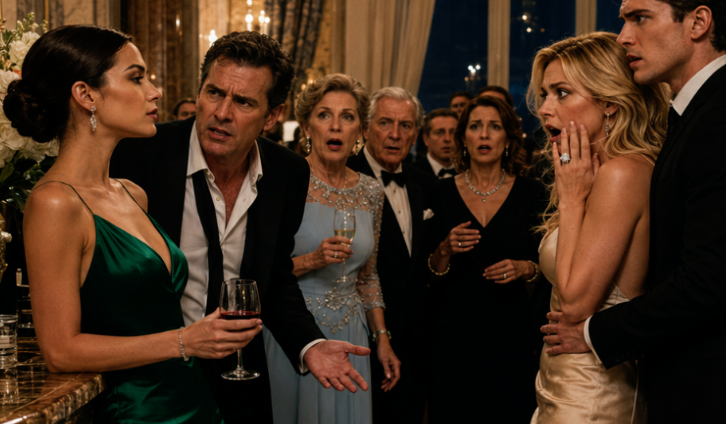
The ambient chatter in our immediate radius dialed down with such violent abruptness that the DJ’s fading transition track sounded like a siren. The surrounding guests froze, their heads tilting in that synchronized, predatory angle people adopt when attempting to eavesdrop without appearing to do so.
Across the small circle, Brooke’s hand—suspended in mid-air to display the ring—went entirely rigid. My mother’s champagne flute halted inches from her lips. My father, who had been detailing Michael’s corporate trajectory to a captive uncle, suffered a catastrophic failure of speech. The blood drained from his face with terrifying speed, leaving him looking like a faded sepia photograph.
“What house?” my father choked out, the words strangling in his throat. “James… what house?”
I took a deliberate, agonizingly slow sip of my pinot noir. The wine suddenly possessed a depth and complexity I hadn’t noticed before. I allowed the liquid warmth to coat my tongue, swallowed smoothly, and finally shifted my gaze back to the frozen tableau of my family.
Eight years. The timeline expanded in my mind like a blooming fractal. Eight years of existing as a footnote. Eight years of offering updates on my rigorous academic and professional life, only to be met with polite, vacant nods before the conversation inevitably rubber-banded back to Brooke’s latest social media triumph. I had not engineered this public detonation, but as I stood in the heavy, pregnant silence between my uncle’s casual disclosure and my father’s breathless shock, a tectonic plate within my psyche locked firmly into place.
“The craftsman property on Sterling Heights,” James answered, blissfully ignorant of the psychological minefield he was tap-dancing across. He smoothly accepted a fresh glass of champagne from a paralyzed waiter. “The one Sophia closed on back in 2016. It’s an architectural masterpiece. The panoramic mountain view from her deck is unrivaled.”
Brooke was the first to successfully reboot her cognitive functions, though her voice emerged sharp and defensive. “Sophia does not own a house. She rents a cramped apartment near the university campus. The one with the nightmare parking situation.”
“I did rent that unit,” I corrected, my tone pleasant, modulated, and utterly lethal in its calm. “For approximately two years, while completing my doctoral dissertation. Following that, I purchased the property on Sterling Heights. That was eight years ago.”
I watched the syllables strike them like physical blows.
My father’s knuckles turned bone-white around his glass. “What on earth are you talking about?” he demanded, a brittle edge of panic slicing through his voice.
“I am referring to the five-bedroom craftsman home I acquired for one-point-two-two million dollars in June of 2016,” I stated, the clinical precision of the numbers cutting through the ballroom’s glamour. “A property currently appraised at roughly one-point-five million, based on this quarter’s market comparables.”
I did not raise my voice. The silence surrounding us was so absolute that I didn’t need to.
My mother’s hand fluttered erratically to her pearl necklace. “That is… that is mathematically impossible,” she gasped. “Where would you possibly acquire over a million dollars?”
“I utilized a two-hundred-forty-thousand-dollar down payment and financed the remainder,” I explained patiently. “Although, to be accurate, I satisfied the mortgage balance in full six years ago.”
James nodded in vigorous approval, sipping his champagne. “It was a masterclass in wealth management. She took her entire signing bonus from Helix Pharmaceuticals and dropped it directly onto the principal. Eliminated a nine-hundred-thousand-dollar note in twenty-four months. Frankly, I was taking notes.”
“Signing bonus?” my father echoed, swaying slightly.
“Helix Pharmaceuticals offered me a hundred-and-eighty-thousand-dollar incentive to abandon my postdoctoral fellowship and join them as a senior researcher,” I clarified.
Brooke’s manicured facade began to visibly fracture. “You received nearly two hundred thousand dollars… just for signing a contract?”
“It is the industry standard for specialized, high-level oncology research,” I noted. “Currently, my total annual compensation is three hundred and seventy-five thousand dollars, factoring in performance bonuses and vested stock options.”
Somewhere in the periphery, a guest dropped a glass. It shattered against the marble floor with a violent crack, but no one in our circle flinched.
“Three hundred and seventy-five,” my father repeated mechanically, his brain failing to process the data.
“That excludes the patent royalties, obviously,” James interjected, raising his glass to me.
“Patent royalties?” my mother whispered, looking at me as if I were an imposter wearing her daughter’s skin.
“I currently hold eleven registered patents in nanoparticle oncology drug delivery systems,” I said. “They generate a supplementary ninety-five thousand dollars annually in global licensing fees.”
I watched my parents’ entire reality collapse. They were being confronted with a towering, undeniable monument to my existence—a version of me that utterly obliterated the soft-focus, comfortably disappointing caricature they had sketched for me a decade ago.
“I don’t understand,” my mother wept, her voice breaking. “You’re just a… a lab researcher.”
“I am the Director of Oncology Research at Helix,” I corrected gently. “I manage a department of forty-seven scientists. We are currently navigating phase three clinical trials for a compound that will fundamentally alter the survival rates of pancreatic cancer.”
James pulled out his smartphone, his thumb flying across the screen. “In fact, Nature Medicine published a feature on her last month. They described her methodology as ‘potentially Nobel-worthy.’ I explicitly emailed the link to you, Patricia.”
My father released a sound that was half-gasp, half-sob. “Nobel…”
“Why didn’t you tell us?” Brooke shrieked, the volume of her voice shattering the quiet constraint of the circle. “You never said a word about a house, or millions of dollars, or any of this!”
I looked at my sister, the lifelong protagonist of our family’s theater. “I did tell you,” I replied softly. “Repeatedly.”
“That is a lie,” my father snapped, reflexively protecting his own narrative. “We would remember.”
James’s face hardened. The casual, charismatic uncle vanished, replaced by the ruthless venture capitalist. “Actually, Richard, she did.” He tapped his screen. “November 2016. Sophia emailed you both about the house. Patricia, you replied by telling her she was financially reckless and asking if she could ‘handle the maintenance’ without crawling back to you for a bailout. And in April 2018, when she mentioned paying off the mortgage at Easter dinner, you literally asked if she was unemployed.”
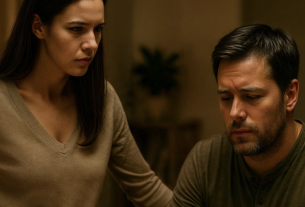
My mother’s face mottled with shame. “I was just… I was concerned…”
“You were dismissive,” I corrected, my voice dropping to a whisper that commanded the entire room’s attention. “You assumed that paying off a house meant I had failed. Because in your minds, I was only capable of failure.”
Before they could mount a defense, the crowd parted, and Dr. Elizabeth Park—one of the world’s leading oncologists and my mentor—stepped into the clearing, her face bright with celebration. “Sophia! I had no idea you’d be here. My God, congratulations on the FDA breakthrough designation. The entire community is buzzing.”
My mother looked at Elizabeth as if she were an alien. “The… FDA?”
“They fast-tracked our pancreatic drug three weeks ago,” I told my parents, the clinical reality of my life anchoring me against their hysteria.
“She is an absolute visionary,” Elizabeth beamed at my stunned parents, misreading the tension entirely. “I cannot wait for her keynote address in Geneva next month. Youngest keynote speaker in the symposium’s forty-year history!”
Brooke stared at me, her chest heaving, her two-carat diamond suddenly looking absurdly trivial against the weight of global scientific advancement. “So you’re just… famous? You just came here to humiliate me?” She turned on her heel and fled toward the terrace, Michael trailing nervously behind her.
My father reached out, his hand trembling. “Sophia… how could you build all of this, achieve all of this, and we knew absolutely nothing?”
“Because,” I said, looking directly into his eyes, “you never once asked.”
The absolute truth of the statement hung suspended in the ballroom air.
“Every conversation for the last eight years was redirected to Brooke,” I continued, stripping away the last remnants of their plausible deniability. “Because I wasn’t performing my life for an audience, you assumed my life lacked value. You treated my career, my intellect, and my choices as background noise.”
“We can fix this,” my mother pleaded, tears finally spilling hot and fast down her cheeks. “We love you. We can start over—”
“Can we?” I asked, feeling a strange, hollow peace settling into my ribs. “Or do you just want front-row tickets to the millionaire daughter’s life? Do you want to know me, or do you just want a new trophy to brag about?”
My father flinched as if I had struck him across the jaw with a closed fist.
“Enjoy the engagement,” I said smoothly, stepping back from the wreckage of their illusions. “It’s a beautiful party.”
I turned and walked away. The rhythmic click of my heels against the marble floor echoed like a metronome marking the end of an era. I felt the burning weight of two hundred pairs of eyes tracking my exit, but I did not look back. The cold, crisp air of the lobby hit my face, a sudden rush of oxygen that cleared the suffocating perfume of the ballroom from my lungs.
James caught up with me at the revolving doors. “You don’t owe them a reconciliation,” he said quietly, placing a steady, grounding hand on my shoulder. “Pain isn’t the same as obligation. You are a titan, Sophia. Don’t let their blindness convince you the dark is normal.”
“Thank you,” I whispered, embracing him fiercely. “For always seeing me.”
I stepped out into the damp, neon-lit night. The drive back to Sterling Heights felt like crossing a dimensional threshold. As my practical, paid-off sedan climbed the winding roads away from the glittering, superficial heart of the city, the heavy knot in my chest began to dissolve.
I pulled into the driveway of my craftsman estate. The low stone walls and the sprawling Japanese maples were bathed in the soft, warm glow of the porch light. Inside, the house was a sanctuary of silent, staggering achievement. My bare feet moved across the gleaming hardwood floors, past the sprawling, quartz-lined kitchen where I hosted brilliant minds, past the library walls groaning with medical texts, and into my office, where the whiteboards held the complex, beautiful math of saving human lives.
My phone, resting on the console table, buzzed in an endless, frantic staccato of missed calls and desperate messages from my parents and sister.
I didn’t even look at the screen. I let it vibrate against the wood until it eventually fell silent.
Standing before the floor-to-ceiling windows, looking out over the sweeping, starlit expanse of the mountain valley, I felt the monumental weight of my reality. Eight years of grueling, relentless, magnificent work. I had built an empire of intellect and independence entirely in the shadows of their neglect. I had not needed their applause to achieve greatness, and I certainly did not need it now to validate it.
I turned off the lights, the darkness wrapping around me not as a void, but as a vast, unassailable territory that belonged entirely to me.