Sarah Martinez smoothed the modest, meticulously pressed fabric of her blue dress as she navigated the revolving glass doors of the Grand Plaza Hotel. It was a garment chosen not for its designer pedigree—it had none—but because her daughter, Emma, had once remarked that the color lent Sarah an aura of calm. Today, above all days, required an ocean of calm. It was Emma’s wedding day. After a lifetime of grueling double shifts at the hospital, breathless anxiety over tuition payments, and fervent, silent prayers for her daughter’s upward mobility, Sarah had made a solemn vow to herself: she would cross this threshold with an unshakeable smile.
The hotel lobby was a masterclass in calculated opulence. It gleamed like the interior of a velvet-lined jewelry box, boasting highly reflective marble floors, towering cascades of white orchids, and hotel staff who drifted like phantoms in severe black uniforms. Every minute detail screamed of the Thompson family’s aesthetic—a curated, intimidating wealth designed to make ordinary folk instinctively lower their voices and question their own worth. Clutching a small gift bag containing a modest silver-and-blue-stone bracelet from Emma’s childhood, Sarah anticipated a quiet, tearful exchange with her daughter before the chaos of the ceremony. She imagined a tender, suspended moment. Instead, she was met with Emma’s hurried, panicked approach across the vast expanse of the lobby.
Emma was pale, her bridal preparation abandoned halfway, her hair only partially pinned. She darted across the marble, not with the radiant anticipation of a bride, but with the frantic, guarded energy of someone trying to reach a sanctuary before being intercepted. “Mom,” she breathed, and for a fleeting second, the accomplished young woman dissolved into the terrified six-year-old Sarah used to hold after school. Emma hesitated, her eyes darting nervously toward the elevators, then toward the ballroom corridor, refusing to fully yield to her mother’s embrace. That singular, fractured moment telegraphed a library of unspoken truths to Sarah. A decision had already been made without her.
“You made it,” Emma chirped with a brittle brightness that shattered instantly against Sarah’s seasoned maternal intuition.
“Of course I made it, sweetheart. I wouldn’t miss your big day,” Sarah replied, her hand finding Emma’s arm. The girl’s skin was remarkably cold. “What’s wrong?”
Emma swallowed hard, her heavy, ostentatious engagement ring catching the lobby’s chandelier light—a diamond that suddenly looked far heavier than any stone ought to be. “There were some… logistical changes. James’s family made them. Mom, I didn’t know how to argue without making everything worse.”
Sarah’s smile remained firmly in place. She had spent decades absorbing catastrophic news in sterile hospital hallways; she knew exactly how to keep her face composed while her heart braced for impact. “What kind of changes, Emma?”
The girl’s gaze dropped to her shoes, her words tumbling out in an ashamed, rehearsed rush. “They moved your seat. You’re at the back table now, by the kitchen entrance. Patricia says it is because of the photographer’s setup, and because the front rows are strictly for immediate family and senior guests.”
Immediate family. The phrase settled like a block of ice behind Sarah’s ribs. She had been Emma’s entire universe, her singular guardian through childhood fevers, crushing rent deficits, collegiate anxieties, and late-night panic attacks long before the Thompsons even learned how to pronounce Emma’s name. Yet, Sarah merely nodded. “I see,” she murmured, acutely aware that uttering another syllable would shatter Emma’s fragile composure.
Before the wound could be tended, the sharp, military staccato of heels announced the arrival of Patricia Thompson. The groom’s mother materialized as though the entire hotel belonged to her by divine right. Her ivory suit exuded a terrifyingly expensive perfection, and her smile was razor-thin. “Emma, darling, why are you downstairs? Your hair appointment was ten minutes ago,” Patricia commanded, before allowing her gaze to drag patronizingly over Sarah’s blue dress and department-store shoes. “Oh. You’re here.”
“Hello, Patricia. The venue looks beautiful,” Sarah said, her spine rigidly straight.
Patricia’s smile turned feral. “Yes, we demanded perfection for James and Emma.”
“Patricia, I was just telling Mom about the seating,” Emma interjected, drawing a shaky breath.
Patricia offered a soft, musical laugh—the precise, chilling sound wealthy women utilize when they wish to disguise cruelty as etiquette. “There is nothing to tell. It is a complicated room, dear. We had to make choices.”
“Choices reveal a great deal about a person,” Sarah countered softly, meeting the woman’s gaze without flinching.
For a fraction of a second, Patricia’s pleasant facade cracked. She stepped closer, her voice dropping to a venomous whisper meant only for them. “Listen carefully, Mrs. Martinez. Emma insisted you be included, and we respected that. But this is a Thompson event. We have a reputation to maintain. Support your daughter quietly from the rear of the room. We cannot have every photograph complicated by unfortunate contrasts.”
Unfortunate contrasts. Sarah thought of her hands, scrubbed raw from unrelenting twelve-hour shifts. She thought of the stained scrubs she had worn through grueling flu seasons, medical shortages, and endless nights where monitors screamed and shattered families prayed for miracles. She wondered which part of her survival Patricia found so profoundly unfortunate.
“We have also arranged for the staff meals to be served at your table,” Patricia continued smoothly, mistaking Sarah’s dignified silence for submission. “It seemed appropriate.”
Emma’s eyes welled with tears. “Patricia, please.”
Sarah silenced her daughter with a gentle, grounding squeeze of the hand. “Go upstairs, honey. Do what you need to do. I am not going anywhere. Do not spend your wedding morning apologizing for someone else’s manners.” Patricia’s mouth tightened into a severe line, but having delivered her poison, she turned and marched away.
Alone in the cavernous, glittering expanse of the lobby, Sarah allowed the searing heat of humiliation to wash over her in a slow, suffocating wave. Fleeing would have been the simplest, perhaps even the most dignified, recourse. Yet, she envisioned Emma scanning the congregation from the altar, desperately searching the room and finding only a desolate void by the kitchen doors. Swallowing her pride, Sarah adjusted her gift bag, lifted her chin, and marched toward the ballroom. Every footfall against the marble was an unyielding declaration of maternal endurance.
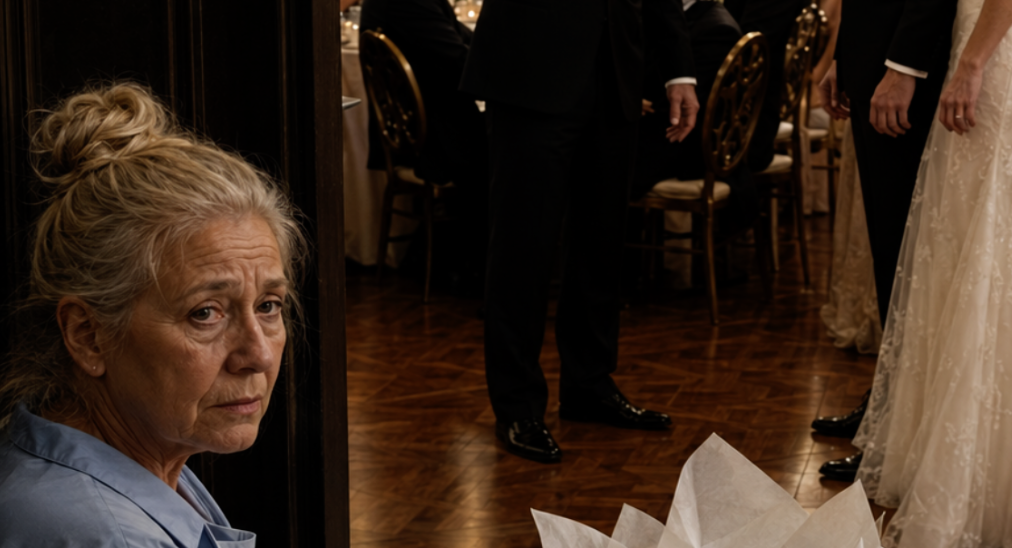
The ballroom was a breathtaking testament to sterile luxury. Crystal teardrops rained light over snowy linens, while colossal arrangements of cream roses and eucalyptus dominated the space. Sarah bypassed the front rows, where thick, calligraphed cream cards proudly displayed the names of judges, doctors, and Thompson patriarchs. She navigated to the very back, where the swinging kitchen doors violently expelled blasts of heat and culinary clatter. There, half-obscured by an imposing structural pillar, was a flimsy, hastily printed card bearing her name. The chair was angled awkwardly, a visual representation of her exile. It was a choreographic insult: You may have raised the bride, but we dictate where you belong.
A young hotel employee approached, clutching a clipboard defensively against her chest. Her silver name tag read Jenny Morales. “Mrs. Martinez?” she asked quietly, casting a wary glance around to ensure they were unobserved. “I am with Event Services. I was instructed to show you to this seat.”
“Then you’ve executed your duty,” Sarah replied with profound gentleness.
Jenny remained rooted, a quiet, luminous fury burning in her dark eyes. “I also wanted to say… I know who you are. My younger sister was brought into County General after the highway pileup last year.”
The chaotic memory surfaced in Sarah’s mind—the scent of rain and iodine, the relentless wail of ambulances, a teenage girl with shallow breathing, and a desperately overwhelmed emergency department.
Jenny’s voice trembled with indignation. “Everyone was stretched thin. You noticed her oxygen dropping before anyone else did. You stayed with her. My family says she is alive today because you refused to walk away. She’s in college now, studying to be a respiratory therapist.”
The room seemed to shift on its axis. “I am so glad she made it,” Sarah whispered, genuinely moved.
Jenny leaned in, her voice dropping to a fierce conspiratorial whisper. “The entire service staff knows what they did with your table. People have been talking. Half of us have family who have passed through County General. We know what kind of person you are. If you need anything today, absolutely anything, you ask.”
For the first time since entering the imposing hotel, Sarah allowed a genuine smile to touch her lips. It was not a mask of polite endurance, but the calculating grin of a strategist. “Actually,” she murmured, retrieving her phone from her purse, “there may be something you can help me with.”
She retreated to a secluded corridor near the coatroom, safely insulated from the hum of the ballroom, and dialed a number she had never used casually. Marcus Chen, CEO of the hotel group that owned the Grand Plaza—and the deeply grateful father of a child Sarah had once fiercely advocated for—answered warmly. Sarah laid bare the situation, devoid of embellishment or self-pity. She presented the cold, unvarnished facts of Patricia’s discriminatory decree.
“Stay exactly where you are,” Marcus commanded, the warmth in his voice hardening into unyielding steel.
The subsequent two hours unspooled like a masterfully orchestrated storm gathering behind silk curtains. Guests in bespoke suits and haute couture filed into the ballroom, their practiced laughter echoing off the crystal. Sarah sat silently by the swinging doors, enduring the thinly veiled sneers and condescending whispers of the elite as they were greeted by a triumphant Patricia. Sarah sipped her water, letting the insults bounce off the armor she had forged over decades. Patricia’s cruelty did not highlight Sarah’s insignificance; it broadcasted Patricia’s profound, desperate fear. A secure woman does not need to hide another woman behind a pillar.
Then, the atmosphere fractured. It began subtly. Jenny deliberately untied her pristine apron. A bartender methodically dismantled his polished shaker station. Waitstaff lined up by the exit, shed their signature Grand Plaza blazers, and draped them uniformly over the backs of chairs. The synchronized withdrawal was so eerily calm that for several seconds, no one comprehended what was happening.
“Excuse me!” Patricia barked, her voice shrill with disbelief. “Where do you think you are going? The appetizers haven’t been served.”
Jenny turned in the center of the ballroom, her posture radiating absolute defiance. “We are ceasing service.”
“You absolutely are not! I am the client!”
“Not anymore, ma’am,” Jenny replied coolly.
Before Richard Thompson could erupt into threats of litigation, the towering, impeccably tailored figure of Marcus Chen breached the ballroom entrance. The ambient chatter died a sudden, final death. Patricia rushed forward, morphing her outrage into a desperate, sycophantic grin. “Mr. Chen, thank heavens. There has been a massive misunderstanding with your staff.”
“There has been no misunderstanding,” Marcus stated, his voice echoing with devastating calm. He bypassed her entirely, addressing the bewildered congregation. “The Grand Plaza refuses to host an event under management that intentionally degrades the mother of the bride based on her income, profession, or social background. I have instructed our staff to temporarily cease service.”
A collective gasp rippled through the guests. Patricia’s complexion mottled with fury and profound humiliation. “You cannot publicly accuse us of this!”
“You made the insult public when you relegated Mrs. Martinez to the service entrance,” Marcus retorted immovably.
Emma, clad in her bridal finery, pushed through the sea of guests, her face ashen, with James trailing behind her. “Mom? What is going on?”
Marcus smiled warmly at Sarah as she stood. “Mrs. Martinez saved my daughter’s life last year. More than that, she has served quietly and brilliantly on the advisory board of our charitable health foundation for years, directing grants that actually save underserved communities. When she called me today, she didn’t ask me to punish anyone. She merely requested that her daughter’s marriage not commence under a regime of unchecked cruelty disguised as etiquette.”
The energetic polarity of the room inverted violently. The guests, previously orbiting the Thompsons, now pivoted their absolute attention and respect toward the woman by the kitchen doors. Testimonials sprouted organically from the crowd—a clinic board member, a corporate donor, a hospital administrator—all publicly corroborating Sarah’s instrumental, unsung heroics. Patricia’s desperate attempt to dismiss her as “just a nurse” was swiftly obliterated by a chorus of elite validation.
James, awakening from a lifelong stupor of filial obedience, stepped forward. His face was flushed, but his posture was resolute. “I am so sorry, Mrs. Martinez,” he said, his voice ringing with newfound conviction. He turned a hardened gaze toward his mother. “I understand perfectly what you tried to do, Mother. And we will not be a part of it.”
Emma, trembling but resolute, echoed his sentiment, finally shedding the last vestiges of her desperate need for the Thompsons’ conditional approval.
Under Marcus’s unwavering authority, the ballroom was swiftly and democratically reconfigured. The offensive back table was entirely dismantled. A new, prominent seat was placed at the very front of the aisle, unequivocally labeled: Sarah Martinez. Mother of the Bride. As Emma wept tears of profound release into her mother’s shoulder, the fractured wedding finally began to heal.
The ceremony, though delayed, proceeded with extraordinary tenderness. Emma’s vows were a tearful, pointed pledge to build a home devoid of conditional love and status-obsessed metrics, while James solemnly promised to prioritize truth over his family’s suffocating traditions. Patricia, pale, furious, and entirely marginalized, watched from a side table. Her absolute authority over the narrative was broken irrevocably.
The reception that followed was stripped of its aristocratic stiffness, replaced by a warm, genuinely joyous atmosphere. The staff engaged with guests with authentic smiles, and the invisible caste system had been decisively abolished. The coup de grâce arrived midway through the evening when Dr. Katherine Reynolds, the formidable state health commissioner, made a surprise entrance. She bypassed the fawning Patricia entirely, bee-lining for Sarah to announce the immediate approval and doubled funding of Sarah’s sweeping community health initiative. The ballroom plunged into stunned silence as Dr. Reynolds publicly eviscerated Patricia’s hypocritical charity efforts, elevating Sarah as a primary candidate for the commissioner’s soon-to-be-vacant seat.
It was a triumph of staggering, cinematic proportions, yet Sarah remained deeply grounded. When the time came for her to speak, she addressed the room with the quiet, unassailable dignity of a woman who had spent her life pulling humanity back from the brink of the abyss.
“Marriage is not two families pretending their profound differences don’t exist,” Sarah proclaimed, her voice steady, echoing under the crystal chandeliers. “It is two people deciding what kind of family they will build from this day forward. Build one where no one is forced to sit in the shadows to keep someone else comfortable. Build one where respect is not an exclusive privilege of the wealthy. And remember this: people reveal their truest selves most clearly in how they treat someone they believe cannot answer back.”
The applause that followed was thunderous, genuine, and intensely validating. Emma kissed her mother’s cheek, recognizing the monumental, generational shift that had just occurred.
Later, standing on the cool, stone terrace overlooking the glittering grid of the city, Sarah breathed in the crisp night air. The arduous years of relentless poverty, desperate double shifts, and quiet, invisible sacrifices had culminated not in a petty display of vengeance, but in this sublime moment of clarity. Emma joined her, barefoot and fully liberated, confessing her past shame and vowing never to compromise her dignity again. James followed shortly after, pledging to forge his own arduous path in frontline medicine rather than safely inheriting his father’s hollow corporate empire.
The Thompsons’ reign of quiet terror was over, dismantled not by malicious sabotage, but by the undeniable, crushing gravity of earned respect.
Sarah returned to her life the very next day, fundamentally untouched by the social tremors and frantic damage control that continued to rock the city’s elite circles. She remained exactly who she had always been: a healer, an architect of better systems, and a fiercely devoted mother. She kept the tiny, degrading place card in her desk drawer, an enduring, stark reminder that true worth is never dictated by one’s physical placement in a room, but by the courage required to stand tall within it. The work continued. And so did Sarah Martinez—quieter than triumph, stronger than anger, and finally standing unapologetically in the radiant light she had earned.