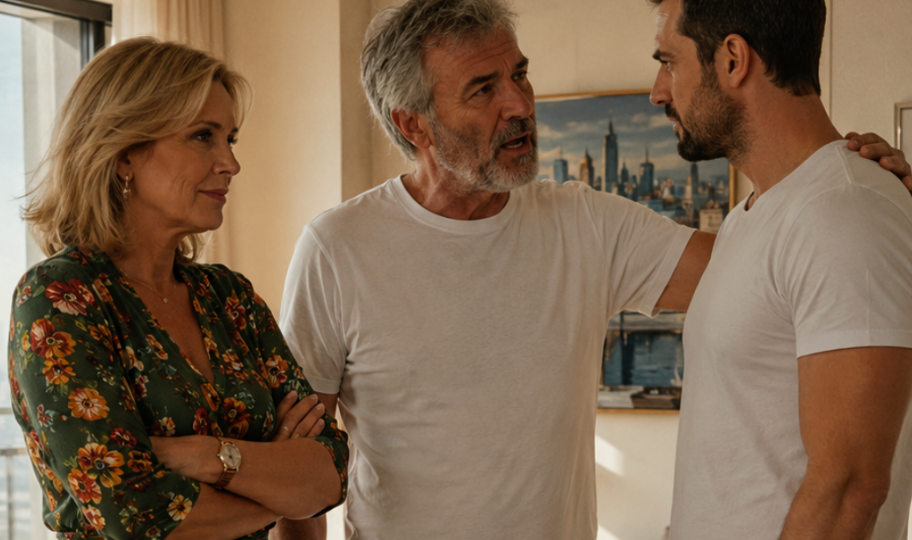
The sound of a plate shattering cut through the kitchen like a gunshot. Porcelain shards scattered across the tile in a fan, and in the sudden silence, only the uneven breathing of two women standing opposite each other could be heard.
“Then buy your son a car yourselves and stop asking me for money!” Sveta’s voice rang with fury. “I’m not a bank. I’m your daughter-in-law!”
Lilia Petrovna slowly straightened up, and her face took on that particular shade of righteous indignation that everyone in the household knew so well.
“How dare you speak to me like that?” she hissed, pointing a trembling finger at her daughter-in-law. “This is my house! My son! And if Miron needs a car, then the family must help!”
“The family must help,” echoed in Sveta’s head. Always the same thing. Family mattered only when they needed something from her. But when she had asked for help renovating the nursery after the baby was born, where had that family solidarity been then?
“Your Miron is vacationing at the seaside right now!” Sveta bent down and began gathering the shards, more to keep her hands busy than out of any desire to clean. “He’s wandering around bars! And you’re asking me for money!”
Her mother-in-law sat down on a chair and theatrically pressed a hand to her heart.
“My blood pressure rises from conversations like this… Kirill! Kirillushka! Come here!”
Her husband appeared in the doorway, still in his work clothes, with the tired face of a man who could sense another family storm coming.
“What happened?” He looked around the kitchen: shards on the floor, his wife flushed with anger, his mother wearing the expression of a martyr.
“Your wife is being rude to me!” Lilia Petrovna rose from the chair with the air of an offended empress. “I merely asked for help for Miron’s car, and she… she starts smashing plates!”
Kirill looked at Sveta. In her eyes he saw not just anger, but exhaustion. Deep, draining exhaustion from the constant demands, from the fact that their home had turned into a revolving door where his mother gave orders like a general on a parade ground.
“Mom,” he began carefully, “maybe this isn’t worth—”
“Isn’t worth it?” his mother-in-law’s voice shot up into a shriek. “It isn’t worth helping your own brother? Miron is your brother! He has no job, no money, and you two live here like royalty!”
“Like royalty!” Sveta suddenly straightened up; a porcelain shard crunched under her foot. “We work from morning till night! We pay the mortgage, pay for our child’s kindergarten, buy your medicine! And what does your Miron do? Thirty years old and not a single day of honest work!”
“Enough,” Kirill thought, looking at the two most important women in his life. His mother, who had sacrificed herself for her sons all her life but had never learned to let go. His wife, who was pulling the family along with the last of her strength and was still being blamed for it.
“Miron called yesterday,” Lilia Petrovna continued, ignoring the tension in the room. “He said he found a good car, but he’s short on money. Only fifty thousand! That’s pocket change for you!”
“Pocket change?” Sveta sat down on a stool, and despair crept into her voice. “Lilia Petrovna, we have a child! We need a car ourselves! We take buses!”
“So what if you take buses? At least you live in your own apartment! And Miron rents a room for twenty thousand!”
“Which we pay for!” Sveta exploded. “Every month! Twenty thousand! And what does he do? He goes to the seaside! Posts photos on Telegram with cocktails!”
Kirill took out his phone and opened his brother’s social media. On the screen were photos: Miron by the pool with a glass in his hand, Miron in an expensive restaurant, Miron on a yacht with unfamiliar girls.
“Mom,” he showed the phone to his mother, “look. Here’s your poor son. Posted yesterday. Dinner at a restaurant — a five-thousand-ruble bill.”
Lilia Petrovna took the phone and stared at the screen for a long time. Her face gradually turned pale.
“Maybe… maybe his friends treated him…”
“Mom,” Kirill’s voice became firm. “Enough. He’s thirty. It’s time for him to earn his own money.”
“But he can’t find a job!”
“Can’t, or doesn’t want to?” Sveta stood and walked to the window. Twilight was thickening behind the glass, and in the reflection she saw her family: her husband, torn between his mother and wife; her mother-in-law, unable to let go of her loser son; and herself — tired, worn out from the endless struggle.
“When will this end?” she thought. “When will I be able simply to live, instead of surviving in my own home?”
The phone rang. Kirill glanced at the screen — Miron was calling.
“Hey, bro!” the voice from the speaker sounded cheerful and carefree. “Listen, here’s the thing! I found an amazing car! An Audi, almost new! The owner needs to sell it fast, we can bargain! I’m only short fifty grand!”
“Miron,” Kirill said, “where are you?”
“Still in Sochi! It’s beautiful here! Yesterday we went out on a boat, today we’re going to a club!”
“A club?” Kirill’s voice became dangerously quiet. “And where is the money coming from?”
“Come on, bro! Don’t act poor! I know how much you earn! Help me with the car, yeah?”
Kirill looked at his wife, then at his mother, then back at the phone.
“Miron,” he said slowly, “do you remember when your tooth hurt three years ago?”
“Well, I remember… So what?”
“Who paid for the treatment?”
“You did… But that was a tooth! It hurt!”
“And when you took driving lessons — who paid?”
“Well, you… Listen, what is this about?”
“And when you needed a suit for a job interview?”
“Kirill, have you lost your mind? I’m your brother!”
“That is exactly why,” Kirill’s voice turned to iron, “I’m telling you this now as your brother: come home. Tomorrow you go to work. Any job. Even as a street sweeper.”
“Are you crazy? I have an education!”
“What education? You’re a dropout! You left university in your third year!”
“Kirill…” Miron’s voice became less confident.
“And another thing,” the older brother continued. “Starting tomorrow, you pay for your room yourself. And you will give Mom money for food. Yourself. From your own earnings.”
“And what if I don’t find a job?”
“You will. Or you’ll live on the street.”
Silence hung in the air. Then Miron laughed nervously.
“You’re joking, right? Mom won’t allow it!”
Kirill looked at his mother. Lilia Petrovna was sitting with her eyes fixed on the floor, still holding the phone with the photos of her son.
“Mom?” he asked quietly.
She slowly lifted her head. There was something new in her eyes, as if a veil had fallen away.
“I…” she began, then stopped. Then, as though overcoming an invisible obstacle, she said, “Kirill is right, Miron. It’s time to grow up.”
“Mom! What are you saying? I’m your son!”
“That is exactly why I spoiled you so badly,” Lilia Petrovna’s voice trembled, but it was firm. “Come home. We’ll live differently from now on.”
Miron kept saying something, protesting, threatening, but Kirill had already ended the call.
Sveta walked over to her mother-in-law and carefully touched her shoulder.
“Lilia Petrovna… this is right. It’s right for him, too.”
The older woman nodded without lifting her eyes.
“All my life I thought I was protecting him… But it turns out I was crippling him.” She stood and looked at her daughter-in-law. “Forgive me, Svetochka. I… I didn’t understand what I was doing.”
“Here it is,” Sveta thought. “The thing I’ve been waiting for all these years. Not victory over my mother-in-law, but understanding. Finally, understanding.”
“Grandmother Katya always used to say,” Lilia Petrovna said quietly, “that children must be loved, but not spoiled. And I… I thought that after their father left, I had to be both mother and father to them. So I overdid it.”
A week later, Miron returned from Sochi. Without a car, without money, but with a new expression on his face — confused and a little frightened.
“Bro,” he said to Kirill as he entered the apartment, “I’ve been thinking… Maybe I really should work somewhere? Temporarily, of course.”
“Not temporarily,” Kirill answered calmly. “Permanently. Like all normal people.”
“And the car?”
“You’ll buy the car when you earn the money. Yourself.”
Miron looked at his mother, expecting support, but Lilia Petrovna only nodded.
“Kirill is right, son.”
“Miracles,” Sveta thought, watching the scene. “Turns out people can change. Even at fifty. Even at thirty.”
That evening, after Miron had gone to look for work — seriously, for the first time in his life — and Lilia Petrovna was putting her grandson to bed, Kirill and Sveta sat in the kitchen drinking tea.
“Do you think it will work?” Sveta asked.
“I don’t know,” her husband answered honestly. “But it was worth trying. Miron isn’t evil, just… spoiled.”
“And your mother… is she taking it hard?”
“She is. But she understands we’re right.” Kirill took his wife’s hand. “Forgive me for not stepping in for so long. I thought it would somehow sort itself out.”
“Nothing sorts itself out on its own,” Sveta smiled. “But now everything will be different.”
And indeed, things became different. Miron got a job with a delivery service. The work was hard, but honest. He brought his first paycheck to his mother — the whole amount.
“Mom,” he said, handing her the money, “this is for the room and food.”
Lilia Petrovna took the bills with trembling hands. Tears stood in her eyes — not from resentment, but from pride.
“Thank you, son.”
“I’m the one who should thank you,” Miron said unexpectedly. “For finally stopping feeling sorry for me.”
“This is how people grow up,” Sveta thought, watching the scene. “Not from praise and gifts, but from responsibility. From finally becoming truly needed.”
And six months later, Miron really did buy a car. Used, inexpensive, but his own — earned with his own hands. And when he sat behind the wheel for the first time, there was something new in his eyes. Something that had not been there before.
Pride. Real, deserved pride.
“It’s nice,” Sveta said, looking over the car.
“Yeah, it’s not an Audi,” Miron laughed. “But it’s mine.”
And in that word — “mine” — there was everything.
Lilia Petrovna stood by the window and looked at her younger son too. There was a smile on her face, the kind Sveta had never seen before. Calm, wise, without anxiety.
“Finally,” the mother-in-law said quietly. “Finally, both my sons have grown up.”
And Sveta understood: the war was over. Not because one side had defeated the other, but because everyone had become adults. Truly adults.
But life, as everyone knows, does not like long periods of peace.
A month after buying the car, Miron came to his brother with an interesting proposal.
“Kirill,” he began, sitting down at the kitchen table, “I have a proposal. A serious one.”
Sveta tensed. “He’s come up with something again,” flashed through her mind.
“I’m listening,” Kirill said cautiously.
“Do you remember Seryoga Volkov? We went to school together.”
“I remember. So what?”
“He’s in business now. He’s selling a franchise — coffee shops. Says it’s profitable. You only need to invest a hundred thousand, and the income is up to fifty a month!”
Kirill and Sveta exchanged glances. The air suddenly smelled of familiar trouble.
“Miron,” Kirill said slowly, “where would you get a hundred thousand?”
“That’s the thing!” Miron’s eyes lit up even brighter. “I don’t have it. But we’re family! We can pool our money!”
“We?” Sveta’s voice became cold as ice.
“Well, yes! You and Kirill put in fifty, Mom puts in thirty, I put in my savings — twenty thousand… and we’re off! In six months we’ll return all the money with interest!”
“Lord,” Sveta thought, “has he learned absolutely nothing?”
“And what if it doesn’t work?” Kirill asked.
“How could it not work?” Miron pulled colorful brochures from a folder. “Look at these statistics! Ninety percent success rate! Seryoga is already opening his third coffee shop!”
“Miron,” Sveta sat across from him and looked into his eyes, “a month ago you didn’t even know how much bread costs. How would you know how to run a business?”
“Well… I’ll learn! Seryoga will help!”
“And where will this coffee shop be located?”
“On Central Street! Huge foot traffic!”
“And how much is the rent?”
“Well…” Miron hesitated. “Seryoga is calculating that…”
“Miron,” Kirill’s voice became stern, “have you even seen the contract?”
“What contract?”
“The franchise agreement! The property documents! The permits!”
Miron blinked in confusion.
“Seryoga said everything is already ready… We just need to put in the money…”
Sveta stood and walked to the window. “And here it is,” she thought. “It seemed like he had changed, but now again… Only this time he’s not asking for a car; he’s dragging us into some shady scheme.”
“Miron,” she said without turning around, “what do you know about selling coffee?”
“Well… people drink coffee… a lot of it…”
“What about suppliers? Bean quality? How coffee machines work?”
“You can learn anything!”
“What about taxes? Inspections? What to do if competitors open nearby?”
With every question, Miron’s voice grew quieter.
“I… all that can be solved…”
Kirill took the brochures and studied them carefully. Then he took out his phone and dialed a number.
“Hello, Maxim? Hi, it’s Kirill… Listen, you know about trade, right… Can you take a look at a franchise?”
He photographed the documents and sent them to his friend. Ten minutes later, the phone rang.
“Well?” Kirill asked.
“Kirill,” the voice on the line sounded concerned, “this is a classic scam. This Volkov guy has been in court for a year already. Half of his ‘partners’ lost their money.”
“Understood. Thanks.”
Kirill hung up and looked at his brother. Miron sat pale, his gaze empty.
“Seryoga lied to me?” he asked quietly.
“He didn’t lie to you,” Kirill said. “You lied to yourself. Once again, you believed in easy money.”
“But I wanted the best… I thought we’d all get rich…”
“Miron,” Sveta sat beside him, “do you remember what I told you six months ago? That I’m not a bank?”
He nodded.
“Well, I’m still not a bank. And I’m not a sponsor for your experiments either. If you want a business, start small. With your own money.”
“But I only have twenty thousand…”
“And that’s wonderful!” Lilia Petrovna unexpectedly interrupted. She had been listening silently by the door the entire time. “You can do a lot with twenty thousand.”
“Mom, what can you do with twenty thousand?”
“Think about it,” his mother-in-law sat down at the table. “Sell ice cream in the summer. Or newspapers and magazines. Or do small repairs in people’s homes — you have golden hands when you want to use them.”
“Now that’s a twist,” Sveta thought in surprise. “Lilia Petrovna is teaching her younger son reality. Miracles indeed.”
“Mom, that’s small stuff…”
“Miron,” his mother’s voice became strict, “do you think your father started big? He started with coin purses. Bought them in one place, sold them in another. Counted every kopek of profit.”
“But that takes so long…”
“Are you in a hurry somewhere?” Sveta smiled. “You have your whole life ahead of you.”
Miron sat silently for a long time, digesting what he had heard. Then he suddenly asked:
“And if I… well, try something small… will you help me with advice?”
“With advice — absolutely,” Kirill nodded. “With money — no.”
“That’s fair,” Miron unexpectedly agreed. “I understand. I have to do it myself.”
A week later, he came with a new plan. This time, a much more modest one.
“I’ve decided,” he announced. “On weekends I’m going to wash cars. At people’s homes. Wash the car, clean the interior. The equipment isn’t expensive, and I’ll find clients online.”
“Now that sounds like a real thing,” Kirill approved.
“I’m just scared… what if it doesn’t work?”
“What if it does?” Sveta countered.
And it did. Slowly, gradually, but it did. Miron turned out to be a conscientious worker — he washed cars well, with care. Clients began recommending him to their friends.
After three months he already had regular clients. After six months he rented a small garage bay and registered everything officially. Another year later, he bought equipment for interior dry cleaning.
“You know,” he once said to Sveta, wiping his hands after work, “it’s actually amazing when you’ve earned it yourself. When you know every ruble is yours.”
“That’s good,” she smiled.
“And also…” he hesitated. “Thank you. For not giving me money back then. If you had, I would have stayed a beggar forever.”
“Here it is,” Sveta thought. “The reason all those scandals were worth enduring. Not revenge, not victory, but simply so that a person could become a real person.”
That same evening, Lilia Petrovna approached her daughter-in-law and said quietly:
“Svetochka, forgive me for everything. I understand now myself — loving and spoiling are different things.”
“It’s all right,” Sveta replied. “The important thing is that everything ended well.”
“And do you know the funniest thing?” her mother-in-law laughed. “Miron now brings me money every week. Not because I ask, but just because. He says, ‘Mom, buy yourself something tasty.’ And it’s completely different money. Not out of pity, but out of gratitude.”
“Yes,” Sveta thought. “It really is completely different money. And a completely different family.”
A year later, something happened that no one had expected. Miron fell in love. Truly, seriously, with a good girl — Oksana, a nurse from the district clinic.
“Bro,” he said to Kirill, “I want to get married.”
“It’s about time,” his older brother approved.
“But the wedding… I’ll pay for it myself. Modest, but my own.”
“That’s right.”
“And I’ll rent an apartment myself. I won’t go begging to you.”
“Even better.”
“And Oksana… she’s good. Hardworking. Not like I used to be.”
And Sveta understood: the circle had closed. That spoiled, constantly whining Miron had disappeared. In his place stood a man who earned his own money, made his own decisions, and took responsibility for his own life.
“Sometimes,” she thought, looking at the family dinner where everyone spoke calmly, without scandals or accusations, “sometimes the cruelest thing is the kindest. And the kindest thing can seem cruel.”
And she was right. Because family is not when everyone forgives everything. Family is when everyone respects one another. And respect is impossible without responsibility.
That is how the story ended — the story of how a daughter-in-law refused to be a bank.
And everyone only benefited from it.