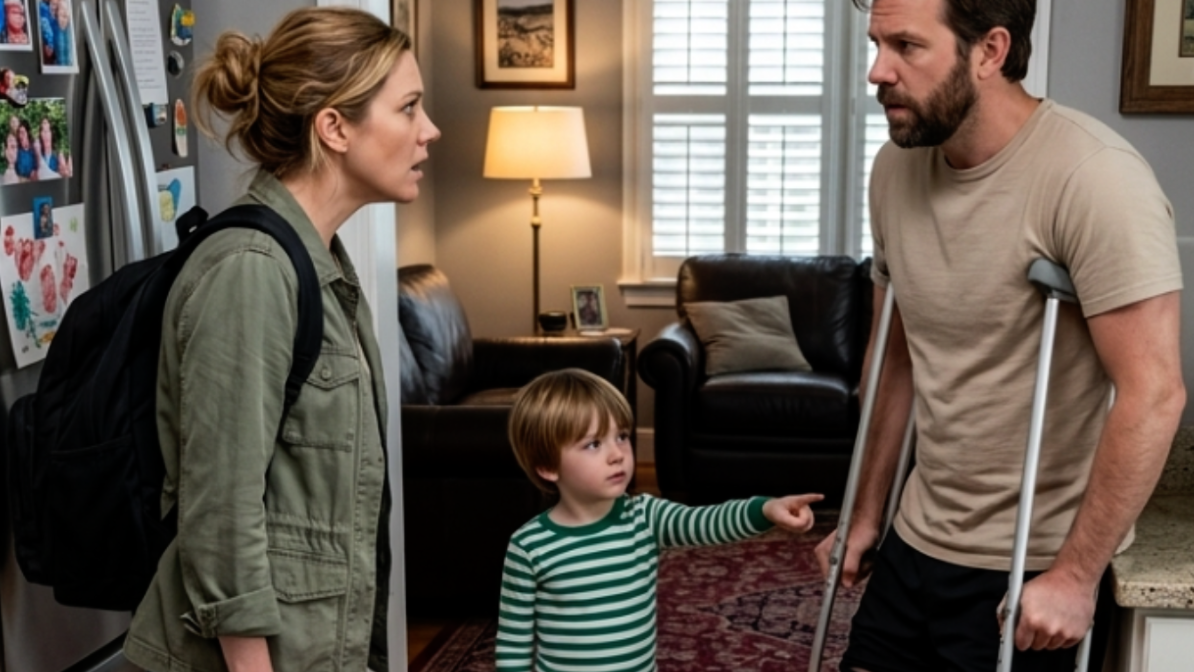
The sharp, astringent scent of lemon cleaner collided violently with the thick, comforting aroma of freshly baked bread the precise moment I pushed open my apartment door. The sensory contrast hit me so forcefully that I froze on the threshold, my hand still gripping the brass doorknob. For one suspended, dizzying second, I was absolutely certain that the sheer, bone-deep exhaustion of another punishing twelve-hour shift at the hospital had finally caused my internal compass to fail, guiding me into the wrong unit entirely.
My first, panicked thought was that I had miscounted the flights of stairs, a common symptom of my chronic fatigue. My second, far more unsettling thought was that an intruder had broken into my home and, with a deeply unnerving courtesy, decided to completely rearrange the fabric of my life. Both of these frantic theories disintegrated the moment my eyes fell upon Oliver’s brilliantly crooked crayon drawing. It was still taped to the scarred surface of the refrigerator, right beside my chipped, blue ceramic mug, anchored exactly where it had always lived.
The apartment was undeniably mine, yet it had been profoundly and meticulously transformed. To fully grasp the shock of this, one must understand the usual state of my living quarters—a
Then, the profound silence was broken by a quiet rustling from the kitchen. A remarkably tall man turned slowly away from the stove, his movements visibly constrained as he steadied himself with a heavy-duty medical brace secured tightly around his right knee. For a breathless, fractured moment, my exhausted mind simply refused to bridge the gap between the homeless stranger I had reluctantly sheltered the night before and the quiet, intensely domestic scene currently unfolding in front of me. He was wearing one of my oversized, faded gray t-shirts. The sleeves hung awkwardly, almost comically, past his elbows—an absurd visual on a man possessing his broad, structured frame. A heavy loaf pan rested cooling on the laminate counter, and beside it sat a ceramic plate radiating the intoxicating, warm scent of melted cheddar and fresh herbs.
He raised both of his large hands immediately, his palms open and facing me. It was the universal, instinctual gesture of a person desperately trying not to alarm someone who possessed every logical reason to be terrified.
“I stayed entirely out of your bedroom,” he said quickly, his voice remarkably calm but thrumming with a hyper-vigilant alertness. “I only cleaned the front rooms. I figured it was the absolute least I could do to repay the immense risk you took on my behalf.”
My pulse hammered a frantic rhythm against my eardrums, a physical manifestation of my rising panic. “How did you manage all of this?” I demanded, my voice sharper than I intended.
He gestured vaguely toward the stove. “I used to cook a lot before… before things changed,” he murmured, leaving the dark, heavy weight of that unfinished sentence hanging suspended in the quiet air between us.
On the small wooden table sat two perfectly golden grilled cheese sandwiches alongside a steaming bowl of soup, its surface beautifully flecked with bright green parsley and thyme. My physical exhaustion lingered deep and heavy in my bones, but a sharp, protective suspicion rose fiercely right alongside it.
“You went through my private cabinets without asking,” I stated, my tone defensive.
“I searched strictly for ingredients, not personal belongings,” he replied evenly, without a hint of defensiveness. “I thoroughly documented every single item I used.” He pointed a long finger toward a carefully folded piece of notebook paper resting near my scattered keys.
Bread, cheese, carrots, celery, three broth cubes, the note read in a surprisingly elegant, careful handwriting. Will replace at the earliest possible opportunity.
“Replace?” I asked, a bitter laugh threatening to break free. “With what?”
Before he could formulate an answer, Oliver came bursting out of the narrow hallway, his heavy school backpack still bouncing rhythmically against his small shoulders. “Mom! Adrian fixed the front door! The one that always gets stuck!” he announced, his voice practically vibrating with excitement.
I blinked, processing the words slowly. “Fixed?” I repeated, dumbfounded.
“It closes perfectly now,” Oliver declared proudly. “And he made me sit down and finish all my math homework first before I could play.”
Adrian’s firm mouth twitched faintly at the corner, the ghost of a smile. “He focuses incredibly well when the environment is quiet,” he noted softly.
I walked slowly toward the heavy front door—the very same door that had aggressively scraped the floorboards and jammed tight for months. I had filed three separate, documented complaints to the building management since moving in, entirely without result. I pulled the handle. It swung and closed with a smooth, silent glide. The deadbolt engaged effortlessly under the slight pressure of my hand. Deep within my chest, a profound wave of relief forcefully collided with a dark, lingering unease.
“Where exactly did you learn to execute repairs like that?” I asked, turning back to him, my eyes narrowing.
“I worked heavy construction and specialized facilities maintenance for a major hospital contractor for years. Right up until I severely injured my knee,” he explained, his posture stiffening slightly.
The next question erupted from my lips, sharper and far more interrogative than I had consciously intended. “If you have those skills, why were you sleeping on the concrete outside the grocery store last night in the freezing rain?”
His intense gaze dropped immediately to the polished floorboards. “Complicated workers’ compensation disputes,” he said, his voice dropping an octave. “The rent fell behind by two months. My family support network… disappeared.”
I folded my arms tightly across my chest, desperately needing a physical barrier to ground my spinning thoughts. “I explicitly agreed to let you stay for one single night,” I reminded him firmly.
“I understand,” he replied, his tone laced with quiet dignity. “I genuinely didn’t intend to overstay my welcome. But I simply couldn’t leave this morning without attempting to balance the enormous risk you took on me.”
Then, he did something that caused the base of my spine to tighten considerably. He reached slowly into the deep pocket of my winter coat hanging by the door and withdrew a neatly rubber-banded stack of my mail, meticulously arranged by category. “I swear I didn’t open anything that was sealed,” he added hastily, sensing my immediate flare of anger. “But your landlord’s final notice was already lying open on the kitchen counter.”
My throat instantly constricted, swallowing becoming a painful endeavor.
“You are exactly two notices away from an eviction lock-out,” he said gently, not with pity, but with factual gravity.
“I know,” I whispered, the shame of it burning my cheeks.
“I cannot contribute financial capital yet,” he continued, his eyes locking onto mine with an intense, calculated focus. “But I can offer you substantial leverage.”
A short, entirely humorless laugh escaped my lips before I could suppress it. “Landlords don’t trade in human compassion, Adrian,” I said bitterly.
“No,” he agreed calmly, his face a mask of absolute certainty. “They do not. They respond exclusively to advantage and liability.”
That evening, long after Oliver had fallen into a deep sleep, I sat directly across from Adrian at the small kitchen table. The landlord’s threatening notice trembled slightly between my exhausted fingers.
“Let me formally inspect the entire building tomorrow morning,” he suggested quietly.
The pure, audacious simplicity of that proposal unsettled me far more than his cooking or cleaning had. I realized then that Adrian did not react to life’s chaos the way normal, terrified people did. He was fundamentally analyzing the underlying structure of our disaster. He looked at our impending eviction the way a master engineer stares at a cracked concrete foundation—he began instantly calculating the load-bearing weight rather than panicking about the superficial crack itself.
Saturday morning arrived, accompanied by thin, pale light filtering weakly through my cheap, translucent curtains. I had half-expected him to have vanished into the pre-dawn shadows, taking whatever meager comforts he’d scavenged. But at seven o’clock sharp, he stood perfectly ready by the door, his heavy leg brace securely strapped, my battered, rusted toolbox already resting open on the counter.
“I will leave the absolute second you ask me to,” he stated firmly. “Until that moment arrives, I am going to remain aggressively useful.”
We walked shoulder-to-shoulder down to the cramped building management office, hidden away behind the violently humming industrial laundry machines in the damp basement. Mr. Pritchard, the property manager, looked up from his cluttered desk, his face contorting with immediate irritation before either of us had uttered a single syllable.
“Your rent is severely overdue, Ms. Bennett,” Pritchard stated flatly, ignoring Adrian entirely.
“I am fully aware,” I replied evenly, channeling Adrian’s strange, calm energy.
Pritchard finally shifted his narrowed, suspicious eyes toward the towering man standing beside me. “And just who are you?” he demanded.
“I am an independent temporary consultant,” Adrian replied, his voice remarkably smooth, utterly devoid of intimidation. “I would like to immediately address several unresolved, critical maintenance failures that are currently threatening tenant safety and your insurance premiums.”
Pritchard scoffed loudly, a wet, dismissive sound. “There are absolutely no major structural issues in this building.”
Adrian didn’t blink. He began reciting facts with the rhythmic, devastating precision of a metronome, ignoring the interruption completely:
Pritchard stiffened visibly, the color draining slightly from his ruddy cheeks. “Who the hell told you all that?” he demanded, his voice pitching higher.
“The building did,” Adrian replied simply, offering no further explanation.
A heavy, suffocating silence stretched endlessly between the two men.
“I can personally rectify every single one of those violations by sundown today,” Adrian continued, his voice dropping into a register of pure negotiation. “In direct exchange, you will grant Ms. Bennett thirty additional days of grace to catch up on her arrears. We require a signed, written agreement immediately.”
Pritchard hesitated, his eyes darting back and forth as he visibly ran frantic calculations behind his eyes. “And why, exactly, would I ever agree to let some random guy touch my building?” he sneered.
“Because of insurance liability,” Adrian answered, delivering the final, fatal blow. “Unmitigated fire risks. Documented municipal code violations. And the undeniable paper trail I will leave with the city inspector’s office if you refuse.”
After a painfully long, agonizing pause, Pritchard muttered, “Thirty days.”
Adrian smoothly produced a handwritten, legally sound contract he had apparently drafted by the dim street light the night before, while I slept believing he was merely resting. Pritchard signed it within two minutes.
The following weeks did not deliver magical, cinematic miracles, but they delivered a slow, grinding stabilization that was infinitely more valuable. Adrian’s complex disability claim was successfully reopened. Modest, steady payments began arriving in the mail. My apartment ceased its slow, depressing slide into physical deterioration. Furthermore, Mr. Pritchard treated us with a newly discovered, cautious respect—the very specific demeanor of a man who has definitively decided never to underestimate an opponent twice.
The relative, fragile peace of those first few weeks felt remarkably like a delicate glass sculpture—undeniably beautiful and deeply functional, yet terrifyingly prone to completely shattering at the slightest vibration. Adrian had morphed into a benevolent phantom of extreme productivity.
But the process of deep restoration, as I was soon forced to learn, is never a linear journey. It is a jagged, bloody climb, fraught with terrifying, unexpected drops.
The shattering of our fragile peace commenced on a freezing Tuesday evening, heralded by the aggressive, rhythmic thumping of heavy fists against our newly repaired front door. I pulled it open to reveal a man who looked distinctly like a rougher, violently weathered iteration of Adrian himself—entirely stripped of any inherent gentleness. He was draped in a heavily grease-stained canvas jacket, and a deeply predatory look of recognition flashed across his face the instant he registered the interior of my home.
“I heard a nasty little rumor he was holed up in 3C playing house,” the man sneered, violently pushing his way past me without waiting for an invitation. “Adrian! Don’t tell me you’re playing the domestic hero while you still owe the crew for that botched site job downtown.”
Adrian materialized from the kitchen doorway, the faint, healthy color he had gained over the past month draining instantly from his face, leaving him looking like a corpse. The vague story of his “disappearing family support network” suddenly crystallized in my mind. It wasn’t a tragic tale of simple neglect; it was a desperate story of escape.
“Get the hell out of here, Miller,” Adrian commanded. His voice was a low, terrifying vibration—a dangerous, coiled frequency I had never heard him use before.
“Not until I get my rightful cut of that back-pay disability settlement you’ve been bragging to the boys about reopening,” Miller spat, his eyes roving over my cheap, chipped furniture with undisguised, mocking contempt. “Or maybe I’ll just extract it directly out of the little lady’s security deposit instead.”
The ensuing confrontation was brief, bloodless, but utterly devastating in its psychological violence. Adrian could not physically fight—his knee would have buckled instantly—but he utilized the exact same calm, terrifyingly analytical tone he had weaponized against Mr. Pritchard to systematically dismantle Miller’s threats.
He spoke coldly of sealed police reports. He rattled off the exact dates of horrific workplace accidents Miller had actively overseen and covered up. He detailed a massive, hidden paper trail he had meticulously maintained for years, clearly anticipating this exact, dreadful day. Eventually, Miller, realizing he was outmatched intellectually, simply spat a wad of saliva onto my spotless linoleum floor and stormed out.
But the silence Miller left in his wake was suffocating, heavy with the toxic stench of a violent, chaotic life I had no idea Adrian was dragging behind him.
That night, the dinner Adrian prepared tasted like dry ash in my mouth.
“He is completely right about one specific thing,” Adrian whispered, his eyes fixed firmly on the grain of the wooden table. “I didn’t simply lose my career because of a bad knee. I was destroyed because I attempted to formally report the gross safety violations Miller was purposefully ignoring on the high-rise sites. They blacklisted me across the state. That dispute I vaguely mentioned to you? It wasn’t a bureaucratic paperwork error. It was a total, scorched-earth war.”
He finally forced himself to look up at me, his dark eyes raw and exposed. “And I just brought the front lines of that war directly to your doorstep. I have fundamentally broken the one, single rule I promised to uphold. I have made your sanctuary unsafe.”
He immediately stood up and began packing his few meager possessions into the small, battered canvas duffel bag I had gifted him weeks prior. Every cleanly folded shirt he tucked away felt like a violent, physical betrayal of the delicate stability we had built.
“Where exactly will you go in this weather?” I asked, my voice betraying a pathetic tremble.
“Somewhere Miller’s people cannot track me,” he replied flatly. “Somewhere I am no longer a massive liability to a mother who is already barely clinging to the edge of the street.”
I stared at the heavy front door that no longer jammed. I thought of Oliver’s math scores improving, of the simple, miraculous way the stale air in the apartment felt inexplicably lighter simply because another steady soul was breathing it alongside us. Adrian was not a broken appliance I was fixing out of charity. He was a deeply honorable man who had been shattered by the very same systemic cruelty and greed that was actively trying to evict me.
“You explicitly told me once that landlords, and the world at large, respond only to advantage,” I said firmly, stepping physically between his massive frame and the exit. “Well, so do I. And the profound advantage of having you here—the structural repairs, the physical safety, the actual, living soul you dragged back into this sterile kitchen—vastly outweighs the statistical risk of a violent coward like Miller showing up to posture.”
“You are being foolishly sentimental,” Adrian warned, his voice cracking. “That is a dangerous luxury we cannot afford.”
“No,” I fired back, mirroring his intense, unyielding gaze. “I am being entirely structural. We are two heavily damaged pillars leaning desperately against one another. If you move away now, I will inevitably fall. If I push you out into the snow, I will collapse. Stay. We will call the authorities if Miller ever returns. We will document his every move just like you documented the broth cubes.”
He stayed.
As the bitter, unforgiving winter deepened outside our frosted windows, the apartment remained remarkably warm. Adrian’s back-dated disability checks finally cleared the bank—certainly not a fortune by any standard metric, but more than enough to fully reimburse the borrowed grocery money and contribute meaningfully to the household.
But his contributions were never merely financial. He purchased Oliver a sturdy pair of insulated winter boots that didn’t leak icy water at the seams. He found a high-quality, secondhand slow cooker at a thrift store, ensuring that a hot, fragrant meal was always waiting for me after my exhausting double shifts.
The most significant piece of our mutual restoration arrived a month later, when Adrian finally secured employment. It wasn’t in the grueling world of physical construction, but as a remote logistics dispatcher for a regional freight firm. The role allowed him to sit comfortably, resting his shattered knee, while simultaneously weaponizing his encyclopedic knowledge of municipal building codes and complex city grids.
Watching him operate at the small, sturdy pine desk he had built for himself in the corner of our living room—wearing a professional headset, his deep voice radiating calm authority as he coordinated massive shipments—I realized a profound truth. The desperate, homeless vagrant I had allowed onto my couch was gone. In his exact place sat a man who had entirely reclaimed his inherent worth.
One quiet Friday evening, as we sat together in the dim light of the living room after Oliver had been tucked into bed, I reached into my pocket. I handed Adrian a key. It was not the rusted spare I kept hidden under the filthy hallway mat for emergencies. It was a freshly cut key, shiny, silver, and still physically warm from the heat of my hand.
“For the front door,” I whispered. “The one that finally closes perfectly.”
Adrian took the small piece of metal, his calloused fingers brushing against mine for a fleeting second. For the very first time since the night we met, the rigid, defensive hyper-vigilance that seemed permanently anchored in his broad shoulders evaporated completely. It vanished all at once, like a desperate, held breath finally being exhaled into the open air. He wasn’t merely staying to be ‘useful’ anymore. He was home.
I must interject a moment of absolute honesty here, avoiding the temptation of a superficial, fairy-tale ending. It would be entirely too simple, and intellectually dishonest, to conclude the narrative there—with a shiny key, a soft glance, and perfectly resolved trauma. The long months that followed were not uniformly easy.
There were brutal, agonizing nights when the barometric pressure dropped and Adrian’s ruined knee ached so fiercely he could not sleep. I would lie perfectly still in my bed at 3:00 AM, listening to the heavy, uneven drag of his careful footsteps as he paced the living room floor. There were difficult mornings when he awoke incredibly distant, his mind trapped in the dark, unspoken memories of a past he couldn’t fully articulate. I had to learn the difficult, quiet discipline of not pressing him for answers on those days, but rather simply brewing strong coffee and allowing the safe silence of our home to do the heavy emotional lifting.
Furthermore, I was no saint in this chaotic equation. There were shameful nights, before his paychecks stabilized, when I felt a dark, festering resentment at having an extra, massive body to feed on my already fractured grocery budget. There were moments of pure, maternal terror when I watched my son grow deeply attached to a man who had brought a violent criminal to our door.
Adrian never once demanded that I conceal that ugly fear from him. When I finally confessed my lingering terrors aloud, sitting at the kitchen table with my face buried in my hands, he didn’t offer a defensive rebuttal. He merely nodded slowly and stated, with absolute sincerity, that he would have genuinely questioned my fitness as a mother if I hadn’t been terrified. That specific brand of radical, undefended honesty did infinitely more to permanently cement my trust than a thousand successfully repaired hinges ever could have.
The delicate glass sculpture of our lives, once so incredibly fragile, had fundamentally altered its molecular structure by the conclusion of our first year together. It had been forged and tempered by the shifting seasons, structurally strengthened by the exact types of immense stress that logically should have shattered it into dust.
One full year after that terrifying, transformative evening, Apartment 3C no longer felt like a desperate, temporary shelter. It felt like an impenetrable fortress—a sanctuary that had been violently tested by the world and had triumphantly held its ground.
The sharp, clean smell of lemon astringent still greeted me after my shifts, but it was now permanently intertwined with the rich, intoxicating scent of blooming jasmine. It drifted from an expansive, custom-built wooden planter Adrian had constructed along the windowsill—a small weekend project that had organically exploded into a sprawling indoor garden of culinary herbs and bright flowers seeking the light.
My grueling shifts at the hospital remained a grueling twelve hours long, but the crushing, existential weight of poverty and isolation had lifted from my shoulders. I no longer dreaded opening my own front door, bracing my body for a new, expensive catastrophe—a burst pipe, a broken lock, an eviction notice. I walked through the threshold expecting profound peace.
Adrian’s knee still throbbed on damp, rainy afternoons—a permanent physical ledger of the price his integrity had cost him. But he no longer leaned on his medical brace with the sheer desperation of a drowning man. He moved through the world with a slow, calculated grace, having finally made peace with his physical limitations rather than violently warring against them. His dispatcher job had swiftly evolved into a senior supervisory role; his brilliant, structural mind making him absolutely indispensable to a logistics company that had spent decades ignoring its own deep inefficiencies.
We sat together on a warm Sunday evening, resting on a beautifully curved stone retaining wall in the building’s central courtyard. It was a massive community space project Adrian had personally engineered for the neighborhood association, transforming a patch of dead, forgotten dirt into a vibrant garden where children now played safely.
“Mr. Pritchard formally asked me if I would consider taking over the master maintenance contract for the entire city block,” Adrian mentioned casually, his eyes tracking Oliver as the boy kicked a worn soccer ball across the thick grass.
I leaned my head back, letting the dying evening sun warm my skin. “And what exactly did the ‘temporary consultant’ tell him?” I asked, smiling.
“I informed him that my hourly rates have significantly increased,” he replied dryly. We both fully knew, of course, that he had already drafted a comprehensive, ten-page proposal on modernizing the block’s thermal insulation, which currently sat neatly on his desk, awaiting Pritchard’s inevitable signature.
Later that night, the apartment was completely silent. Oliver was deeply asleep, and Adrian had retreated to our bedroom. I stood alone in the quiet kitchen, staring thoughtfully at the refrigerator door.
Oliver’s original, crooked crayon drawing remained exactly where it had always been. But it was no longer a solitary anchor in a sea of chaos. It was now deeply surrounded by the rich, overlapping layers of our shared existence:
The terrifying original eviction notice—the piece of paper that had trembled so violently in my hands that first night—had long since been fed through a shredder. The scraps had been recycled into rough papier-mâché that Oliver used for his art projects. It was an entirely powerless object now, thoroughly stripped of its ability to dictate my terror.
“You are thinking about the very first night,” Adrian’s deep voice echoed softly behind me. He stepped into the kitchen, reaching up to pull two mugs from the cabinet for our nightly tea.
“Is my face that obvious?” I asked, turning to him.
“You possess a highly specific expression when you are mentally calculating the sheer distance we have traveled,” he observed, handing me the steaming mug. “It is the exact same look you wore when you cynically informed me that the world doesn’t trade in compassion.”
“I was entirely wrong about that,” I admitted quietly, breathing in the rich steam. “It wasn’t the landlord, or the world, that traded in compassion. It was us.”
We were no longer two damaged pillars desperately leaning against one another to avoid collapsing. We had fused into a singular, unshakeable foundation. We were solid enough now to comfortably support the weight of a normal, beautiful life—solid enough that Oliver could construct an ordinary, joyful childhood upon our shoulders without ever realizing how close we had all come to the abyss.
When I looked up into the warm eyes of the man who had once slept on the concrete, I no longer saw a tragic figure I had sheltered out of fleeting pity. I saw the profound, undeniable proof that the most effective way to rebuild a shattered life is to dedicate yourself to repairing someone else’s. And when that work is genuine, the restoration travels beautifully, forcefully, in both directions at once.