The first sound that greeted me as I crossed the threshold into the house of my childhood was not the warmth of a welcome, but the sharp, serrated edge of my mother’s voice. It sliced through the humid, stale air of the kitchen like a blade, severing any lingering hope I had for the afternoon.
“Scrub harder, useless girl. If you cannot even manage a simple pan, what exactly are you good for?”
I froze. For a heartbeat, my mind stalled, refusing to parse the cruelty of the statement. My mother, Linda Whitaker, had always been a woman of sharp edges—she carried her words like daggers—but there were thresholds of civility that even the most difficult people were expected to respect. I stepped into the hallway of that old, drafty white house in South Bend, Indiana, and the reality shattered my hesitation.
There, standing on a wooden crate in front of the kitchen sink, was Emma. She was seven, her sleeves soaked through to the elbows, her small, trembling hands straining against the overwhelming weight of a seasoned cast-iron skillet.
She was my daughter. She was not mine by blood, a biological distinction that felt entirely meaningless to the ache in my chest. I had adopted her when she was three, following years of fostering children for the county—a role I had approached with a structural engineer’s precision, believing I could remain detached, clinical, and helpful. Emma had dismantled that fortress on her first night in my apartment, standing outside my bedroom door with a stuffed rabbit, whispering a request to call me “Dad.” From that moment, the blueprints of my life had been redrawn.
I was thirty-six, a man who spent his days calculating stress loads on municipal bridges, ensuring steel and concrete could hold the weight of a city. My life was defined by order, by the safety of structures. After Emma, my world became smaller, perhaps, but it grew infinitely richer. I learned the taxonomy of cartoon dinosaurs; I packed lunches into the shapes of stars; I discovered that a crayon drawing taped to the refrigerator held more architectural integrity than any skyscraper I had ever helped design.
But my parents had never accepted her.
They were subtle, like a slow-creeping rot in a support beam. My father, Richard Whitaker, a retired factory supervisor, viewed lineage as a rigid, unassailable civic institution. My mother had spent decades curating a public image in our old neighborhood, branding me as her “successful” son to bolster her own fragile reputation. When I first introduced Emma to them, my mother had offered a thin, antiseptic smile before pulling me aside.
“You are still young enough to marry properly, Aaron,” she had hissed. “Adoption is charity for the barren, but you are choosing to anchor yourself to a burden that is not yours to carry.”
My father had been more direct. “A child from strangers will never carry the Whitaker name with the weight it deserves.”
I should have walked out then. I should have recognized the structural failure of that family connection immediately. Instead, I clung to the vanity of hope. I told myself that time would educate their prejudice. I convinced myself that if Emma remained gentle, bright, and resilient, my parents would eventually feel the crushing weight of their own shame and soften.
I was wrong. Prejudice does not dissipate when exposed to the light of kindness. It simply learns to hide in the shade, growing stronger and more venomous in the dark.
My older sister, Melissa, had navigated our parents’ volatility with far more cynical grace. She lived in a polished, brick house in Naperville, married to a dentist, raising two daughters—Madison and Chloe—who were paraded around as the crowning achievements of the Whitaker legacy. My mother showered them with embroidered dresses and expensive toys, while my father carried them on his shoulders, regaling neighbors with tales of the “thriving” family line. Emma, meanwhile, received only the cold, clearance-rack scraps of affection and a constant, stifling directive not to touch the “breakable things.”
I noticed. I always noticed. But like a fool, I continued to prop up their failing facade with my own resources.
For five years, I had quietly covered their mortgage, their heating bills, their pharmacy co-pays, and the credit card my mother used for groceries. I justified it as duty. I told myself that regardless of their character, they had raised me, and I was the sort of man who provided for his own. Every month, twenty-eight hundred dollars vanished from my account before I spent a cent on my own life. They never expressed gratitude. They simply called it “family.”
On that Friday, the Friday that became the pivot point of my existence, I had been tied up in an emergency meeting downtown regarding a bridge project. Melissa had dropped her girls off at our parents’ house, and when my mother suggested Emma join them, I had let myself believe it was a bridge toward reconciliation. Emma had been ecstatic. She packed a backpack with her crayons and her tiny plastic horse.
“I will share with them,” she told me, her eyes bright with earnest hope. “Maybe Grandma will like me better if I am helpful.”
I had knelt in the driveway, looking into her face. “You do not have to earn love by being helpful, Emma.” She had nodded, trusting me, though I knew she didn’t believe it.
When I returned to the house, the sky was bruised with dusk, and a biting, icy rain tapped against the windshield. I entered the kitchen, expecting the quiet joy of a reunion. Instead, I heard the shouting.
When I stepped into the room, Emma looked up, her eyes wide with a shame that was not hers to carry. Rage, cold and absolute, flooded my veins. My sister was scrolling on her phone; my father was buried behind a newspaper. My mother stood over the sink, a dish towel gripped in her hand like a weapon.
I crossed the room in three strides and plucked the heavy iron skillet from Emma’s hands.
“What is happening here?” I demanded.
Emma threw herself against me, burying her face in my coat. “I tried, Daddy,” she whispered, her voice muffled against my shirt. “I tried, but the pans were too heavy.”
I held her with a ferocity that stopped her apologies in their tracks. My mother sighed, a sound of profound inconvenience. “Aaron, do not make a scene. I was merely teaching her responsibility.”
“She is seven years old,” I said, my voice dangerously low.
My father folded his paper. “Melissa’s girls are guests. Your child needs to learn her place.”
The word your—delivered with the deliberate sting of an outcast—landed with lethal precision. My sister didn’t even look up. “Honestly, Aaron, you are being dramatic. Nobody hurt her.”
I looked at the scene: the red, raw skin of Emma’s hands, the wet sleeves, the wobble of the crate, and the other two children sitting at the table, learning the dark lesson that cruelty could be a spectator sport.
“Get her backpack,” I ordered.
My mother blinked, confused by the shift in the power dynamic. “Excuse me?”
“I said, get my daughter’s backpack.”
I didn’t wait. I grabbed the bag myself, hoisted Emma into my arms, and turned toward the door. As I walked out, my mother hurled accusations of ingratitude; my father spat that “blood” didn’t come from paperwork. I didn’t turn around. I didn’t defend myself. I simply walked out into the freezing rain, carrying the only thing that mattered.
When I buckled her into the car, her face was etched with terror. “Daddy, are you mad because I could not clean it?”
Something inside me snapped, but in a way that finally aligned my soul with the truth. “No, sweetheart. I am angry because they forgot who you are.”
“Who am I?” she asked.
I kissed her cold, shaking fingers. “You are my daughter.”
That night, after Emma fell asleep, the silence in my apartment felt different. It was no longer empty; it was peaceful. I opened my laptop and stared at the digital records of the financial umbilical cord I had kept attached to my parents for years. Mortgage, utilities, insurance—a quiet, constant river of my labor funding the people who had treated my child like a servant.
I realized then that I had not been a “dutiful son.” I had been an accomplice. Every dollar I sent had bought them the comfort to sit in their home and judge my daughter. I canceled the mortgage transfer first. Then the utilities. Finally, the credit card. I sent no warning. I simply severed the supply line.
The following weeks were a trial of silence. Emma, ever perceptive, withdrew, drawing the same image repeatedly at school: a girl outside a house with no door. I sought the help of a therapist, Dr. Helen Ward, who taught me that I couldn’t explain the conflict to Emma; I had to show her, through consistency, that she was safe. I told her she was wanted, every single day, until the apologies ceased, and she understood that accidents were not moral failings.
Then, the phone rang. My father. No pleasantries, just a bark of demand. “What did you do to the bank account?”
“I stopped paying your bills,” I replied.
My mother’s voice erupted in the background, a shrill panic that sounded like a theatrical performance. “Aaron, you cannot do this! This is our home!”
“Then you should protect it with your own money,” I said.
The conversation disintegrated into threats and insults. They tried to bargain, tried to minimize the abuse as “discipline,” and tried to assert the superiority of their bloodline. I simply blocked the numbers. When my sister called, her tone dripping with self-righteous indignation, I gave her the same treatment. The bridge had burned, and I realized I had no desire to extinguish the flames.
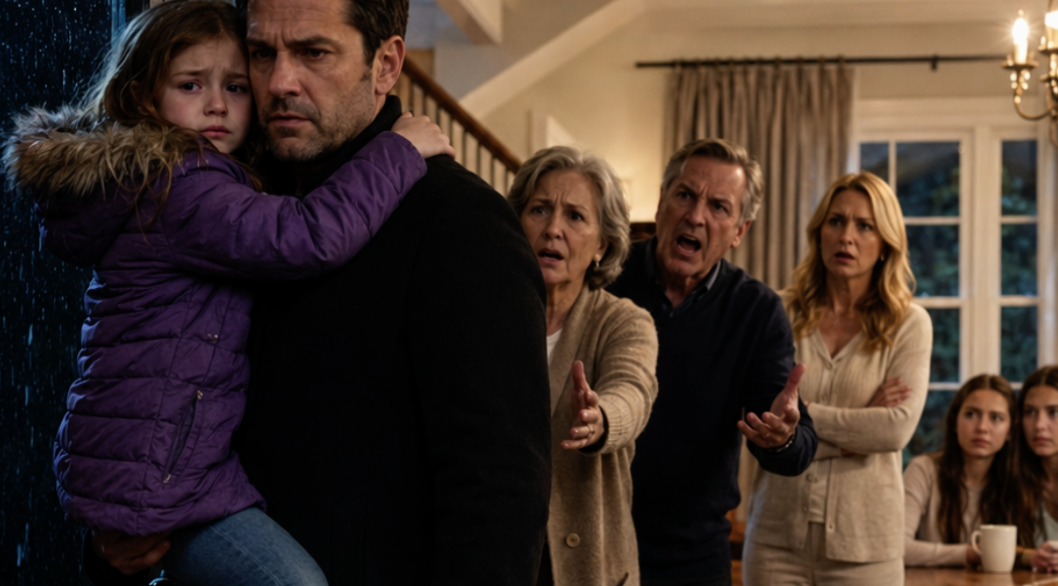
The climax arrived in January. A bitter Indiana winter had descended, turning the landscape into a grayscale photograph. My parents had lost the house—the inevitable consequence of their own choices—and they had arrived at my apartment complex with nothing but duffel bags and the pathetic, brittle remnants of their pride.
I opened the door to find them standing in the hallway, older and smaller than I remembered. My mother cried immediately; my father looked at the floor, his posture defeated.
“Please,” my mother sobbed. “We have nowhere else.”
For a second, the old training flared—the urge to be the good son, the fixer, the man who absorbs the pain of others to maintain order. But then, from the living room, I heard the faint, beautiful sound of Emma laughing at a movie.
The sound anchored me. I stepped into the hall and pulled the door almost closed, creating a physical barrier between my past and my future.
“You cannot stay here,” I said.
My mother looked horrified. “We are your parents.”
“And Emma is my child.”
My father’s face twisted. “We apologized.”
“You apologized because you lost your house, not because you found your conscience.”
I handed my father a piece of paper with the address of a county shelter. “They have intake until midnight. I called them last month to verify, because unlike you, I take responsibility for those in my care.”
My mother looked at the paper with disdain. “A shelter? After everything we did for you?”
“After everything you did, yes.”
I stepped back inside. I didn’t look back. I didn’t wait to see their expressions. I walked back to the living room, where Emma stood clutching her blanket.
“Was that them?” she asked.
“Yes.”
“Are they coming in?”
I knelt to meet her eyes. “No.”
She studied me, the tension in her small frame slowly unraveling. “Because of me?”
“Because of what they chose to do.”
She leaned into me, a heavy, relieved sigh escaping her. She whispered, “I do not want to wash pans there again.”
“You never will,” I promised.
Spring eventually broke through the winter, and with it, Emma blossomed. Her drawings changed; the houses she sketched gained doors, windows, and sunlight. We built a life that was honest and sturdy. My parents moved to a subsidized apartment, and though Melissa sent occasional updates laced with guilt-tripping vitriol, I ignored them. They saw my peace as arrogance, but it was merely the silence of a man who no longer had to defend his reality.
One afternoon, years later, Emma asked me if people could be forgiven from far away. She was older then, more grounded. We sat on the living room floor, and I told her that forgiveness was not about granting someone the power to hurt you again; it was about releasing the burden of resentment.
On her eighth birthday, at a party filled with friends, she made a wish. Later, she slipped her hand into mine. “Daddy, I wished that every kid gets someone who picks them first.”
I turned away, blinking back tears. “That is a very good wish.”
“You picked me first,” she said.
“Every day.”
When my father eventually passed, he left behind a letter—a final attempt to rewrite history. He mentioned my mother’s failing health and asked me to visit, ending with the stinging, dismissive line: “Tell the girl we hope she is well.”
“The girl.” Even in his final days, he could not bring himself to acknowledge her existence, her name, or her value.
I folded the letter and placed it with the old bank statements—a record of a debt I had finally paid in full. I did not visit. I did not attend the funeral. I mailed back one sentence: “Her name is Emma.”
There was no reply. There never would be.
The last time I heard my mother’s voice was a voicemail from Melissa’s phone after the funeral. She was old, brittle, and still wrapped in the armor of her own victimhood, warning me that I would regret my choices because “blood is blood.”
I deleted it.
That night, Emma and I made pancakes. She was ten, taller, brighter, and entirely herself. She spilled flour on the counter, paused, and then laughed. I watched her—the girl who once believed love was a transaction defined by labor—and I felt a gratitude so fierce it was almost painful.
I had succeeded. I had broken the inheritance of fear, of conditional love, and of performance. I had given her a life where love did not require shrinking, a home where doors protected rather than excluded, and a father who finally understood the difference between guilt and duty.
If I could return to that winter night, to see them shivering in the hallway, I know my hand would still close around the knob. I know I would still choose the child who had no one else over the adults who had spent years proving they would never choose her. That decision had cost me the family I was born into, but it had preserved the family I built.
If there is any definition of fatherhood worth carrying, it is this: when the world forces you to choose between the dead weight of “blood” and the vibrant, beating heart of a child’s safety, you do not hesitate. You do not analyze. You do not bargain.
You open the right door. You close the wrong one. And then, you stay.