
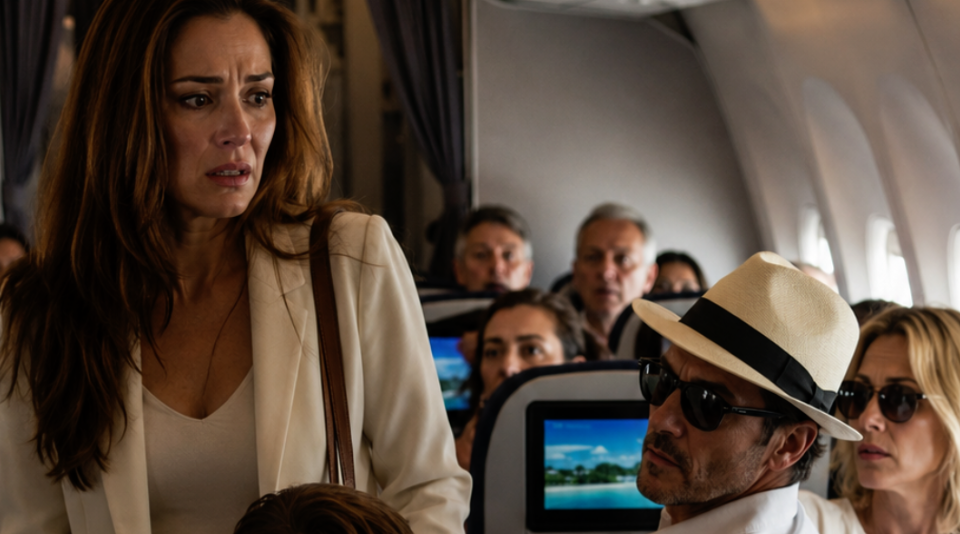
The realization did not arrive as a thunderclap or a blinding flash of insight; it came with the quiet, devastating precision of a clock striking midnight. Noah, at nine years old, had seen him first. The boy had stood up from his seat, his small frame rigid, his face drained of the color that a spring vacation to Key West should have brought. When he had gripped the fabric of his mother’s seat, his knuckles white, the aircraft floor seemed to tilt beneath them, unmooring the very reality Caroline Mercer had spent the last three years clinging to.
“Mom,” he had whispered, his breath a tremor against her ear. “The man in the tan hat near the front. It’s Dad.”
Caroline had felt the air leave her lungs, replaced by a vacuum of sudden, inexplicable cold. She had forced her hand to release the plastic cup of water she was holding, though the rim had already bent under the pressure of her grip. She had turned slowly, not because she believed him—how could she?—but because a mother’s primary duty is to witness her child’s terror with gravity, even if she intends to dismantle it with logic.
And there he was. A broad-shouldered man in the final row of business class, his posture familiar in its arrogance, his profile obscured by a tan Panama hat and dark sunglasses. Beside him sat a younger woman, all glossy blonde hair and pristine white linen. From behind, he could have been a stranger—a businessman, a tourist, a ghost. But then, as he reached for a glass of orange juice, the light caught his left hand. There, etched into the skin like a map of a life she thought she had buried, was the narrow, jagged scar he had earned repairing a dock ladder at their Cape Cod cottage the summer Noah turned four.
Caroline felt the world fracture. The Coast Guard had been unequivocal. The boat, the empty horizon, the scattered lobster buoys, the phone washed ashore—it had all coalesced into a narrative of tragedy. There had been no body, but there had been a death certificate, a sterile document that had severed her life into the time before Daniel and the time after. She had mourned the man, the partner, the father. She had navigated the labyrinth of widowhood, the administrative cruelty of closing bank accounts and canceling subscriptions, and the suffocating silence of a house that seemed to hold its breath.
As the plane touched down in the humid heat of Key West, Caroline watched him. She watched him pull the silver carry-on from the bin, watched him place a hand on the young woman’s lower back, watched him stand and move with the practiced grace of a man who believed he was invisible. The beard was a new addition, a camouflage for a face that had once been her anchor. The hair, once rich and dark, was salted with grey. But it was him. It was Daniel, alive and breathing, drinking orange juice while his son, in the seat behind him, had spent three years drawing their home without windows, afraid to let the world—or his father’s memory—inside.
The Architecture of Deception
The hotel they had chosen was a sanctuary of denial. Nestled behind a row of swaying palms, its pale blue and white facade was a deliberate pivot away from the grey austerity of Boston. Caroline had booked it with reward points, seeking a place that held no ghosts. She spent the first two days attempting to curate a version of motherhood that didn’t involve the wreckage of the past. She bought mango shaved ice, she watched Noah chase lizards, she answered emails with a rhythmic, mechanical efficiency.
Yet, the truth was an invasive species. It had taken root the moment she saw him on the plane, and it fed on every familiar gesture. When, on the third evening, the man’s voice drifted up from the balcony below, it was not merely recognizable; it was a physical blow.
“Tessa, I am not buying another bracelet because you got bored before dinner.”
The voice was rougher, perhaps deepened by the weight of his charade or simply the erosion of time, but the cadence was unmistakable. He clipped the ends of names when he was irritated. He sounded superior when he was defensive. It was Daniel.
“Michael,” the young woman had called him.
The name was a bitter irony. Daniel Mercer had not only survived; he had performed a total renovation of his existence, adopting a name as bland and unthreatening as a hotel suite. Caroline stood on her balcony, her fingers white as they gripped the iron railing, listening to them argue. The woman, Tessa, was bored and demanding, and Daniel—this “Michael”—was using the exact sharp, condescending logic he had once used to gaslight Caroline during their own failing marriage.
“You sold me a fantasy,” Tessa had accused.
“Love?” Daniel had retorted, his voice dripping with a cruel, familiar irony. “What do you think you will have left when pretty stops being enough?”
The words cut through Caroline with the sharpness of glass. She remembered him saying that to her, years ago, during a fight about her returning to work. He had smiled while delivering the line, a smile that was meant to dismantle her self-worth. That was the moment the last of her doubt vanished. A ghost could not recreate that specific, devastating cruelty.
That night, she found the room. Room 218. She stood near the ice machine, a sentinel of justice, until the door swung open. Tessa stormed out, oblivious to the woman in the shadows. Then, Daniel emerged. He was dressed in linen, his movements restless, checking his watch, adjusting his collar. He walked to the bar, and without hesitation, Caroline followed.
The Confrontation
The beach bar was an oasis of soft music and string lights, a stark contrast to the darkness that had descended on Caroline’s resolve. She sat three stools away, the silence between them thick with unspoken history. She watched him order a second whiskey, his movements sloppy with the false confidence of a man who believes his past is successfully interred.
“You look like someone who has made sensible choices,” he said, turning to her, his eyes unfocused. “Tell me something. Why do young women believe a man’s wallet is a personality?”
He was fishing for an audience, for validation. Caroline didn’t look at him; she looked out at the ocean, the darkness of the water mirroring the state of her heart.
“Perhaps because certain men choose women who reflect their own emptiness,” she said, her voice steady, stripped of the tremor that had plagued her since the flight. “Then they complain when the mirror is expensive.”
Daniel froze. He squinted at her, the alcohol receding, replaced by a dawning, frantic recognition. “That was almost too precise.”
“Men who run from ordinary loyalty usually end up paying luxury prices for imitation devotion,” she continued. She turned her head then, letting the light catch her face.
He stared at her, his composure splintering. “Have we met before?”
Caroline rose, the chair scraping against the deck—a final, decisive sound. “Maybe I only sound like someone you abandoned.”
She left him there, anchored to his barstool, his drink half-raised, his face a canvas of disbelief. She went back to their room, locked the door, and allowed her hands to shake. The rage, once a jagged, painful thing, had begun to smooth into something colder and harder. It had become a purpose.
The Breaking Point
The following day brought the inevitable collision. Caroline took Noah to the beach, determined to give him a morning of normalcy despite the storm that was brewing. They sat near the water, the sun bright and unforgiving. Then, Daniel appeared, accompanied by Tessa. The scene was surreal—the man she had mourned, the man she had buried in spirit, standing in the sand, complaining about the heat, about the hotel, about the lack of luxury.
Then, Tessa laughed, a harsh, dismissive sound. “This place is full of abandoned mothers pretending a beach trip fixes their sad little lives.”
Noah tensed. Caroline felt the shift in him, a protective instinct igniting in her chest. She began to stand, her intention to shield her son from the casual cruelty of the stranger, but then the world turned. Daniel gripped his chair, his face losing its color, his chest heaving. He stumbled, falling into the sand, clutching his chest.
Tessa screamed. The crowd on the beach—the tourists, the sunbathers—stalled in that collective, paralyzed hesitation that precedes chaos. But Caroline did not hesitate. She was already in motion. She was a woman who had spent years as both mother and father, the one who navigated the crises, the one who remained standing when the floor fell out. She reached his side, the medical protocols she had learned in her own grief—the need for order—taking over.
“Call 911!” she commanded, her voice cutting through the panic. “Bring the AED! Move!”
Tessa stood by, useless, sobbing. Caroline looked at her, and the raw authority in her gaze silenced the younger woman. “Do not scream at him. Give him air.”
As the hotel medical team rushed forward, Caroline’s hat fell, and her sunglasses slid into the sand. Daniel, gasping, opened his eyes. He focused on the woman kneeling above him. The shock that registered on his face was not the shock of a heart attack; it was the shock of seeing the past return to claim him.
“Caroline,” he whispered.
She did not answer. She stood, took Noah’s hand, and walked away, leaving the man who had abandoned them to face the consequences of his own mortality.
The Anatomy of Cowardice
That evening, the knock came. Daniel stood in the doorway of their room, pale, wearing a hospital wristband like a badge of his failure.
“I need to thank you,” he stammered.
“You have thirty seconds,” Caroline said, the chain of the door still fastened.
What followed was a conversation that stripped away the last of her illusions. Down in the garden, under the canopy of palms, Daniel told his story. It was a mundane, wretched tale—debt, bad investments, the cowardice of a man who believed he was protecting his family by vanishing, when in reality, he was simply running away from his own failures.
“They knew where we lived,” he pleaded, his voice breaking. “I convinced myself that if I disappeared, the debt would die with me.”
“You convinced yourself that abandoning your wife and five-year-old son was protection,” Caroline replied, her voice dangerously quiet.
He wept. He spoke of the money he had sent through a partner, the money Caroline had never seen, the money that would never have replaced the years of parent-teacher conferences, the nightmares, the crushing weight of being the sole guardian of a grieving child. He wanted to be the tragic hero of his own narrative, but Caroline refused to play the supporting role.
“You are only calling it cowardice because I found you,” she said, her eyes fixed on his. “Before today, you were calling it sacrifice.”
The arrival of Tessa, demanding an explanation, served as the final act. When Caroline exposed him—when she told the girl that “Michael” was actually Daniel, a man who had staged his own drowning to escape the life he had built—the house of cards collapsed. Tessa, disgusted, stripped off the jewelry he had given her and left him alone in the garden.
The Reclaiming of Self
The final morning was the quietest. Caroline sat with Noah, explaining the truth with a grace that surprised even her. She didn’t spare the reality, but she wrapped it in the truth of his own worth. Noah’s reunion with his father—a brief, sobbing embrace in the hotel café—was a moment of closure for the boy, not a beginning for the man.
When they stood under the portico, waiting for their ride, Daniel looked broken. The artifice of his new life had been dismantled. He begged for a chance, for forgiveness, for a future.
“Is there any chance for us, Caroline?” he asked, his eyes searching hers with a desperate, pathetic hope.
Caroline looked at him, and she saw not the man she had loved, but the man he had chosen to be. The memory of their marriage—the tenderness, the shared history—was still there, but it was archival. It was a book she had finished reading.
“There is a chance for you to become a better father,” she said, her voice firm, devoid of malice but equally devoid of longing. “There is not a chance for you to become my husband again.”
As the car pulled away, leaving Daniel on the curb, Caroline watched him fade into the landscape of Key West. She felt a profound, quiet shift in her center of gravity. For years, she had been defined by the absence, by the ghost, by the widowhood that had been imposed upon her. She had been a woman defined by her husband’s actions, even in his disappearance.
But as the plane ascended, leaving the island behind, she looked at her son, asleep with his hand tucked securely into hers. She felt the heavy, suffocating weight of the past finally lift. She realized that forgiveness was not about him—it was not about his repentance or his redemption. It was about her own liberation. It was the act of reclaiming her narrative, of taking her life out of the hands of a man who had treated it like a liability.
She was not a widow. She was not a wife. She was simply Caroline. And for the first time in three years, she was the one holding the pen, and she was finally ready to write the next chapter on her own terms. The woman who had been left behind was gone, and the woman who had walked out of the airport was someone entirely new: alive, whole, and unequivocally free.