For four uninterrupted decades, the absolute center of my gravity was my family. I do not state this to solicit a medal or to drape myself in the quiet martyrdom that so many men of my generation wear like a threadbare coat. In places like Naperville, Illinois—where the sprawling maple trees cast long, comfortable shadows over brick-front houses, where the manicured lawns speak of quiet conformity, and where sacrifice is simply the unspoken covenant of holding a thirty-year mortgage—putting yourself last was merely the cost of admission to a respectable life.
The rhythm of that life was relentless, defined by its predictability. You woke before the sun. You commuted in traffic. You returned home hollowed out by the day’s corporate demands, yet you immediately set to work repairing whatever had broken in your absence. You paid the premiums, the tuitions, the hidden costs of an upwardly mobile existence, and you silenced your own longings so that no one else under your roof would ever have to experience the sharp, undignified sting of want. That was the blueprint of my existence.
My name is George Bates. I am sixty-eight years old, residing on the west side of Naperville, in a subdivision called Stillwater. It is the kind of neighborhood where residents still display flags on Memorial Day and where the state of a driveway—whether it holds a practical sedan or a teenager’s discarded bicycle—tells you everything you need to know about the current era of the family inside. I have occupied the exact same house for twenty-two years. It possesses the same brick facade, the same two-car garage, and the same narrow, stubborn crack in the front walkway that I eternally mean to repair. It features the same backyard deck where my wife, Maggie, drinks her evening tea, observing the cardinals that only dare to approach when I am not operating power tools.
For thirty-four years, I operated within the unforgiving machinery of industrial supply management. I began at the absolute bottom, learned the intricate dance of inventory systems long before digital automation rendered the task effortless, and eventually retired as the director of procurement for an international distributor. I was never a man who signaled his wealth. I drove hyper-practical, depreciated vehicles. I wore heavy work boots until the rubber soles were smoothed into glass. I purchased store-brand groceries when my children, Jake and Chloe, were young—even when my salary could easily accommodate luxury—because every dollar saved felt like a silent promise kept to their future.
Maggie frequently joked that I could squeeze a coin so tightly that the president on the face would beg for mercy. She was entirely correct. When Jake required orthodontia, I delayed the replacement of my aging truck. When Chloe was accepted into an elite summer literature program in Evanston, I authorized the expense before I even dared to look at the tuition invoice. When Maggie’s mother fell ill, I quietly absorbed the devastating costs of the hotels, the fuel, the uncovered medications, and the bleak hospital cafeteria meals. I took on side consulting contracts and disguised my exhaustion behind the universally accepted male code of “keeping busy.”
What Jake and Chloe fundamentally failed to understand was that while I lived with austere modesty, I was accumulating capital with aggressive, systemic discipline. Every corporate bonus, every vested stock option, every sliver of profit-sharing that wasn’t immediately devoured by their sudden emergencies was quietly funneled into diversified investment accounts. I was not merely building a family; I was engineering a financial fortress. I desired money to serve as an invisible barrier, a quiet luxury that kept fear permanently locked outside our front door. For the longest time, I believed I had succeeded.
The illusion of my success began to unravel just after my sixty-eighth birthday. It was a sweltering Thursday in late June, the kind of heavy Midwestern afternoon where the asphalt shimmers and the air is thick with the scent of cut grass and charcoal. Maggie had prepared a quiet, perfect dinner: grilled steak, roasted vegetables, and her celebrated lemon icebox pie. Jake called from traffic, offering a distracted, echoing birthday wish through his car’s Bluetooth. Chloe called shortly after, her voice competing with the wind of downtown Chicago, promising that we would celebrate “properly soon.” Their calls combined lasted less than three minutes.
That brief, hollow acknowledgment should have been enough. But three days prior, I had executed a decision I had been meticulously planning for six years. I walked into a Naperville dealership and purchased a 2024 BMW 7 Series.
It was mineral white with a flawless black leather interior. It was not a vehicle of loud, ostentatious wealth; it was a masterpiece of quiet luxury, boasting a cabin so silent it forced you to confront your own thoughts. It looked like a machine that belonged to a man who had spent an entire lifetime making ruthlessly smart decisions and had finally authorized one solely for his own pleasure. I paid eighty-five thousand dollars in liquid cash. I did not finance it, nor did I compromise the family’s emergency reserves. I utilized funds I had isolated specifically for this exact moment.
When I drove it home, I sat in the driveway for eleven minutes. In the profound silence of that insulated cabin, I suddenly realized how deafening the rest of my life had been. For decades, my mind was a chaotic switchboard of bills, needs, crises, and requests thinly veiled as casual conversation. For the very first time, I had executed an action that solved absolutely no one else’s problem. The guilt lasted exactly five minutes. It was swiftly replaced by a profound, private joy—a sensation I had almost trained myself to forget.
Chloe was the first to discover the breach in the status quo. She arrived unannounced the following Saturday, treating our home with the lingering entitlement of a child, despite possessing her own apartment in Oak Brook. I watched through the kitchen window as she parked, stepped out, and stared at the BMW as if it were an offensive monument.
“How much?” she demanded, bypassing any greeting, leaning over the pristine roof of the vehicle.
“Eighty-five thousand,” I replied, taking a slow sip of my coffee.
Her eyes darted rapidly, her mind actively calculating the impact on her own hidden ledgers. It was not concern for my financial well-being that clouded her face; it was an arithmetic panic desperately attempting to dress itself in the noble garments of daughterly worry. “Dad, that’s a lot of money. Does Mom know? I hope you know what you’re doing.” She left ten minutes later without ever stepping inside, instantly dialing her brother.
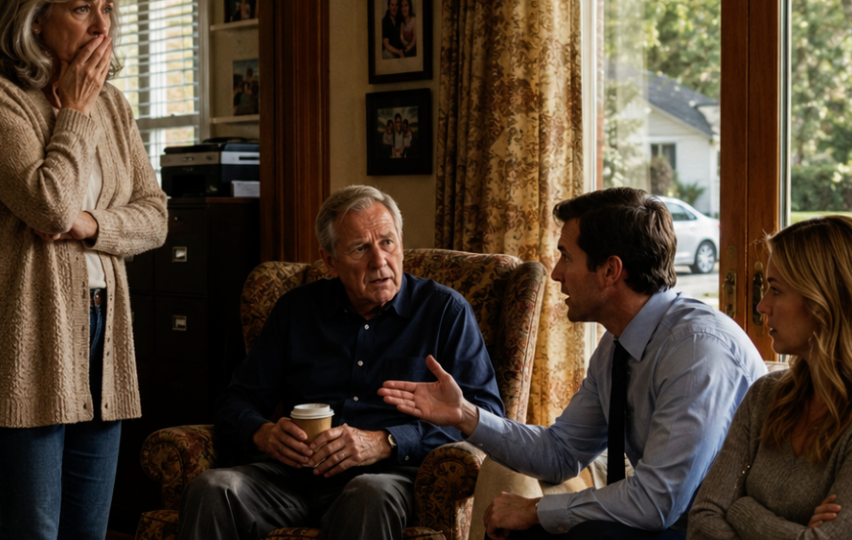
The coordinated ambush occurred the following morning. Jake and Chloe arrived together, a rare alignment that signaled a strategic pre-meeting had taken place. They bypassed their usual relaxed postures and arranged themselves on the living room furniture with the stiff, adversarial geometry of opposing counsel.
“Dad, we want to talk about the car,” Jake began, his thirty-six-year-old face attempting to project corporate authority. “We’re worried. You’re retired. You should be protecting your money.”
“And then there’s the family,” he continued, deploying the phrase people use when they lack the courage to say ‘me.’ “You can’t just start spending like this. It affects all of us. It looks like you’re being careless with family money.”
The phrase hung in the air, toxic and heavy. Family money. “Our inheritance,” Jake finally clarified, stripping away the polite veneer.
I looked at my son, a man standing in a house I paid for, questioning the allocation of capital I had earned. “You believe I spent your inheritance. I thought about this for six years. I saved for it.”
“That doesn’t make it smart,” Jake countered.
“No,” I replied, a quiet, terrible clarity settling over me. “I suppose it only makes it mine.”
They pressed their demands, insisting I needed to “cut back” and protect their future equity. I offered no resistance. I simply nodded, agreeing that I heard them, and promising that I would, indeed, cut back. They left feeling triumphant, believing they had successfully managed an aging, irresponsible patriarch.
That night, enveloped in the quiet solitude of my home office, I logged into my financial portals and initiated an exhaustive audit of my existence. I discovered exactly forty-one recurring payments attached to my accounts that benefited my adult children. There was Jake’s Audi lease support, Chloe’s health insurance supplement, a sprawling family cell phone plan, streaming services, gym memberships, rent subsidies, a storage unit for Jake’s post-divorce clutter, and a student loan I had quietly absorbed because the interest rate was “killing him.”
Forty-one invisible tethers. They had demanded I cut back. I decided to grant their request with absolute, surgical precision.
The financial dismantling commenced in early August. Jake was the first to trigger the tripwire. He called on a Tuesday morning, his voice tight with barely suppressed panic, demanding to know why his Audi payment had been rejected by the financial institution.
“I cut back,” I informed him, watching a solitary cardinal land on Maggie’s tomato cages. “You told me I needed to cut back on payments leaving my account. Seven hundred twenty-four dollars a month for a car in your name is unnecessary spending.”
“Dad, that’s not what I meant!” he argued, the entitlement flaring into anger. “What am I supposed to do?”
“Pay your car payment with your own money,” I suggested, and terminated the connection. My hand did not shake.
Chloe lasted three additional days before her subsidized reality collapsed. She called her mother, weeping uncontrollably because her Wi-Fi had been disconnected, her premium gym membership canceled, and her Netflix account suspended. Maggie looked at me, her eyes reflecting the deep, instinctive pain of a mother hearing her child cry.
“George, she is thirty-two,” Maggie reasoned, though the defense lacked conviction.
“Exactly,” I replied. “It bothers me that our daughter cannot lose internet and a gym membership without dissolving into tears. It bothers me that our son drives a luxury vehicle he cannot afford. It bothers me that when I finally purchased one item for my own joy, they arrived in our living room behaving like hostile creditors.”
I was furious with their audacity, but my deepest anger was reserved for myself. I had conflated financial rescue with parental love. I had operated as a limitless central bank, shielding them from the natural economic consequences that forge adult resilience. Over the subsequent weeks, as their phones slowed from lost premium data and their rent supplements evaporated, my phone illuminated with angry texts and wounded emails. I ignored the vast majority of them. I was busy compiling a much larger document.
In early September, I summoned them for a Sunday dinner. They arrived with the cautious, overly polite demeanor of hostile negotiators entering enemy territory. Maggie had prepared a heavy, comforting meal of baked mostaccioli, filling the house with the scent of garlic and childhood nostalgia. It was a painful contrast to the absolute financial reckoning I was about to deliver.
After the plates were cleared, I directed them to the living room. I retrieved a thick, unassuming black folder from my office and placed it deliberately onto the center of the coffee table. The label read: JAKE / CHLOE — SUPPORT HISTORY.
“In June, you informed me that I was spending your inheritance,” I began, my voice devoid of anger, operating purely on facts. “This folder contains a one-hundred-forty-four-page record of what I have paid on your behalf over the last twenty-two years. It is strictly what I could prove through bank records, checks, and transfers.”
Jake picked up the summary page. His eyes scanned the categories: auto insurance, dental surgeries, security deposits, tuition balances, emergency transfers, and credit card payoffs. His gaze eventually locked onto the total sum printed at the bottom of the page.
“One point two million,” Jake read, his voice stripped of its usual bravado.
“Give or take,” I confirmed. “I thought love did not keep a ledger. I wanted you to begin life without the financial terror I experienced. But somewhere along the line, my sacrifice ceased to be a gift; it became your expected income. I do not regret helping you. I deeply regret teaching you that you were owed it.”
As Chloe began to weep, quietly and legitimately, I produced the second document: a newly finalized revocable living trust.
“I have restructured the estate,” I announced, laying out the new architecture of our family’s capital. “The funds remain, but they are no longer a guaranteed prize for outliving me. Jake, to receive any discretionary distribution, you will be required to maintain continuous employment for two full years. Chloe, you will need to independently cover your own rent, utilities, and living expenses for eighteen consecutive months.”
The reaction was instantaneous and explosive. Jake stood up, utilizing anger to mask his profound humiliation. He accused me of cruelty, of laying a trap, of punishing them for a single conversation. He refused to acknowledge the decades of dependency, choosing instead to focus on the shock of its sudden removal. “I hope that BMW was worth it,” he spat, retreating toward the front door. Chloe followed closely behind him.
The quiet click of the closing door was devastating. Maggie wept into my shoulder, terrified that the fracture was permanent. I held her, offering a hope I desperately needed to believe myself. “They will come back,” I promised. “If they don’t forgive me, I will still love them. But I cannot be their bank anymore.”
The silence lasted for weeks, characterized by tense waiting and the slow, painful recalibration of our family dynamics. The turning point arrived on a Thursday evening in late October. Chloe pulled into the driveway, parking respectfully beside the BMW rather than blocking it in. She looked exhausted, devoid of her usual polished armor, but fundamentally grounded.
“I was awful,” she admitted, standing in the cold garage. “I was terrified of finding out I couldn’t stand on my own.”
It was not a cinematic, flawless apology, but it was honest. Over tea, she detailed her new reality: she had negotiated a cheaper gym, requested additional hours at work, and was actively interviewing roommates to halve her rent. She was navigating the mundane, frustrating mechanics of actual adulthood, and in doing so, she was finally building her own equity.
Jake’s capitulation required more time, dictated by the stubborn gravity of male pride. He appeared the Saturday prior to Thanksgiving, silently taking up a rake in the yard to assist me with the autumn leaves. We worked in the biting wind, communicating through the shared rhythm of physical labor.
“I sold the Audi,” he eventually confessed, staring at the piles of leaves. “Bought a 2018 Camry. When the payment bounced, I was furious with you because it was easier than confronting my own failure. I realized I had been using your money without feeling anything for years. It felt like you took something from me… but it was never mine to begin with.”
Thanksgiving that year was not a flawless, storybook reconciliation. There was a lingering caution, a careful navigation of new boundaries. But Chloe brought a slightly burnt sweet potato dish she had cooked herself, and Jake proudly complained about the exorbitant hourly labor rates his mechanic charged to fix the Camry’s steering—complaining not as a dependent seeking a bailout, but as an autonomous adult navigating the world.
The trust remained entirely unchanged. The restrictive conditions stood firm, and the recurring financial subsidies remained permanently canceled. Forgiveness, I had learned, does not require a regression to old, destructive habits.
On clear, crisp winter mornings, I drive the BMW along the rural routes west of Naperville. Maggie often accompanies me, appreciating the quiet, heated luxury of the cabin. She recently admitted that she initially hated the vehicle, believing it had shattered our family.
“It didn’t break us,” I told her, watching the bare trees blur past the pristine glass. “It just forced us to examine the foundation.”
I love my children with an intensity that has never wavered. But I finally understand that love is not strictly measured by the endless deployment of capital. Sometimes, the most profound act of love is the strategic withdrawal of comfort, forcing the people you cherish to discover their own resilience. At sixty-eight years old, I finally ceased funding the illusion of their independence, and in doing so, secured a legacy that money alone could never purchase.