
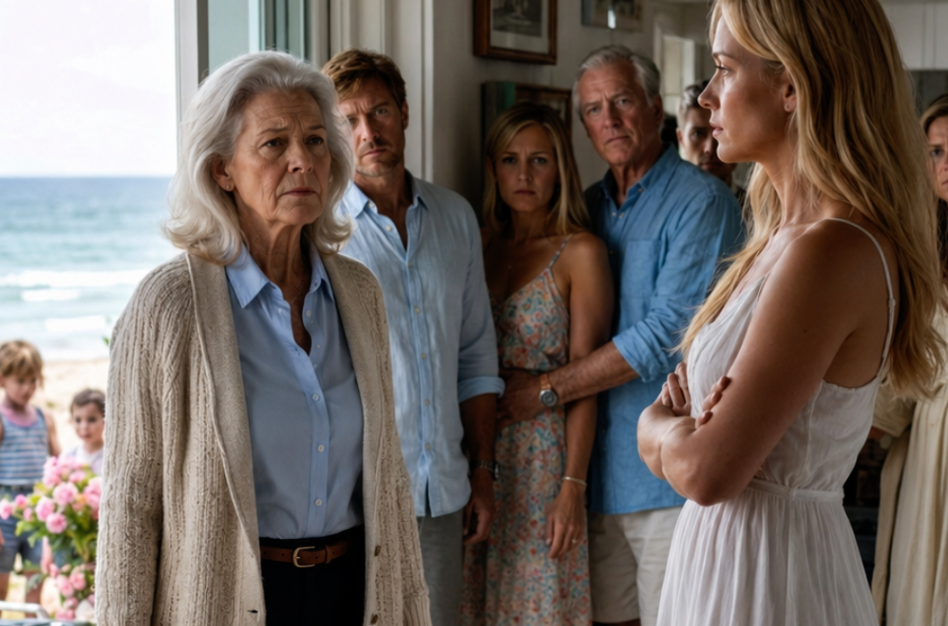
Margaret deliberately kept her gaze averted from Megan. Instead, she allowed her eyes to wander across the expansive living room, tracing the familiar lines and shadows of the space she knew better than the lines on her own hands. The late afternoon sun was currently in its most glorious phase, spilling through the wide, custom-built windows that her late husband, Henry, had installed himself nearly three decades ago. The light painted long, luminous golden bands across the distressed oak hardwood floor, highlighting the slight imperfections where countless family gatherings had left their mark. From beyond the glass, the innocent, untroubled laughter of children drifted in from the wraparound porch, mingling with the rhythmic, eternal crash of the Atlantic waves.
Upon the mahogany side table rested a beautiful blue ceramic vase, freshly filled with white hydrangeas. It was the very vase she and Henry had purchased on a rainy Tuesday in Charleston during their twenty-fifth wedding anniversary. She remembered how Henry had tucked it inside his trench coat to protect it from the downpour, laughing as they ran back to their bed and breakfast. Yet, as Margaret looked around her living room, her heart grew heavy. The space was filled with elegantly dressed guests, sipping wine and nibbling on artisanal cheeses, and not a single one of them knew the story behind that vase. They did not know about the blood Henry had shed building the fireplace mantel, or the tears she had cried in the kitchen when they lost their first pregnancy.
No one in this room knew the soul of the house. Yet, they moved through it, touching the woodwork and appraising the square footage, behaving with an air of entitlement, as though they already held the deed to every memory, every object, every square inch of the property. Megan, her daughter-in-law, had even been overheard earlier discussing which walls she intended to knock down to create a “more modern, open-concept flow,” casually erasing forty years of history with a wave of her manicured hand.
Margaret reached into her modest leather purse and retrieved her phone. Her fingers, though slightly arthritic, were entirely steady. She pressed a single name on her speed dial. The line rang only twice.
“Daniel? It’s time.”
She offered no further explanation, no pleasantries. She ended the call before anyone on the other end, or anyone in the room, could ask another question.
Megan, observing the cryptic phone call from her perch by the kitchen island, let out a small, sharp laugh. She folded her arms tightly across her chest, her posture defensive and mocking. “Well? Are we supposed to be impressed by the theatrics, Margaret? Who was that?”
Margaret calmly slipped the phone back into the dark depths of her purse, clasping it shut with a definitive snap.
“No,” Margaret replied.
Her voice was not raised; in fact, it was incredibly soft. Yet, it carried a particular weight, a gravity so profound that several of the gossiping guests instinctively ceased their chatter and leaned closer, straining to hear the unfolding drama.
“I simply don’t enjoy repeating myself,” she added, her tone smooth and impenetrable.
Finally, Robert stepped forward from the periphery of the room. Her son. He wore a tailored linen suit that looked completely out of place in a home meant for sandy feet and wet bathing suits. His smile looked agonizingly forced now, the corners of his mouth trembling slightly, refusing to stay lifted under the intense atmosphere permeating the room.
“Mom…” Robert began, his voice placating, tinged with a nervous hesitation. “Maybe we should talk privately. In the study. This isn’t the time or the place.”
Margaret turned her head slowly and met her son’s eyes. For a long, excruciating moment, neither of them spoke. The surrounding silence in the room deepened, broken only by the clinking of ice in a glass somewhere near the back.
As she looked into his eyes, Margaret desperately searched for the little boy she once knew. She looked for the boy who used to chase seagulls relentlessly across this very stretch of beach, his small legs pumping, his laughter ringing out over the surf until he collapsed in the warm sand. She searched for the boy who had once fallen asleep, exhausted and covered in sawdust, leaning against Henry’s shoulder while they spent a whole weekend building the porch swing. She looked for the earnest, tender-hearted child who had cried over a broken seashell.
She couldn’t find him.
That boy was entirely gone. In his place stood a tired, anxious man who kept glancing nervously toward his wife, Megan, as if seeking silent permission before finishing every sentence. He had become a hollow echo of the values Henry had tried so hard to instill in him.
“There isn’t anything private left to discuss, Robert,” Margaret answered, her voice ringing with finality.
A heavy, suffocating silence settled over the crowded living room. Outside, oblivious to the human drama unfolding within the walls, the Atlantic Ocean rolled against the sandy shore with its steady, ancient rhythm. The waves crested and crashed, retreating and returning, as if the ocean itself refused to hurry for anyone’s timeline.
Then, the distinct, sharp crunch of tires rolling across the crushed seashells and gravel of the driveway shattered the quiet. Every head in the room swiveled toward the front windows.
A dark, conservative sedan rolled to a stop beside the house. Immediately, another vehicle—a sensible silver SUV—followed and parked behind it. Two figures stepped out into the afternoon sun.
The first was a tall, middle-aged attorney wearing a sharp gray suit, carrying a thick leather briefcase. The second was a woman in a practical blazer—the county property manager whom Margaret had known and trusted for nearly fifteen years.
Megan’s mocking smile vanished instantly, replaced by a tight, pale line of apprehension. She uncrossed her arms. “Who are they? What is going on?”
Margaret answered without pulling her gaze away from the window, watching the two figures approach the porch steps. “The people I asked to meet me here.”
The heavy oak front door opened. The attorney stepped inside, pausing on the doormat to remove his coat and meticulously shake the loose beach sand from his polished shoes. He approached Margaret with an air of quiet, profound respect, ignoring the dozens of staring eyes fixed upon him.
“Mrs. Bennett,” he said, bowing his head slightly.
“Thank you for coming, Daniel,” Margaret replied, her posture straightening.
He nodded once before turning his gaze to survey the crowded, tense living room. He adjusted his glasses, adopting a deeply professional, authoritative demeanor.
“I understand there has been some significant confusion among the family and your guests regarding the future of this property,” Daniel announced, his voice carrying effortlessly across the space.
Nobody spoke. The guests seemed to be collectively holding their breath. The only sound in the suffocating quiet came from the rhythmic breaking of the waves outside and the distant, mournful cries of the gulls circling the shoreline.
Daniel set his leather briefcase down onto the large, rustic dining table. With deliberate, unhurried movements, he popped the brass latches. He withdrew one thick manila folder. Then another. Finally, he extracted a heavy document bearing a raised golden seal and placed the certified deed squarely in the center of the table.
“The current, sole, and legal owner of this residence remains Margaret Anne Bennett,” Daniel stated, tapping the document with his index finger.
He paused, allowing the words to sink into the minds of everyone present.
“There has never been any transfer of ownership. No deeds have been signed over, no early inheritance clauses triggered, and no legal standing exists for anyone else to make alterations or claims to this estate.”
Several guests, realizing they had been invited to what was essentially a premature victory party for a hostile takeover of a living woman’s home, exchanged highly uncomfortable, deeply embarrassed glances. A few subtly set their wine glasses down and began edging toward the hallway.
Megan took one quick, aggressive step forward, her face flushing with indignation. “But Robert told everyone—he assured my family—that the house was being transferred into our trust this month! He has power of attorney!”
Daniel gently but firmly raised a hand, stopping her outburst in its tracks. “I can only speak to the legal facts, ma’am.”
He reached into the second folder and slid another thick, stapled document across the polished wood of the dining table.
“Furthermore, Mrs. Bennett executed a comprehensive, revised estate plan exactly eight months ago. The power of attorney you reference was formally revoked at that time.”
Robert’s face drained of all color, leaving him looking sickly and hollow. He stared at the blue-backed folder on the table as if it were a venomous snake preparing to strike. He made no move to touch it. His breathing slowed drastically, then caught in his throat with a ragged sound.
“…Mom?” he whispered, the single word carrying a mixture of betrayal, confusion, and profound guilt.
Margaret did not flinch. Her hands remained calmly folded in front of her, her expression resolute.
“I overheard enough whispered conversations in the kitchen, Robert. I read the architectural plans Megan carelessly left on the patio table last summer. I knew enough to realize that I needed to legally protect the home your father and I built from those who saw it only as an asset to be liquidated.”
The room seemed to shrink violently. The air grew thick and unbreathable. No one reached for another drink. No one dared touch the lavish spread of charcuterie and hors d’oeuvres displayed across the marble kitchen island. Even the children playing outside seemed to sense the shift in the atmosphere, having wandered much farther down the beach, leaving the immediate vicinity of the house dead quiet, save for the whisper of the wind rustling through the sea oats.
Robert swallowed hard, his Adam’s apple bobbing in his throat. “You… you changed everything?”
“No,” Margaret replied softly. “I changed one thing.”
She turned her head, looking lovingly toward the long row of framed family photographs lining the stone mantel. Pictures of Henry holding up a freshly caught striped bass; pictures of a young Robert missing his front teeth; pictures of a family that once understood the meaning of contentment.
“I chose to leave this house to the people who would actually love it,” Margaret said, her voice echoing with absolute clarity, “instead of leaving it to people who spent the last two years calculating its resale value while I was still sitting in the living room.”
Megan’s expression hardened into a mask of pure fury. The polite veneer she usually wore had completely evaporated. “That’s not fair, Margaret. We are your family. We have plans. We have children who deserve a financial head start.”
Margaret turned her body fully toward her daughter-in-law. For the first time that entire afternoon, their eyes met directly, locked in an unspoken battle of wills.
“No,” Margaret said. The word hung in the air, heavy and irrefutable.
Her voice never rose, but the steel within it was unmistakable. “What wasn’t fair, Megan, was standing quietly in my own home, mourning the husband I loved for forty years, while listening to someone else decide that there simply wasn’t room for me here anymore.”
Those words settled over the room like a rising tide, drowning out any possible counterargument. No one stepped forward to defend Megan. No one dared to interrupt the profound justice of a mother claiming her own space.
Robert, utterly defeated by the truth he could not deny, lowered himself onto the edge of the floral sofa. He moved as though his legs no longer trusted him to bear his own weight. His elbows came to rest heavily on his knees, and he buried his face in his hands, hiding his shame from the crowd.
“I kept telling myself…” Robert mumbled through his fingers, his voice trembling. “I kept telling myself we’d make it right later. That once the paperwork was done, we’d make sure you were comfortable somewhere nice.”
Margaret watched him quietly, her heart aching for the boy he used to be, but refusing to coddle the man he had become.
“Later,” Margaret observed gently, “has a tragic way of arriving long after the damage is already done.”
Another long, stifling silence followed. Daniel, the attorney, efficiently gathered the papers and closed the manila folders, slipping them back into his briefcase.
“For clarity’s sake,” Daniel addressed the room at large, “the revised trust establishes this property in perpetuity as a coastal conservation residence. It has been legally bound so that it cannot be sold, leveraged, or stripped for private profit at any point after Mrs. Bennett’s lifetime.”
Megan blinked, her anger giving way to sheer confusion. “What does that even mean? A conservation residence?”
“It means,” Daniel explained, “that upon Mrs. Bennett’s passing, this estate will be operated as a sanctuary retreat. It will be maintained specifically for widows and military families who are in need of temporary housing, respite, and a place to heal.”
Margaret smiled faintly, a genuine, warm expression that finally reached her eyes.
“Henry always believed that a home’s primary purpose was to shelter people. To offer safety when the world was too much to bear,” she said, looking around the room one last time, making peace with her decision. “I finally understood what he meant. This house has too much love in its foundation to be torn down for a larger profit margin.”
The guests, taking the hint, began quietly gathering their coats without needing to be asked. The boisterous, entitled conversations that had filled the afternoon instantly became hushed, embarrassed whispers. Half-eaten plates of expensive food disappeared into black trash bags as a few well-meaning friends tried to clean up the awkwardness. Children were quickly called in from the beach, their mothers wrapping them in towels and hurrying them toward the parked cars.
Within thirty minutes, the grand beach house had completely emptied. The driveway was clear.
Only Robert remained.
The evening light had begun its descent, turning the vast ocean beyond the windows into a stunning sheet of hammered bronze. The shadows inside the house grew long and deep. He stood near the heavy oak front door for several minutes, his hand resting near the doorknob, before he finally found the courage to speak.
“I don’t know when it happened, Mom,” Robert whispered, his back still turned to her. “I don’t know when I stopped seeing this place as home, and just started seeing it as… real estate.”
Margaret didn’t answer immediately. She walked slowly over to the front door, stopping beside him. She reached out and brushed her fingertips across the worn, beautifully smooth porch railing that Henry had sanded by hand decades earlier. She could still feel the love in the wood. Neither of them looked at the other; they simply stared out at the cooling sand and the crashing waves.
Finally, her voice breaking slightly with sorrow, she said, “It happened when you started measuring your life in dollars instead of memories, Robbie.”
Hearing his childhood nickname broke the last of his defenses. His shoulders sagged dramatically, the rigid posture of a corporate climber collapsing under the weight of his own profound regret. There was no argument left to make. Only the bitter, undeniable truth.
He opened the door and walked out into the twilight, leaving Margaret alone in the quiet embrace of her home.
Months later, the beach house was quieter than it had been in years, but it was no longer a lonely silence. The legal structures had been fully implemented, and Margaret had opened the doors early. The house was now alive with a different, purer kind of energy.
Widows—women who had known the exact same hollow grief that Margaret carried—gathered on the wraparound porch at sunrise. They sat in the rocking chairs, wrapped in thick wool blankets, holding steaming mugs of chamomile tea as they watched the horizon turn pink and gold, finding silent solidarity in one another’s presence.
Military families, exhausted from deployments and the stresses of service, spent glorious, sun-drenched afternoons watching their children build elaborate, towering sandcastles in the exact same spot where Robert had once played with his plastic buckets and shovels.
Laughter returned to the property, but this time, it was entirely without entitlement. The walls of the old house seemed to absorb the joy, holding deep gratitude instead of grasping expectation.
Then, on one particularly crisp, windy autumn afternoon, a familiar car pulled into the driveway.
Robert arrived alone. He wore old jeans and a faded flannel shirt that Margaret hadn’t seen in years. He carried no briefcase. He brought no paperwork, no legal challenges, and no demands.
He carried only a small, dented red metal toolbox.
Without knocking, without asking for permission or demanding attention, he walked around to the side of the house. He knelt down in the sandy grass and began repairing the loose wooden gate that led to the beach path—a project that Henry had always meant to get around to replacing, but never quite managed before his heart gave out.
Margaret stood behind the glass of the kitchen window, watching her son work. She watched him carefully measure the wood, his brow furrowed in concentration, echoing the exact expression his father used to wear.
Neither of them spoke. For a long time, the only sounds were the distant crash of the autumn surf and the rhythmic, steady tapping of Robert’s hammer.
Margaret understood then that some wounds are simply too deep to be healed by mere apologies or desperate conversations. Words can only do so much when trust has been so thoroughly broken. True healing requires time, patience, and humble, quiet acts of service, repeated over and over again until the foundation is strong once more.
As the sun settled slowly over the Atlantic, painting the sky in brilliant hues of violet and burnt orange, Robert finished his work. He packed his tools away. The newly repaired gate swung closed with a solid, gentle, reassuring click, securing the yard against the wind.
For the first time in many years, the house felt exactly as Henry had always hoped it would. It was not a prize to be claimed by the greediest hands. It was not an asset to be leveraged on a spreadsheet. It was, finally, a genuine sanctuary—a place where love was freely given, and where peace could finally, truly come home.