
The iron glided smoothly over the soft blue linen, releasing a cloud of warm steam into the quiet kitchen. It was not a new dress, nor did it boast a designer label. It was simply a garment I had cherished for years, one of those rare pieces a woman holds onto because it remembers the shape of her life and still forgives the passage of time. My late husband, Robert, had always loved this shade of blue. He once told me, standing in the sunlit fellowship hall of our church the summer our daughter Olivia turned sixteen, that the color made my eyes look less exhausted. I had laughed at the time, accepting that fatigue had simply become a permanent fixture of my face, a quiet testament to the labor of motherhood. Yet, I never forgot his words.
So, on the eve of my only daughter’s wedding, I pressed the collar with deliberate care. I smoothed the sleeves. I inspected the hemline twice over, fully aware that none of the affluent guests at Thornfield Vineyard would likely cast a second glance at the modest attire of the bride’s mother. Or perhaps they would. That was the peculiar affliction of the extraordinarily wealthy: they possessed the uncanny ability to scrutinize everything while appearing to observe nothing at all.
My house was wrapped in a heavy silence, punctuated only by the low, steady hum of the ancient refrigerator and the rhythmic ticking of the wall clock above the stove. In the six years since Robert’s passing, I had grown intimately accustomed to these sounds. Initially, they had only magnified my solitude, echoing the profound emptiness left in his wake. But gradually, they transformed into a comforting proof of persistence—a reminder that the world had not ceased its rotation simply because my personal universe had been cleaved in two.
I draped the pressed dress across the ironing board and allowed my mind to wander back to the days when Olivia was just a little girl. I pictured her sitting cross-legged on the linoleum floor, a picture of absolute, judge-like seriousness, coloring meticulously while I graded elementary spelling tests at the kitchen table. Whenever she completed a masterpiece, she would hold it aloft, her eyes wide with hope, and ask if Daddy would display it on the refrigerator. He always did. Every single one. Even the chaotic, colorful scribbles that resembled nothing in particular. Especially those.
Beside my iron, my phone lay silent and dark. It had not chimed with replies to the myriad of anxious, motherly text messages I had sent throughout the evening. Sweetheart, do you need me to bring the seating cards? Should I come early to help with your dress? Did the caterer confirm the final count? Every single message was marked as delivered. Not a single one had been answered. I rationalized this silence, telling myself that brides were naturally overwhelmed, that weddings distorted people’s priorities, and that daughters often pushed their mothers away precisely when they needed them the most. It is what mothers do; we construct elaborate excuses out of our enduring love and mislabel it as patience.
Around half past ten, a soft knock echoed from the back door. I switched off the iron and opened the door to find Colleen Murray, my neighbor of twenty-five years, standing on the porch wrapped in her thick robe and balancing two steaming mugs of chamomile tea. Colleen possessed a razor-sharp tongue, a remarkably tender heart, and the uncanny habit of materializing at the exact moment you desperately wished to hide your quiet unraveling from the world.
“I saw your kitchen light,” she stated, her gaze drifting past me to the blue dress draped over the chair. “Are you truly going, Evelyn?”
“She is my daughter,” I replied softly, dodging the true weight of her question.
Colleen stepped inside, setting the mugs on the table with the comfortable authority of someone who practically paid taxes in my home. She watched me pointlessly fold and refold a dish towel. “Evelyn,” she pressed gently, “has Olivia actually asked you to be there?”
I hesitated, the silence stretching uncomfortably between us. “She hasn’t told me not to be there.”
“That is fundamentally not the same thing, and you know it.” She sighed, tracing the rim of her mug. “You bankrolled more than half of this extravagant affair. Why do you sound as though you are preparing to crash a party you aren’t welcome at?”
Her words landed with a bruising accuracy I was unequipped to defend against. I glanced toward the hallway console table, where a framed photograph of eight-year-old Olivia sat. In it, she was clad in a patriotic sundress, her face sticky with watermelon juice, her small hand enveloped securely in Robert’s grasp. She had loved us fiercely then, completely devoid of the sophisticated embarrassment the world eventually teaches its children.
“She is under immense pressure, Colleen,” I murmured. “Evan’s family… they operate on a different frequency. The wedding is at a sprawling vineyard with three hundred influential guests. His father is a commercial real estate magnate; his mother orchestrates charity galas like high-stakes courtrooms. Olivia just wants everything to appear flawless.”
“And you disrupt this illusion of flawlessness?” Colleen asked, her voice softening into a painful pity. “Oh, honey. Protect your heart tomorrow.”
The next morning, beneath a pale dawn sky, I pinned my late mother’s pearl brooch to the collar of my blue dress. The clasp was slightly precarious, but my mother had always insisted that quality jewelry never needed to shout if the woman wearing it retained her posture. I locked my front door and began the familiar drive to Charlottesville.
The winding road was shrouded in a soft, ethereal mist, flanked by ancient oak trees heavy with the memory of overnight rain. In the distance, the Blue Ridge Mountains stood silent and stoic. I had traversed this route dozens of times over the past year. I had driven it in January to inspect the venue, in March to consult with florists, and in May to stroke a pen across a final, staggering contract while Olivia sat beside me, utterly radiant. This place feels like something out of a movie, Mom, she had whispered. And I had simply smiled and written the check. People rarely understand that mothers do not always give out of sheer blindness; sometimes, we give because we recall every instance the world made our child feel insignificant, and we desperately wish to purchase a single, golden day where that feeling cannot touch them.
Thornfield Vineyard materialized from the rolling hills, a breathtaking monument to generational wealth and meticulous landscaping. The main hall, constructed of pristine white stone accented by dark, tasteful shutters, was enveloped by manicured vines and a sprawling terrace designed for guests to sip vintage wine while discreetly appraising one another’s tailored attire.
As I approached the grand wrought-iron gate, a young security guard in an impeccable dark suit stepped forward, a clipboard resting in his hand. “Good morning, ma’am. Name, please?”
“Evelyn Pierce,” I stated calmly.
His index finger traced down the printed columns. Then, it halted. I noticed the microscopic tightening around his eyes, the subtle shift in his posture. He pressed two fingers to his earpiece and murmured into his lapel. “Yes. She is here.” He turned back to me, his professional veneer cracking with profound discomfort. “I am deeply sorry, ma’am. The guest list is strictly finalized. The bride explicitly requested that absolutely no one be granted late entry.”
“I am not a late addition,” I corrected him, my voice remarkably steady. “I am the mother of the bride.”
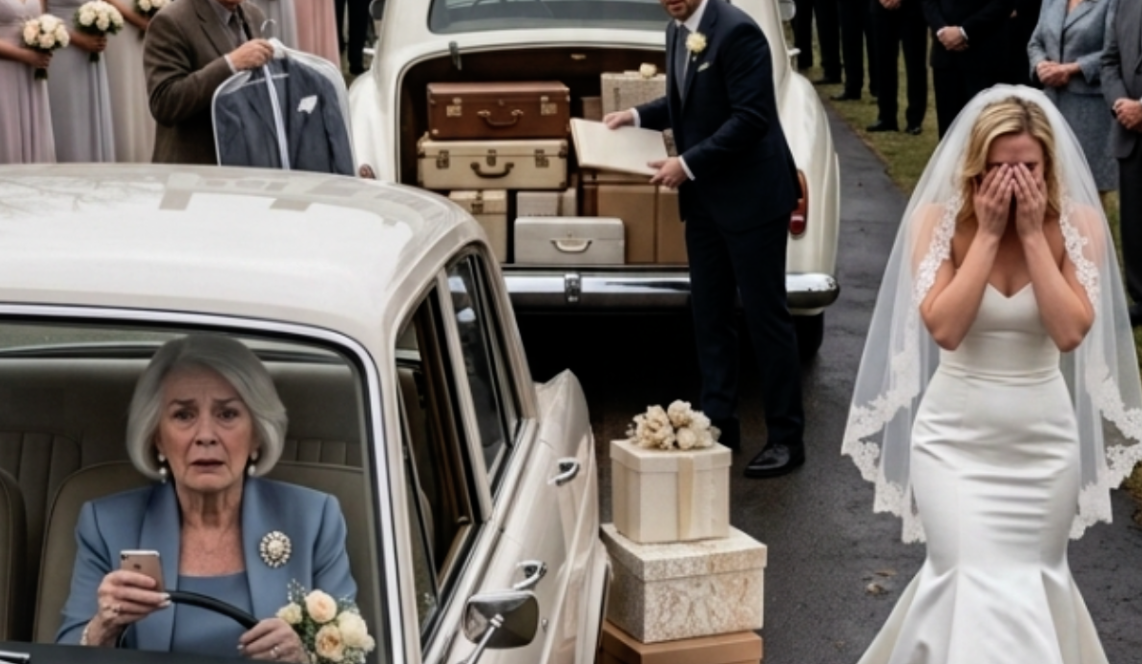
Before the flushed guard could formulate a response, the crunch of gravel drew my attention. Olivia was marching down the winding path. For a fleeting second, the breath evaporated from my lungs. She looked breathtakingly beautiful. Her white satin gown was flawlessly tailored, cascading gracefully to the earth, paired with a delicate lace veil that captured the morning sunlight. She looked exactly like the little girl who used to drape pillowcases over her head, dreaming of this exact moment.
Yet, as she drew closer, she looked entirely like a stranger marching toward a deeply frustrating inconvenience.
“Mom,” she said, her voice thin, tightly coiled. “We need to speak before you attempt to come inside.”
She led me slightly away from the entrance, standing near the edge of the sprawling vines. The morning breeze tenderly lifted the edge of her veil, brushing it against my cheek—a soft gesture that made her subsequent words feel all the more devastating.
She swallowed hard. “You are not invited.”
The words did not detonate. They did not echo across the valley. They simply sank, heavy and cold, into the space between us.
“What?” I breathed.
“Mom, you are not invited. You’re not family anymore. Not today.”
The gravel shifted beneath my sensible heels. I heard the distant, melodic laughter of early arrivals floating from the terrace. Not family anymore. My mind inexplicably flashed to a memory of a four-year-old Olivia, sobbing hysterically in a crowded supermarket aisle because she had lost sight of me for mere seconds. Don’t leave me, Mommy, she had wailed, clinging to my knees. Now, clothed in thousands of dollars of white satin, she was looking me in the eye and demanding my quiet disappearance to spare her the embarrassment of my existence.
“Please do not make this more difficult than it already is,” she pleaded, noticing my silence.
“That is a remarkably strange request to make after informing your mother she has been excised from your family,” I noted, my voice dropping an octave.
She gripped her expensive bouquet until her knuckles blanched. “You know I love you.”
“No,” I replied softly. “I know that you know how to recite those words.”
She flinched, glancing anxiously toward the white stone hall. “This day is not about us, Mom. It is about the image. Evan’s parents have cultivated a specific standard in this community. Everyone who matters in Charlottesville is inside that building. His father’s investors, the charity boards, the foundation donors. You spent your entire life working in public education. You live a very simple, modest life. There is nothing wrong with that, but it is not the level I need to project today.”
The level I need to project. The phrase was so polished, so violently superficial, that I could almost see the moral rot eating through it.
“And my money?” I asked, looking her directly in the eye. “Did my modest, public-school-pension money fit the level?”
“Mom, that isn’t fair.”
“No, Olivia. It truly isn’t.”
“I just wanted one day where I felt like I truly belonged,” she whispered, tears pooling but refusing to fall.
“And you genuinely believed that belonging necessitated my total erasure?”
When she refused to answer, looking away as a photographer called her name from the distance, I simply nodded. I turned on my heel and began the solitary walk back to my sedan. “But before you walk down that aisle,” I called back to her over my shoulder, “do not forget to check your phone.”
I was not, by nature, a theatrical or vindictive woman. Thirty-seven years spent in the trenches of public school administration had thoroughly sterilized any dramatic inclinations I might have once harbored. But there inevitably arrives a threshold where quiet endurance crystallizes into cold, unyielding clarity.
That clarity had found me two weeks prior, outside Olivia’s townhouse. I had arrived unannounced to drop off a final vendor invoice. Through a partially open window, I had heard Olivia and Evan laughing at my expense. She still writes paper checks, Olivia had mocked. She doesn’t fit. Your mother looks at her like she wandered in from a church bake sale. Evan had casually suggested keeping me “busy with little tasks” so my lack of sophistication wouldn’t embarrass them. Not like us, they had concluded.
The very next morning, I had sat across the worn mahogany desk of Rowan Tilly, my late husband’s trusted estate attorney, and meticulously dismantled the financial architecture of my daughter’s elaborate charade. I rerouted the discretionary trust funds meant for her comfort into a community college scholarship for single mothers—a cause Robert had fiercely championed. Then, I drove to the bank and systematically revoked every pending authorization for the wedding. The venue, the high-end catering, the string quartet, the florists—nearly eighty thousand dollars in pending transactions, halted with a single stroke.
Now, sitting in the driver’s seat of my car outside the vineyard gates, I watched through the rearview mirror as the digital reckoning arrived.
Her phone buzzed. Once. Twice. Thrice.
Olivia looked down. The blood instantly drained from her face, leaving her as pale as her gown. “Mom! Wait!” she shrieked, lifting her heavy skirts and sprinting awkwardly across the gravel toward my window.
I lowered the glass.
“What did you do?” she gasped, sheer panic replacing her polished poise. “The florist says the final payment was declined. The venue just emailed—the balance is outstanding!”
“I was informed that I am no longer family,” I stated calmly, resting my hands on the steering wheel. “I have simply accepted the terms of my dismissal. And since a wedding is a family event…”
Evan came jogging down the path, his tuxedo jacket flapping open, his face flushed with irritation. “What on earth is happening? The event coordinator is claiming there is a catastrophic payment issue.”
“There is,” I confirmed.
Evan stared at Olivia. “You explicitly told me your family was handling their half of the contributions.”
“I was handling it, Evan,” I interjected smoothly. “I paid the deposits, the initial venue balance, the invitations, the linens, and the absurdly expensive champagne tower your mother insisted upon.”
Before Evan could process the magnitude of the lie he had been fed, the frantic wedding coordinator arrived, headset askew, clutching a tablet. “Mr. Thornfield, without an immediate alternate payment method for the final eighty thousand dollars, we are legally barred from proceeding. The catering team will initiate breakdown protocol in exactly fifteen minutes.”
Three hundred influential, deeply judgmental guests were sitting on white wooden chairs, waiting for a grand spectacle entirely built upon a foundation of unpaid invoices and deceit.
Charles Thornfield, Evan’s imposing father, materialized on the terrace, demanding to know the cause of the delay. When the coordinator explained that the funding had been revoked by the account holder, his steely gaze locked onto me in my modest blue dress. “And you are?”
“Evelyn Pierce. Olivia’s mother. The woman who was, until moments ago, paying for this charade.”
The fallout was swift and merciless. Evan turned on Olivia, his eyes filled with a chilling, self-serving disappointment. He had been perfectly willing to spend my money while laughing at my expense, but the moment the financial scaffolding collapsed, he abandoned her to the wolves. He walked away, leaving Olivia standing alone in the gravel, weeping, her immaculate bouquet discarded in the dirt. Charles Thornfield barked an order to clear the hall. The grand, expensive illusion was over.
I stepped out of my car, picked up the bruised bouquet, and placed it gently into my daughter’s trembling hands. “Enjoy your day, sweetheart,” I murmured softly. “Whatever kind of day it turns out to be.”
For the first ten minutes of the drive back to Charlottesville, the silence inside my car was absolute. The Virginia countryside looked entirely too beautiful, completely indifferent to the catastrophic shattering of a family. By the time I reached my driveway, my phone had accumulated seventeen missed calls. I turned it off, walked inside, carefully unpinned my mother’s pearl brooch, and hung the blue linen dress on the back of the laundry room door. My neighbor Colleen arrived shortly after with a casserole, offering no questions, only the profound comfort of silent solidarity.
In the weeks that followed, the local rumor mill churned relentlessly. The Thornfields, masters of public relations, retreated into dignified silence, effectively starving the scandal of oxygen. Evan swiftly moved out of Olivia’s townhouse, proving that his devotion was inextricably linked to the convenience of her carefully curated image. By October, the engagement was a mere ghost, and Olivia was forced to sell the condo, relocating to a tiny, unglamorous apartment above a laundromat on Cherry Avenue.
We did not speak for months. I did not pursue her, and she was too burdened by shame to pursue me. But at Christmas, a blank card arrived in my mailbox containing a solitary photograph of a small window adorned with cheap string lights. On the back, in Olivia’s familiar handwriting, were three words: I am trying.
The true thaw began in February, on a dreary afternoon consumed by freezing rain. My phone rang, and against every self-protective instinct I possessed, I answered. Her voice was small, stripped entirely of the artificial polish she had spent years cultivating. She told me she was working a menial scheduling job at a marketing firm, making coffee for people who didn’t bother to learn her name, but that she was finally paying her own rent.
“I hated you for a while,” she confessed into the receiver, her voice breaking. “But I think I hated you because I knew you were right. You forced me to face the consequence of my own cruelty.”
I did not offer her easy absolution. I did not rush to coddle her guilt. Love, I had learned, could be unconditional, but access to it required respect. “I did not want to be right,” I told her simply.
Three days later, I drove to the brick building on Cherry Avenue. There was nothing curated or glamorous about her new life. It was raw, grounded, and intensely real. When she opened the door, wearing faded jeans and bearing the weary shadows of genuine labor under her eyes, she looked more beautiful to me than she ever had in that seventy-thousand-dollar wedding gown.
We sat at her tiny kitchen table, drinking chamomile tea from mismatched mugs. She did not ask for money. She did not ask for a clean slate. She simply apologized—a deep, agonizing, unreserved apology for her arrogance, her shame, and her terrible willingness to erase the woman who had loved her most, all for the approval of people who cared for her least.
“We cannot start over from the beginning,” I told her, holding my warm mug. “But we can start from exactly where we are.”
And so, we did. The healing was glacial, measured in small, quiet Saturday afternoons spent pruning Robert’s neglected rosebushes and sharing simple, inexpensive meals. Trust did not bloom overnight simply because the tears were genuine. But as the months turned into a year, the foundation of our relationship shifted. It was no longer built on my endless financial enabling or her endless taking. It was being built, brick by brick, on mutual respect.
One warm summer evening, after she had successfully helped a neighbor repair the brass light fixture on my front porch, Olivia stood on the sidewalk and looked back at my house. The warm, golden light spilled over the front steps, steady and unpretentious.
She turned to me, offering a smile that was not meant for an audience, a camera, or a society page. It was meant only for me. “I love you, Mom,” she said softly. “And I respect you.”
Those words, hard-earned and heavy with truth, settled into the spaces where my heart had been broken. I watched my daughter get into her small, second-hand car—the one she had purchased with her own wages—and drive away. Standing under the glow of the porch light, listening to the quiet hum of the evening, I realized that life had not given us a fairy tale ending. It had given us something infinitely better: the truth, and a very real, very solid place to stand together.