The thirty-sixth floor of the technology tower in Seattle did not merely exist; it presided over the city. It was a space designed for those who viewed the world from the perspective of an architect, not an inhabitant. The air smelled of sterile cedar, high-end espresso, and the sharp, metallic tang of absolute, unassailable confidence. Every surface—the polished obsidian of the reception desk, the floor-to-ceiling glass that turned the Olympic Mountains into a digital backdrop, the seamless, handle-less doors—seemed engineered to remind a visitor that they were an anomaly in a perfect system.
Harold Finch stood in the center of this pristine environment, looking as though he had wandered off a completely different map. He was seventy-one, and his body was a catalog of the manual labor that had built the foundation upon which cities like this were constructed. His hands were etched with the permanent, dark stains of oil and engine grease—marks that soap could never lift—and his back carried the slight, permanent curve of a man who had spent his life leaning into a task. He held his faded work cap between his hands, his knuckles white with the strain of keeping his trembling under control.
Harold had come from Port Angeles, a place where life was measured in the success of the fishing season and the structural integrity of a fence. His jacket was clean, but it was threadbare at the seams, a garment that had seen a decade of service. His breathing was shallow, a rhythmic, wheezing complaint that turned the simple journey from the elevator to the reception desk into a negotiation with his own failing physiology.
The man he had come to see was Bennett Chase. To the world, Bennett was a titan—the cybersecurity founder whose exit had made him a legend in business journals. To the people in the office, who moved with the hushed, urgent efficiency of acolytes, he was a deity of the new economy.
To Harold, however, Bennett was still the terrified ten-year-old boy he had carried home after a playground brawl. He was the boy who had slept with his hand white-knuckled around Harold’s sleeve, terrified of the dark, of the silence, and of the sudden, hollow absence of his mother.
When Harold was ushered into the conference room, the sight of Bennett standing by the window was jarring. Bennett was dressed in a charcoal suit that cost more than Harold’s annual rent. Beside him, his wife, Rachel, stood with a look of mounting apprehension. Bennett’s expression was a masterpiece of control—a mask of cold, professional distance.
Harold approached the table, his heart laboring against the restriction of his failing valve. He placed a thick, plain envelope on the mahogany surface. His voice, when he spoke, was thin but steady with the weight of his dignity.
“The cardiologist in Spokane was clear, Bennett,” Harold said, his eyes avoiding his son’s. “The valve replacement is urgent. The hospital that specializes in this is out of my network. The estimate is one hundred and sixty-eight thousand dollars before rehabilitation. I am not asking for a gift. I will sign any paperwork. I will pay it back for as long as there is breath in my lungs.”
Rachel looked from the old man to her husband, her face a mask of confusion and growing anger. She waited for Bennett to rush forward, to embrace the man who had effectively been his father in every way that mattered.
Bennett did not move. He stared at the envelope, then at the cap in Harold’s hands, and finally at the stooped shoulders of the man who had sold his own truck, slept on a folding cot in a workshop, and taken every extra shift offered at the docks just to put a computer in Bennett’s hands.
Bennett took a breath, the sound unnaturally loud in the quiet room. “I am not giving you a single dime, Harold.”
The words hit the room with a violence that made the air seem to freeze. Harold nodded once, a slow, mechanical motion. The light seemed to drain from his eyes, not with surprise, but with a weary acceptance. He tucked the envelope back into his pocket, placed his cap upon his head with a stiff, prideful grace, and turned toward the door.
He did not argue. He did not beg. He had been a man who accepted blows his entire life; he knew how to endure the quiet ones, too.
Harold walked out of the tower and into the biting chill of a Seattle afternoon. He didn’t hail a taxi or look for the bus; he simply walked, his pace slow, his body failing. He stopped periodically, pressing his back against the brickwork of buildings to catch his breath, unaware that Bennett was shadowing him from half a block away.
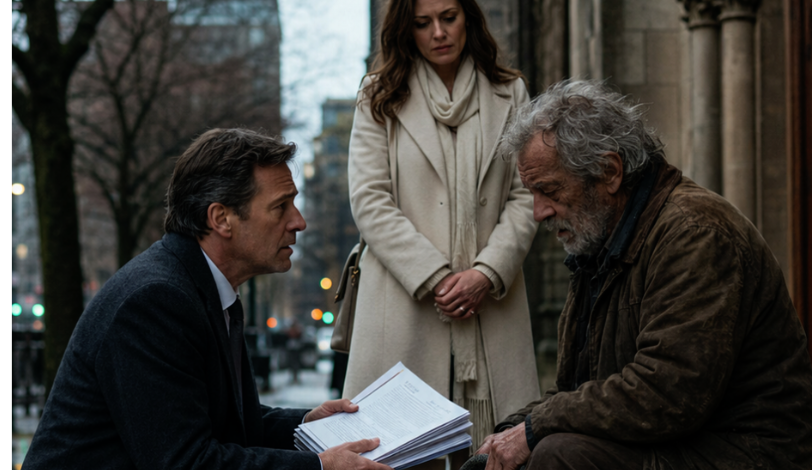
By the time Harold reached a small, stone church—St. Mark’s—sandwiched between a busy clinic and a bookstore, he was exhausted. He sat on a bench beneath a leafless maple, taking off his cap and lowering his face into his hands. It was the posture of a man finally allowing the weight of the world to rest on his shoulders.
Bennett approached, his face a ruin of conflict. Rachel, who had followed in her car, caught up with them, her eyes blazing. “If this is some sort of sick, dramatic test,” she hissed, “you have chosen the cruelest possible way to execute it.”
Bennett looked at her, his composure shattering. “I know.”
“Then fix it,” she whispered. “Before he spends one more minute believing you have forgotten who you are.”
Bennett walked to the bench and knelt on the wet, unforgiving pavement, ignoring the ruin of his expensive trousers. Harold looked up, startled, his eyes swimming with a mixture of shame and confusion.
“Please,” Harold whispered, “don’t come here to tell me why I should have known better than to ask.”
Bennett reached into his coat and withdrew a thick, leather-bound folder. He didn’t speak. He simply placed the documents on Harold’s knees.
“I said I would not give you a dime,” Bennett said, his voice thick, “because there is no debt. There is no loan.”
Harold stared at the papers. They were receipts—official, stamped, and settled.
“Your surgery is paid in full,” Bennett continued, his hands trembling as he gestured to the forms. “The hospital, the surgeon, the cardiac rehabilitation, the home nursing staff—it is all arranged for Monday at seven-thirty. Dr. Albright called me the moment you refused to list an emergency contact. You didn’t give me a chance to surprise you earlier.”
Harold touched the paper as if it were fragile glass. “You… you paid it?”
“I paid it,” Bennett affirmed. He produced another document. “And you are not going back to that room above the supply store. I bought a house for you in Port Townsend. It has a porch that looks out over the water, a proper workshop for your tools, and the bedroom is on the main floor. No stairs, Dad. Never again.”
Harold recoiled, his voice cracking. “Bennett, this is too much. I cannot—”
“Too much?” Bennett let out a sharp, jagged laugh. “Too much was you selling your truck to pay for my robotics program. Too much was you skipping dinner for three years so I could have lunch money. Too much was you pawning your own wedding ring—the one you kept for Mom—because I needed a laptop for college.”
Harold’s shoulders began to tremble, the dam of his reserve finally breaking.
“I did what any man would do,” Harold wept.
“No,” Bennett corrected, his voice a whisper of absolute certainty. “You did what a father does when no one else has the courage to stand in the gap.”
Then, Bennett pulled out the final sheet of paper. It was a DNA report, dated three months prior. It showed a 99.9 percent genetic match. It was the answer to a question no one had ever dared to ask aloud.
Harold read the line, his face turning pale. “Your mother…”
“She was terrified,” Bennett explained, pulling out a letter found in an old recipe tin. “She was forced into the marriage with Conrad Chase. She didn’t know how to survive the scandal of a child out of wedlock, and she didn’t know how to tell you the truth without losing you. She spent her life living in fear.”
Harold looked at Bennett, his eyes searching the younger man’s face for the first time with the recognition of lineage. “I suspected,” he whispered. “I suspected it the day you were born.”
“Why didn’t you demand the truth?”
Harold reached out, his hand cupping Bennett’s cheek. “Because if she denied it, I would have lost the boy I loved. If she admitted it, I might have become bitter about the years the world stole from us. I chose to love you every day, and that was more important than proving I had the right.”
Bennett slumped forward, burying his face in his father’s lap, sobbing with the release of a man who had finally put down a burden he had carried for a lifetime.
The recovery was long, but it was marked by a new kind of peace. Bennett cleared his schedule, driving his father back to the coast. For the first time, their roles began to soften. They walked the pier in Port Angeles, not as a wealthy man and a dependent, but as two men who had finally navigated the fog of their shared history.
The surgery, performed at a top-tier center in Seattle, was a success. But the true healing happened in the months that followed, within the quiet walls of the house in Port Townsend.
The cottage was modest, yet it possessed a dignity that reflected its owner. It sat on a bluff overlooking the sound, where the gulls circled against a backdrop of slate-grey water and passing tankers. There was a workshop out back where Harold spent his afternoons. He didn’t work for money anymore; he worked for the joy of creation. He built birdhouses for neighbors, mended broken chairs, and occasionally fixed the engines of the local fishing fleet just to keep his hands busy.
He had become a fixture in the community. He was the man who always had a kind word, the man who over-tipped the young girl running the lemonade stand at the marina, the man who accepted life with a gentleness that bordered on the holy.
Bennett visited every weekend. Sometimes he brought Rachel, and sometimes he came alone. They would sit on the porch in the cooling autumn air, watching the rain drift across the water.
One afternoon, Bennett invited Harold to the city for a major company gathering. Harold, stubborn to the end, refused the custom-made shoes Bennett tried to buy him. “These boots,” he said, tapping his worn leather soles, “have walked me through every hard season of my life. They have walked through the mud and the snow and the oil. They can walk through your office, too.”
And they did.
In the boardroom, with the weight of the company’s future hanging in the air, Bennett stood at the head of the table. Beside him, Harold sat with his hands resting on his knees, looking entirely out of place and yet, somehow, the most substantial person in the room.
“Before we discuss the strategy for the next quarter,” Bennett began, “I want to introduce you to Harold Finch, my father. Everything you see here—every success, every innovation, every dollar—is built on the foundation of his sacrifice. He repaired boats, he skipped meals, and he gave up his own comfort so that I could learn. If anyone thinks I am a ‘self-made man,’ look at this man beside me. He is the truth of my existence.”
The room was silent. There were no murmurs, no tactical glances at smartphones. Even the most hardened investors seemed to feel the gravity of the moment. Harold, for his part, simply offered a small, embarrassed wave and a shy smile, looking as if he were just happy to be invited along for the ride.
Years passed, and the inevitable cycle of life began to wind down for Harold. His heart, having served him through seventy years of grit and labor, finally began to slow. There was no panic this time. There were no secrets left to unravel.
He lay in the bedroom that faced the water, the curtains dancing in the breeze. Rachel sat in the corner with a book, and Bennett held his father’s hand, his own life feeling suddenly vast and empty in anticipation of the coming void.
“Do not,” Harold said, his voice a whisper that carried across the room, “spend your life trying to pay me back.”
Bennett squeezed his father’s hand, tears tracking through the stubble on his cheeks. “I will never stop owing you, Dad.”
“Then owe me properly,” Harold said, his eyes clear and sharp. “Be kind to people who have nothing to offer your ambition. Answer when the humble knock. Do not let your success become a fortress. Never let the world teach you contempt.”
He paused, a faint, mischievous smile touching his lips. “And for heaven’s sake, never again tell a sick old man you won’t give him a dime, even if you’ve already paid the hospital bill.”
Bennett laughed, a wet, choking sound of joy and grief. “I was a fool.”
“You were a son,” Harold corrected softly. “Learning how not to be one is the work of a lifetime.”
He closed his eyes then, drifting into the quiet light of the morning. When he passed, it was as peaceful as a boat finding its slip after a long, turbulent voyage.
The funeral in Port Angeles was not a solemn, hollow affair. It was a testament. The church was filled beyond capacity—not by business associates or board members, but by the people who had actually known Harold. The dockworkers, the nurses, the neighbors whose furnaces he had fixed for free during the dead of winter, the people who had received anonymous help when the world had been unkind to them.
When Bennett stood to deliver the eulogy, he did not speak of his company. He held up a small, rusted pawn ticket—the ticket for his mother’s watch, which he had kept as a talisman for years.
“My father,” Bennett told the gathered crowd, “once gave up the last beautiful thing he owned so that I could have a future. Years later, when he finally came to me for help, I told him I would not give him a dime. I thought I was being strong. I thought I was protecting him. I was wrong. I was cruel. And I have spent every day since then trying to be the man he believed I was.”
He looked out over the crowd, seeing the impact of a life lived in service to others.
“Some debts,” Bennett concluded, “cannot be repaid in currency. They can only be honored in the way we live our lives. Fatherhood is not defined by blood—though blood, in our case, revealed a truth we had lived by all along. Fatherhood is defined by the nights spent working while the child sleeps, believing the world is safe. It is defined by the boots worn thin. It is defined by the love that spends itself without ever keeping score.”
Today, in Bennett’s office in Seattle, there is no plaque commemorating his IPO or his market share. Behind his desk, in a simple wooden frame, is a photograph of Harold on his porch, his battered cap on his head, his eyes crinkled against the sun as he looks out over the water.
Beneath it is a small, bronze inscription that Bennett reads every morning before he starts his day:
First Investor. Paid in work, hunger, and love. Never to be repaid, only to be continued.
Bennett learned the hardest lesson of his life: that a father is not a man who gives once at the beginning, but a man who keeps giving pieces of himself until the child is strong enough to stand on their own. Harold had given Bennett his name long before the court recognized it. He had given him his future long before Bennett understood the cost. And though Bennett had become rich enough to buy houses, and hospitals, and companies, he knew with absolute, humble certainty that he had never become rich enough to settle the debt carried in one simple, sacred word:
Dad.