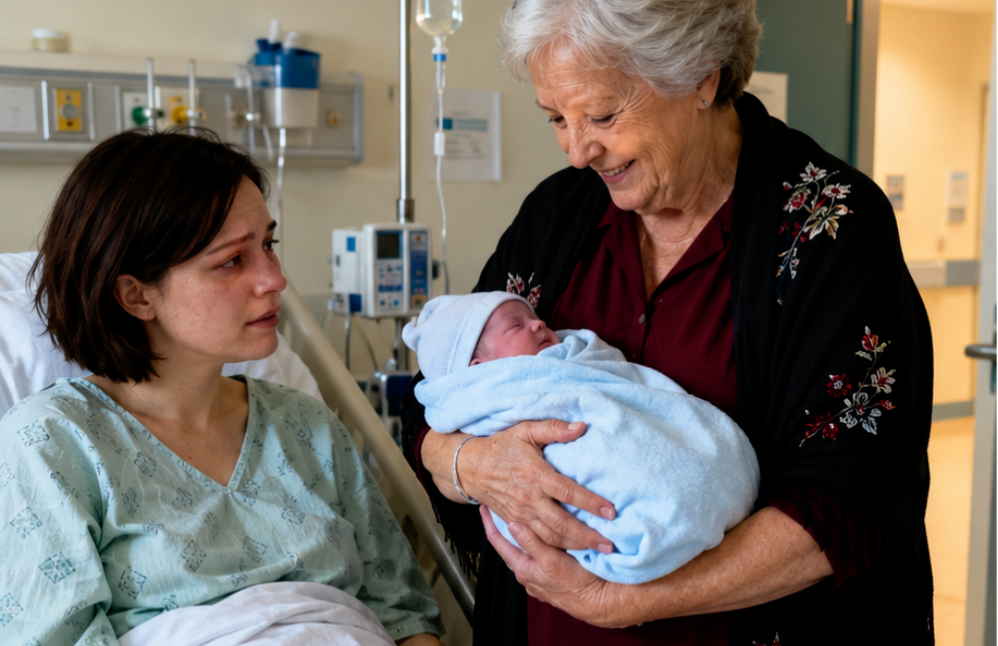
he physical sensation of emerging from major abdominal surgery is not merely pain; it is a profound, grounding gravity that pulls you deep into the mattress. Just hours after the emergency Cesarean section, the lingering fog of the anesthesia still clung stubbornly to the edges of my consciousness. It dulled the sharpest edges of my agony, but left behind a heavy, unrelenting, throbbing ache in my lower abdomen. My body felt as though it had been violently cleaved in two and then hastily stitched back together with burning wire. Yet, anchoring me to the present, serving as a beautiful counterweight to the trauma of the operating table, a dual heartbeat rested against my bare, trembling chest.
The recovery suite at St. Mary’s Medical Pavilion was designed to obscure the clinical realities of childbirth. It resembled a five-star luxury hotel rather than a sterile medical facility. The lighting was warm and recessed, the walls were adorned with tasteful, muted artwork, and the linens were a heavy, comforting silk-blend. At my explicit request, the nursing staff had quietly and efficiently removed the extravagant floral displays that had arrived earlier that morning. Those arrangements had been sent by various colleagues from the Attorney General’s Office, a few prominent federal associates, and the local circuit judges. Leaving them out would have prompted questions I had no desire to answer.
For the entirety of my marriage to Andrew, I had worked exceptionally hard to maintain the illusion of being a simple, unassuming work-from-home freelancer around his family. I told them I reviewed basic contracts, drafted boilerplate legal documents, and occasionally consulted for small firms. It was a fabricated existence, one I had carefully constructed because it was undeniably safer that way. My true profession was not something that could be casually discussed over Sunday brunch with a family obsessed with social climbing and public optics.
Beside me, swaddled tightly in soft, striped hospital blankets, my newborn twins—Noah and Nora—slept with the profound, undisturbed peace known only to the newly born. The emergency surgery had been a terrifying ordeal, a sudden plunge into chaos when their heart rates had begun to drop. But now, holding their fragile, perfectly formed bodies against my skin, inhaling the intoxicating, sweet scent of their heads, every ounce of the preceding pain was entirely erased. I was a mother. For a few fleeting hours, the world outside this room did not exist.
Then, the heavy oak door of the suite was violently slammed open.
Margaret Whitmore, my mother-in-law, did not merely enter rooms; she invaded them. She swept into the private suite in a suffocating cloud of designer perfume—a cloying, aggressive scent of heavy florals and musk—and absolute, unchecked entitlement. She was dressed meticulously, as always, in a tailored Chanel suit that spoke of old money and new arrogance. Her sharp, calculating eyes immediately swept across the dimly lit room, taking in the silk bedding, the spacious seating area, and my exhausted, pale face with a look of obvious, undisguised contempt.
“A private suite?” she scoffed, her voice a harsh, grating intrusion into the quiet sanctuary. She stepped closer, lifting the pointed tip of her expensive leather shoe to tap against the metal frame of the hospital bed. The vibration sent a sharp, agonizing wave of pain tearing through my fresh abdominal incision, causing me to gasp silently and instinctively curl my arms tighter around my sleeping babies.
“My son works himself to absolute exhaustion at the firm so you can lounge around in silk bedding like some displaced royalty?” Margaret sneered, her lip curling. “You have absolutely no shame. None whatsoever.”
Before I could summon the energy to formulate a response to her vitriol, she reached into her designer handbag, pulled out a thick, meticulously bound stack of legal papers, and tossed them carelessly onto my rolling tray table. They landed with a heavy, ominous thud.
“Karen can’t have children,” Margaret said, her tone suddenly flat, devoid of any emotion or empathy. Karen was Andrew’s older sister, a woman who had suffered through years of failed fertility treatments and miscarriages. It was a tragedy, certainly, but Margaret did not speak of it with sorrow; she spoke of it as an administrative problem that required immediate correction. “She needs an heir to secure her husband’s trust fund. You’ll give her one of the twins. The boy. You can keep the girl.”
For several agonizing seconds, the silence in the room was so absolute I could hear the faint, rhythmic ticking of the wall clock. My brain, still sluggish from the narcotics and the exhaustion of childbirth, simply refused to process the words she had spoken. It was an absurdity so profound it defied immediate comprehension.
“Excuse me?” I finally breathed, my voice barely a raspy whisper.
“Sign the papers immediately,” she ordered, pointing a manicured finger at the stack. “You don’t deserve to live like this, leeching off my son. And looking at you now, weak and pathetic, you’re certainly not capable of raising two babies. It’s decided.”
“You’ve completely lost your mind,” I whispered, the maternal instinct rising in my chest, hot and fierce, burning away the remnants of the anesthesia. I pulled Noah and Nora closer to my collarbone. “These are my children. You are out of your mind.”
“Stop being hysterical,” Margaret snapped, her eyes narrowing as she stepped aggressively toward the clear plastic bassinet where I had just intended to lay Noah down. “You’re clearly overwhelmed by the hormones and the surgery. Karen is downstairs waiting in the car. We are finalizing this today.”
When her clawed, diamond-ringed hand actually reached out toward my son, something ancient, primal, and deeply terrifying ignited inside me. The veneer of the quiet, polite daughter-in-law shattered instantly.
“Do not touch my son!”
Ignoring the searing, blinding pain that ripped through my freshly sutured incision, I pushed my upper body forward, throwing my arm out to block her reach. Margaret, shocked by my sudden resistance, spun around. Her face twisted into a mask of pure, aristocratic rage. Without a second’s hesitation, she raised her hand and struck me hard across the face.
The force of the blow was staggering. My head snapped violently to the side, the side of my skull colliding with the heavy metal bed rail with a sickening, dull crack. My vision went white, then fractured into a kaleidoscope of dancing black spots. The metallic taste of blood instantly flooded my mouth from where my teeth had bitten through my lower lip.
“Ingrate!” Margaret hissed, her voice venomous. Taking advantage of my disorientation, she lunged forward and roughly lifted Noah from the crook of my arm. Startled from his peaceful sleep, my son immediately began wailing, a high, piercing cry that tore at my heart. “I am his grandmother! I am a Whitmore! I decide what is best for this family and for him!”
Through the dizzying pain and the blood dripping down my chin, a cold, crystalline clarity washed over me. I did not scream. I did not plead. With shaking, blood-stained fingers, I reached out and slammed my palm against the emergency security button mounted heavily on the wall beside my bed—a specialized button installed specifically for my room prior to my admission.
The response was instantaneous.
Alarms did not just sound; they blared, echoing through the corridors of the VIP wing. Within seconds, the heavy doors burst open. Hospital security, flanked by two armed guards, rushed into the suite. Leading them was Chief of Security Daniel Ruiz, a broad-shouldered, imposing man who carried the unmistakable bearing of former federal law enforcement.
The moment the men entered, Margaret’s demeanor transformed with terrifying speed. The cruel, calculating kidnapper vanished, replaced instantly by a weeping, terrified matriarch.
“Help! She’s unstable!” Margaret cried out dramatically, clutching my wailing, terrified son tightly to her chest and pointing a trembling finger at me. “She’s having some kind of psychotic break! She tried to hurt the baby! I had to step in and save him! Look at her, she’s completely out of her mind!”
Chief Ruiz stepped fully into the room, his hand resting instinctively on his utility belt. His sharp, trained eyes rapidly took in the chaotic scene. He saw my split lip, the blood dripping onto my hospital gown, my pale, trembling form half-slumped against the bed rail. Then, his gaze shifted to the elegantly dressed woman aggressively clutching the crying newborn.
Finally, his eyes met mine.
Ruiz stopped cold. The authoritative momentum of his entrance evaporated into absolute stillness.
“Judge Carter?” he murmured, his voice dropping in genuine shock.
The room went instantly, horrifyingly silent. The only sound was Noah’s soft whimpers as he slowly calmed down.
Margaret blinked, her theatrical tears drying up in an instant of sheer, unadulterated confusion. “Judge? What on earth are you talking about, officer? She doesn’t even work. She’s a freelancer. She types documents in her pajamas.”
Chief Ruiz ignored her completely. He straightened his posture immediately, his military background showing as he respectfully removed his cap. He stepped closer to my bed, his face a mask of deep concern. “Your Honor… are you injured? Do we need to call the surgical team back in?”
I took a slow, agonizing breath, forcing myself to sit up straighter despite the fiery agony in my abdomen. I kept my voice steady, resonant, and entirely stripped of emotion—the exact voice I used when addressing a crowded, tense courtroom.
“I have sustained a minor head contusion and a lacerated lip,” I said clearly. “This woman assaulted me. She then forcefully removed my son from my physical custody and attempted to exit this secured medical facility with him. Furthermore, she just made a false and defamatory accusation against me to law enforcement personnel.”
Chief Ruiz’s posture shifted completely. The concern morphed into cold, hard authority. He slowly turned his head to look at Margaret, who was now staring at me as if I had suddenly grown a second head.
“Ma’am,” Ruiz said, his voice carrying the weight of impending doom, “you have just committed aggravated assault, attempted kidnapping, and filing a false report inside a federally protected medical wing.”
Margaret’s carefully constructed composure cracked, shattering into a million pieces. “That is absurd! This is a joke! My son told me she works from home! She’s a nobody! Look at her!”
“For severe security reasons,” I replied calmly, lifting a sterile gauze pad to wipe the smudged blood from my chin, never breaking eye contact with my mother-in-law, “I am required to maintain an exceptionally low public profile. The cases I handle bring inherent risks. I preside over federal criminal cases, including organized crime and cartel litigation. Today, however, I just happen to be the victim of one.”
I lowered the gauze and held Ruiz’s steady gaze.
“Place her under arrest, Chief Ruiz. Ensure she is read her rights. I will be filing federal charges immediately.”
“Yes, Your Honor,” Ruiz said. He gestured to his officers, who immediately moved in, gently but firmly prying a screaming, bewildered Margaret away from my son. Ruiz himself carefully took Noah, cradling the infant with surprising gentleness, and returned him to my waiting arms.
“You can’t do this! Do you know who I am? I am Margaret Whitmore!” she shrieked, the heavy steel handcuffs clicking shut around her wrists. The sound was incredibly satisfying.
Just as the officers began to march her forcefully out of the suite, my husband, Andrew Whitmore, rushed through the doorway, breathless and clutching a bouquet of generic hospital-gift-shop balloons. He froze, his eyes darting from his handcuffed mother, to the security guards, to my bloody face, and finally to the twins safely in my arms.
“Mom? What is happening? Elena, what did you do?” he stammered, dropping the balloons.
“She physically assaulted me and attempted to kidnap Noah,” I said, my voice unnervingly even. “She brought legal documents for me to sign away my parental rights to your sister. And, most interestingly, she claimed that you fully approved of this arrangement.”
Andrew hesitated. It was only for a second, a fleeting pause, but in a marriage, a second of hesitation is a lifetime. It was all the confirmation I needed.
“I didn’t… I didn’t approve,” he said quickly, his hands raising defensively, his eyes wide with cowardice. “I just… I didn’t object when she brought it up. I thought it was a crazy idea, but I thought we could just talk about it, Elena. You know how she gets. I didn’t think she would actually do it.”
“Talk about it?” I asked, my voice dropping an octave, carrying the lethal chill of a winter storm. “Talk about giving away our firstborn son to appease your mother’s vanity and your sister’s inheritance?”
“She’s my mother, Elena! You can’t have her arrested! She was just trying to help Karen!”
“And they are my children,” I stated.
My voice never rose. It never needed to. I did not yell, I did not cry, and I did not plead. I simply looked at the man I had married—a man who had stood by while his mother orchestrated the theft of his child because he was too weak to tell her no.
I informed him, calmly, clearly, and with absolute legal precision, exactly what was going to happen next. I told him that any further interference from him, his mother, or his sister would immediately initiate ruthless divorce proceedings and a unilateral custody battle that he was statistically and legally guaranteed to lose. I detailed the specific statutes regarding conspiracy to commit kidnapping. I also quietly reminded him, as a practicing corporate attorney, that obstruction of justice carries severe, irrevocable consequences—both professional and personal.
For the very first time in our five-year relationship, Andrew looked at me and truly saw me. He did not see his quiet, accommodating, freelance wife who nodded politely at family dinners and let his mother make snide remarks about her clothes. He saw the woman who sentences violent, unrepentant criminals to life without parole without a second of hesitation. He saw the Federal Judge.
He backed slowly out of the room, his face pale, his hands trembling, leaving his mother to be hauled away to a holding cell.
Six months later, I stood inside the quiet, oak-paneled sanctuary of my federal chambers, adjusting the heavy, black silk of my judicial robe. The fabric settled over my shoulders, a familiar, comforting weight.
Through the tall, bulletproof windows, the late afternoon sun cast long, golden shadows across my heavy mahogany desk. Resting prominently on the leather blotter was a newly framed photograph of Noah and Nora. They were six months old now—healthy, smiling, thriving, and above all, utterly safe.
My lead clerk knocked gently and entered, carrying a stack of final case files. She paused, offering a small, professional smile. She informed me that the sentencing hearing in the adjacent district had concluded.
Margaret Whitmore had formally been convicted of aggravated assault, attempted kidnapping of a minor, and filing false reports to law enforcement. Despite her expensive legal team and her frantic attempts to leverage her social standing, the federal prosecutor—a colleague who had seen the photographs of my bruised face—showed no mercy. She received a sentence of seven years in a federal penitentiary.
Andrew, facing intense scrutiny and the threat of being named as an unindicted co-conspirator, voluntarily surrendered his law license. The resulting divorce was swift, brutal, and entirely in my favor. He was granted strictly supervised visitation with the twins, twice a month, in a monitored facility.
As I absorbed the news, I looked out over the city skyline. I felt no grand, cinematic sense of triumph. There was no joy in the destruction of a family, even a deeply broken one. There was only the quiet, resolute peace of absolute closure.
For years, the Whitmore family had mistaken my deliberate silence for inherent weakness. They had mistaken my desire for a simple, private home life for professional incompetence. They assumed that because I did not flaunt my authority, I possessed none. Margaret genuinely believed she could walk into a hospital and steal my child simply because she thought she was dealing with a woman who had no power to stop her.
She, and her son, forgot one essential, unyielding truth of the world.
Real power does not need to announce itself. It does not demand attention, it does not throw tantrums in hospital rooms, and it does not need to wear expensive perfume to command a room.
It simply moves.
I turned away from the window, picked up my heavy wooden gavel, and walked out into the courtroom to begin the afternoon session.