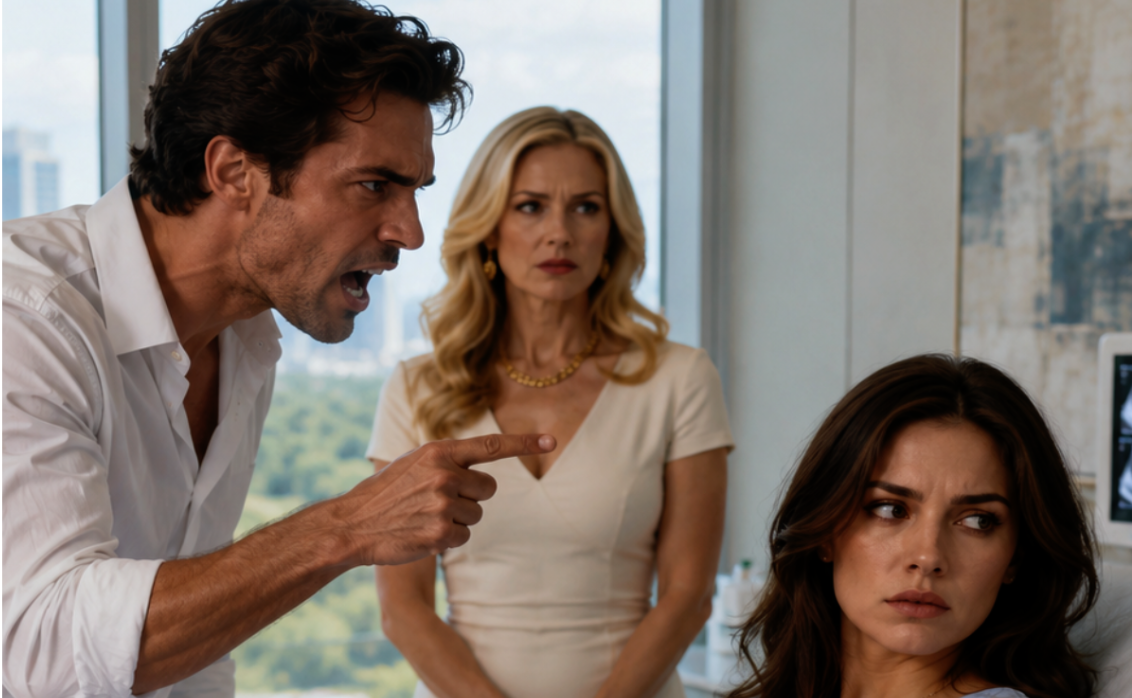
“Mr. Diego, before you continue insulting your wife, you need to take a very close look at what is appearing right here.”
Dr. Salinas’s voice was remarkably calm, yet it sliced through the suffocating tension of the examination room with the finality of a heavy iron door slamming shut.
Diego’s arrogant, self-satisfied smile froze instantly. For the first time since he had brazenly walked into the intimate space of the ultrasound room—trailing the other woman, Paula, right behind him as if attending a twisted victory parade—he finally directed his gaze toward the glowing monitor. Beside him, Paula crossed her arms defensively, letting out a small, sharply impatient laugh that sounded entirely out of place in a medical clinic.
“What exactly are we supposed to be looking at?” she asked, her tone dripping with condescension. “A baby? We already know there’s a baby. That was never the question.”
Dr. Salinas did not so much as glance in Paula’s direction. She kept her unwavering, clinical gaze fixed entirely on Diego.
“Do you see this specific measurement?” the doctor asked.
Diego stepped an inch closer, though his features still bore the smug, impenetrable confidence of a man who firmly believed that both modern medicine and absolute cruelty were stationed on his side of the battlefield. “Yes,” he replied curtly. “So?”
Dr. Salinas pointed a pen at the corner of the screen. “This pregnancy is not nearly as recent as you have led yourself to believe.”
My breath caught violently in my throat. I felt the cold slide of the ultrasound wand against my abdomen, anchoring me to a reality I could scarcely comprehend.
Diego’s thick brows drew together in a heavy frown. “What does that mean?”
The doctor deliberately clicked a sequence of buttons, enlarging the grainy image until the monitor emitted a soft, pulsing blue-white glow that bathed the darkened room. Outside the narrow clinic window, the late afternoon sunlight was quietly spreading across the asphalt of the small suburban medical plaza. A solitary American flag shifted faintly on a pole near the entrance, looking profoundly ordinary and bright, entirely oblivious to the fact that my entire existence was currently being weighed and measured in the breathless silence of that room.
Dr. Salinas did not rush her delivery. She understood the gravity of her medical authority. “It means that the gestational development displayed here does not, in any way, match a conception occurring after your vasectomy.”
The room went entirely silent. In the absence of human voices, the mechanical hum of the ultrasound machine seemed to magnify. Then, the rhythmic sound of the heartbeat filled the stifling air.
Fast. Strong. Undeniably alive.
Diego’s eyes narrowed into dark, defensive slits. “Say that clearly.”
Dr. Salinas turned her body to face him fully, a physical manifestation of an irrefutable fact confronting a fragile ego. “Based on the biometric measurements from this ultrasound, your wife appears to have conceived before your vasectomy procedure took place.”
For one impossible, suspended second, nobody in the room drew a breath. The words entered the sterile space and settled heavily upon us, commanding the room like a high-court judge taking a seat at the bench.
Before. Before he went under the surgeon’s knife. Before Diego had looked me in the eye and branded me a traitor. Before his mother, Dolores, had marched up to my front porch gripping black trash bags, fiercely instructing me to pack my belongings before I brought any further disgrace upon their family name. Before Paula had smiled triumphantly across a coffee shop table, casually stroking her own flat stomach as if she had already won a grand prize. Before the neighborhood had begun to whisper behind cupped hands. Before I had resorted to dragging a heavy wooden chair under my bedroom doorknob every night, paralyzed by the realization that I no longer trusted the sound of footsteps echoing on my own front porch.
Before all of that orchestrated devastation, this tiny life had already taken root.
I clamped both hands over my mouth. A ragged sob tore its way up my throat. This was not the broken, pathetic weeping I had done while collapsed on the cold bathroom floor weeks prior. This was not the desperate, hollow sound of profound humiliation. This was an entirely different emotional entity. It was a wave of relief so violently powerful that it physically ached in my chest.
Diego blinked rapidly, his mental architecture visibly collapsing. “No.”
Dr. Salinas remained an immovable pillar of calm. “Yes.”
“No, that’s simply not possible.”
“It is entirely possible,” she countered, her voice dropping into a tone of educational reprimand. “A vasectomy does not retroactively prevent a conception that has already occurred.”
Paula’s expression was the first to completely shatter. The practiced smugness drained instantly from the corners of her mouth. She turned her head to look at Diego, and for the first time since she had confidently strutted in behind his broad shoulders, she no longer resembled a woman attending a coronation. Instead, she looked exactly like a trespasser who had suddenly realized she had eagerly bought a front-row ticket to the wrong execution.
“You specifically said it was impossible,” Paula whispered, her voice trembling with sudden dread.
Diego did not even acknowledge her. He was staring unblinking at the illuminated screen, looking at the black-and-white static as if the machine itself had orchestrated a personal betrayal against him.
Dr. Salinas was not finished. “And even if conception had occurred after the vasectomy, Mr. Diego, pregnancy following a recent procedure is never considered impossible until a post-procedure semen analysis scientifically confirms absolute sterility. Patients are universally and strictly instructed to utilize alternative protection until that medical clearance is confirmed by a laboratory.”
She paused, looking directly into his rapidly paling face. “Were you medically cleared?”
Diego’s jaw flexed, a hard ridge of bone pressing against his skin. I already knew the damning answer. He had never bothered to return to the clinic for the mandatory follow-up test. I had explicitly reminded him twice. Once while we were standing together folding warm laundry in our bedroom. Once in the kitchen while he was casually pouring dark roast coffee into the silver travel mug he carried to his office every morning. Both times, he had waved his hand dismissively in my direction, his tone laced with patriarchal condescension: “Laura, I know my own body.”
Now, that specific, blinding arrogance stood stripped completely naked beneath the fluorescent lights of the ultrasound room.
Dr. Salinas repeated her question, her tone noticeably colder. “Were you medically cleared?”
Diego looked away, unable to meet the doctor’s eyes.
Paula whispered, a frantic edge to her voice, “Diego?”
He snapped, his temper flaring to cover his terror, “Be quiet.”
The doctor’s features hardened into a mask of absolute intolerance. “Do not speak that way to anyone in my examination room.”
For some inexplicable reason, that sharp defense almost caused me to break down again. A virtual stranger wearing a white coat had defended my basic human dignity with more ferocity than my own husband had offered me in a month.
Diego dragged both of his shaking hands violently through his hair. “This still doesn’t prove the baby is mine.” The words left his mouth, but they lacked their former venom; they were pathetic, grasping at invisible straws.
Dr. Salinas looked at him as if he had managed to disappoint her both clinically and morally within a span of five minutes. “No ultrasound in the world can definitively prove paternity,” she stated evenly. “But it absolutely proves that your vile accusation, which you based solely and entirely on the timing of your vasectomy, was medically ignorant and fundamentally flawed.”
Paula physically flinched at the phrase.
I sat up slowly on the examination table, reaching for a paper towel to wipe the cold, sticky transmission gel from my belly. My hands were shaking violently, but my spirit was galvanizing. For the first time since Diego had set his coffee cup down on our granite kitchen island and looked at me as if I were nothing more than discarded garbage, I felt the vertebrae in my spine lock into a rigid, unbreakable line.
I looked directly into his eyes. “You left me for her before asking one single doctor one single question.”
Diego opened his mouth to formulate a defense, found none, and closed it. Paula’s panicked eyes darted frantically between the two of us.
Then, the second seismic shock of the afternoon arrived.
Dr. Salinas turned the monitor slightly toward me. “There is one more thing we need to address.”
My heart vaulted into my throat. I gripped the padded edge of the examination table until my knuckles turned white. “What is it?”
Her stern expression softened into an expression of profound, gentle warmth. “The baby’s heartbeat is very strong. But I need to show you something else.”
Diego muttered from the corner, his voice defensive and small, “What now?”
The doctor moved the transducer probe slowly across my lower abdomen. On the screen, a second dark, hollow shape slowly materialized in the static right beside the first one. My mind, overloaded by the trauma and the triumph of the last ten minutes, could not comprehend the visual data at first. Then, I saw another tiny, rhythmic flicker. Another distinct rhythm. Another pulsing life.
Dr. Salinas spoke with a quiet reverence. “Laura, there are two babies here.”
The walls of the room seemingly dissolved into thin air. Two. I stared blankly at the screen. One rapid heartbeat. Then, just millimeters away, another. Two tiny, resilient pulses of life beating fiercely inside of me, while the man who had authored this entire catastrophic nightmare stood immobilized with his mistress at his side.
“Twins?” I whispered, the word tasting foreign on my tongue.
Dr. Salinas smiled a genuine, soft smile. “Yes. Fraternal twins.”
Both of my hands flew instinctively to shield my stomach. I began weeping so intensely that the room blurred into a wash of gray and blue. Two babies. Two absolute miracles. Two innocent children that Diego had loudly and publicly condemned as another man’s offspring without ever having seen them.
Paula made a sharp, strangled noise in the back of her throat.
Diego simply stared at the monitor. He was completely drained of color. “Twins,” he repeated, the word falling from his lips like a lead weight.
There was no joy in his voice. There was no wonder. There was only raw, unadulterated terror. Because in the dark, calculating corners of his mind, one baby could perhaps be legally and socially dismissed as a temporary inconvenience. Two babies meant undeniable consequence. Two babies meant doubled child support. Two babies meant a colossal public truth that could not be swept under a rug. Two babies meant the romantic, victimized narrative he had carefully spun with Paula was no longer a tragically beautiful love story; it was a permanent monument to his own reckless, devastating carelessness.
Dr. Salinas pressed a button, and the printer in the corner began to hum, producing a soft mechanical rhythm. A moment later, she carefully tore the glossy, black-and-white thermal strip free. She bypassed Diego completely, walking around the table to press the printed photographs directly into my trembling hands.
“Laura, I want you to go to the front desk and schedule comprehensive bloodwork and another specialized scan. With a multiple pregnancy, you will need very careful, frequent monitoring.”
I nodded mutely, tears dripping down my chin.
Diego stepped out of the shadows. “Let me see them.”
I immediately pulled the glossy strip of photos tight against my chest, shielding them. “No.”
His facial muscles darkened instinctively, flashing the reflexive anger of a man who was unaccustomed to being denied access to anything he demanded. “What do you mean, no?”
“I mean the word no.”
He stared at me, genuinely perplexed, as if the syllable itself did not belong in my vocabulary. For eight long years of marriage, I had systematically softened my edges for him. I had carefully modulated my tone, perpetually explained myself, constantly apologized for his bad moods, and tirelessly worked to maintain an artificial peace in our household.
Not anymore. Not with two tiny, rapid heartbeats still echoing loudly in my ears.
“You deliberately walked into this clinic today to witness my humiliation,” I said, my voice dropping an octave, finding a resonance I didn’t know I possessed. “You do not get the privilege of holding the very first picture of my babies.”
His jaw tightened dangerously. “They are our babies.”
I laughed. The harsh, brittle sound surprised everyone in the room, myself included. “Our?”
Paula went completely rigid.
Diego swallowed hard, the Adam’s apple bobbing in his throat. “Laura, please listen—”
“No. You listen to me.” My voice was shaking with the sheer force of the adrenaline pumping through my veins, but it did not break. “You called me a traitor. You packed a bag and left me for your coworker. You stood silently by while your mother came to my door and called me a disgrace to the neighborhood. You posted online, for all of our friends and family to see, that my life was a lie. You brought Paula to a legal mediation where you actively tried to strip me of my house, my basic dignity, and my child’s legal rights.” I paused, looking down at the protective cage my hands made over my belly. “Children’s rights.”
Diego closed his eyes, as if shutting out the visual evidence would erase the auditory truth. “Laura, I was incredibly angry.”
“No,” I corrected him smoothly. “You were unthinkingly cruel.”
He opened his eyes. “That is not a fair assessment.”
I almost smiled at the utter absurdity of his word choice. “Fair? Diego, fair is the concept you ask for before you decide to burn the entire house down. It is not the concept you demand after you suddenly realize you have locked yourself inside of it.”
Paula’s face flushed a deep, mottled red. “Don’t you dare speak to him like that.”
I pivoted my head slowly to look at her. “And you do not have the right to speak to me at all.”
Her mouth dropped open in shock. I immediately raised a single hand, silencing her. “No. You walked into my private ultrasound appointment hiding behind my husband’s back, proud and eager to watch a doctor measure my shame. You stood right there, waiting for the medical establishment to validate your affair. The only reason you are standing there quietly now is because the ultimate truth pointed its finger directly at you instead.”
Dr. Salinas stepped neatly between us, establishing a physical barrier. “This medical appointment is officially over. Mr. Diego, Ms. Paula, you both need to vacate these premises immediately.”
Diego planted his feet. “Laura, we desperately need to talk about this.”
I bypassed him entirely, looking directly at the doctor. “Can you please call someone from reception?”
She nodded without hesitation. Within sixty seconds, a clinic nurse appeared in the doorway. She was a deeply serene woman dressed in crisp navy scrubs, wearing a security badge clipped to her pocket and an expression that strongly suggested she had escorted highly difficult, emotionally volatile people out of restricted rooms many times before.
Diego looked visibly staggered. It was as if his brain could not process the fact that I, his historically compliant wife, was actively having him removed from a space he felt entitled to invade. “I am your legal husband,” he protested, gesturing weakly to the room at large.
I clutched the ultrasound photographs even tighter against my heart. “Only for now.”
His entire demeanor shifted, morphing into the exact same look of hollow terror he had worn when he first saw the positive pregnancy test on our bathroom counter. Except this time, the dynamics had irreversibly shifted; he was the one standing in the dock, formally accused by reality.
Paula reached out, her fingers grasping his forearm. “Diego, let’s just go.”
He jerked his arm away from her touch without even looking at her, a purely instinctual rejection. She noticed it. I noticed it. Dr. Salinas noticed it. That single, minute, microscopic movement of withdrawal was the very first structural crack in the grand, romantic fantasy the two of them had built upon my destruction.
Diego cast one final, lingering look in my direction. His voice dropped into a register of pleading he had never used before. “I will call you later.”
“No,” I replied evenly. “You will call my lawyer.”
The nurse efficiently escorted them down the hallway. The moment the heavy wooden door clicked shut, the adrenaline evaporated, and I finally broke. It was not a pretty, cinematic crying. It was not quiet. I folded my upper body over my knees and sobbed with a guttural intensity, mourning the death of my marriage and celebrating the vindication of my sanity simultaneously. Dr. Salinas sat quietly beside me on the examination table, placing a warm, steadying hand on my shuddering shoulder.
“You are entirely safe in here,” she murmured.
Safe. I had not fully realized how many excruciating weeks had passed since I had actually felt the physical sensation associated with that word.
When I finally emerged from the clinic, the two ultrasound photos secured safely inside my leather purse, a new, untamable fire was burning steadily in my chest. Outside in the fading afternoon light, Diego was loitering near the edge of the parking lot. Paula stood several feet away from him, her arms crossed defensively, her features hardened into an angry mask. They were engaged in a fierce, hushed argument near a neatly trimmed row of hedges. A large pickup truck rolled slowly past them. A woman loading brown paper grocery bags into her SUV glanced over at the drama, then quickly averted her eyes, preferring the safety of her own routine.
As I approached my car, Paula’s sharp voice carried on the wind. “You explicitly told me she cheated on you.”
Diego snapped back, his voice ragged, “I genuinely thought she did.”
“You thought? You completely destroyed your own marriage and dragged me into it over something you merely thought?”
He caught sight of me approaching and instantly stopped talking, stepping away from the hedges. “Laura.”
I did not break my stride. I kept my eyes locked on my car. He scrambled to follow me across the asphalt.
“Laura, please wait. Just wait a second. Please.”
Please. He had managed to locate that particular word with astonishing speed now that the power dynamic had inverted. I stopped at my car door and turned around slowly. “What do you want?”
His face looked completely alien to me now. He did not exactly look remorseful; rather, he looked fundamentally shaken, like a man who had confidently stepped onto solid ground only to find it was deep water. “I need some time to process all of this.”
I stared at him, my expression deadpan. “That’s incredibly funny. You didn’t seem to require any processing time whatsoever to publicly condemn me.”
Paula tentatively took a few steps closer. Diego ignored her entirely, keeping his desperate focus on me. “I made a massive mistake.”
“No, Diego,” I corrected him, enunciating every syllable. “A mistake is a mathematical error. What you made was a deliberate choice. In fact, you made dozens of consecutive choices.”
His lips pressed tightly together. “I didn’t fully understand the medical timeline.”
“Because you purposefully refused to ask.”
“I was hurting.”
“You were already cheating.”
Paula let out an audible gasp from her position near the hedges. Diego’s eyes flashed with a sudden, defensive panic. “That is completely un—”
“What? Untrue?” I cut him off smoothly, my voice ringing with absolute clarity. “You packed a bag and moved into her apartment the exact same night I handed you the positive pregnancy test. Tell me, Diego, did she already happen to have a spare toothbrush waiting in a cup on her bathroom sink just for you?”
His total, suffocating silence provided the only answer I needed. Paula looked down at her shoes. I nodded slowly, the final pieces of the puzzle locking perfectly into place. “That is exactly what I thought.”
Diego took a half-step toward me, lowering his voice into a conspiratorial whisper. “Let’s just go home and talk about this privately.”
I let out a dry, humorless laugh. “You don’t live at that address anymore.”
“I can pack my things and come back tonight.”
“Absolutely not.”
His eyes sharpened, a flicker of the old entitlement bleeding through the panic. “Laura, those are my genetic children.”
I stepped into his personal space, refusing to yield an inch. The wind whipped my hair across my face, but for the first time in an eternity, I did not feel like a discarded, pathetic wife. I felt like a fiercely protective mother. “You loudly branded them as another man’s bastard children before you even possessed the decency to find out if they had heartbeats. Do not dare to use them now as a convenient key to unlock the front door that you violently slammed behind you.”
The remaining color drained completely from his face. I turned my back to him, opened my car door, and drove away, leaving him standing in the parking lot with the ruins of his own choices.
That very evening, sitting at my kitchen island with a cup of ginger tea, I contacted a lawyer. Her name was Valeria Montes. She had come highly recommended by a former colleague from my old corporate office—a woman who had successfully divorced a man so politely and covertly dangerous that even her golden retriever had required behavioral therapy afterward.
Valeria sat in her office the next morning and listened to my entire narrative without interrupting me once. I laid out the facts chronologically: The vasectomy procedure. The shocking pregnancy. The immediate accusations. The coworker. The vicious social media post. The highly coercive, one-sided divorce agreement he had tried to force me to sign. The confrontation in the ultrasound room. The revelation of the twins.
When my voice finally faded into silence, Valeria placed her pen down on her legal pad and said only one definitive sentence. “Do not sign a single piece of paper he gives you, and absolutely do not meet with him in a private setting ever again.”
“I promise I won’t.”
“Excellent,” she said, her eyes gleaming with predatory legal efficiency. “I need you to forward me every text message, every online post, every financial document, and the official medical report from yesterday’s ultrasound. Diego tried to control this narrative with fiction. We are going to permanently dictate the story with verifiable facts.”
Facts. The word washed over my exhausted mind like clean, freezing water.
By the time midnight rolled around, Diego had called my phone twelve separate times. I did not pick up once. He resorted to a barrage of text messages. Laura, please. I just panicked. We desperately need to sit down and talk, for the sake of the babies. I swear I never intended for things to escalate this far.
Then, the true motivation finally surfaced in a final message: My mother is incredibly upset about how this looks. Please, just don’t tell anyone in the neighborhood about the twins or the timeline yet.
There it was, glowing in stark white text against the black screen. Not enduring love. Not genuine remorse. It was purely damage control and reputation management.
I typed out a single, definitive reply: From this moment forward, all communication regarding this matter goes directly through my retained attorney. Then, with a deep sense of satisfaction, I blocked his number.
The repercussions of setting that boundary arrived the very next morning, heralded by loud, aggressive banging on my front door. My nervous system jolted, sending a spike of adrenaline straight to my heart. I pulled up the porch camera feed on my phone.
It was my mother-in-law. Of course it was.
Dolores was standing aggressively on my front porch, dressed impeccably in a burgundy church dress, clutching her leather purse in both hands like a shield. She had carefully arranged her facial features into a mask of righteous, maternal suffering. Behind her, the massive maple tree in our front yard cast shifting, dappled shadows over the concrete steps. The suburban neighborhood was beginning to wake up. Automatic garage doors were grinding open. Golden retrievers were barking in fenced backyards. Lawn sprinklers ticked rhythmically over meticulously manicured grass.
I refused to open the heavy wooden door. Instead, I pressed the microphone button on the security app. “What exactly do you want, Dolores?”
She jumped, startled by the disembodied voice coming from the speaker. “Laura, open this door right now.”
“No.”
“Stop acting like a petulant child. We need to sit down inside and discuss what happened yesterday.”
“What happened yesterday,” I said, my voice projecting clearly through the outdoor speaker, “is that your son’s false accusations were medically destroyed after he abandoned his pregnant wife.”
Her mouth tightened into a thin, bloodless line. “Diego was utterly devastated by the situation.”
“Diego was factually wrong.”
She glanced nervously toward the street, her lifelong obsession with maintaining appearances overriding everything else. “Lower the volume on that speaker, the neighbors will hear.”
“No.”
Her features hardened into a mask of pure entitlement. “Do you honestly believe that carrying twins suddenly grants you some sort of supreme power over us?”
I stood in my quiet hallway, resting one hand securely over my lower abdomen. “They grant me an absolute responsibility to protect them. You are the only one standing on a porch obsessing over power dynamics.”
She stepped right up to the camera lens, her eyes wide and menacing. “Listen to me very carefully, Laura. Diego made a mistake, yes. But he is their blood father. You will not, under any circumstances, keep those children away from our family.”
“Our family?” I echoed dryly.
“Their blood is our blood,” she hissed.
I felt a cold, metallic dread slide down my spine. There it was again, the defining trait of their lineage. Possession. It was never about unconditional love; it was entirely about ownership and legacy.
“You stood on this exact porch and called them a disgrace to your bloodline just last week,” I reminded her coldly.
Dolores lifted her chin, attempting to salvage her aristocratic dignity. “I was heavily misinformed by my son.”
“No, Dolores. You were exceptionally eager to believe the worst about me.”
A dark flush of embarrassment crept up her neck. “I am demanding to come inside your house.”
“No.”
“I am still your mother-in-law.”
“Only until the paperwork clears.”
Her eyes bulged in shock. Then, dropping her voice to a venomous whisper, she threatened, “You are going to deeply regret trying to humiliate my son like this.”
I smiled directly into the glowing blue ring of the camera. “Thank you for saying that. My attorney is going to thoroughly enjoy reviewing this recorded footage.”
Dolores stumbled backward down the steps as if the wooden door itself had reached out and struck her. She practically ran to her car and sped away. True to my word, I emailed the saved video file directly to Valeria.
By three o’clock that afternoon, Valeria had officially filed our first devastating legal response. It was a masterpiece of legal warfare. It included a formal notice aggressively rejecting Diego’s initial proposed settlement. It contained a strict legal demand that he preserve every single financial record and bank statement. It filed a formal notice of marital abandonment. Crucially, it included a comprehensive medical documentation request demanding his vasectomy records, his discharge instructions, and proof of his failure to ever complete the required medical clearance. Finally, it ended with a severe warning regarding ongoing harassment by third parties, heavily referencing his mother.
The subsequent weeks descended into a bizarre, exhausting reality. Publicly, Diego launched a frantic campaign to soften the narrative. He hastily deleted the romantic restaurant photograph he had posted with Paula. It was entirely too late; Valeria already had the screenshots filed away. He ceased posting entirely. He began pulling mutual friends aside at social gatherings, desperately spinning a tale that “things were just incredibly complicated right now” and that he had simply “reacted emotionally to highly confusing medical circumstances.”
Confusing medical circumstances. That was the sanitized, corporate phrasing men like Diego utilized to dress their profound cruelty in acceptable social clothing.
Paula, however, did not remain silent, which genuinely surprised me. Three agonizing days after the clinic confrontation, she sent me a direct message.
I swear I didn’t know he had never been medically cleared. I didn’t know he packed his bags and moved in with me before ever consulting a doctor. I stupidly believed every lie he told me. I am truly sorry for showing up at your medical appointment. I was cruel and out of line.
I sat on my sofa and stared at the glowing text for a long time. A hastily typed apology did not magically erase the sheer maliciousness of her actions. But, objectively speaking, it was significantly more accountability than Diego had managed to muster.
I typed back a measured reply: You eagerly helped him attempt to destroy my life and humiliate me in public. Remember your willingness to do that before you comfortably paint yourself as the sole victim of his deceit.
She answered simply: I will.
Two weeks later, life delivered a sharp twist of irony. Valeria informed me—having heard it through the legal grapevine from Paula’s own attorney—that Paula had been forced to temporarily move out of her own leased apartment because Diego adamantly refused to leave the premises after she broke off the relationship.
My first trimester was an absolute, unmitigated nightmare. The waves of nausea were relentless and suffocating. The bone-deep exhaustion was so profound that I frequently found myself crying on the edge of the bed simply because the physical act of standing up to shower felt like scaling a mountain. I painstakingly learned which specific brand of saltines I could manage to keep down. I learned that boiling fresh ginger root for tea only provided relief if I forced it down before the sun rose. Most painfully, I learned the harsh psychological lesson that a woman can be completely surrounded by well-meaning friends and doctors, yet still feel utterly, devastatingly lonely if the one specific person who had vowed to protect her becomes the primary threat she requires protection from.
Yet, through the physical misery, every subsequent ultrasound appointment illuminated two fiercely strong, galloping heartbeats. I began to refer to them by secret names in the quiet solitude of my mind. Sun and Moon. One twin was perpetually frantic, kicking and tumbling on the monitor; that was Sun. The other was tranquil, usually curled up peacefully in the corner; that was Moon.
When I reached twelve weeks, Valeria orchestrated a formal legal mediation with Diego’s attorney. Diego aggressively insisted on attending in person. I agreed to his presence under two strict, non-negotiable conditions: the entire session had to be audio-recorded, and it had to occur on Valeria’s home turf in her downtown office.
The meeting took place on the fifth floor of a historic brick building, featuring towering glass windows that overlooked the slow crawl of traffic along Main Street. Valeria’s office was intimidatingly pristine—a heavy oak desk, a framed law degree on the wall, a sweating glass pitcher of ice water in the center of the conference table, and a discreet box of tissues positioned exactly where emotionally broken clients might require them.
Diego walked through the heavy wooden door wearing the carefully constructed face of a deeply repentant man. His eyes were soft and pleading. His jaw was deliberately unshaven to convey distress. There was no Paula hovering over his shoulder. There was no Dolores demanding access. He immediately dropped his gaze to my slightly rounded belly. I had purposefully worn a loose, flowing green dress—not to look attractive for him, but to feel comfortable in my changing skin.
His voice audibly fractured when he spoke my name. “Laura.”
I remained seated stiffly across from him. “Diego.”
For a fleeting, agonizing fraction of a second, I looked at his face and vividly remembered the man I had joyfully married. I remembered the man who used to dance terribly with me in this very kitchen. The man who had sobbed uncontrollably into my shoulder when our golden retriever had to be put down. The man who had gripped my hand tightly enough to bruise during my father’s dreary, rain-soaked funeral. I viscerally hated that sudden intrusion of memory. I hated it not because it was a fabricated lie, but because that past goodness was entirely insufficient to balance the scales of his recent cruelty.
Diego folded his hands carefully on top of the polished mahogany table. “I want to offer you a profound apology.”
Beside me, Valeria sat completely still, her silver pen poised over her legal pad. I offered a single, curt nod.
He looked directly into my eyes, searching for a lifeline. “I was in absolute shock. I truly thought the vasectomy meant there was zero statistical possibility. I allowed my own fear and wounded masculine pride to completely hijack my brain.”
I waited in silence, letting his words hang in the sterile air. “And?”
He swallowed hard. “And I falsely accused you. I did it publicly and privately. I abandoned our home. I selfishly involved Paula. I cowardly allowed my mother to come to your door and insult you. I aggressively tried to pressure you into signing an incredibly unfair divorce agreement.”
Across the table, his own lawyer shifted uncomfortably in his leather chair. It was a good sign.
Diego pushed forward. “I was entirely wrong.”
The words finally landed on the table between us. They did not penetrate deeply into my heart, but they legally and morally landed on the record.
I leaned forward slightly. “Do you possess even a fraction of an understanding of what you actually did to me psychologically?”
His eyes filled with dramatic tears. “I really think I do.”
“No,” I said, my voice dropping to a glacial temperature. “You absolutely do not.”
He flinched physically.
“You systematically humiliated me while I was newly pregnant and terrified,” I outlined, my voice steady. “You actively made me terrified of walking out to my own mailbox to face my neighbors. You made me lie awake terrified that my own children would be born into a community that believed they were the product of a vile betrayal. You made me sleep with a heavy wooden chair wedged under my bedroom doorknob because I was afraid of the man you had become.”
His carefully constructed face completely crumpled. “I swear I didn’t know you were doing that.”
“You didn’t care to know.”
A heavy, suffocating silence blanketed the room. Then, Diego leaned forward and whispered the single question I had been dreading. “Can we somehow fix this?”
A tiny, traitorous fraction of my exhausted soul desperately wanted to scream yes. A part of me wanted to rewind the clock back to the mundane morning before the coffee cup, before the introduction of Paula, before the vicious social media post, before the nightmare of the ultrasound room. But adult life does not possess a reverse gear simply because a man finally experiences the painful friction of his own consequences.
“No,” I stated quietly, shutting the door permanently.
His face collapsed.
“We cannot repair what we had. It is entirely gone.” I placed one protective hand over my stomach. “But moving forward, we can carefully dictate exactly what kind of father you will be permitted to become.”
His tear-filled eyes snapped up to mine. Permitted. The weight of that specific word altered the entire dynamic of the room.
Valeria seamlessly slid a thick, stapled legal document across the polished wood. It outlined a rigorous framework: Immediate temporary financial support. Total coverage of all prenatal medical expenses. All non-emergency communication restricted to a monitored, court-approved parenting application. Absolutely no direct, unscheduled visits to my property. Complete prohibition of Dolores’s involvement without my explicit written consent. A mandatory public correction of his false online accusations. Mandatory individual therapy. And finally, the completion of his vasectomy follow-up testing with full medical disclosure to the court.
Diego read silently down the list. His lawyer rubbed his temples, looking distinctly pained. I felt an absolute absence of sympathy.
Diego stopped at one specific clause and read it aloud. “Public correction?”
“Yes.”
He looked up at me, his pride wounded. “You are forcing me to post about this humiliation online?”
“You happily posted online when you were convinced I was a liar.”
His shame flooded back, painting his neck red. “You just want revenge.”
“No,” I corrected him smoothly. “I simply want the lie meticulously removed from the exact public square where you proudly placed it.”
He stared at the paper for a long time, then nodded slowly in defeat.
Two days later, Diego published a new post on his social media: Several weeks ago, I publicly and aggressively implied that my wife Laura had betrayed our marriage because she became pregnant after I underwent a vasectomy. I was completely and entirely wrong. I had irresponsibly failed to complete the required medical follow-up testing and did not comprehend the biological timeline. I accused her unfairly and caused her immense psychological harm. Laura did not betray me. I betrayed her.
The digital neighborhood went dead silent for an hour. Then, it violently exploded. Dozens of private messages flooded my phone. Some were from neighbors issuing frantic, groveling apologies. Some were from acquaintances pathetically pretending they had never judged me in the first place. Some claimed they “always intuitively knew there had to be more to the story.”
I did not reply to a single one of them. My internal peace was no longer a community project subject to public voting.
According to a bleak message Diego sent me through the sterile parenting app, Dolores had called him screaming in rage immediately after the post went live. I responded with cool detachment: That dispute is entirely between you and your mother. Do not attempt to bring that dysfunction to my door.
At my sixteen-week scan, the ultrasound technician confirmed the twins were both girls. Sun and Moon suddenly transformed into distinct, undeniable realities.
Diego wept openly in the clinic at the appointment. I had permitted him to attend only because he had flawlessly adhered to Valeria’s rules for an entire month. He had arrived alone. He sat quietly in the plastic chair pushed against the far wall. He did not attempt to touch the expensive medical equipment. He did not loudly speak over my questions to the doctor. He waited patiently until Dr. Salinas explicitly asked if he would like to step closer to the monitor. When the doctor officially announced “two girls,” he buried his face in his hands and sobbed.
I watched him cry and felt nothing simple. I did not feel petty satisfaction. I certainly did not feel forgiveness. I did not feel the resurgence of romantic love. I simply felt a deep, hollow sadness mourning the supportive father he easily could have chosen to be from the very beginning.
Following the appointment, he tentatively asked if he could have a printed copy of the ultrasound. I hesitated, weighing the request, before finally handing him one of the glossy strips. He held the thin paper in his hands as if it were spun from fragile glass.
“I am so incredibly sorry,” he whispered.
“I know.”
He looked up, a dangerous spark of romantic hope igniting in his eyes. I instantly moved to extinguish it. “Sorry is just a beginning, Diego. It is not a bridge back to me.”
His shoulders slumped in resignation, but he nodded his understanding.
The divorce was officially finalized during my twenty-fourth week of pregnancy. I attended the hearing wearing a structured blue maternity dress. Valeria sat solidly to my right. Diego sat at the opposing table, looking entirely hollowed out. The judge’s voice droned in an even, bureaucratic cadence. The cavernous courtroom smelled faintly of decaying paper and harsh chemical floor polish. An American flag stood perfectly still in the corner, formal and unmoving, as if the state itself had been summoned to witness the legal death of a union I had once foolishly believed would last until I died.
The judge systematically approved the financial support, the medical cost coverage, the framework for future custody evaluations, and the strict protective communication boundaries. I retained sole ownership of the house. This was not a grand gesture of generosity from Diego; it was a cold legal fact because my name was the only one on the deed, my personal inheritance had funded the entire down payment, and his aggressive lawyer fundamentally could not rewrite financial history, regardless of his efforts.
As the courtroom emptied, Diego approached me with extreme caution. “Laura.”
Valeria shot me a warning glance. I nodded slightly to assure her I was fine.
He stopped several feet away, maintaining a respectful distance. “I know today is absolutely not a day to celebrate,” he said softly.
“No.”
“But I sincerely hope that, someday in the future, the girls will know that I desperately tried to become a better man.”
I looked at him, feeling the weight of the twins settling heavily in my pelvis. “Then you need to focus on becoming a better man when absolutely nobody is watching you.”
He absorbed the advice, nodded, and I walked out of the double doors into my new life.
The girls were born prematurely at thirty-five weeks following a chaotic, terrifying midnight rush to the hospital—a night where Diego, remarkably, followed every rule and sat quietly against the wall, waiting for permission to exist in my space.
They were tiny, furious, and absolutely perfect. Isabel arrived first, screaming at the top of her lungs as if she were registering a formal legal objection to the cold air. Lucía followed minutes later, much quieter, but gripping the neonatal nurse’s gloved finger with an astonishing, fierce strength.
Sun and Moon. Real names. Real, breathing daughters.
Years inevitably passed, smoothing the jagged edges of our shared trauma. Co-parenting was a grueling, complicated negotiation. Diego underwent extensive therapy. I underwent my own therapy. We deliberately never attended together. He eventually evolved into a surprisingly decent, careful father. He painstakingly learned how to clumsily braid Isabel’s thick hair. He learned that Lucía absolutely despised green peas but would happily eat carrots if he took the time to cut them into the shape of little stars. Crucially, he learned never to contact me unless it was a genuine logistical necessity, and he learned to strip his messages in the parenting app of all emotional manipulation.
He never once introduced Paula to the girls, and he instituted a zero-tolerance policy regarding Dolores speaking poorly of me in their presence.
When the girls finally turned five, the inevitable question arrived. Isabel sat on the rug, playing with a block, and innocently asked why Daddy lived in a completely different house. I had meticulously practiced the psychological answers in my head for years. Yet, my throat still tightened.
“Because sometimes adults hurt each other deeply, and they cannot stay married safely,” I explained gently. “But both Daddy and I love you very much.”
Lucía looked up, her dark eyes piercing. “Did Daddy hurt you?”
Diego happened to be standing in the kitchen; he had come over to drop off a birthday cake. The entire room went completely still. He looked at me, then down at the two little girls. I possessed the power in that moment to soften the narrative, to protect his ego, to preserve a comfortable, fictional peace. But I had sworn a blood oath to myself never to construct the foundation of my daughters’ childhood upon lies.
Diego walked over and knelt heavily on the carpet. “Yes,” he said, his voice thick with old sorrow. “I hurt Mommy very badly with my cruel words and my bad choices. I was very, very wrong. I am deeply sorry for it, and I have to work hard every single day to be a kinder person now.”
Isabel tilted her head, processing the confession. “Did Mommy hurt you?”
Diego shook his head firmly. “No. Mommy just told the truth.”
Lucía considered this information for a long moment. Then she asked, “Can we please have the cake now?”
Children possess an astonishing, miraculous capacity for moving forward in the exact moments when adults are convinced the world has permanently ended. We ate the cake.
Decades from now, when I reflect back on the trajectory of my life, my mind always returns to that frigid clinic room. I remember the cold, blue transmission gel. I remember the arrogant way Diego swaggered in. And I remember the exact moment the truth arrived to draw blood. The day Diego witnessed those two tiny heartbeats, he permanently lost the fictional story he had maliciously written about me. And in the ashes of that narrative, I finally gained the one essential tool I needed before becoming a mother: my own unbreakable voice.
Now, when Isabel and Lucía ask to see the very first picture ever taken of them, I pull out the faded thermal ultrasound print. Two tiny, blurry shapes. Two incredibly stubborn, undeniable heartbeats. Two fierce daughters who were born into a world surrounded by lies, and who effortlessly forced that world to bend back toward the truth.