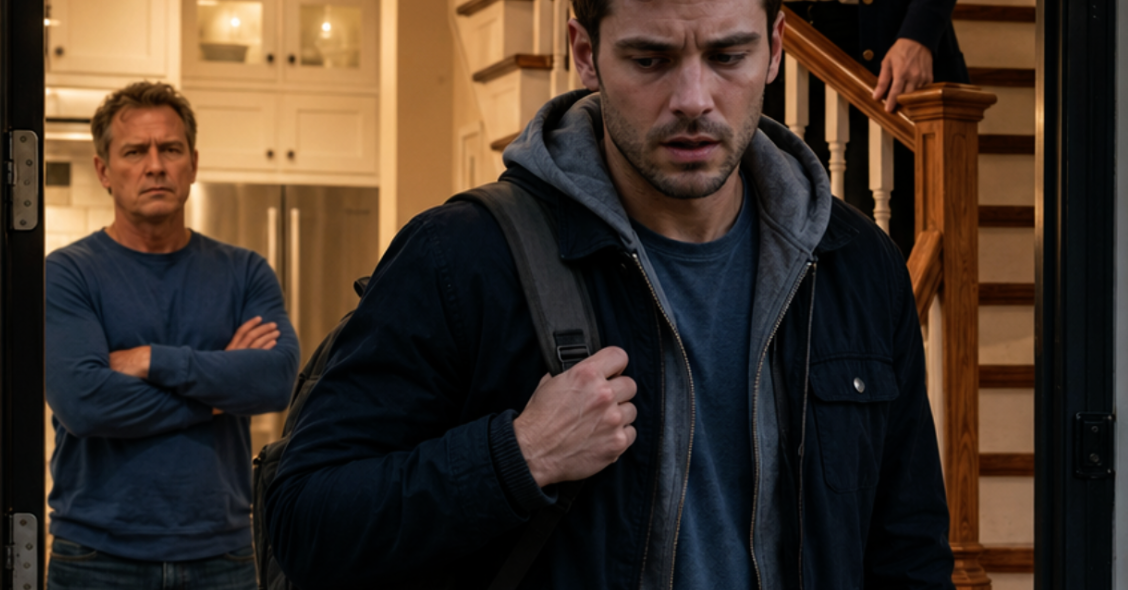
My mother stood at the bottom of the staircase with my suitcase in her hand and delivered a sentence that would permanently alter the geography of our family.
“You’re just a guest in this house, Jake. Know your place.”
Without waiting for a response, she sent the bag tumbling down the steps as if it belonged to an intruder. I looked down at the battered luggage, then at my father, who stood silently behind her like a shadow. Finally, I spoke the one truth none of them were prepared to hear: “Good luck finding another guest who pays your bills.”
For a fleeting second, the entire house went dead still. Overhead, the hallway light buzzed with a faint, electric hum. The antique clock near the kitchen ticked its dry, rhythmic judgment. My black suitcase lay open at the base of the stairs, the sleeve of a white dress shirt hanging out of the zipper like a surrender flag. My mother’s face grew tight—not with regret, but with the indignation of a parent whose child had dared to answer back without an apology. My father simply crossed his arms, staring at me as though I had violated an unspoken, sacred covenant.
I was twenty-six years old, working full-time as a web developer and freelancing deep into the night, and somehow, I had become the antagonist in a household I was actively keeping afloat.
I had moved back to my childhood bedroom six months prior, not out of failure or a need to be rescued, but out of obligation. My father had been laid off from his logistics job of twenty-three years, and my mother’s clinic hours had been abruptly slashed. While their mortgage remained current, the essential pillars of their daily lives—electricity, internet, groceries, insurance—had begun to crumble.
At first, my presence was framed in gratitude. My mother would fold Sunday coupons at the kitchen island and remind me how lucky they were to have me. My father would clap my shoulder as I hauled groceries inside, murmuring his approval. I wanted to believe them. I wanted to believe that family meant passing the burden around the table until everyone could breathe again. So, I took over the utility bills. I put the internet on my credit card. Every Sunday, I bought the premium groceries my mother loved but could no longer justify.
But gratitude is a fragile thing, and soon it curdled into quiet expectation.
It started with small, abrasive comments. My father would notice me on my laptop and casually suggest that “real work happens around the house too.” My mother would spot me eating leftovers late at night and sigh about how nice it must be to keep my own schedule under “our roof.” The groceries I bought with my own money and labeled for my busy workdays vanished overnight, dismissed by my mother with a wave of her hand: “Don’t be selfish, Jake. Food is for the house.”
The house. That phrase became a weapon. It was their roof, their rules, their kitchen. My financial contributions became invisible, treated like oxygen—expected, consumed, and entirely unacknowledged. The final fracture occurred when I politely asked my father to stop using my expensive, work-essential noise-canceling headphones. He accused me of acting like I owned the place.
That Friday, completely exhausted from a grueling week of coding and client meetings, I walked through the front door to find my mother waiting at the stairs, my suitcase already packed. When she told me I was a “guest,” the word washed over me like ice water. Guest meant temporary. Guest meant tolerated.
When she threw the bag down the stairs and my father said absolutely nothing to stop her, the message was clear. I bent down, tucked in the sleeve of my shirt, and zipped the bag closed. I walked past them, packed my car in the dead of night, and drove to a cheap interstate hotel.
The hotel room smelled of cheap disinfectant and stale carpet, and the comforter was paper-thin. But as the ice machine rattled down the hall, I locked the door and realized that, for the first time in months, no one on the other side could demand my obedience while reaching into my wallet.
The next morning, the adrenaline faded, making way for a cold, clarifying anger. Sitting at a wobbly veneer desk, I opened my banking app. Line by line, I reviewed my automatic payments. I paused the electric bill. I canceled the internet autopay. I removed my credit card from the grocery delivery app and revoked access to every shared streaming service. With each confirmation screen, the hotel room felt a little more like the foundation of a life I was finally building for myself.
I did not leave a note, and I did not explain. They had ordered the guest to leave, and the guest had complied.
For an entire week, the silence was absolute. No one called to see if I was safe, or if I had a place to sleep. It was a painful but necessary lesson: my absence only mattered when it interrupted their comfort. I quickly secured a one-bedroom apartment with scuffed hardwood floors and a noisy bathroom fan. It wasn’t perfect, but the afternoon light was golden, and the fast internet was mine alone.
Four weeks later, while debugging a website for a client, my phone screen illuminated.
Dad: The power just got shut off.
There was no greeting. No inquiry about my well-being. It was simply a report from a manager to a subordinate who had neglected a chore. I stared at the text, my thumb hovering over the keyboard, cycling through a dozen angry responses. Finally, I typed the only truth that mattered:
Guess the guest took the electricity with him.
I muted the phone and went back to my code. By sunrise, I had fifteen missed calls—from my parents, my sister Liz, and extended family members who suddenly cared deeply about my existence now that the suburban house was dark. My mother left a scathing voicemail, accusing me of punishing the family and complaining about spoiled food. My father texted to ask if I had “forgotten to pay again,” as if my financial support was a legally binding chore.
When my sister Liz—the golden child who lived two hours away and only visited for holidays—called to tell me I was being dramatic, I looked around my half-empty apartment. My shoes were by the door. My coffee mug sat on my own table.
“I’m not paying bills for people who don’t respect me,” I told her. “This is just the part where everyone notices.”
I blocked their numbers, leaving one final message in the family group chat: I’d rather be a guest in my own life than feel unwanted in yours.
For three weeks, my life settled into a beautiful, quiet rhythm. Work was steady, my clients paid on time, and the groceries I bought stayed exactly where I left them. I learned to appreciate the mundane sounds of my own space. Silence was no longer a punishment; it was a physical comfort.
Then, on a rainy Sunday afternoon, an email arrived that shattered the peace: Urgent Notice Regarding Defaulted Account.
It was from the electric company. At first, I assumed it was a clerical error regarding my new apartment. But the address listed in the stark, formal text was my parents’ house. Because I had originally set up the account in my name to save them from late fees, simply canceling my credit card autopay wasn’t enough. The overdue balance, the mounting penalties, and the looming threat of collections were all legally tied to my name.
I called customer service immediately. A polite representative named Patrice explained the harsh reality of the system: until the current residents signed a change of responsibility form, the debt would continue to anchor itself to my credit score. My parents were perfectly willing to sit in the dark and let my name absorb the financial ruin.
My anger shifted from emotional to intensely practical. I walked to a local print shop, printed the transfer of responsibility form, and placed it inside a manila folder with the overdue notices. Then, I drove back to the neighborhood I had abandoned.
The pristine, manicured lawns and familiar cracked driveways felt insulting in their normalcy. When my mother opened the door, she looked smaller, but her posture was immediately defensive, her arms crossed tight against her chest.
“What do you want?” she demanded.
I held up the folder. “You need to sign the utility transfer form. The electric account is still under my name. You live here. You use it. You need to take responsibility for it.”
She refused, demanding I explain my “attitude” first. She still believed that my compliance was a toll I had to pay before basic fairness could be granted. Behind her, my father appeared in the hallway, looking unkempt and tired. He told me I didn’t have to make things so hard.
“I made it fair,” I replied, my voice remarkably steady. “You want lights, internet, groceries? Pay for them. That’s what adults do.”
I placed the manila folder on the welcome mat between us. I informed them that if they didn’t sign it, I was sending the company written notice, and every subsequent collection agency call would include a documented paper trail of their refusal. I walked away as my mother called my name, refusing to look back.
A week later, a confirmation email arrived. The account had been transferred. They had signed it.
I assumed the paperwork was the end of it, until my cousin Sarah texted me the day before Easter. She warned me that my mother was spreading rumors, not just about me, but about Zoe—our quiet, nineteen-year-old cousin who was navigating her first year of college. According to my mother’s new narrative, Zoe had borrowed a large sum of money from them, causing their recent “financial strain.”
The pattern became glaringly obvious. Without me to serve as the ungrateful scapegoat, my mother needed a new target to absorb the blame for their empty bank accounts. Zoe was young, polite, and deeply vulnerable.
The next morning, I drove to Aunt Dana’s house for Easter brunch. The backyard was a pastel-colored illusion of harmony—Costco fruit trays, plastic eggs, children running near the fence, and adults aggressively pretending everything was fine. When I walked in, the ambient chatter noticeably dipped.
I ignored my parents and found Zoe sitting alone at a small table near the fence, looking small and defeated. She confirmed the rumors, her voice trembling as she admitted that no one in the family had bothered to ask her for the truth; they simply nodded along with my mother’s lies.
Watching my parents casually sip orange juice and flip burgers while destroying a teenager’s reputation was the final catalyst. I stood up, walked to the dessert table, and picked up a cake knife.
Clink. Clink.
I tapped the knife against a glass plate. The yard slowly fell silent as every eye turned toward me. My body wanted to retreat, but looking at Zoe gave me the necessary anchor.
“I know we don’t usually do speeches at Easter brunch,” I began, my voice projecting clearly across the manicured lawn. “But since so many stories have been passed around lately, I figured it would be useful to let the people inside those stories speak for themselves.”
My mother froze. My father stopped mid-flip at the grill.
I laid out the undeniable facts. I told the family exactly why I left: because I was called a guest while funding their lives, and because my suitcase was thrown down the stairs. I explained how I had paid for their electricity, internet, and groceries, and how they had allowed the overdue utility bills to damage my name until I forced them to sign the transfer papers.
“This is private family business!” my mother hissed, her face flushed with panic.
“Then maybe private family business shouldn’t have been turned into public gossip,” I shot back.
I gestured for Zoe to join me. She walked over, pale but holding her head high. I dismantled the lie completely, stating clearly that Zoe had never borrowed a dime from my parents, nor had she stayed with them. My cousin Sarah spoke up from the patio steps, validating Zoe’s alibi.
The atmospheric pressure in the yard fundamentally shifted. The family stopped looking at me as a rebellious problem and began looking at my parents as the actual architects of the chaos. My father tried to deploy his old, authoritative tone, telling me, “Enough, Jake.”
I looked him dead in the eye. “That’s exactly what I said when I left.”
I grabbed a paper plate, took a slice of quiche, and reminded my mother that when she threw me out, it wasn’t exactly the “time or place” either. Then, I sat back down with Zoe. The brunch limped to a quiet, awkward conclusion, but the wall of my parents’ absolute authority had permanently cracked.
My parents and I did not speak after that Easter. Updates reached me through the usual family grapevine: my father was forced to pick up part-time consulting work, and my mother had to take on extra shifts at a different clinic. The house didn’t collapse; they simply had to carry the weight they had so comfortably placed on my shoulders.
In July, my sister Liz finally texted me. I didn’t know about the suitcase, she wrote.
Now you do, I replied. Days later, she sent a genuine apology for calling me dramatic. I accepted it, but I did not invite her back into the inner circle of my daily life. I was finally learning that extending forgiveness did not require leaving your front door wide open.
By the time autumn arrived, my apartment had transformed from a temporary refuge into a permanent sanctuary. I bought a comfortable couch, hung heavy bookshelves, and placed the ceramic mug my grandmother gave me—the one that read Build Something Good—squarely on my desk. My black suitcase sat safely in the closet, repaired with a new zipper. I kept it not as a monument to trauma, but as a reminder of the exact moment I stopped negotiating for my right to exist.
One rainy Thursday evening, Zoe came over after her new shift at a local bookstore. We sat on the floor by the coffee table, eating takeout noodles and talking about her classes and my demanding freelance clients. Looking around at the warm lamps and thriving houseplants, she smiled.
“This place feels peaceful,” she noted.
“It is,” I agreed. For the first time in my adult life, family felt like two people sharing a meal in a room where neither of us had to earn our right to a chair.
Later that night, after Zoe had gone home, I sat at my desk and opened my banking app. I watched the numbers. My rent was cleared. My internet was paid. My electricity was current. Every single dollar leaving my account was funding a life that belonged entirely to me. I hadn’t abandoned my family; I had simply stopped allowing them to confuse my generosity with their ownership.
I thought back to my mother’s furious declaration at the bottom of the staircase: You’re just a guest in this house.
For months, the sentence had felt like a brutal rejection. But standing in the quiet of my own living room, listening to the rain against the glass, it finally felt like a key turning in a lock. Perhaps I had always been a guest there. Perhaps the true mistake was believing that belonging could ever be purchased by paying the bills for people who viewed gratitude as strictly optional.
I turned off the kitchen light and checked the deadbolt on my own front door. No one was calling my name from down the hall. No one needed my money to keep the lights on. No one made my peace feel like a borrowed commodity.
I was not a guest anymore. I was home.