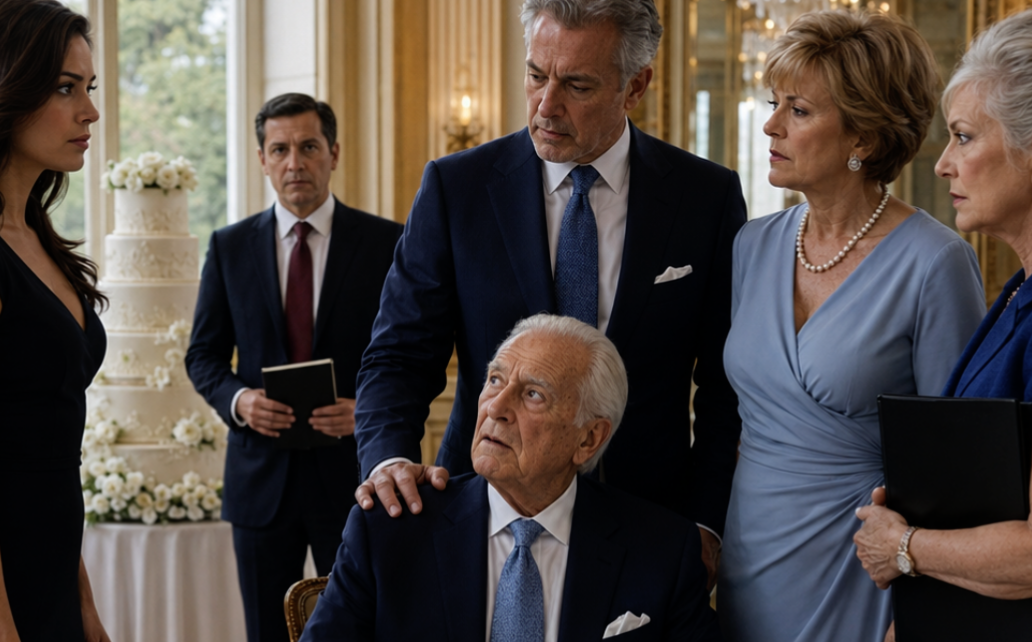
My mother placed a heavy gold pen into my grandfather’s trembling hand while the eight-tier birthday cake sat untouched in the center of the grand ballroom.
For a lingering moment, the entire room seemed to hold its breath. The jazz trio had already migrated out to the gardens, drawing the majority of the party guests with them. Champagne glasses caught the fractured light of the chandelier, glittering like scattered diamonds on the long linen-draped table. The white roses—flawless, scentless, and imported from three counties away—leaned elegantly in their silver vases. Across the expanse of the ballroom, the magnificent cake stood beneath a halo of unlit candles, its sugar-spun flowers appearing almost too delicate to bear the weight of the occasion.
Grandpa Arthur sat anchored at the head of the table. He was dressed in a stifling navy suit he had not selected himself, the collar pressing uncomfortably high against his throat. His left hand rested palm-up on the tablecloth, plagued by a faint, rhythmic tremor. Meanwhile, my mother masterfully curved her elegant fingers over his right hand, physically guiding the golden pen toward the signature line of a thick, imposing document encased in a cream-colored folder.
“Just a routine update, Daddy,” she murmured, her voice laced with a practiced, silken softness. “It keeps everything beautifully simple.”
My father stood directly behind her, playing his part to perfection. One hand rested casually on the back of Grandpa’s chair, while the other was tucked neatly into his jacket pocket. Richard Whitmore always looked remarkably composed whenever there were witnesses present. He had spent his entire adult life wearing calm like an expensive, imported watch—something polished and gleaming, designed specifically to distract observers from whatever terrible toll it was actually measuring.
Beside the closed double doors leading to the garden, a notary in a dark, nondescript suit waited silently, a wooden stamp case tucked securely under one arm.
I stood frozen near the mahogany sideboard, my hands wrapped so tightly around a crystal glass of ice water that my fingers ached. I had not taken a single sip. My name is Cressa Whitmore. I was thirty-four years old that summer—certainly old enough to comprehend the mechanics of family greed, yet apparently still young enough to be utterly paralyzed by the sheer elegance with which it could be executed.
My parents had spent the entire afternoon basking in adulation. They were receiving endless praise for throwing Arthur Whitmore the kind of opulent eightieth birthday celebration that the town’s elite would discuss for a decade. It was a masterpiece of staging: a string quartet playing at the entrance, live jazz floating through the garden, a renowned chef carving prime rib on the stone terrace, and an endless flow of champagne passed by servers in crisp white jackets. The guest list was a meticulously curated collection of wealthy neighbors, hospital donors, old family friends, and half the town’s most comfortable, complacent smiles.
To everyone else milling about the lawn, it looked like the ultimate display of filial devotion.
To me, it looked like a trap.
To understand the gold pen, you have to understand the two weeks that preceded it. Before this sudden burst of extravagant affection, my parents had barely visited my grandfather at all.
Grandpa Arthur was the sole owner of Whitmore House, a sprawling, historic estate perched on the edge of Charleston. It was tucked away behind towering iron gates and ancient, sprawling magnolia trees. The estate boasted pale brick walls, deep wraparound porches, and a ballroom commissioned by a great-grandfather who firmly believed that every family required a space large enough to pretend they were far happier than they actually were. The house sat on prime acreage that relentless real estate developers had been circling like vultures for years.
Grandpa had steadfastly refused every single offer. He frequently told me that houses like this were not financial prizes to be liquidated; they were memory crowned with a roof.
My parents, however, did not see memory. They saw a lifeboat. Specifically, they saw their own financial rescue.
For the better part of two decades, Richard and Eleanor Whitmore had lived under the delusion that impeccable taste could somehow mathematically cover catastrophic debt. Their lives were a hollow shell of leased luxury cars, exclusive country club dues, towering dinner accounts, and a beachfront condominium they perpetually referred to as an “investment property,” even long after the meager rental income failed to cover the exorbitant mortgage payments.
My mother’s high-profile charity luncheons and designer wardrobe, coupled with my father’s endless string of “business ventures” that arrived with glossy, high-end brochures but inevitably left behind quiet, threatening invoices, had drained them. They were not broke in the way ordinary, hardworking people are broke. They were dangerously overextended in gilded rooms where everyone still complimented the polish on their silver.
Grandpa Arthur saw right through their facade. That was precisely why they generally avoided him, making contact only when they required the use of his esteemed name, his checkbook, or the aristocratic backdrop of his house for a family holiday photograph.
Then, quite suddenly, they became suffocatingly attentive.
They began calling the estate every single day. They loudly lamented to anyone who would listen that he seemed “tired.” They insisted he needed constant, vigilant supervision. They whispered that the historic estate was simply too much of a burden for a man of his advanced age.
I had noticed a change in Grandpa too, and it terrified me. He had always been fiercely sharp, even approaching his eightieth year. He was the kind of man who might forget where he left his gardening shears, but never the details of a complex conversation. He might mix up the time of a dental appointment, but he never forgot a person’s face.
But that month, a heavy, unnatural drowsiness settled over him. It did not feel like the natural progression of age. His bright eyes often looked entirely clouded by noon. He began sleeping through important phone calls. He entirely forgot a lunch date we had planned for weeks and then apologized to me twice in the exact same minute.
When I finally confronted my mother and demanded to know what his primary physician had said, she simply waved a manicured hand in the air.
“Old age is not a medical mystery, Cressa,” she chided. “It happened much too fast,” I argued. “You always dramatize illness because you cannot stand being out of control.”
That was my mother’s greatest, most toxic gift: the ability to seamlessly twist genuine concern into a personal character flaw.
I pushed aggressively for professional, in-home help regardless of my mother’s dismissals. That was how Elena Morris crossed the threshold of Whitmore House.
Elena was a highly credentialed, licensed geriatric nurse personally recommended by Grandpa’s longtime primary physician, Dr. Hadley. She was a quiet, observant woman in her mid-fifties, with striking threads of silver woven through her dark hair and a serious, measured expression that naturally made people speak much more carefully than they originally intended. She wore simple, unadorned navy scrubs and soft-soled shoes.
Crucially, she did not flatter my mother. She did not laugh at my father’s forced, charming jokes. Upon entering the home, she introduced herself directly to Grandpa first, pointedly ignoring the rest of the room, and respectfully asked whether he preferred to be addressed as Arthur or Mr. Whitmore.
“Arthur,” he had said with a faint smile. “Arthur, then,” she replied firmly.
My mother despised her instantly.
“The woman has absolutely no warmth,” Eleanor complained to me later in the vast kitchen, dramatically lowering her voice as if Elena were not simply in the adjacent sitting room helping Grandpa sort out his afternoon medication. “You would think she was a federal agent auditing us.”
Within forty-eight hours of Elena’s arrival, I completely understood why my mother felt as though she were being audited. Elena possessed a terrifyingly meticulous attention to detail. She noticed absolutely everything.
She began her tenure by rigorously checking the various prescription medication bottles clustered under the brass reading lamp near Grandpa’s favorite leather armchair. She methodically cross-referenced every single faded label against a freshly printed, official medical directive she had obtained directly from Dr. Hadley’s clinic.
Elena documented everything in a small, black leather ledger that she kept securely tucked in the pocket of her scrubs. I watched her discreetly photograph specific dosage times with her smartphone, always operating quietly, and always ensuring she had Grandpa’s explicit, coherent permission before doing so.
One terrible afternoon, I found Grandpa sitting alone in the sunlit conservatory, staring blankly at a small, plastic tray of sorted pills.
“Grandpa?” I asked softly. He looked up at me, his movements heartbreakingly slow. “These… these look different,” he whispered. I stepped closer, my heart pounding. “Different how?” He shook his head, a profound frustration contorting his features. “I cannot catch the thought.”
That single, devastating sentence anchored itself in my mind. He didn’t say, I forgot. He didn’t say, I am confused. He said, I cannot catch the thought. It was as if his brilliant mind was still entirely intact, but it was being forced to wade through a thick, artificial fog that someone else had deliberately pumped into the room.
The night before the grand birthday gala, sleep completely evaded me. My apartment was only twenty minutes away, but that geographic distance felt absurdly dangerous while Grandpa sat isolated in that massive house, surrounded by my parents who were orbiting him like incredibly careful, well-dressed vultures.
I drove over at midnight without calling ahead. The winding road leading to Whitmore House curved darkly under ancient oak trees, their massive branches heavy with weeping Spanish moss.
I knocked softly on the heavy oak door. No answer. I tried the handle; it was unlocked. The door creaked open a few inches, revealing Grandpa standing in the dimly lit foyer in his robe. He was pale, trembling violently, and gripping the heavy doorframe for physical support.
“Cressa,” he breathed, his voice laced with a primal fear I had not heard since I was a frightened child hiding from summer thunderstorms. He pulled me inside with a sudden, desperate strength. “The study,” he commanded in a harsh whisper. “Now.”
We slipped into his old, dark-wood study, leaving the heavy door open just a fraction of an inch. A moment later, the sharp, unmistakable click of my mother’s designer heels echoed from the grand staircase, followed closely by the low, rumbling baritone of my father’s voice. They descended the stairs together, moving not like concerned adult children checking on an ailing, beloved parent, but exactly like two ruthless corporate partners reviewing a hostile takeover strategy.
“Tomorrow, directly after the garden toast,” my father instructed coldly. “The guests will naturally move outside toward the jazz band. The notary comes in through the side hall. We keep the entire transaction under ten minutes.” “I’ll tell him it is merely a routine healthcare management update,” my mother replied, her tone terrifyingly smooth. “He only needs to sign exactly where we mark.” “He will.” “And if Cressa decides to hang around?” “She will not. I’ve already instructed Aunt Lydia to keep her occupied with the university alumni group during the toast.”
I pressed both hands forcefully over my mouth to stifle my own breathing.
“Once the deed transfer is legally recorded and notarized,” my father continued, “we can begin immediately discussing maintenance cost liquidation, commercial sale options, or a favorable trust adjustment. But the property has to be completely in our legal control first.” “Arthur will not understand enough of the paperwork to object,” my mother assured him.
When their footsteps finally faded toward the distant dining room, I turned to Grandpa. He was weeping silently. I reached for the evening pill organizer my mother had personally filled after dismissing Nurse Elena for the evening. I stared at the mismatched, unfamiliar capsules resting in the Tuesday slot.
“I’m calling Elena,” I said.
I drove three blocks away before dialing her number, terrified the house itself was listening. Elena answered on the second ring and listened to my frantic, shaking explanation of the deed transfer, the notary, and the horrifying plot to use the party as a chaotic smokescreen.
“I suspected a legal document was in play,” Elena responded, her voice completely devoid of panic, vibrating with absolute, terrifying control. “I just did not know the exact timing.”
She then revealed the contents of her black ledger.“We do not confront them tonight,” Elena instructed. “We keep Arthur safe. We keep the medical record pristine. Tomorrow, Cressa, you must act completely normal. Let their fraudulent paperwork meet our legitimate paperwork.”
The next afternoon, Whitmore House was transformed into a glittering stage set. By four o’clock, the sweeping circular driveway was jammed with polished luxury vehicles and hired valet attendants darting about in black vests.
I tried desperately to act normal. I greeted distant cousins with a tight smile. I thanked wealthy guests for attending. I accepted a tall flute of vintage champagne and held it for three hours without taking a single sip. At exactly six o’clock, my mother triumphantly tapped her crystal glass with a silver spoon.
“Everyone!” she announced, practically glowing with counterfeit joy. “We are now going to move out into the beautiful garden for some live music and the family toast before we cut the cake!”
The guests happily drifted through the grand double doors. The ballroom emptied precisely as my parents had meticulously orchestrated. The only people remaining in the vast room were my parents, Grandpa, Elena, the hired notary, me, and my father’s nervous assistant holding a cream-colored folder.
My father calmly walked over and closed the heavy garden doors.
“Arthur,” my mother chirped brightly, gliding toward the table. “Before we go out and cut that massive cake, we just need one tiny signature. Just some tedious administrative housekeeping.”
She opened the folder, revealing the heavily legalistic document, and pressed the heavy gold pen into his trembling fingers.
“Just sign right where Eleanor has marked the tab,” my father commanded from behind the chair.
Grandpa looked down, his foggy eyes struggling to focus on the dense paragraphs. His hand, heavy with the gold pen, moved agonizingly slowly toward the signature line.
Then, Elena stepped forward.
She reached out, placed her bare hand flat over the center of the legal document, and forcefully slid it away across the mahogany table before the gold nib could even touch the pristine paper.
“No,” she said.
The single syllable wasn’t shouted. It didn’t need to be. It struck the quiet ballroom like a physical blow.
My father’s face flushed a deep, violent crimson. “Excuse me?” Elena kept her hand firmly planted on the folder. “Mr. Whitmore cannot legally sign this document under these medical conditions.” My mother’s radiant smile vanished so instantly it looked as though someone had severed a wire in her jaw. “You are a hired nurse here to assist with physical care, not to brazenly interfere with private family decisions.” “Protecting his cognition is care,” Elena replied smoothly.
Elena calmly reached into her navy scrub pocket and withdrew the battered black leather ledger, setting it on the table. Beside it, she placed a thick, sealed medical envelope bearing the crest of Dr. Hadley’s clinic.
She turned her gaze to the wide-eyed notary. “Before you affix your state seal to any signature in this room, you should be legally aware that Arthur’s physician has provided a sworn, written medication reconciliation dated at eight o’clock this morning. It exhaustively documents serious, deliberate discrepancies between this patient’s current pill organizer and his active medical requirements. The authorities at the medical board have been notified.”
My mother lunged toward the table. “That is highly protected, private medical information!” “Arthur gave his explicit consent to share it,” Elena countered. Grandpa looked up then. His voice was faint, but entirely clear. “I did.”
Before my parents could recover, the side door of the ballroom clicked open. Graham Whitaker, Grandpa’s notoriously ruthless, longtime estate attorney, stepped into the room. Behind him stood Mrs. Bell, Grandpa’s fiercely loyal neighbor, clutching a manila folder to her chest like a shield.
Graham did not mince words. He slapped his own folder onto the table. “Arthur called me four days ago, deeply concerned about aggressive pressure regarding the deed to this house. We immediately drafted a temporary legal instruction requiring any major estate action to be independently reviewed by both his physician and his legal counsel. Mrs. Bell witnessed it.”
The hired notary instantly stood up, his professional demeanor crumbling into sheer panic. “I was explicitly told this was a routine healthcare update. I will absolutely not proceed with this notarization.”
He grabbed his wooden stamp case and practically ran out the side door.
My father tried to salvage the burning wreckage. “Everyone is getting absurdly dramatic. Arthur is just tired. We can revisit these minor estate details privately.” “No,” Grandpa said.
The word belonged to him this time. It was soft, but it carried the immovable weight of an anvil.
Graham adjusted his reading glasses and delivered the final blow. “Arthur has instructed me to immediately revoke your access to the estate, all financial accounts, and all household decision-making. Until the criminal medication tampering issue is formally resolved by the authorities, Nurse Morris will maintain absolute oversight of his care, and Cressa will act as his sole family proxy.”
My father looked frantically toward the closed garden doors. Beyond the glass, the oblivious guests were laughing, entirely unaware that inside the elegant ballroom, the masks had violently melted off the faces of their gracious hosts.
We did not make a grand, dramatic announcement to the party that night. Graham and Elena firmly agreed it was better not to transform an eightieth birthday into a public, humiliating spectacle. The guests eventually returned, the candles were lit, and Grandpa blew them out while my parents stood frozen, their faces arranged in carefully painted, hollow expressions of defeat.
Over the next several weeks, isolated from my parents’ toxic influence and free from the heavy sedatives they had been secretly feeding him, Grandpa’s mind cleared beautifully. The fog evaporated.
Graham completely restructured the estate plan. My parents were legally excised from every single aspect of his life and finances. Grandpa then made a decision that shocked the entire city: he sold Whitmore House.
He didn’t sell it to the greedy developers, nor did he leave it to my parents. He sold the entire estate to a prominent historical preservation foundation under a strict charter.
“I am completely exhausted from guarding a monument, Cressa,” Grandpa told me one bright morning. “I would much rather spend my remaining time living in a home.”
He purchased a charming, light-filled cottage near the coastal marshes of Beaufort. It had a wide screened porch and a small kitchen he could easily navigate. I drove down every single weekend to sit with him, drinking black coffee while we watched the white egrets pick their way elegantly through the tall marsh grass.
He lived three more wonderful, quiet years in that little cottage. When he finally passed away, it was utterly peaceful. There was no grand ballroom. There was no expensive champagne. There were no hidden, sealed folders waiting to trap him in his most vulnerable moments. It was just me holding his warm hand, with Elena sitting vigil nearby, listening to the coastal wind move through the reeds.
At the formal reading of the final will, Graham handed me a sealed envelope. Grandpa had written my name across the front in his elegant, slanted handwriting.
Cressa,
You came to the door when the room was entirely quiet. You actively listened to the truth while everyone else was busy performing for an audience. Do not ever confuse financial inheritance with a moral reward. The only meaningful thing I ever truly wanted to leave you was the absolute freedom and ability to choose a peaceful life—one where you never have to beg anyone to call it family.
Arthur.
I sat alone in my car in the law firm’s parking lot and wept for a long time. I didn’t cry for the loss of a grand estate, or for the money in the trust. I cried because, in a family entirely blinded by greed, my grandfather had truly seen me.
There are critical, agonizing moments in life when a fractured family does not need yet another screaming argument. It doesn’t need a compromise, and it doesn’t need forced reconciliation. It needs a permanent, undeniable record. It needs an unblinking witness. It needs someone brave enough to reach out and stop the golden pen before the dark ink can make a devastating lie look official.
My parents truly believed that the historic house was finally theirs that night. They were entirely wrong. The sprawling estate was never the actual inheritance. The real inheritance was my grandfather’s final, crystal-clear lesson: genuine love does not violently guide your hand toward a signature you cannot comprehend.
Love pulls the paper away.