The Grand Meridian Hotel dominated the Seattle skyline, standing as a masterclass in quiet luxury and architectural restraint. Its pale stone façade caught the afternoon light in crisp, deliberate angles, functioning as a physical rebuke to the fleeting, ostentatious trends of modern hospitality. Inside, the lobby was a symphony of old-world affluence: soaring ceilings, vast expanses of meticulously polished marble, and crystal chandeliers that cast a warm, golden glow over the white roses and champagne flutes below. I knew every functional and aesthetic inch of this building. I knew the structural integrity of the load-bearing columns, the specific acoustic dampening layered behind the silk wall panels, and the exact thread count of the Egyptian cotton upstairs. Over the past four years, I had overseen its painstaking restoration from a decaying, forgotten relic into one of the West Coast’s most exclusive properties.
Yet, to the guests mingling around the grand staircase, and most notably to my own family, I was simply Eleanor Anderson: the struggling, eccentric older sister who drove a battered Honda, resided in a modest Capitol Hill apartment, and wore a practical navy dress purchased on clearance three years prior. To anyone watching, I possessed none of the markers of success.
The lie, of course, was not that I had failed. The lie was that I had ever owed them a performance of success.
My family, particularly my mother’s side, adhered to a strict, theatrical definition of wealth. To them, prosperity was not a quiet state of security; it was a loud, constant broadcast that demanded validation through the envy of others. It lived in the right zip codes, drove the right European cars, and could be summarized in a single, impressive sentence over expensive cocktails. My younger sister, Victoria, was their crowning achievement in this regard. Today was her wedding day, a heavily mortgaged spectacle designed to prove to Seattle society that she had finally secured her place in the upper echelons.
“Eleanor?” The voice was sharp, cutting effortlessly through the low murmurs of the string quartet rehearsing by the east windows. My cousin Patricia stared at me, her eyes wide, looking as though I had tracked mud across a sacred altar.
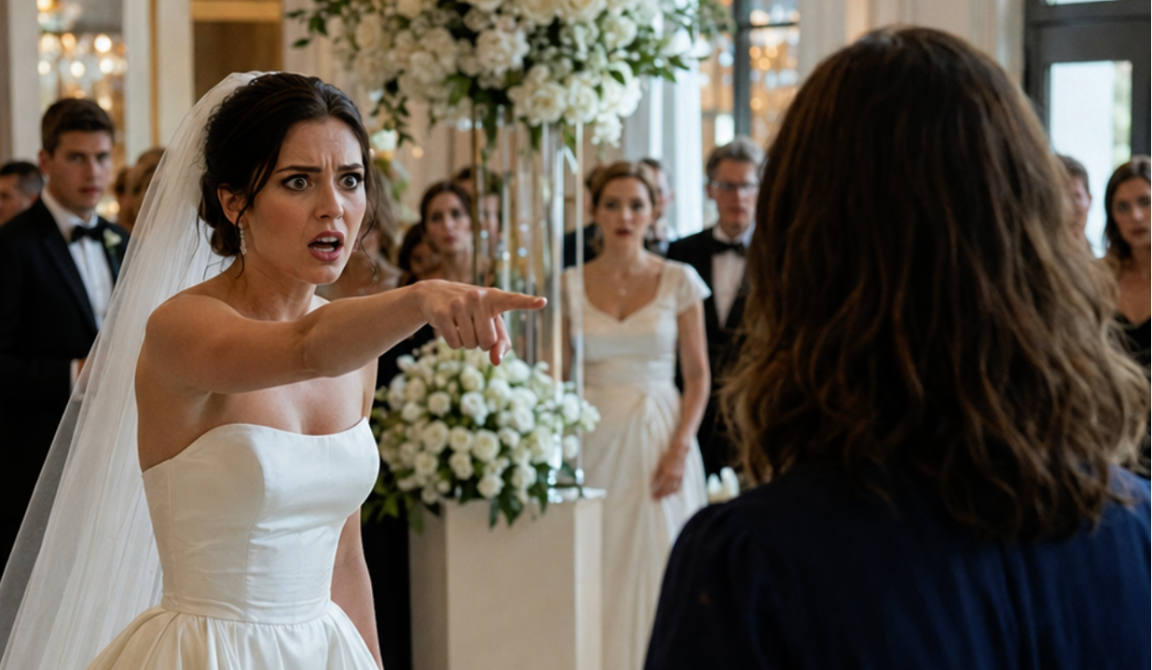
Before I could formulate a polite, noncommittal greeting, Victoria descended the grand staircase in a cascading cloud of white organza, radiating theatrical certainty. “Well, well,” she announced, her voice perfectly engineered to carry. “Look who decided to crash the wedding.”
She swept her gaze over my unassuming attire with practiced disdain. “She can’t even afford a room here. I specifically left her off the guest list for a reason.”
My mother materialized beside her, her face settling into a familiar mask of calculated disappointment—an expression curated to suggest my existence exhausted her, but no longer surprised her. “Victoria, darling,” my mother said, placing a manicured hand on the bride’s arm. “Don’t let her ruin your special day. Security can handle this.”
As if on cue, the family instinctively arranged themselves into their well-rehearsed phalanx of judgment. Victoria stood at the epicenter, the aggrieved and glowing bride; our mother flanked her, supplying moral permission for cruelty; aunts and cousins formed the perimeter, eager spectators to my perennial unsuitability.
“Do you have any idea how embarrassing this is?” Victoria hissed, stepping closer. The enormous diamond on her finger caught the chandelier’s light as she gestured wildly. “This is the Grand Meridian. The most exclusive venue in the city. I spent three years on a waiting list to book this room, and you show up looking like that? You didn’t attend my engagement party, my showers, or my bachelorette weekend. You have never supported me.”
“I wasn’t invited to those, either,” I pointed out evenly.
“Because you humiliate us!” she cried, abandoning any pretense of volume control. “Look at you. Thirty-four years old, no husband, working some vague job you can’t explain, probably still driving that ancient car Dad left you. Marcus and I just ordered matching Teslas, Eleanor. And you bring your reliable Honda to my wedding?”
A security guard, summoned by my mother’s frantic gesturing to the concierge, approached with professional unease. “Ma’am,” he said, addressing me. “If you aren’t a registered guest or on the event list, I’m going to have to ask you to leave the premises.”
“On whose authority?” I asked, keeping my voice remarkably calm.
“On mine,” Victoria snapped. “I am the bride. This is my venue, and you are trespassing.”
I stood perfectly still, hands clasped loosely in front of me, letting the immense weight of their assumptions settle over the marble floor. The urge to retreat into the anonymous safety of the city was a familiar, well-worn instinct. But I was deeply tired of shrinking to accommodate their narrow, performative understanding of the world.
“Actually,” I said, my gaze shifting smoothly past Victoria’s shoulder, “I believe the general manager is already on his way.”
Every head in our immediate circle pivoted toward the elevator bank. Jonathan Wright, the Grand Meridian’s impeccably tailored general manager, was crossing the lobby with the swift, decisive gait of a man trained to neutralize corporate catastrophes before they fully materialized. Jonathan and I had spent the better part of four years transforming this property. We had shared late-night coffee over complex spreadsheets, negotiated arduous union contracts, and meticulously curated a brand ethos centered firmly on substance over spectacle. He was discreet, exacting, and fiercely loyal.
“Is there a problem with the Henderson wedding preparations?” Jonathan asked, his sharp eyes scanning the tense, defensive circle of my relatives.
“Yes,” Victoria demanded, stepping forward with renewed authority. “This woman is my sister, unfortunately, but she is absolutely not welcome here. She is trespassing. I want her removed immediately.”
Jonathan turned slowly to face me. For a fraction of a second, his expression remained deliberately, professionally neutral. Then, his eyes silently asked the question he knew better than to ask aloud. How would you like this handled?
“Ms. Anderson,” he said carefully, his voice carrying with crisp clarity across the suddenly quieted lobby. “How would you like us to handle your family’s reservations?”
The silence that followed was absolute. It was the kind of quiet that strips the oxygen from a room, heavy and terminal. My mother’s designer credit card slipped from her fingers, hitting the polished marble with a sharp clatter that echoed like a gunshot.
“I’m sorry,” Victoria stammered, the aggressive color completely draining from her cheeks. “What did you just call her?”
Jonathan looked genuinely, politely perplexed by their confusion. “Ms. Eleanor Anderson. The owner of this hotel.”
“That’s impossible,” Aunt Margaret blurted out, her voice shrill with disbelief. “Eleanor has nothing. She lives in a tiny apartment on Capitol Hill. She drives a Honda.”
“I do drive a Honda,” I corrected gently. “It was my father’s car, and it holds tremendous sentimental value. But Jonathan is correct. I own the Grand Meridian, along with seven other commercial properties in the Anderson Hospitality portfolio.”
“Eight properties,” Jonathan amended smoothly. “We officially closed on the San Francisco acquisition last month. Congratulations again on that, by the way.”
Victoria collapsed into a nearby velvet chair, her lavish gown pooling around her in a defeated, deflating heap. “This is a prank. This has to be a joke. Dad was a failure. He left you nothing but boxes of old papers.”
I reached into my practical leather handbag and withdrew the worn, heavily annotated journal I had carried for nearly a decade. “He left me his real estate portfolio. Twenty-three properties he quietly acquired, renovated, refinanced, and managed over thirty years. He built a quiet empire while this family was busy curating public images and worrying about dinner party gossip.”
I opened the journal, revealing my father’s meticulous handwriting—a masterclass in long-term strategic vision, sustainable growth, and compounding value. “He didn’t need to announce his success to anyone. He built something real, something enduring. When he knew his illness was terminal, he spent his final year teaching me how to govern and protect it.”
“Why you?” Victoria whispered, a raw, painful envy bleeding through her state of shock. “Why not me? Or Mom?”
“Because,” I said, softening my tone because the truth was brutal enough on its own, “he knew you would liquidate the assets to finance a lifestyle of depreciating liabilities. He wanted to build generational wealth, to create jobs, and to sustain a legacy rooted in quiet luxury and actual value. He didn’t want his life’s work turned into designer handbags and temporary vacations.”
My mother stared at the journal as if it were a sacred artifact from a civilization she had completely misunderstood. “Richard said that?”
“He loved you, Mom. He loved all of us. But he saw the truth about how this family operates.”
Jonathan politely cleared his throat, sensing the atmospheric shift. “Would you like me to clear the lobby, Ms. Anderson? Or perhaps I should call the event coordinator and accounting?”
“Accounting, please,” I replied. “Let’s review the ledger.”
When the accounting manager arrived, laptop in hand, the financial reality of Victoria’s dream wedding was laid bare in sterile spreadsheet cells. The running total was staggering, creeping dangerously into the mid-six figures. Venue rental, bespoke catering, ceiling-suspended floral installations, premium bar packages, live music coordination, and a litany of last-minute upgrades my mother had hastily authorized, assuming the illusion of endless capital would somehow manifest the reality of it.
“Who is responsible for payment?” I asked.
“The initial deposit was paid by the groom,” the accountant stated. “Subsequent charges, including today’s twelve-thousand-dollar floral upgrade, have gone to Mrs. Patricia Henderson’s card.”
I turned to my mother, who was staring at the floor, suddenly looking incredibly fragile and much older than her sixty-two years. “Mom, can you actually afford this?”
Her silence was a devastating confirmation. They were plunging into catastrophic debt to fund a single evening of performative grandeur, terrified of losing face in front of people who did not truly care about them.
I looked back at the accountant. “Transfer all current and future charges for the Henderson wedding to my personal account. Past, present, and everything that arises through the end of the reception tonight.”
My mother let out a small, fractured sound—half gasp, half sob. Victoria stared at me, her defensive posture completely crumbling into a profound, complicated shame. “You don’t have to do that,” she whispered, her voice barely audible over the lobby music.
“I know I don’t,” I said, meeting her eyes. “Consider it my wedding gift. But I do have conditions.”
In our family, generosity had always been highly transactional. It was a weapon used for leverage and control. But I was my father’s daughter, and my conditions were not about manipulation; they were about forcing the radical transparency and accountability my father had always craved.
“First,” I said, “I want a formal invitation to this wedding. Not reluctant toleration. Second, I want a seat at the main family table during the reception. And third, starting today, we begin having honest conversations about Dad, about his legacy, and about why you all decided I was a tragic failure without ever bothering to ask what I was actually doing with my life.”
The weight of my words settled heavily over them. “I spent eight years executing a massive corporate strategy, expanding a commercial portfolio, preserving architecture, and navigating complex acquisitions. And not once did any of you ask how I was doing, because I didn’t fit your aesthetic criteria for success. You measured me by your standards and found me wanting, without ever considering I was playing an entirely different game.”
Victoria stood up, tears finally spilling over her meticulously applied, highly expensive makeup. “You’re right. I was awful to you. I dismissed you, and you didn’t deserve any of it.”
“No,” I agreed calmly. “I didn’t. But I’m not doing this to extract an apology, Victoria. I’m doing this because I want a real family, not just a collection of relatives who tolerate me when they have to.”
The tension finally broke. Victoria stepped forward and threw her arms around me, burying her face in my shoulder like the terrified little girl who used to seek shelter in my bedroom during thunderstorms. When we parted, my mother embraced me, whispering her own frantic, tearful apologies into my hair.
The rest of the day operated on a surreal, elevated frequency. I checked into a standard suite—eschewing the penthouse to prove a quiet point about restraint—and changed into a suitable dress for the evening. When I descended to the ballroom, the familial atmosphere had irrevocably shifted.
The wedding was spectacular, a flawless execution of high-end event management, but the true transformation occurred at the family table. The careful, dismissive distance was gone. Relatives who had spent a decade treating me like a cautionary tale now approached me with a newfound, tentative respect. Uncle Gerald asked brilliant questions about adaptive reuse in commercial real estate; cousin Patricia inquired about hospitality management.
During the toasts, Victoria stood before her hundreds of guests. She thanked her new husband, Marcus, and our mother. Then, she raised her champagne flute and looked directly at me.
“I also want to thank my sister, Eleanor,” she said, her voice trembling but resolute. “Earlier today, I said things I am deeply ashamed of. I mocked her, and I tried to have her removed from this venue. What I didn’t know is that Eleanor actually owns this hotel. But that isn’t why I am thanking her. I am thanking her because even after years of being excluded and misjudged, she still wanted to be here to celebrate my happiness. She still loved me enough to stay when anyone else would have walked away.”
She lifted her glass higher. “To Eleanor. The best sister I’ve been too blind to appreciate. I promise to do better.”
The next morning, I awoke early, sitting by the window of my suite with a cup of black coffee. The city of Seattle was just beginning to stir beneath a blanket of pale gray mist. The streets below were damp from overnight rain, and delivery trucks were quietly navigating the service entrances. My phone was flooded with messages—apologies, expressions of love, and tentative overtures of reconciliation from my mother and sister. The polished facade of our family had finally cracked, and beneath it, there was a desperate, hopeful foundation we could build upon.
At nine o’clock, I met Jonathan in the administrative wing for our standard operations review. We discussed occupancy rates, the seamless execution of the wedding under budget, and the logistics of donating the thousands of dollars of floral arrangements to a local hospice center—a policy I had strictly implemented to combat the staggering, unethical waste inherent in luxury hospitality.
“Your father would have been incredibly proud of how you handled yesterday,” Jonathan noted quietly as he closed his ledger. “He always told me that the best leaders are those who remember that wealth is merely a tool, not an identity. He said you understood that better than anyone.”
I smiled, feeling a profound wave of warmth for the quiet, observant man who had raised me. “He knew me better than anyone.”
Before I left the hotel, I met Victoria in the lobby. Stripped of her bridal finery, wearing a simple sweater and jeans, she looked significantly younger and entirely stripped of the armor of societal expectation.
“I keep replaying everything I said,” she confessed, wrapping both hands tightly around her coffee cup. “I was terrified, Eleanor. I’m always terrified that if I stop performing, people will realize I’m ordinary. I thought your lack of pretense meant you had given up on life. Now I realize you were the only one of us who was actually free.”
“Freedom is just the discipline to ignore the noise,” I told her gently. “Dad taught me that. True luxury is quiet. It doesn’t need to shout to prove it exists.”
Over the next two years, the fundamental architecture of our family was painstakingly renovated. It was not a swift or seamless process; families, much like historic buildings, possess deep structural memories, hidden fractures, and old rot that require patient, careful reinforcement.
My mother began reading my father’s journals, discovering the brilliant, methodical, and deeply empathetic man she had been married to but had never truly seen. She learned to take pride in the substance of my work rather than the optics of my net worth. Victoria and Marcus insisted on slowly repaying the wedding costs through monthly installments—a gesture of financial and emotional accountability that proved they were maturing far beyond the superficiality of our upbringing.
When Anderson Hospitality eventually opened our new San Francisco property—a meticulously restored historic landmark near Nob Hill—my entire family attended the ribbon-cutting ceremony. As I stood in the grand lobby, surrounded by the gleaming results of years of strategic planning, risk management, and uncompromising aesthetic standards, my mother stood beside me. She was not bragging about my wealth to the travel journalists. Instead, she spoke quietly and proudly about my father’s vision, and how he had taught me to see what buildings could become before anyone else did.
Success, I realized as I looked around the room, was never about the applause. It was not the chandeliers, the marble floors, or the polished veneer of a perfect, highly curated life. It was the enduring strength of the foundation you poured when absolutely no one was watching. It was the quiet certainty of knowing exactly who you are, what you have diligently built, and possessing the grace to leave the door open for those who finally learn how to walk through it.