At first, the geometry of the room felt violently skewed. The air hung heavy with the scent of warm plastic, sanitized linens, and the faint, citrusy tang of industrial cleaner lingering just beyond the doorframe. My body was still trapped in a relentless, involuntary tremor—the physical aftermath of pulling three new souls into the blinding light of the world. Yet, amidst the profound exhaustion, my vision narrowed to a single, devastating focal point: the rigid, tan corner of a manila envelope resting with blunt finality upon my knees.
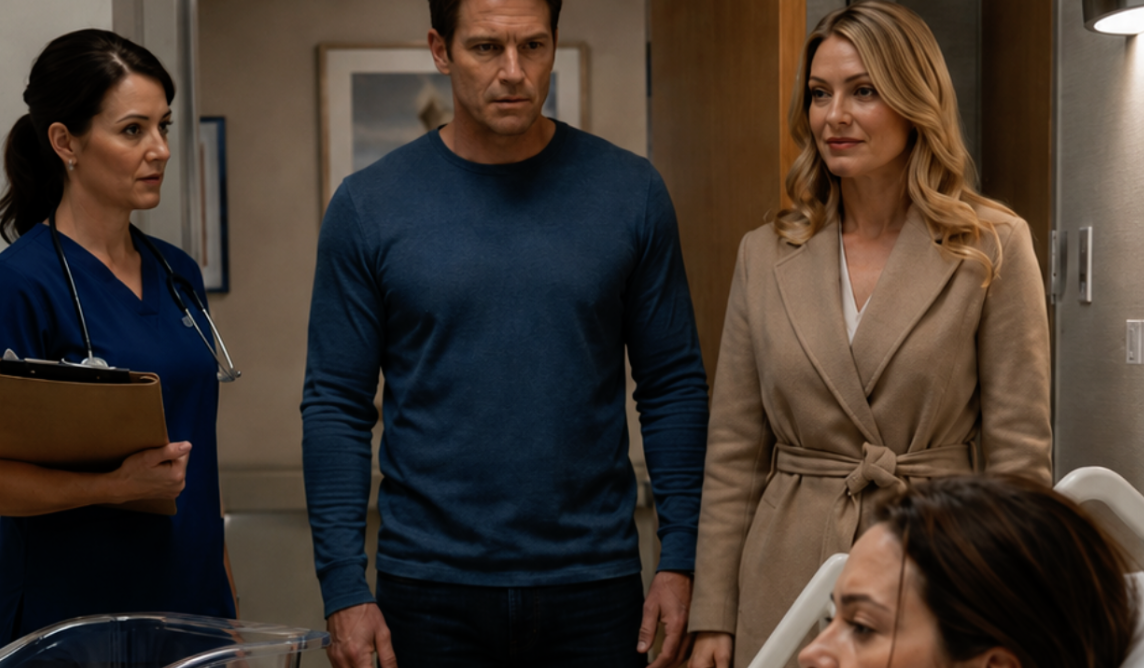
Richard had not spared a single glance for the bassinets. He had not reached out to graze the laminated index cards where I had inscribed the names Audrey, Caleb, and June in letters that shook with the remnants of labor. A nurse, Marcy, had just settled a knitted blue cap onto Caleb’s fragile head, and she now stood flush against the sterile wall, her clipboard clutched to her chest like a shield.
Behind Richard hovered Tiffany. She was wrapped in a peach-colored coat that seemed offensively soft for a room defined by clinical edges and raw suffering. Her sunglasses were perched atop her head, an absurd accessory in a windowless maternity ward. She cast hurried, impatient glances between Richard, myself, and the envelope, exuding the distinct irritation of a woman who had been assured this unpleasant errand would be brief.
“I’m sick and tired of this poverty, Eleanor.”
Richard delivered the line with enough volume to ensure Marcy heard it. He spoke these words while my wrists still bore the angry red welts of medical tape, while one of our daughters emitted a tiny, desperate whimper of hunger. His tone lacked the chaotic, untethered desperation of a man losing control; instead, it possessed the chilling, polished cadence of rehearsal. He sounded entirely prepared.
The topmost document had slipped marginally from the envelope. My eyes traced the ink: my name, his name. Then, my gaze plummeted to the section designated for our children. The line had been populated with a sterile, typographic indifference: Baby A, Baby B, Baby C.
That was the primary anomaly that managed to pierce through the dense fog of my physical pain. It was not the presence of his mistress, nor the audacity of the divorce papers themselves. It was the paralyzing realization that Richard had marshaled the executive function to locate a printer, secure a pen, and summon the nerve to abandon his family, yet he had not found the emotional bandwidth to type his own children’s names.
Richard’s mouth continued to move, dispensing sterile corporate jargon repurposed for domestic slaughter: clean breaks, realistic futures, financial strain, carrying my limitations. Each phrase felt meticulously curated, designed to absolve him of guilt. Tiffany placed a hand on his arm—a tactile cue to expedite the process, her pale pink manicure contrasting sharply with my own fingernails, which were jagged and broken from gripping the steel bedrails through agonizing contractions. The juxtaposition was designed to humiliate, yet I found myself retreating to a hollow, silent cavern deep within my own mind.
“Sign it,” he demanded. “Don’t make this harder than it has to be.”
I pressed my palm flat against the manila envelope. The paper was warm, insulated by the heat of my blankets. My entire nervous system urged me to shatter, to let my throat tear open with a primal scream. Instead, I locked my eyes onto his and issued a single directive: “Say their names.”
Richard blinked, his rhythm abruptly derailed. Tiffany’s performative smirk vanished. Marcy lowered her clipboard a fraction of an inch.
He offered a derisive scoff. “This is exactly what I mean. You turn everything into a scene.”
“Say their names,” I reiterated, my voice a low, unyielding anchor.
His gaze flicked unwillingly toward the bassinets, where three fragile forms lay swaddled, their tiny mouths working in subconscious dreams of sustenance. His jaw tightened. “The babies are fine,” he deflected.
The word babies struck me—simultaneously softer than a slur and infinitely sharper. I had known, of course, that Richard was slipping away. The signs were a mosaic of quiet betrayals: the hushed phone calls taken in the hallway, the sudden implementation of passwords, the ostensibly gifted luxury watch that I had found buried in a credit card statement. But suspecting abandonment is a fundamentally different intellectual exercise than lying in a postpartum bed, watching your husband actively refuse to humanize his own offspring.
I pushed the envelope away with two fingers, letting it slide harmlessly against the metal rail. I did not sign. Richard’s face hardened. “You always do this,” he spat. “You make me feel like the bad guy for wanting more.”
I swallowed the venomous retort rising in my throat. There are absolute truths that are simply too valuable to be spent on a man who is already walking out the door.
Three minutes later, a knock broke the tension—a firm, archaic sound made by knuckles that believed in the sanctity of closed doors. The door swung open to reveal Daniel Morse, a man with silver hair and the impeccable posture of old money. He was trailed by a highly uncomfortable hospital administrator. For a fleeting second, the sterile ward dissolved, and I was twelve years old again, standing on a mahogany staircase while Daniel waited in the foyer.
“Ms. Prescott,” Daniel intoned, the surname slicing through the room’s atmosphere like a scythe.
Tiffany’s eyes darted frantically. “Prescott.”
For five years, I had allowed Richard to believe that the lineage of the Prescott name had withered and died in my narrative. Daniel’s eyes briefly softened as he took in the bassinets before hardening into professional sorrow. “I am sorry to come here so soon after delivery,” he said, his voice carrying the inescapable gravity of an incoming tide. “Your father passed three days ago. You are the sole controlling beneficiary of the Prescott Trust. The estimated value is approximately five billion dollars.”
The numerical value did not register as currency; it registered as a seismic rupture in the foundation of the room. Richard’s jaw went slack. In a fraction of a second, the man who had marched in to surgically extract himself from my life looked utterly horrified—the visceral panic of a man watching a priceless artifact slip from his fingers and shatter on the pavement below.
“Five billion,” Tiffany whispered, the syllables tasting of ash.
My father was dead. My marriage was contained within a manila envelope. My three children were mere hours old. I had instantaneously become the wealthiest person in the building, and I had never felt less victorious.
Richard, whose fatal flaw was consistently mistaking rapid calculation for actual intelligence, recovered first. “Eleanor,” he purred, his voice dropping an octave into a sickeningly sweet register. “Honey. This is a shock. We should talk privately.”
The endearment hung in the air, grotesque and transparent.
I looked at him, feeling the absolute, crystalline clarity of a woman who had just survived the worst hour of her life. “You can leave.”
He attempted to pivot, to transform the hospital bed from an execution block into a witness stand, accusing me of deception. Tiffany, possessing a keener instinct for survival, recognized that Richard had just publicly exposed a fatal lack of judgment. She retreated into the hallway, abandoning him to the consequences of his own hubris. When Richard finally exited, he did not touch the bassinets. The silence he left behind was not peaceful; it was the suffocating quiet that follows the shattering of fine porcelain.
When the tears finally came, they were hot, humiliating, and fiercely human. Daniel took a seat with the reverence of a man entering a sanctuary, offering a singular, profound sentence: “I am sorry, Eleanor.” It was the only statement uttered that day capable of holding the dual weights of birth and death.
In the ensuing quiet, the mechanics of my past came into agonizing focus. For years, I had confused peacekeeping with true devotion. I had functioned as the shock absorber for Richard’s volatile moods, his financial ineptitude, his creeping resentments. I had met him when he was a charmingly rumpled startup employee who claimed that wealth made him nervous. I had laughed, understanding the sentiment, having fled the oppressive, ledger-driven love of my father, Samuel Prescott. I traded a midtown penthouse for a Queens walk-up, believing that authentic love required mutual struggle.
Richard had loved my sharp intellect only when it served to entertain him or edit his invoices. He despised it when it accurately assessed his shortcomings. The degradations had been systemic and gradual. It was the dinner party where he publicly mocked my financial acumen to his colleagues, deliberately suppressing the fact that I covertly balanced his books. It was the day I printed the sonogram revealing three heartbeats, only to find it buried under his meticulously labeled folder of financial anxieties. It was his absence at the twenty-week anatomy scan, followed by the delivery of a floral arrangement bearing a card that read, Proud of you and the twins. I had cataloged these micro-funerals of my marriage in silence, mistakenly believing that endurance was a synonym for loyalty. A person reveals the true dimensions of their heart through what they assume cannot feel pain. Richard assumed my silence was compliance. I had stayed because pride forbade me from returning to my father to admit I had wagered my life on a hollow man and lost.
But as Helen Cho, the ruthlessly efficient family attorney Daniel summoned, reviewed the divorce papers, the paradigm shifted. I looked at Audrey, Caleb, and June. I was completely finished keeping the peace at the expense of the truth.
The transition from victimhood to authority was not instantaneous; it was constructed in excruciating increments. I relocated to a secure, ivy-draped brownstone in Brooklyn Heights, financed by the trust but distinct from my father’s imposing Westchester estate. I learned to navigate the cyclical, demanding reality of infant care—the feedings, the burpings, the desperate choruses of simultaneous crying—while systematically dismantling Richard’s leverage.
I did not seek flamboyant vengeance. I simply allowed gravity to do its work. Richard had anchored his entire professional trajectory on the illusion of steadfast stability and upward mobility. By abandoning a postpartum wife in front of a witness tied to his primary investor, he authored his own ruin. Tiffany withdrew. The partnership evaporated. He was quietly excised from his firm.
In retaliation, he bombarded me with messages drenched in victimhood, demanding I repair the catastrophic fallout of his own autonomy. He believed love was synonymous with a woman shielding a man from his own consequences. I simply stopped replying.
Instead, I channeled my energy into the boardroom. I attended my first trustee meeting in a black dress, my body aching, my bag smelling faintly of sour milk, and my mind sharpened to a razor’s edge. When Arthur Bellamy, a trustee who mistook my grief for malleability, attempted to patronize me regarding the trust’s affordable housing divisions, I surgically dismantled his financial obfuscations using the very reports he assumed I hadn’t read. The men in the room rapidly deduced that I was not a symbolic figurehead; I was a sovereign entity.
Two months later, I granted Richard an audience in Helen’s office. He arrived clad in a modest gray sweater—a sartorial performance of humility. He spoke of missing “us,” of feeling emasculated by the phantom weight of my undisclosed wealth, of drowning in the pressures of impending fatherhood.
“You tested me,” he accused, clinging desperately to his constructed narrative.
“No,” I replied, my voice devoid of the anger he expected. “I trusted you. I trusted that if life stayed ordinary, you would still choose us. That was not a test, Richard. That was marriage.”
Helen presented him with a meticulously rigid parenting plan: mandatory psychological evaluations, supervised visitations, communication strictly relegated to a monitored application. No financial leverage. No unregulated access.
He recoiled, his pride flaring. “You want me to earn my own children.”
“Yes,” I stated, unblinking. “I want you to earn trust.” He left the room without signing, fundamentally incapable of accepting terms that did not afford him unearned applause.
True healing does not adhere to a linear trajectory. It is chaotic, visiting at unscheduled hours. It arrived when Audrey mirrored Richard’s furrowed brow, or when Caleb smiled in a way that resurrected the ghost of our early courtship. Yet, the paralyzing act of waiting had permanently ceased. I was no longer holding my breath for his epiphany, his perfect apology, or his miraculous transformation into the man I had hallucinated him to be.
I restructured the Prescott Trust, transforming it from a monument of patriarchal control into an instrument of profound utility. We funded a comprehensive postpartum clinic in Queens, a facility dedicated to ensuring that no mother had to beg for baseline dignity while her body was broken.
At the private reception for the clinic, the past and present momentarily collided. Richard appeared, his suit ill-fitting, his aura subdued. He had finally completed the mandated parenting classes. He did not ask for absolution; he merely asked if the children looked like him.
“Sometimes,” I answered, extending a boundary-lined kindness. He nodded, accepting the famine of my response, and walked away. He had finally learned that he could not manipulate his way back into the center of the narrative.
On the first anniversary of the day the manila envelope was dropped onto my hospital bed, I found myself sitting on the back steps of the Brooklyn house. Caleb was asleep against my chest; Audrey and June were resting nearby. The symphony of the city hummed in the background—a chaotic, beautiful testament to survival.
Inside the house, resting in a shadow box, was the blue knitted hospital cap and the laminated name cards. It was not a shrine to trauma, but a monument to the precise coordinate in time where I ceased allowing someone else to appraise my worth.
If I could reach back through the fabric of time to that terrified, trembling woman in the hospital bed, I would not offer her warnings, for warnings are entirely futile after the impact has occurred. I would tell her that the deafening silence following abandonment is not a void; it is an open doorway.
When someone attempts to render you infinitesimally small at the exact zenith of your vulnerability, the instinct is to explain, to plead, to rationalize your right to occupy space. How long do you keep explaining before you finally choose yourself?
You stop explaining the moment you realize that their cruelty is not a misinterpretation of your value, but a desperate reflection of their own profound emptiness. I did not save myself when the billions were transferred into my name. I saved myself in the breathless, terrifying fraction of a second before the door opened. I saved myself when I looked at the man who had promised to protect me, pushed his cowardly paperwork aside, and demanded that he speak the names of the children he was too weak to carry.
I saved myself, and in doing so, I became the architect of a world expansive enough to hold us all.