When the first light of my seventy-fifth birthday filtered through the curtains, it was that pale, thin Michigan sun that seems more like a memory of warmth than the thing itself. It traced the contours of the room I had known for half a life: the dresser Agnes chose in 1978, the framed watercolor of Lake Huron, and the vast, quiet expanse of the mattress where she had slept for forty-five years.
I lay there, listening to the house wake up. A house has a rhythm, a heartbeat composed of its own unique creaks and rattles. But lately, the rhythm had been hijacked.
Downstairs, dishes clattered. That was Violet, my daughter-in-law. She was making breakfast, but the sounds were sharp, impatient. I knew the sequence by heart now: the quick, aggressive slap of her slippers on the tile; the cabinet door opening twice because she could never remember where she had moved the mugs; the low, drone-like murmur of the television in the breakfast nook. Then came the scrape of my son’s chair—Russell—as he sat down, never once offering to help, a man comfortably settled into a life he hadn’t quite built for himself.
Forty years. That’s how long Agnes and I had lived within these walls. We didn’t just occupy the space; we wove ourselves into it. We repaired the porch after the blizzard of ’78, replaced the shingles after the ’91 storms, and painted the nursery ourselves, laughing as we got more eggshell-blue on our overalls than the walls. Every corner held a ghost of a moment. There was the nick in the dining room floor from the Christmas Russell dropped his metal fire truck, and the faint, penciled height marks on the kitchen doorframe that chronicled his growth from a toddler to a man who now looked through me as if I were made of glass.
I dressed slowly, my movements deliberate. Seventy-five is a respectable age, but I was far from the “halfway gone” relic Violet treated me as. My mind was sharp—I still spent my Tuesday nights at the chess club arguing strategy like a man twenty years my junior. My hands were steady, provided I wasn’t being hovered over.
I paused by Agnes’s photograph on the nightstand. She was smiling, her hair windswept at the lake. “Morning, darling,” I whispered. The house didn’t answer; it only gave another clatter from the kitchen.
When I entered the kitchen, the air was thick with the scent of herbs Violet was growing in ceramic pots on the windowsill—her “orderly” touch. Russell was buried in his tablet, his office shirt crisp but his tie still missing.
“Good morning,” I said.
Violet gave a perfunctory nod toward the stove. Russell mumbled something unintelligible, his eyes never leaving the screen. I walked toward the coffee maker, a simple machine I had used for years.
“Hugh,” Violet said, her voice snapping like a whip. My hand stopped. “I told you not to touch that. You nearly broke the display last time.”
“I pressed one wrong button, Violet. It’s a coffee maker, not a centrifuge.”
“Exactly,” she sighed, the kind of sigh one reserves for a particularly slow child. “Sit down. I’ll pour it for you.”
I stepped back, feeling that familiar, cold bloom of indignation. I had managed a chemical laboratory for four decades. I had patents in my name. I had overseen safety protocols for industrial processes that could level a city block. But in my own kitchen, I was deemed too incompetent for a Keurig.
“And by the way,” she added, her back still to me, “I moved those old magazines out of the living room. They were collecting dust.”
I froze. “Which magazines?”
“The technical ones. Chemistry and Engineering. They’re in the garage now.”
I looked at Russell, seeking some spark of the boy who used to sit on the floor with me, tracing the diagrams of molecular structures. “Russell, you remember those. You used to call the diagrams ‘secret maps’.”
Russell glanced up, his expression one of mild irritation. “Dad, they’re just old paper. They’re taking up space. Violet’s right; the garage is better.”
“It’s my house,” I said quietly.
The room shifted. Not with a bang, but with a sudden, suffocating density. Violet set the spatula down and gave Russell “the look”—the silent signal of weary patience.
“Hugh,” she said, her voice artificial and soft. “We all live here. We all have to consider each other’s interests. I’m just trying to keep things orderly.”
Orderly. That was her word for the slow, systematic erasure of my life.
I spent most of the day in the garage, retrieving my magazines from a cardboard box sitting near the recycling bin. They were curled at the edges, exposed to the damp Michigan air. I ran my hand over the 1952 issue of Chemistry and Engineering, the one I’d bought with my first paycheck. To Violet, it was clutter. To me, it was the blueprint of the life that had paid for the very roof over her head.
The energy for the evening was building. Violet was hosting a dinner—not for me, though it was my birthday, but for Russell’s business associates. I was “the father in the corner,” a piece of living furniture to be displayed or hidden as needed.
I was sitting on the veranda later that afternoon, hidden by the overgrown ivy, when I heard their voices through the open dining room window.
“We should settle this after the birthday,” Violet’s voice was clinical. “I found the place. Sunny Harbor. It’s only twenty minutes away, so it’s not like he’ll be isolated.”
My heart didn’t race; it slowed. It felt like a stone dropping into a deep, cold well.
“He’s attached to the house, Vi,” Russell said, though his voice lacked any real steel.
“Russell, be realistic. He can’t manage this place. The stairs, the garden… it’s too much. Sunny Harbor has staff. He’d be with people his own age.”
“And the house?” Russell asked.
“That’s the practical part. If we sell or even just borrow against it, we can cover the kids’ tuition. We can downsize to something more modern. We have to think about the future, not the past.”
“He’d have to agree,” Russell muttered.
“We’ll do it gently. We’ll show him the brochures, talk about the ‘benefits.’ We’ll make him feel included in the decision.”
Included. The word tasted like ash. I sat there for a long time, watching the apple tree Agnes and I had planted the year Russell was born. I realized then that my son had become a spectator in his own life, and Violet was the director. They weren’t waiting for me to get old; they were treating me as if I were already a ghost haunting their real estate.
I called Terrence.
Terrence Calder had been my colleague for thirty years and my friend for fifty. He had a voice like gravel and a mind like a razor. When I told him what I’d heard, the silence on the other end of the line was heavy.
“They’re planning the funeral while you’re still in the pews, Hugh,” he said.
“I need to change the rules of the room, Terry. I need to make them feel the floor move.”
“What are you thinking?”
I laid out the plan. It wasn’t about a real sale—I wouldn’t let go of Agnes’s roses that easily. It was about perspective. I needed people who could play a role, people who looked like the future Violet so desperately craved.
“My son, Field, and his wife, Darla,” Terrence said immediately. “Field looks like a venture capitalist when he puts on a suit, and Darla has enough theatrical energy to sell a bridge to a bridge-builder. They’ll do it for the sheer justice of it.”
We met that afternoon. I told them the situation, and I saw the indignation in Darla’s eyes. “They’re treating you like an inconvenience in your own home?” she asked, her voice sharp. “Oh, we are going to have some fun with this.”
We choreographed the evening with the precision of a chemical reaction. Terrence prepared the “offer packet”—official-looking documents from a fictional holding company. Field and Darla would be the “buyers” who had supposedly been given a private tour weeks ago.
The Seventy-Fifth Birthday
The party was a sea of people I barely knew—Russell’s coworkers and Violet’s social circle. I was seated in a “chair of honor” by the fireplace, which was effectively a way to keep me stationary.
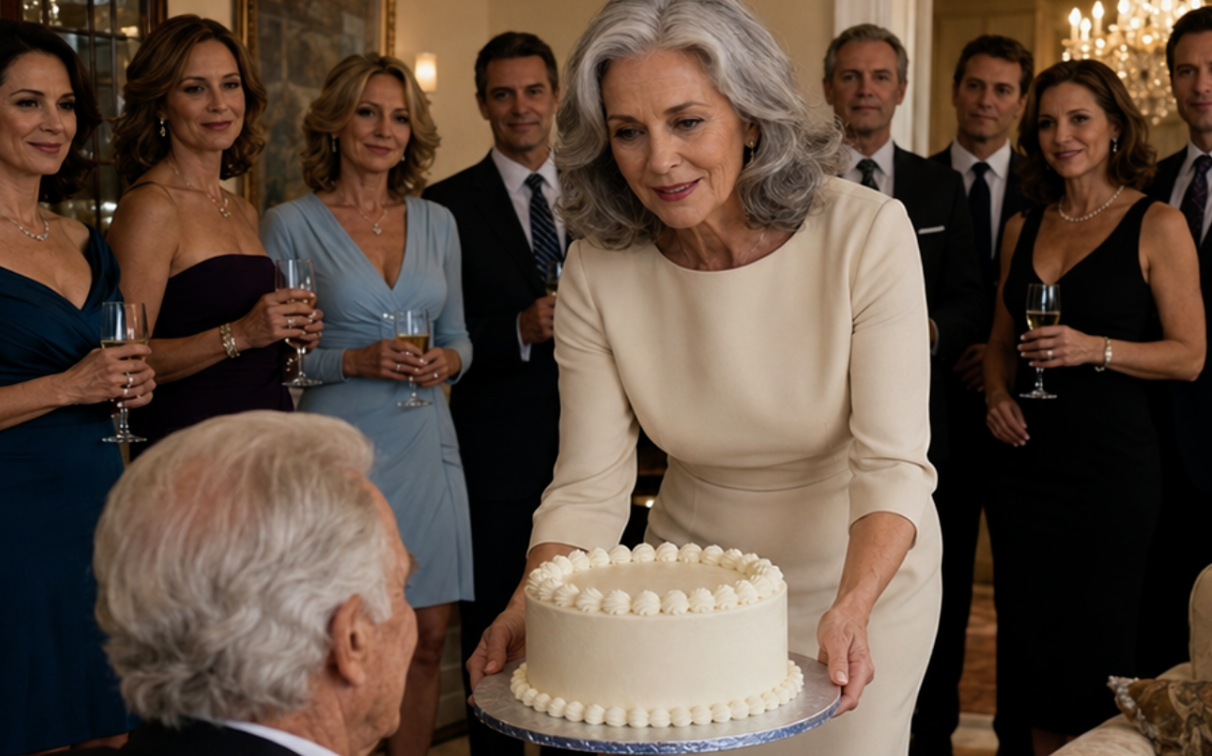
At eight o’clock, the “moment” arrived. Violet clapped her hands for attention. Russell appeared with a bottle of champagne, and Violet carried out a cake.
It was a large, white cake with blue icing. I looked at the words scripted across the top:
FOR SOUTHFIELD’S MOST CAREFUL SAVER.
A ripple of laughter went through the room. Someone whispered about my “famous thrift” and how I still turned off lights in rooms I’d just left. Violet beamed, clearly proud of her little joke. Russell laughed too—a small, compliant chuckle.
They were laughing at my dignity. They were laughing at the habits that had built the very foundation they stood upon.
I didn’t blow out the candles. I stood up. The room went quiet, sensing a shift in the atmosphere.
“Thank you for the cake,” I said, my voice steady, the voice I used when I used to command a lab of fifty. “And thank you for the reminder of what matters in this house. But since we’re celebrating milestones, I have an announcement of my own.”
The doorbell rang. On cue.
I walked to the door and welcomed Field and Darla. They looked impeccable—the embodiment of the high-end “level” Violet always alluded to.
“Everyone,” I said, leading them into the center of the room. “I’d like you to meet Field and Darla Calder. They are the buyers I’ve been negotiating with regarding the property.”
The silence was absolute. Violet’s champagne glass hovered halfway to her lips. Russell looked like he’d been struck.
“Buyers?” Violet managed to choke out. “What are you talking about, Hugh?”
“New arrangements,” I said simply. “As you mentioned yourself, Violet, I’m getting older. This house is a lot to manage. So, I’ve decided to move on. Field and Darla have made an exceptional offer.”
Field stepped forward, tapping a leather folder. “It’s a beautiful lot. We’re planning a full interior gutting, of course. Modern minimalism. We’ll be taking down that load-bearing wall between the kitchen and the dining room first.”
Violet’s face went white. That was the wall she had spent months decorating with her “orderly” shelves.
“You can’t do this,” Russell stammered. “We live here.”
“You lived here ‘temporarily,’ Russell,” I said, looking him in the eye. “Five years is a very long ‘temporary.’ And since you were so concerned about my ‘best interests’ at Sunny Harbor, I thought I’d take the initiative.”
The mention of Sunny Harbor was the killing blow. Russell’s eyes widened; Violet’s jaw tightened. The guests, realizing they were in the middle of a family execution, began to slink away toward the coat rack.
“I heard you,” I said to the remaining family. “I heard you on the veranda. I heard you planning to move me out like a piece of old furniture so you could borrow against my life’s work. I heard the brochures. I heard the ‘inclusion’.”
I turned to Field. “When can you take occupancy?”
“Ten days,” Field said. “We have the architect scheduled for the eleventh.”
“Ten days!” Violet shrieked. “That’s impossible!”
“I’m sure you’ll find somewhere ‘orderly’ to go,” I said.
The house was empty of guests within twenty minutes. Field and Darla left shortly after, giving my hand a supportive squeeze. That left the three of us.
“Is it true?” Russell asked, his voice cracking.
“The house is mine, Russell. It has always been mine. Every shingle, every nail, and every memory. You treated it like an asset. I treated it like a home.”
Violet was already on her phone, likely looking for apartments or a lawyer. But Russell stayed in the living room, looking at the restored magazines I had moved back to the shelf that morning.
“I didn’t think you heard,” he whispered.
“That’s the problem, son. You stopped thinking about me as a person who could hear at all.”
The move happened fast. Once Violet realized I wasn’t budging, her efficiency turned toward her own exit. She found an apartment in Oak Park. She complained the entire time—about the lack of storage, the “downgrade,” the “betrayal.”
Russell was quieter. On the final day, he stood at the door with a box of his things.
“I’m sorry about the cake, Dad,” he said.
“The cake was just sugar and ice, Russell. The laughter was what stayed with me.”
“I know,” he said. And for the first time in years, I believed he actually did.
A month has passed since the house became quiet again. The silence isn’t lonely; it’s spacious.
Terrence comes over on Tuesdays. We drink coffee—strong, black, made by my own hand. My magazines are back on the bottom shelf. Agnes’s photos are back on the mantel. The “sale” was never finalized, of course; the “offer packet” was a masterclass in creative formatting by Terrence, enough to fool a panicked daughter-in-law, but never intended for a courthouse.
Russell calls. We’re rebuilding, brick by brick. He tells me Violet left for Chicago; she couldn’t handle the “reduced circumstances” of a man who wouldn’t fight his father for a house. I’m sorry for his heartache, but I’m not sorry he’s finally learning to stand on his own feet.
Last night, I sat in the living room and looked at the nick in the floor from the fire truck. I realized then what real wealth is. It isn’t the equity in the walls or the market value of the lot.
Real wealth is the ability to walk into your own kitchen at two in the morning, make a cup of coffee exactly how you like it, and know that you are the one who holds the deed to your own dignity.
I am seventy-five years old. My head is clear, my hands are steady, and for the first time in a long time, I am home.