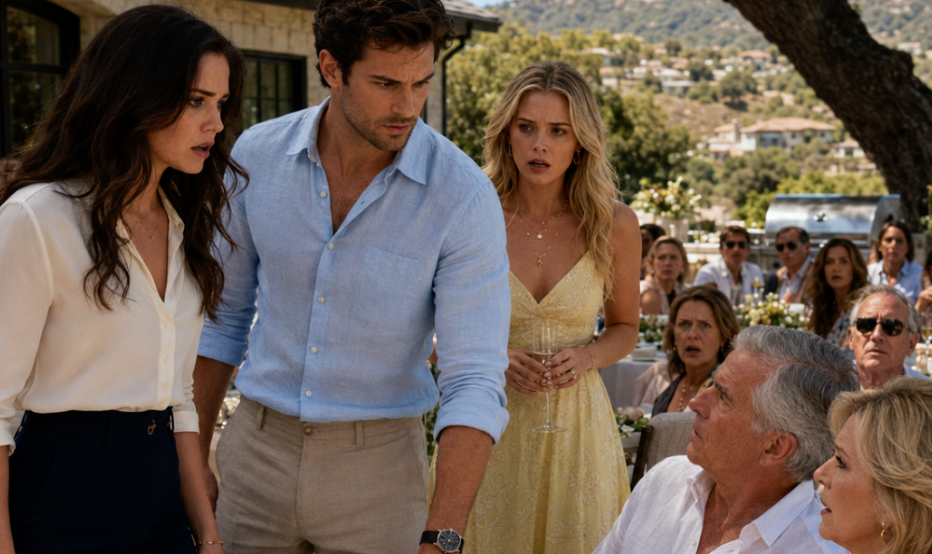
My father’s laughter echoed sharply across the manicured lawn when my sister, leaning intimately toward my fiancé in front of thirty-two relatives, boldly suggested, “You can do better than Clarissa.”
The sprawling backyard fell instantly into that specific, suffocating silence unique to families—the heavy kind of quiet that descends when an invisible line has been blatantly crossed, yet absolutely no one is willing to be the first to acknowledge the transgression. The only remaining sounds were the steady, low hiss of the outdoor grill, the sharp clink of melting ice cubes against plastic tumblers, and the soft, deliberate scrape of my silver knife sliding cleanly through the elaborate dessert cake I had spent my entire morning arranging on a pristine white ceramic stand.
Savannah casually held her wine glass near her chin, gifting Liam with a radiant, conspiratorial smile as if I weren’t standing a mere ten feet away. She was adorned in a pale yellow designer sundress that seemed far too delicate for the thick brisket smoke and the oppressive Texas heat. Her bright blond hair was swept effortlessly over one shoulder, and a diamond bracelet caught the harsh afternoon sunlight with every practiced flick of her wrist. My younger sister had always been an absolute master of presentation. She possessed the rare, cruel talent of spinning a direct insult into a playful compliment provided she had an attentive audience, making sheer cruelty masquerade as charming confidence—especially if our father smiled first.
And on that particular afternoon, Harrison Vance did exactly that. He smiled first.
He was stationed at the head table beneath the sprawling canopy of an ancient live oak tree, one arm draped casually over the back of his chair. A sweating bottle of cold beer sat in front of him, his expensive linen shirt remaining impossibly crisp despite the suffocating humidity. My father had architected his entire existence around a single, uncompromising principle: absolute control. He controlled boardrooms, he controlled massive financial portfolios, and most importantly, he controlled exactly who within our family was permitted to feel valued on any given day. At family gatherings, he never had to raise his voice to command attention. He only had to laugh, and the rest of the family instantly learned what was deemed safe to laugh at.
Beside him sat my mother, wearing a tailored coral blouse, her hands nervously folded in her lap, her eyes stubbornly fixed on her porcelain plate. She had heard Savannah. Everyone at the barbecue had heard Savannah. Yet, true to form, no one made a single move to stop her.
“You really are far too patient,” Savannah continued, addressing Liam directly. Her voice carried across the stone patio with the easy, practiced brightness of a woman pretending she didn’t know she was the absolute center of attention. “Clarissa is already completely married to her laptop. I honestly don’t know why you’re willingly signing up to be second place for the rest of your life.”
A few cousins shifted uncomfortably in their patio chairs. My Aunt Beverly hastily lifted a linen napkin to her mouth to mask her expression. My uncle stared with sudden, intense dedication into the depths of his drink. Even the hired bartender paused, a bottle of sparkling water frozen in his hand.
I didn’t stop slicing the cake. One piece. Then another.
The blade moved effortlessly through the thick buttercream. I forced myself to watch my own hand, knowing that looking at Savannah would only hand her the victory she so desperately craved. And looking at my father would simply have hurt too much.
Liam, however, did not smile.
He stood near the drink station, dressed in a light linen jacket, his sleeves impeccably neat, his posture completely relaxed, a tall glass of iced tea resting effortlessly in his hand. He possessed the calm, anchoring stillness of a man who had learned early in life never to move too quickly in rooms crowded with people making catastrophic mistakes. It was one of the countless things I loved about him. Liam never felt the need to perform his loyalty for an audience; he lived it quietly, in the unseen details.
He was intimately aware of exactly how my family treated me. He had witnessed it firsthand at countless formal dinners, birthdays, awkward business lunches, and fraught holiday gatherings where my father would only praise my professional accomplishments if he could somehow manage to attach his own name to them. He had watched Savannah repeatedly interrupt me mid-sentence to skillfully steer the conversation back to herself. He had watched my mother endlessly attempt to smooth over the disrespect with her careful, hollow smiles and practiced phrases like, “You know how your father is,” or “Savannah simply doesn’t mean it that way.”
But Liam also knew something the rest of my family did not.
For the past two months, we had been meticulously preparing. Not emotionally—we had moved past emotional preparation long ago. I had arguably been preparing emotionally for this breaking point my entire life. We had been preparing practically: gathering digital documents, archiving emails, securing internal meeting notes, reviewing binding contracts, and analyzing a specific, devastating audio file that had landed in my inbox on an unassuming Tuesday afternoon, forever altering the trajectory of my summer.
Nobody in that sun-drenched backyard knew about it yet.
Savannah took one calculated, small step closer to Liam, resting her manicured fingertips lightly against his sleeve, just above his wrist. It was a subtle gesture, not quite enough to manufacture a full scene on its own. That was her specific, inherited genius. She knew precisely where the boundaries were and exactly how to tiptoe across them, always leaving my family just enough plausible deniability to label me “overly sensitive” if I dared to object.
“Call me,” she murmured softly, yet loud enough for the adjacent tables to hear clearly. “When you finally wake up and realize what kind of woman you actually deserve.”
My father barked a laugh, loud and sharp enough to command the entire patio’s attention.
“There it is,” Harrison announced, raising his glass in a mock toast. “A little loyalty test never hurt anybody.”
The words echoed through my mind, heavy and toxic. A loyalty test.
That was the exact phrase he had used the first time Savannah loudly joked about Liam “choosing the wrong sister” during my cousin’s anniversary dinner. It was the excuse he had deployed when she sent Liam a rare bottle of his favorite bourbon accompanied by a handwritten note that read, For when Clarissa forgets you exist. It was the justification he used when she blatantly wore white to our engagement brunch, loudly declaring to my mother, right in front of me, that she was merely “trying to keep the family color palette clean.”
A loyalty test. As if unconditional love were a commodity my family had the inherent authority to inspect and grade. As if my public humiliation were merely useful data to be collected. As if my fiancé somehow needed to prove his worth to people who had never bothered to prove a single thing to me.
I carefully placed another perfect slice of cake onto a small dessert plate. A delicate buttercream rose tilted slightly, and I precisely corrected it with the very tip of the knife.
Across the manicured yard, Liam set down his iced tea. The glass made a distinct, quiet sound against the marble counter. It wasn’t overwhelmingly loud, but I heard it. And so did my father.
Without uttering a single word, Liam turned his back on Savannah.
Her confident smile faltered—just a fraction. She had clearly anticipated his discomfort, perhaps a flush of embarrassment, or for him to laugh politely while shooting me that helpless, pleading look men often adopt when they want a woman to clean up a social mess they didn’t create.
Instead, he began walking toward the head table. His pace was slow. Deliberate. Unwavering.
The backyard felt the atmospheric shift before Savannah even realized what was happening. The ambient hum of conversation thinned out and died entirely. My cousin’s toddler ceased chasing soap bubbles near the tall hedges because his mother abruptly grabbed him by the shoulder. The bartender took a slow step backward, moving away from the drink station. My father leaned back in his chair, his smile still present, but its shape had morphed. It was no longer amused; it was sharply watchful.
I calmly wiped the sticky frosting off the cake knife with a folded linen napkin, set it down on the table, and followed Liam.
By the time he arrived at my parents’ table, the entire barbecue had frozen in anticipation. The heavy scent of smoked brisket hung thickly in the air behind us. A ceiling fan churned the humid air lazily beneath the covered patio. Thirty-two relatives and close family friends sat immobilized beneath large white umbrellas, surrounded by half-eaten plates of food, sweating mason jars filled with lemonade, and the bright, artificial cheer of an event meticulously engineered to project absolute family harmony.
Liam reached smoothly into the inner pocket of his tailored jacket and produced a small, sleek digital recorder. He placed it deliberately on the pristine tablecloth, right beside my father’s plate.
Harrison looked at the device. Then he looked at Liam. Then his dark gaze snapped to me.
“What exactly is this?” Harrison demanded. His voice was perfectly level, though his knuckles whitened rapidly as his grip tightened around his glass.
“A record I strongly suggest you review before you decide to make another joke at Clarissa’s expense,” Liam replied, his tone chillingly calm.
Savannah let out a sharp, incredulous laugh as she hurried up behind us. “Are you seriously doing this right now?”
Liam refused to even glance in her direction. “Completely serious.”
My father leaned forward, his imposing frame taking up space. “Liam, this is my home. If you have something you want to say to me, you say it like a man instead of dropping theatrical props on my dinner table.”
A year ago, a line exactly like that would have had half the men in our family nodding in silent agreement. Harrison Vance was an absolute master at wrapping pure intimidation in the comforting guise of old-fashioned masculine wisdom. But today, absolutely nobody nodded.
I stepped up to stand shoulder-to-shoulder with Liam.
“That recording,” I stated clearly, my voice carrying over the silent yard, “came directly from your internal strategy meeting on Tuesday.”
The remnants of the smile instantly vanished from my father’s face. My mother, who had been staring fiercely at her plate, finally looked up.
Savannah stopped at the far end of the table, her wine glass still clutched tightly in her hand. The harsh sunlight caught her bracelet, sending a frantic flash of light across the white tablecloth.
My father stared me down, letting a long, agonizing second tick by. “You have absolutely no reason to be involved in my company’s private meetings.”
“I do when my own company is the subject being discussed,” I countered.
A collective, shocked murmur rippled across the lawn. That was the first visible crack in his empire.
I watched my father’s eyes dart toward his captive audience, his brilliant mind visibly calculating how to twist this moment back into a manageable narrative of petty family drama. If he could paint me as hysterical and emotional, if he could frame Liam as profoundly disrespectful, and if he could cast Savannah as merely playful, he might successfully wrestle the room back under his absolute control.
But digital files do not possess emotions. Audio recordings do not feel embarrassment.
Liam reached down and pressed play.
The first voice that emanated from the small speaker was my father’s. It wasn’t loud or exaggerated. It was just Harrison in his private sanctuary, speaking in that clean, dangerously confident tone he strictly reserved for moments when he assumed everyone in the room had already surrendered to his version of reality.
“Once Liam signs the prenup, we use the barbecue incident to demonstrate her instability. Savannah keeps the loyalty-test narrative visible and active. Clarissa reacts publicly, and we immediately frame it to the board as a severe leadership concern. Then, we quietly approach the partners with our transition proposal.”
The yard descended into a silence so profound I could actually hear the ice shifting in Aunt Beverly’s cup.
Then came Savannah’s voice, sounding impossibly bright and deeply amused.
“She is so tragically predictable when she feels cornered. I can get Liam’s attention in front of everyone, and she’ll either make a massive scene or look incredibly weak for letting it happen. Either way, Dad, it feeds our story perfectly.”
I kept my eyes locked on Harrison. I refused to look at Savannah. If I looked at her in that moment, I risked remembering too much: the frightened little sister who used to crawl into my bed during violent thunderstorms, the teenager who raided my closet without asking, the grown woman my parents had systematically trained to believe that unconditional love meant never having to hear the word ‘no’.
The cold, metallic recording continued. My father spoke again.
“Clarissa’s firm holds the exact contracts we need right now. If she steps back from management, even on a temporary basis, we can easily push the acquisition through the family investment group and silently transfer full operational control to ourselves before she even understands the paperwork she’s signing.”
Aunt Beverly let out a strangled gasp, sounding as though she had suddenly forgotten how to draw breath.
Savannah whispered, a desperate, reedy sound: “Dad.”
But the recording wasn’t finished.
“And what if she refuses?” Savannah’s recorded voice asked.
My father’s reply was instantaneous and chilling: “Then we make the pressure incredibly personal.”
Liam finally stopped the playback.
The ensuing silence felt infinitely larger than the physical boundaries of the backyard. Not a single person moved. My mother’s hand hovered, trembling, over her napkin. My father’s glass sat abandoned. Savannah’s face had drained of all color beneath her flawless makeup, yet she was still desperately trying to hold her features in a neutral expression, as if physical beauty could somehow function as a shield of denial.
Harrison was the first to break the silence.
“That audio was taken entirely out of context,” he declared.
It was almost darkly impressive how swiftly he reached for his oldest, most reliable tool. Context. The desperate plea people rely on when the naked truth is far too ugly to defend.
Without a word, Liam opened a thick manila folder he had retrieved from our car and placed a stack of printed pages neatly beside the recorder. He didn’t slam them. He didn’t throw them. He placed them. That small act of deliberate precision was far more damaging to my father. Harrison respected control above all else, and Liam had just brought more of it to the table than Harrison had ever anticipated.
“These are the official meeting notes generated from that exact same session,” Liam explained, his voice projecting easily. “The recording was captured through your own firm’s boardroom archive system. Your assistant formally scheduled it as a recorded strategy review. Every single person in that room received the automated calendar notice.”
My father’s eyes darted to the top page of the stack. I watched the flash of recognition hit him as he read the header. Vance Development Group. Internal Strategy Session. Tuesday, 2:00 p.m.
“Harrison?” my mother whispered, her voice fracturing into pieces.
He completely ignored her.
I picked up the second document from the stack and held it up to the light. “This,” I announced, “is the draft transition memo that your own legal counsel explicitly refused to sign. This is the proposed, fabricated letter to my clients heavily implying that I was suffering a breakdown and stepping back from Brightline Strategy. And this—” I tapped the final page, “—is the revised ownership structure proposal, conveniently placing Savannah into a highly paid advisory role for a company she has absolutely never worked a day for.”
Savannah’s mouth fell open in horror. “That wasn’t a final draft!”
“No,” I agreed coldly. “It was merely typed, officially circulated, and scheduled for board review.”
Another wave of murmurs cascaded through the assembled relatives. My cousin Daniel slowly pushed his chair away from the table. Aunt Beverly’s husband stared at the damning paperwork as if printed ink could somehow alter his perception of a man faster than decades of shared family dinners ever could. My father swept his gaze around the table, and for the very first time in his carefully curated life, the audience did not belong to him.
He felt the loss of power immediately. And so did I.
Harrison leaned back heavily, interlacing his fingers. “Clarissa,” he began, seamlessly shifting into the smooth, patronizing tone he utilized during hostile boardroom negotiations. “You are clearly very upset right now.”
That almost elicited a genuine smile from me. Not because it was remotely humorous, but because his playbook was so utterly predictable.
“No,” I corrected him. “I am documented.”
The sentence struck with the force of a physical blow. I heard Liam let out a quiet breath of solidarity beside me.
Savannah looked frantically between our father and me. “You planned this entire thing?”
“For two solid months,” I confirmed.
My father’s eyes narrowed into dangerous slits. “You intentionally allowed your sister to continue her behavior because you desperately wanted to create a scene.”
“I allowed her to continue because every single time she did it, you gleefully explained it away as a ‘loyalty test.’ I needed the documented pattern. Liam and I needed far more than just one bad afternoon at a barbecue to prove what you were doing. We needed the archived emails. The official meeting notes. The fraudulent client drafts. The internal proposals. The illicit financial transfers.”
At the mention of those last two words, my mother’s expression shattered entirely. Financial transfers. She knew something. Perhaps not the entire scope of the betrayal, but enough. Her lifelong silence had never truly been empty; it had functioned as a dark room where she locked away every truth she lacked the courage to confront.
Liam opened the final section of the thick folder. “Brightline’s highly confidential client list was accessed exactly twice from a Vance Development executive office account,” he stated to the crowd. “It was not downloaded from Clarissa’s secure system. It was covertly accessed through archived copies that had been attached to joint family investment proposals last fiscal year. Your team then weaponized that proprietary information to draft outreach language aimed at companies Clarissa had spent years building relationships with entirely on her own.”
The muscles in my father’s jaw twitched furiously. “I run a massive development firm. Business overlap happens.”
“Not like this,” I shot back. I turned to the next page. My hand trembled infinitesimally—a physical reaction I loathed—but I refused to lower the paper. “For years, you assured me that the family investment group was strictly segregated from my company. You swore my shares in the family’s real estate portfolio were locked and safe. You repeatedly told me that Savannah’s exorbitant expenses were deeply personal and absolutely none of my concern.”
“They are none of your concern!” Savannah snapped, her voice cracking.
I turned my full attention to her. I really looked at her. Her lips were perfectly glossy, but her eyes were wide and bright with absolute panic. Her hand remained clamped around her wine glass, but all the manufactured confidence had bled out of her posture. In that moment, she looked shockingly young. Not innocent, by any means, but wholly unprepared to face genuine consequences without a powerful man standing by to arrange her exit strategy.
“They explicitly became my concern the moment massive distributions from the family trust were secretly routed through the very business accounts tied to the contracts you were trying to force me to surrender,” I told her.
My father shot to his feet. The metal chair legs screamed against the stone patio. Multiple people flinched violently, yet nobody dared to leave.
“Harrison,” my mother pleaded softly.
He ignored her completely. “You are making wild accusations about financial structures you do not even begin to understand.”
“I understand more than enough,” I replied.
Right on cue, Liam’s phone buzzed in his hand. A single, crisp notification. He glanced down, read the screen, and then locked eyes with my father.
“The independent financial review officially went live at exactly one o’clock,” Liam announced to the silent yard. “Your primary bank’s internal risk committee, the family trust’s external legal counsel, and the core commercial partners involved in your upcoming riverfront project have all just received this exact same documentation package. They didn’t receive it based on emotion. They received it directly from the evidentiary file.”
My father stared at him, paralyzed. The ruddy color drained from his face with agonizing slowness, as if the blood were retreating to protect his vital organs.
Savannah whispered, her voice barely audible, “What does that even mean?”
Liam didn’t answer her. He kept his unwavering focus locked onto Harrison. “It means that absolutely no one sitting at this table possesses the power to bury this as a simple family misunderstanding.”
Moving with a frantic haste I had never witnessed before, my father snatched his phone from the table. He unlocked the screen and frantically scanned whatever message had just populated. His expression underwent a microscopic shift—not a cinematic breakdown, just a minute tightening around his mouth, a rapid blink, a sudden, devastating loss of absolute command. It was the precise moment he realized the machinery of the outside world had begun to move aggressively against him, entirely without his permission.
Savannah’s phone buzzed next. Then my mother’s. Then Harrison’s rang again.
The digital chimes and vibrations spread rapidly across the tables, a localized storm making landfall one raindrop at a time.
Savannah stared at her glowing screen and froze entirely. “What is this?” she demanded.
Nobody offered her an explanation. She looked desperately at our father. “Dad.”
He refused to meet her eyes. And that single evasion communicated more than a thousand words ever could.
Aunt Beverly rose from her seat with agonizing slowness. “Harrison, what have you done?”
My father snapped his furious gaze toward her, but the terrifying, magnetic force he usually commanded had evaporated. “Sit down and shut up, Beverly.”
She remained standing. That was the second visible crack in the empire.
My mother, with badly trembling fingers, reached out and picked up one of the printed pages. She forced herself to scan the text, actively entering the dark reality she had spent decades avoiding. She saw Savannah’s name printed in black and white. She saw the family trust details. She saw the egregious wire transfers, the inflated advisory fees, the fraudulent expense reimbursements, the drafted letter meant to destroy my reputation. Her lips parted in horror.
“Harrison,” she breathed, but it wasn’t a question anymore. It was total recognition.
He whipped around, cornered and vicious, turning his wrath entirely on me. “You have absolutely no idea what it takes to keep a family empire of this scale together!”
There it was. The magic word. Empire.
It was a term he adored. He wielded it during lavish Thanksgiving toasts, at high-stakes business dinners, and during condescending speeches to younger cousins who remained blissfully ignorant of just how much debt was leveraged against this grand illusion of success. He had spent his life constructing an empire composed of polished iron gates, lucrative commercial leases, staged boardroom photographs, elite country club lunches, and children systematically trained to orbit the sun of his approval.
I took a slow look around the sprawling backyard. I looked at the beautifully set tables. I looked at the stunned relatives. I looked at the woman who had given birth to me, who had chosen the path of silence so frequently that it had become her native tongue. I looked at Savannah, who had tragically mistaken her father’s favoritism for actual safety.
Finally, my gaze returned to my father.
“You didn’t keep an empire together,” I told him, my voice carrying clearly over the smoking grill. “You just kept everyone terrified of being the next person you turned on.”
His jaw locked, the muscles cording in his neck, but he couldn’t find a single word in his defense.
Liam reached out and placed a warm hand over mine—not to steady me, but to silently remind me that I was no longer fighting this war alone.
I turned to face my sister one last time. “You desperately wanted Liam to fail your little loyalty test,” I said quietly. “But his loyalty was never something you could access.”
Tears rapidly filled Savannah’s eyes, and for one brief, fleeting moment, I foolishly thought she might offer something genuine. Something small and fundamentally human.
Instead, she spat out the old, familiar script. “You have always hated me.”
A sudden, profound exhaustion washed over me. It wasn’t weakness. I was just fundamentally tired of living my life trapped inside narratives written by people who directly profited from deliberately misunderstanding me.
“No,” I replied, my voice devoid of anger. “I protected you for far longer than you ever deserved.”
Her face crumpled into ugly lines of genuine distress, but for the first time in my life, I did not step forward to comfort her.
The phones across the yard continued their relentless buzzing. At the far end of the patio, one of my father’s oldest business associates abruptly stood up and walked away from his table to answer a call. Another executive quickly followed suit. A cousin’s husband, a man who worked high up in commercial lending, stared down at his screen and then looked back up at Harrison. His expression had nothing to do with family ties and everything to do with immediate legal liability.
The casual family barbecue had permanently transformed into a hostile boardroom. And that was precisely what undid Harrison Vance.
He was a master at managing domestic shame. He could talk his way out of hurt feelings. He could expertly turn relatives against one another using half-finished sentences and reminders of old, unpaid debts. But he could not charm his way past bank risk committees, formally signed legal memos, emergency partner notices, and the clean, brutal, unforgiving order of a documented timeline.
The first actual phone call rang out from his device. He let it ring. The second call came immediately on its heels. He ignored that one, too. On the third consecutive call, he finally answered.
“Harrison Vance,” he barked, his voice tight and clipped.
He listened. The entire yard watched him listen. The formidable patriarch who could dominate an auditorium with a single sentence stood frozen beneath the live oak tree, a phone pressed to his ear, offering almost nothing in return.
“I understand,” he finally muttered. A long pause stretched out. “No, I am absolutely not going to discuss that matter in this current setting.” Another agonizing pause. His dark eyes flicked over to me. Then they moved to Liam. Then they darted away, unable to hold our gaze.
When he finally terminated the call, his hand was noticeably shaking. He lowered himself back into his patio chair with the slow, stiff movements of a much older man.
Savannah reached a trembling hand toward him. “Dad?”
He violently jerked his arm out of her reach.
That tiny, cruel motion illuminated a truth I should have grasped decades ago. He had never loved Savannah freely or unconditionally. He had merely invested heavily in her because she was a useful asset. She was beautiful, highly agreeable, and perfectly willing to be molded into a weapon whenever he required one. But now, that very weapon had been classified as damning legal evidence.
Savannah saw the truth in that flinch, too. Her mouth opened in silent shock, but no sound escaped.
My mother slowly placed the fraudulent documents back onto the table and buried her face in her hands.
For the first time in family history, absolutely no one rushed forward to rescue the golden daughter. No one scrambled to soften Harrison Vance’s spectacular fall from grace. And most importantly, no one dared to tell me I was being “too much.”
The golden afternoon light began to shift across the manicured lawn. The neglected brisket cooled rapidly near the hissing grill. A young child whispered a request to go inside, and a parent swiftly, silently hushed him. The elaborate cake I had been diligently slicing remained abandoned on the dessert table, half-served, its delicate buttercream roses melting tragically in the unrelenting Texas heat.
My father glared at me with an expression bordering on pure hatred, but for the first time, stark terror lurked just beneath the surface.
“What exactly is it that you want?” he demanded hoarsely.
It was fundamentally the wrong question. He had spent my entire existence operating under the assumption that everyone wanted something from him. Financial approval. Social protection. A coveted seat at his table. The prestige of his last name. That was the only way he comprehended loyalty: as a desperate hunger that he alone possessed the power to feed or intentionally starve.
“I want absolutely nothing from you,” I told him.
His expression flickered in genuine confusion.
“You will immediately resign your controlling position within the family investment group,” I dictated, my voice cutting through the humid air. “The independent trustees will conduct a forensic review of every single financial distribution connected to Savannah’s lifestyle expenses, and every unauthorized point of contact made to my private clients. Brightline Strategy remains entirely mine. My original shares remain fully protected. And neither of you will ever attempt to contact my clients, my staff, or my commercial partners again.”
Savannah let out a choked sound. “You can’t just unilaterally decide that!”
“I didn’t decide it,” I corrected her coldly. “The documents did.”
Liam stepped forward and placed the final, definitive page on the table. It wasn’t flashy or dramatic. It was simply a formal, legally binding letter drafted by the outside trustees, delivered electronically and printed in stark black and white. It outlined a temporary administrative hold, a mandatory independent review, the immediate suspension of all discretionary disbursements pending full documentation, and formal legal notice to all affected parties.
My father read the opening paragraph. Then, defeated, he slowly closed his eyes.
That was the exact moment I knew it was over. Not that the entire ordeal was instantly finished—situations of this magnitude never conclude in a single afternoon. There would be months of aggressive lawyers, forensic accountants, hushed phone calls, heavily revised legal documents, resignations drafted in cautious PR language, and extended relatives quietly choosing sides while desperately pretending to remain neutral. There would inevitably be desperate attempts to rewrite the history of this day. There always are.
But the fundamental power dynamic had permanently shifted. It had shifted in front of thirty-two witnesses. And absolutely no one could unhear the truth.
My mother rose to her feet, her movements fragile. “Harrison,” she whispered, her voice paper-thin. “Please look me in the eye and tell me Savannah’s accounts weren’t being funded through the family trust.”
He said nothing.
Savannah stared at him, horrified. “Dad?”
Still, absolute silence.
His silence answered for him. It rippled through the stunned yard with infinitely more destructive force than the audio recording ever could have. The recording had merely proven what he had maliciously planned to do to me. His silence unequivocally revealed the depths of what he had already done for her.
My mother took a slow, deliberate step backward, away from the table. It wasn’t a large physical distance—just a single step. But having spent my entire life watching the women in my family shrink themselves to accommodate Harrison’s ego, that single step felt like crossing an ocean.
Liam calmly retrieved the digital recorder and slid it back into his jacket pocket. I meticulously gathered the thick stack of documents back into the manila folder.
No one made a move to stop us.
As we turned our backs on the head table and prepared to leave, Aunt Beverly gently caught my arm. Her eyes were swimming with tears, but she didn’t ask me to forgive anyone. She didn’t offer the tired cliché that he was still my father. She didn’t make excuses about Savannah being young, confused, or manipulated by pressure.
She simply looked at me and said, “I am so incredibly sorry we let this go on for as long as we did.”
I managed a stiff nod, entirely unwilling to trust my own voice.
Liam and I walked side-by-side across the sweeping lawn. Behind us, the shattered remnants of my family remained paralyzed in stunned, whispering clusters. Harrison was back on his phone, this time speaking in a hurried, hushed tone that possessed absolutely none of its former commanding force. Savannah stood completely isolated near the drink station, still dressed impeccably, still undeniably beautiful, but permanently stripped of the room’s protection.
As we passed the dessert table, I finally paused. I reached out and picked up one of the delicate cake plates I had carefully served before the world shifted on its axis.
Despite the adrenaline coursing through my veins, a genuine smile broke across my face.
Liam looked at me, bemused. “What is it?”
“I spent ninety dollars on this custom cake,” I told him. “I am absolutely not leaving here without eating my piece.”
For the first time that entire afternoon, Liam laughed. It was a soft, careful sound, as if we were finally, officially granted permission to breathe again.
We ate the expensive buttercream cake sitting in his car, using cheap plastic forks scavenged from the glove compartment, while the heavy wrought-iron gates of my parents’ sprawling estate closed definitively behind us. It was only then that my hands finally began to shake. It wasn’t a tremor born of fear. It was the massive, delayed release of decades of violently suppressed humiliation, finally sharpened into one clean, undeniable moment of absolute proof.
Liam didn’t patronize me by telling me to calm down. He simply reached across the center console and wrapped his hand securely over mine.
“I am so unbelievably proud of you,” he said quietly.
I stared through the windshield at the winding curve of the familiar Austin road, taking in the ancient oak trees, the shimmering summer haze, and the faint, hazy outline of the city skyline in the distance.
“I honestly didn’t know if I could actually stand there and do it,” I confessed, my voice trembling slightly.
“But you did.”
“I just kept slicing the cake.”
“You were brilliant,” he assured me.
That simple statement made me laugh and cry simultaneously, a messy, ungraceful reaction that is sometimes entirely necessary for survival.
The actual fallout unravelled painfully over a period of weeks, not seconds. That specific detail matters immensely. People desperately love to romanticize the idea that a single, cinematic confrontation solves everything instantly. A shocking recording plays, a secret folder is dramatically opened, the villains are instantly stripped of their power, and the triumphant heroine walks blissfully into a new life unburdened by paperwork. But reality is excruciatingly slower. Reality arrives in the form of endless emails, notarized signatures, emergency committee reviews, dense legal jargon, anxious phone calls at profoundly inconvenient hours, and the exhausting, daily discipline of refusing to answer manipulative messages designed to drag you back into toxic old roles.
Initially, my father attempted to spin the barbecue incident as a tragic misunderstanding. When that failed, he pivoted to framing it as a hysterical overreaction on my part. Finally, he desperately tried to lock it down as a strictly private family matter that required no outside interference.
But the independent trustees already possessed the verified documents. The bank held the comprehensive review file. My corporate clients had already received direct, reassuring communications from both me and my legal team long before Harrison could even attempt to intercept them. The staff at Brightline Strategy were informed of exactly what they needed to know to feel secure: that our lucrative contracts were ironclad, that absolutely no outside entity possessed the authority to speak on our behalf, and that I was unequivocally not stepping down as CEO.
Savannah tried calling me exactly once. I let the call ring through to voicemail. Her recorded message contained zero traces of a genuine apology. It was merely a desperate plea heavily disguised as blame.
“You just don’t understand what Dad promised me,” she wept, her voice trembling with self-pity. “You have your successful company. You have Liam. You literally have everything. I just wanted something that was finally mine.”
I listened to the recording exactly once. Then, I coldly saved it directly into the evidence folder. I didn’t do it out of a desire for vengeance or a need to inflict pain. I did it because I was finally, permanently done allowing myself to lose my grip on reality simply because a relative was crying near it.
Exactly three months later, Harrison Vance was formally forced to resign from the family investment group. The trustees aggressively restructured the trust’s distributions. Savannah’s discretionary accounts were completely suspended pending the final results of the forensic review. Several major development deals had to be painfully refinanced under terms my father absolutely despised, simply because commercial lenders no longer trusted the casual way he historically calculated and reported risk. The grand estate remained standing, but the empire operating inside it quietly changed hands. True authority transitioned from his booming personality to my undeniable paperwork.
It may not sound as satisfyingly dramatic as a highly publicized corporate collapse, but it was profoundly better. Because it was permanent.
My mother temporarily relocated into the estate’s guesthouse, and eventually purchased a quiet condo near her sister. She mailed me a single letter, written in her careful, looping cursive on the heavy, cream-colored stationery I immediately recognized from her antique desk.
I should have spoken up so much sooner, she wrote.
It wasn’t entirely enough to erase the past, but it was honest enough to warrant keeping. I didn’t rush to invite her back into my life all at once. I had finally learned the crucial lesson of not mistaking the first decent sentence for a fully completed repair. Boundaries are not a form of punishment; they are structural architecture. They clearly dictate to people exactly where the doors are, where the impenetrable walls stand, and what specific types of toxic behavior will never again be granted a key.
Liam and I were married the following spring in a beautiful, intimate ceremony at a lush garden venue overlooking the river. There were absolutely no loyalty tests. There were no booming speeches detailing the overwhelming importance of the Vance family legacy. There was no younger sister parading around in a dress specifically chosen to compete with the bride. We surrounded ourselves exclusively with people who had proven they loved us without ever attempting to own us.
Aunt Beverly attended. So did several cousins who had taken the time to sincerely apologize without aggressively demanding that I make them feel better for taking so long to see the truth.
My father was explicitly not invited. Savannah was explicitly not invited. My mother was invited strictly to the ceremony itself, and she attended quietly, wearing an understated blue dress, sitting near the very back of the garden, and weeping softly without once attempting to make herself the center of the room’s attention. Afterward, she approached me, hugged me with careful hesitation, and whispered, “You look so genuinely happy.”
“I am,” I replied honestly.
She nodded slowly, a complex reaction that seemed to suggest my simple answer simultaneously wounded her and offered her a profound sense of comfort.
Years later, I still find myself reflecting on that fateful barbecue. I don’t think about it because I harbor any lingering nostalgia for the sprawling estate, the heavy burden of the family name, or the toxic, conditional version of approval I wasted so many years desperately chasing. I think about the precise, silent second Liam placed that digital recorder on the white tablecloth, and my father laughed out loud because he still arrogantly believed the entire world belonged to him.
There is an incredibly potent kind of freedom in allowing manipulative people to wholeheartedly believe they have won, right up until the exact moment the truth is fully armed and ready.
I don’t view it as revenge. True revenge is far too loud, too messy, and endlessly hungry. What Liam and I systematically built was infinitely steadier than mere vengeance. We constructed an undeniable record of truth. We successfully protected the company I had painstakingly grown from a single laptop on a secondhand desk into a thriving firm boasting dedicated employees, loyal clients, and a bright future my father would never get the opportunity to absorb. We protected our relationship, ensuring it would never become just another tragic stage for my family’s endless, destructive games.
But most importantly, I finally protected the quiet woman standing behind that dessert table—the woman slicing cake with a trembling hand while her sister openly flirted with her fiancé and her father laughed at her expense.
I think about that version of myself quite often. I think about how incredibly still she managed to stand in the face of such cruelty. I think about how much devastating truth she already held in her possession. I think about how desperately she wanted someone—absolutely anyone—to stand up and loudly declare, “That is enough.”
But no one ever did.
And so, out of sheer necessity, she was forced to become the person who finally said it herself.
Today, Brightline Strategy operates thriving offices in both Austin and Denver, managing remote teams across three different states, and serving a roster of elite clients I secured entirely on my own merit, completely devoid of my father’s strings-attached introductions. Liam still affectionately teases me because, without fail, whenever we are invited to attend a barbecue, I immediately volunteer to bring the dessert. He playfully insists that I simply enjoy reclaiming the setting of my greatest victory.
And perhaps he is entirely right. Perhaps every woman who has ever been systematically humiliated in a crowded room full of silent, complicit relatives deeply deserves the opportunity to forge a brand new, beautiful memory bathed in the exact same kind of summer sunlight.
The very last time I ever saw Harrison Vance was at a tense legal mediation meeting, exactly eighteen months after the infamous barbecue. He was dressed in a suit noticeably darker than his usual vibrant choices. He looked significantly thinner—not entirely ruined, and certainly not helpless, but undeniably older. It was the specific, hollow kind of aging that attacks people the moment they realize they can no longer successfully force everyone else to carry the heavy consequences of their own selfish choices.
He made one final, calculated attempt to reel me back in.
“You were always my absolute strongest child,” he stated, his voice echoing in the sterile room.
I stared at him from across the expanse of the polished mahogany conference table. There was zero genuine warmth in his tone. It was merely a cold, calculated strategy wearing the desperate mask of a father’s face.
“No,” I corrected him flatly. “I was merely your most useful one.”
He was the first to look away.
And that small, final concession was all the closure I would ever require.
The rest of my healing arrived slowly, manifesting in small, ordinary, beautiful pieces. It arrived in the form of a quiet, sunlit kitchen while Liam brewed our morning coffee. It arrived during energetic staff meetings where my professional opinion did not require my father’s heavy-handed approval to carry genuine weight. It arrived in the framed wedding photograph sitting proudly on my office desk. It arrived in the form of an elaborate cake ordered to celebrate our firm’s annual anniversary, fully decorated with white buttercream roses. It arrived in the form of a chosen family, meticulously built from individuals who did not believe that testing a person’s loyalty required inflicting intentional pain.
If there is one absolute truth I have extracted from this entire ordeal, it is this: some families do not constantly ask if you are loyal because they genuinely love you. They ask because they desperately need to calculate exactly how much of your own soul you are willing to surrender to them before you finally find the courage to push your chair back and leave their table forever.
My father had confidently labeled the entire charade a loyalty test.
Ironically, he was completely right about one thing. That humid summer afternoon unequivocally tested loyalty.
It just didn’t test Liam’s.
It tested mine.
And for the very first time in my entire existence, I finally chose to be completely, unapologetically loyal to myself.