
This data illustrates that visual design is not merely an aesthetic luxury; it is a critical lever of operational efficiency. By redesigning the brand architecture and optimizing the service delivery system, we successfully drove a significant expansion in our yields.
“Fourteen dollars for a single portion of chocolate cake,” Sarah announced, her voice snapping me back to the immediate reality of the table as the dessert menus were delivered. “That is a truly fascinating exercise in premium pricing.”
“It’s a Valrhona chocolate soufflé,” I muttered automatically.
Sarah’s eyes narrowed into a patronizing gleam. “You really have memorized the vocabulary tonight, Emma. It’s almost adorable.”
“I read the operational profiles of businesses that interest me,” I said.
My mother held her menu by the edges, her voice dipping into an anxious whisper. “Sarah, sweetheart, are you absolutely certain about this? The total for this meal must be astronomical.”
“Mom, please relax,” Sarah said, leaning back in her chair to fully inhabit her role as the table’s economic engine. “When you operate at a high professional tier, these figures cease to be obstacles. It’s an honor to provide this for my family.” She turned her gaze slowly back to me, her smile hardening. “Right, Emma? I mean, let’s be entirely transparent here—you couldn’t realistically justify an expenditure like this on your own, could you?”
The table fell into a sudden, vacuum-like silence. Kevin lowered his phone by an inch. My mother’s mouth tightened into a thin, stressed line, and my father looked briefly down at his napkin, though he made no move to intervene.
I looked at the custom-designed high-back chair Sarah was sitting in—a piece I had personally selected after rejecting the manufacturer’s initial production run for prioritizing an expensive aesthetic over ergonomic utility. I thought of the corporate ledger sitting in my office upstairs, and the quarterly reports detailing our multi-state expansion strategy.
I offered a small, quiet smile. “You are likely correct, Sarah.”
The wave of satisfaction that washed over her features was immediate. “I’m not trying to be malicious, Emma,” she said, using the classic prefatory phrase of the intentional executioner. “I simply believe it’s crucial to maintain an objective understanding of our respective positions in life. Some individuals are engineered for commercial acceleration, while others are better suited for more… modest, practical tracks.”
“A realistic perspective,” my father echoed, nodding slowly. “That is a sound way to frame the reality.”
I looked at my father then, seeing him clearly through the lens of my adult life. He was a man who had loved his children within the strict limitations of his own vocabulary. He had maintained a roof, cleared snow from the driveway, and attended every graduation ceremony with a quiet, stubborn pride. But his worldview was rigidly binary—he respected only the visible, institutional markers of success: the corporate title, the W-2 salary, the company vehicle, and the predictable promotion schedule. Because my career path did not conform to the grid lines of his experience, he had classified my entire life under the administrative heading of “paternal concern.”
“Perhaps you should tag the property in your final post, Kevin,” Sarah suggested, her confidence fully restored. “Let your network know where the Williams family coordinates our holidays.”
“The Williams family?” I asked, my voice flat.
She ignored the query, shifting her shoulders to better align with Kevin’s lens. “Just make sure you get the floral display in the background frame.”
Kevin adjusted his angle. “Emma, shift slightly to the left. Get in the shot.”
I shook my head. “I’m fine where I am.”
“Oh, Emma prefers to remain outside the frame,” Sarah told Kevin, her voice loud enough to drift toward the adjacent tables. “She likely doesn’t want her professional acquaintances to see her indulging in an environment she can’t standardly access.”
The statement hung in the air like dust. For the first time all evening, a flicker of genuine embarrassment crossed my mother’s face. “Sarah,” she murmured softly, “that was somewhat unnecessary.”
“I’m not being cruel, Mom,” Sarah insisted, tapping her fingers against her gold watch. “I love Emma. But someone within this family structure needs to introduce her to reality. Look at these line items, Emma. Truly analyze them. This single entree represents more capital than you likely generate in an entire week of drafting logos.”
My father let out a heavy sigh, his face settling into the familiar lines of the wise elder delivering an unavoidable truth. “Sarah has a valid point, Emma. It is time to abandon the defensive postures and confront the hard realities of your economic situation.”
“My situation,” I repeated.
“Stop performing a success you haven’t secured,” my father said, his voice carrying a calm, measured weight that made the judgment cut deeper. “It is entirely acceptable to admit that you are struggling in the margins. That acknowledgment is the necessary first step toward making more practical adjustments.”
The ambient noise of the dining room seemed to recede, leaving our table isolated under the cold light of the chandeliers.
I folded my linen napkin with deliberate precision and placed it beside my plate. “You are entirely correct,” I said.
Sarah blinked, her script suddenly interrupted by my compliance. “I am?”
“Absolutely,” I replied, keeping my eyes fixed on her. “It is always healthy to acknowledge reality.”
Before she could construct a response, Marcus Chin appeared at the perimeter of our table.
He moved through the dining room in a bespoke navy wool suit that looked as though it had been structurally engineered around his frame. Every server in the room altered their trajectory subtly at his approach—not out of anxiety, but out of a profound respect for his operational authority. He was an elite executive, an expert in the silent management of crises, and a man who could detect a variance in a room’s lighting from across a crowded floor.
He caught my eye, a minor tightening of the muscles around his brow signaling an operational development that required my attention.
My family, sensing the approach of senior management, adjusted their postures instantly. My father straightened his tie; Sarah lifted her chin; Kevin lowered his device; and my mother smoothed her pearls.
Marcus came to a stop beside my chair, ignoring the rest of the table entirely as he bowed slightly toward me.
“Ms. Williams,” he said, his voice carrying clearly through the immediate space. “I apologize for the intrusion, but your usual ownership suite has been fully prepared for your occupancy.”
The words landed with the sudden, concussive force of an engine failure.
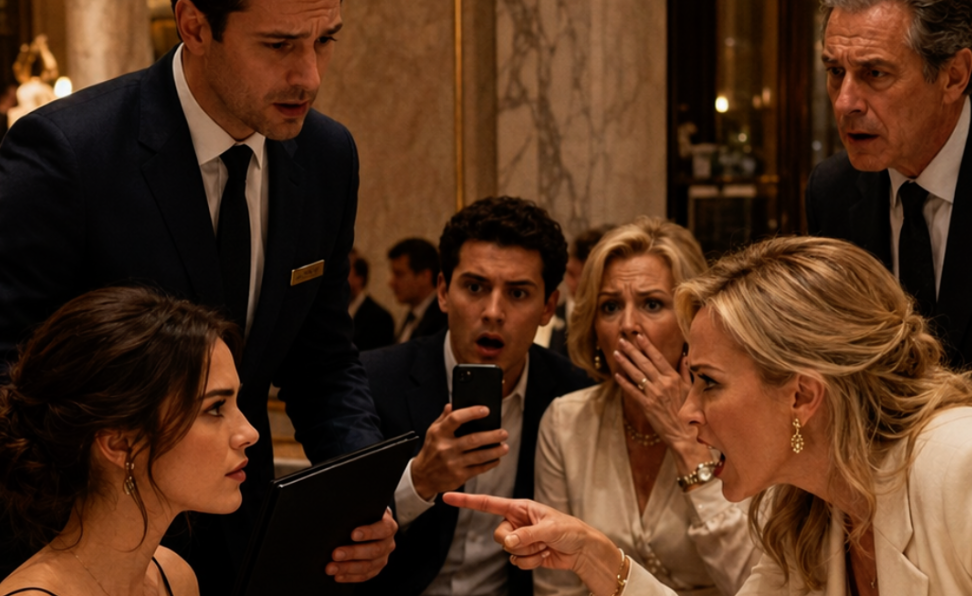
Sarah’s fork remained suspended mid-air. Kevin’s smartphone slipped from his fingers, clattering against the porcelain edge of his dessert plate. My mother’s lips parted in a silent, unfinished gesture, and my father went entirely rigid.
Marcus continued, his professional demeanor flawless. “The quarterly performance metrics are compiled in your study for review, and the principal architect is on-site with the updated structural plans for the executive lounge renovation. Additionally, the executive chef requested validation on the vintage selection for tomorrow’s board of directors dinner. Would you prefer the standard allocation, or would you care to audit the new arrivals from the cellar?”
He paused, casting a polite, generic glance across my stunned family. “I trust your Thanksgiving dinner has met our standard. Please inform me if there is any further accommodation required.”
I looked at my family in the absolute silence that followed. The color had receded from Sarah’s face beneath her cosmetics. Kevin looked at me as though the sister he had mocked had been replaced by a stranger between course updates. My father was the first to attempt an operational recovery, his corporate instincts reaching for an explanation he could manage.
“I’m terribly sorry,” my father said to Marcus, his voice uncharacteristically strained. “I believe there has been a significant administrative error here.”
Marcus turned to him with perfect, disciplined attention. “Sir?”
“You used the term… ownership,” my father stated.
“Yes,” Marcus replied, his expression shifting into a look of genuine institutional confusion. “Ms. Williams is the principal owner of the Grand Metropolitan. She has held the controlling equity position for approximately three years. She is scheduled to audit our quarterly financials this evening, though I can certainly defer the session if her family obligations require priority.”
He turned back to me, his notebook open. “Shall I instruct the architectural team to reconvene tomorrow morning, Ms. Williams?”
The younger version of myself—the girl who had spent her twenties desperate for their validation—would have immediately softened the blow. I would have laughed, made a self-deprecating joke, and apologized for the deception to shield them from their own shame. But the woman who had survived the commercial real estate markets of the Pacific Northwest simply lifted her water glass.
“Tomorrow morning at eight will be sufficient, Marcus,” I said. “And the standard vintage allocation will perform perfectly well for the board dinner.”
“Excellent,” Marcus noted. “I will inform housekeeping that you will be utilizing the penthouse suite tonight after all.”
He turned and walked away, his departure leaving the words behind like a live electrical line on a wet road.
No one at the table moved for a full sixty seconds. A busboy approached to refresh the water carafes, misread the atmospheric pressure of the table, and executed an immediate tactical retreat.
Finally, Sarah’s voice emerged, thin and fractured. “You own this property?”
“Yes,” I said.
“The entire hotel?” Kevin asked, his voice cracking slightly on the final syllable.
“The asset portfolio,” I clarified.
My mother’s hand reached out across the table, her fingers trembling against the wood. “Emma, sweetheart… how is that even possible?”
“Through disciplined capital allocation, Mom.”
My father’s commercial brain was visibly working now, attempting to process figures that exceeded his administrative parameters. “Emma… this is a premier downtown commercial asset. It represents an immense valuation.”
“The valuation is accurate, Dad.”
Sarah looked around the room, her eyes darting from the crown molding to the custom crystal chandeliers as if searching for a structural flaw that would invalidate the truth. “But you still reside in that small apartment.”
“I prefer the location,” I said.
“And you dress like…” She stopped herself, her eyes dropping to my unbranded wool sleeve. “You don’t present yourself like an executive who controls commercial real estate portfolios.”
“I don’t require my clothes to do my corporate negotiation for me, Sarah.”
Kevin was furiously tapping at his device, his eyes wide as he scanned an online directory. “Williams Hospitality Group,” he muttered aloud, reading directly from a business journal profile. “It says here you control four distinct luxury properties, a regional restaurant group, and a boutique resort development in Oregon. Emma… what is this?”
“The enterprise has scaled over the past three fiscal cycles,” I said.
Sarah stared down at her untouched dessert, her shoulders sinking into the back of her chair. “Four hotels.”
“We are currently finalizing the underwriting for two additional acquisitions in Portland,” I added.
My mother’s eyes filled with tears. “Why did you choose to keep this from us, Emma? Why did you let us remain completely unaware?”
The question was entirely predictable. It was framed as an expression of maternal hurt, but beneath the surface, it was an accusation: Why did you allow us to look foolish? Why did you fail to correct our arrogance before it transformed into our humiliation?
I set my glass down, the sound sharp against the quiet. “When was the last time any individual at this table asked a genuine, unprompted question about my professional existence? Not a joke about my little design projects, not a passive-aggressive remark about my lack of security, and not an unearned lecture on the necessity of a traditional corporate structure. An actual, curious question.”
The silence returned, heavier this time.
I directed my gaze toward Sarah. “You interrogated me about my ability to afford the menu before you bothered to ask what initiatives I was working on.”
She looked away, her jaw tightening.
I turned to Kevin. “You have dismissed my career as a digital hobby for seven years.”
He swallowed hard, looking down at his lap. “Emma, I didn’t mean—”
“And you,” I said, addressing my parents, “have spent a decade treating my independence as an administrative problem that required continuous monitoring rather than an enterprise that deserved structural respect. You loved me, certainly. But you chose to manage me because you couldn’t take the time to understand me.”
My father leaned back as if the words carried a physical impact.
“I never claimed insolvency,” I continued, my voice steady and measured. “I never reported a business failure. I allowed you to populate the silence with your own assumptions because it was far more efficient than attempting to convert people who had already finalized their verdict.”
Sarah’s voice came out brittle, her defensive instincts making a final, desperate appearance. “So this entire evening was a security test? You were simply evaluating our behavior?”
“No, Sarah,” I said, looking her directly in the eyes. “A test implies I was hoping for a different result. I wasn’t testing you. I was simply allowing you to demonstrate your default settings.”
That statement concluded the discussion.
Marcus returned a final time, accompanied by a sommelier carrying a chilled bottle of Krug champagne and six crystal flutes on a silver tray. “Compliments of the management team, Ms. Williams,” Marcus said, expertly pouring the wine. “And the staff requested that I convey their appreciation for your intervention regarding the Henderson event this morning. The team feels exceptionally secure under your leadership.”
He finished the service, wished us an exceptional evening, and vanished back into the operational grid.
My father looked at the champagne bubbles rising in his glass, then up at me. The condescension had entirely evaporated from his features, replaced by a raw, painful sincerity. He raised his glass with a slow, deliberate movement.
“I would like to offer a toast,” he said, his voice thick with unexpressed emotion. “To Emma. Our daughter, who built an extraordinary enterprise while we were too structurally blind to recognize the architecture. And to the family we are required to become from this night forward: one that prioritizes curiosity over assumption, one that respects diverse models of achievement, and one that understands that love without respect is merely a form of control.”
My throat tightened slightly, a residual echo of the child who had survived their indifference.
“To Emma,” my mother whispered.
“To Emma,” Kevin repeated.
Sarah lifted her glass last, her hand steady despite the wetness on her cheeks. “To my sister,” she said, her voice dropping into an uncharacteristic honesty. “Who never required my rescue.”
We drank. The vintage was immaculate. I knew its composition intimately; I had reviewed the cellar acquisition costs myself.
As we prepared to leave, the final bill was routed internally to my corporate account, as was standard operating procedure when I dined on-site. Sarah noted the absence of the folder.
“Emma,” she said, her voice quiet as we moved through the lobby marble. “I was intended to pay for this evening.”
“No, Sarah,” I told her gently, opening the brass-trimmed revolving doors for my parents. “You were intended to treat your family to a luxury experience. You fulfilled that intent. The operational cost of the evening is my responsibility.”
Outside, the Seattle air was cold and clean, smelling of saltwater and fresh rain. The valets moved through the amber glow of the entrance lamps with practiced velocity. My father turned to hug me before stepping toward the curb, holding me tighter than he had since I was a girl.
“I am immensely proud of you, Emma,” he whispered into the wind. “And I should have possessed the clarity to articulate that years ago. Not because of this building. Not because of the revenue metrics. But because you possessed the courage to construct your own architecture without waiting for our permission.”
“Thank you, Dad,” I said.
The following morning, at precisely 8:12 a.m., a text message arrived from Sarah:
Emma, do you have availability for a coffee session this Tuesday? I would genuinely appreciate the opportunity to learn about your acquisition model. Truly learn. Without the amateur advice.
I looked out the window of the penthouse suite at the ferry boats cutting white lines through the gray waters of Elliott Bay. I began typing a response.
I would welcome that, Sarah.
True luxury, I had discovered, was not represented by white stone facades, heated marble floors, or forty-two million dollars in annual regional revenue. The true luxury was the exclusive authority to determine who received access to the perimeter of the life you had built. The ultimate success was realizing that the table belonged to you, that the truth had arrived precisely at the moment of dessert, and that you had absolutely nothing left to prove to the ghosts of your past.