The ceiling fan traced its relentless, lethargic circles above our bed, and I lay in the suffocating darkness, meticulously counting the blades as they swept past. One. Two. Three. The rhythm was unyielding and entirely indifferent, possessing that cold reliability inherent only to mechanical things. Yet, somewhere within that monotonous repetition, I discovered the first profound stillness I had experienced in months.
It was long past midnight. The house, usually a vessel of negotiated tensions, was draped in absolute silence. Beside me, Greg was ostensibly asleep—or, more likely, performing the act of sleep. His breathing was entirely too measured, too consciously calibrated for a man who had truly surrendered to unconsciousness. I made no move to turn toward him. I offered no words to bridge the chasm that had opened between us. Instead, I fixed my gaze on the spinning blades, allowing the fan to carve the silence into something tangible, something I could finally grasp.
My name is Diane Mercer. I was fifty-two years old, residing in a sprawling house in Carmel, Indiana—a house for which I had dutifully paid half the mortgage for just over a year. My life, up until that evening, had been an exercise in careful curation and desperate optimism.
I had traversed the terrain of marriage twice. My first union, spanning two decades, did not conclude with a spectacular detonation, but rather with a slow, colorless erosion. It was a gradual fading that eventually left me sitting solitary in a kitchen I no longer recognized, grappling with the phantom mechanics of how my life had slipped through my fingers. In the aftermath, I made a solemn vow to myself: I would never repeat that specific tragedy. I swore I would never again conflate silence with stability, accommodation with genuine affection, or the mere absence of conflict with the presence of peace.
And yet, there I was, suspended in the dark, cataloging the rotations of a fan because my stepdaughter had explicitly reduced me to “the help” at my own meticulously set dinner table, and my husband had vehemently declared that I possessed no authority to defend my own dignity.
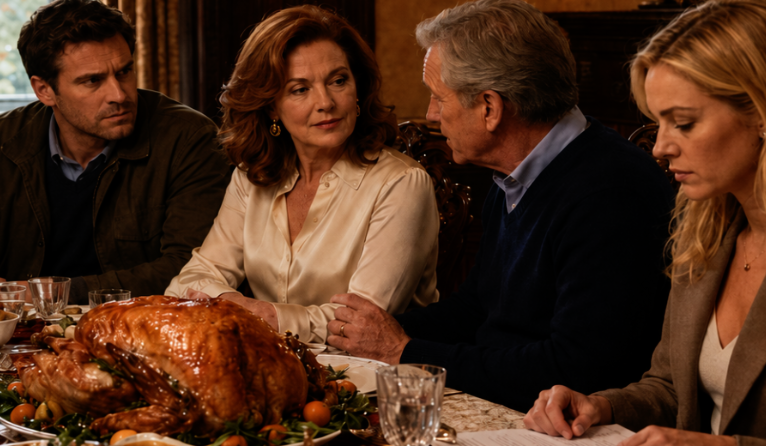
The catalyst had occurred hours earlier on a Sunday evening, a mere week before the enforced gratitude of Thanksgiving. It was the precise type of evening I had poured my soul into orchestrating. My sister, Patricia, had arrived bearing her perennial green bean casserole, generously crowned with an excess of crispy onions—a culinary tradition I playfully mocked but secretly cherished. Her husband, Ron, occupied the living room, oscillating between a Colts game and a hunting program, his boots resting comfortably on an ottoman I had spent weeks selecting from a spring catalog. My son, Ethan, had driven up from Fishers. He arrived smelling nostalgically of motor oil and crisp November air, pressing an unprompted kiss to my cheek the moment he crossed the threshold. Ethan possessed a quiet observance; he registered the subtle emotional currents that eluded others.
I remember standing at the kitchen island, rhythmically wiping down the granite counter, gripped by a fleeting, crystalline conviction that the fractured pieces of my life had finally coalesced. After the dissolution of my first marriage, I had spent years painstakingly reassembling my identity. Marrying Greg felt like the culmination of that grueling labor. We had a home. We had a blended family that included his daughter, Ashley. We shared meals where voices overlapped in lively debate.
That illusion of arrival survived exactly twenty minutes.
Ashley made her customary late entrance. I heard the aggressive click of her heels against the hardwood long before her physical presence graced the room. She was twenty, a sophomore at Indiana State University, characterized by sharp blonde features and a perpetual demeanor of being delayed for an engagement vastly more significant than her current surroundings. Without a word of greeting, she discarded her purse and yanked open the refrigerator.
“Dad, do we have anything decent to eat, or is it all casseroles again?”
She barked out a laugh at her own expense. The room remained conspicuously silent.
Over the preceding year, I had rigorously trained myself in the art of emotional rationing. I understood that not every slight required a counter-offensive; not every micro-aggression necessitated a diagnosis. Greg’s perpetual defense was that Ashley was merely “adjusting,” that the transition was a heavy burden for her, that she simply required time and grace. Consequently, I offered her an abundance of both. I offered a warm, unconditional smile when she breezed past me, uttering a dismissive “Hi, Diane” to the air rather than to me. I returned the greeting and let the disrespect dissolve into the ether.
Dinner commenced with ordinary, comforting acoustics: the scrape of silverware against porcelain, the shifting of ice in water glasses, the muted murmur of the television drifting from the adjacent room. I recall these sounds with agonizing precision because they were the final remnants of normalcy I would experience in that house.
Mid-meal, Ashley abruptly abandoned her fork and locked eyes with Patricia.
“So,” Ashley began, her voice carrying a manufactured innocence, “how long has Diane been running things like this?”
Patricia’s brow furrowed in genuine confusion. “What do you mean?”
Ashley executed a nonchalant shrug, a masterclass in passive aggression. “I don’t know. It just feels like she acts like she’s in charge of everything. Like it’s her house or something.”
A specific, suffocating silence descended upon the dining room. It was the communal realization that the social contract had been breached, that the atmospheric pressure of the room had irrevocably altered. I felt the physical manifestation of it in my chest—a sudden, sharp tightening, a breath instinctively trapped in my lungs.
Drawing upon every ounce of my cultivated restraint, I maintained a perfectly even timbre. “Ashley, this is my house.”
Her smile was devoid of warmth; it was a weapon. “Yeah, but let’s be honest. You’re basically just the help here.”
The sheer audacity of the statement struck with a force I hadn’t anticipated. It was not the inherent cruelty of the words that devastated me—I had weathered far more vicious storms in my half-century of living than the barbed tongue of an entitled undergraduate. The devastation stemmed from the context. We were in my home. My sister was seated to my left. My son sat directly across from me. The humiliation was violently public, served squarely in the center of the table like a grotesque centerpiece no one had requested.
I deliberately placed my fork on the table, the metallic clink ringing out like a gunshot. “Don’t speak to me like that,” I instructed. My voice was calm, utterly lucid, and devoid of hysteria.
She responded with an exaggerated roll of her eyes. “See? This is what I mean. You’re always correcting me like you’re some kind of…”
“Like I’m an adult in this house,” I interjected smoothly. “Which I am.”
It was precisely at this juncture that Greg intervened. However, his intercession was not directed at Ashley to temper her insolence or restore decorum. He turned his entire physical focus toward me. His voice adopted a flat, authoritarian resonance—the tone of a man delivering an undisputed universal truth.
“She’s not your daughter,” he stated. “Don’t correct her.”
The room plunged into an absolute, breathless stillness. The ambient hum of the refrigerator in its alcove became deafening. The wall clock above the archway marked the seconds with agonizing clarity. Somewhere down the street, a dog barked twice and fell silent.
I looked at my husband. I examined him with the terrifying clarity that arrives only when you finally permit yourself to acknowledge the reality you have been desperately avoiding. There was no internal conflict visible in his posture. He was not a beleaguered patriarch torn between competing loyalties. He possessed absolute certainty. He fundamentally believed the decree he had just issued.
I offered no argument. I did not escalate the volume of my voice. I did not engage in the theatrics of pushing my chair back and storming from the room.
“Okay,” I said quietly.
That single word concluded the confrontation. The meal limped onward in the surreal manner that life continues when a collective trauma is universally ignored. Patricia valiantly attempted to introduce a new topic. Ron muttered a commentary on the football game. Ethan remained paralyzed, his gaze fixed upon me, bearing the heavy, helpless expression of a son witnessing a sorrow he lacks the power to cure. Ashley seamlessly returned to scrolling on her phone, entirely untroubled. Greg assumed the posture of a monarch who had successfully quelled a minor peasant uprising.
When the guests departed, I undertook the ritual of cleaning the kitchen with agonizing slowness. I washed every dish by hand, tracing the porcelain rims, drying them deliberately, and returning them to their exact designated spaces. Greg remained anchored in the living room. He offered no assistance; he offered no apology. I did not request either.
And so, I found myself adrift in the midnight darkness, calculating the rotations of the ceiling fan, while the internal geography of my soul violently rearranged itself. The dominant emotion was not rage, though a cold fury certainly pulsed through my veins. It was not sorrow, though a profound grief lay foundational beneath the anger. It was an emotion far more formidable and infinitely quieter. It was the crystallization of something that had been gestating in the shadows of my marriage for a year.
It was absolute clarity.
This crisis did not originate with Ashley. The conflict was not fundamentally about a spoiled child’s disrespect. This was a damning indictment of a man who had comfortably watched me underwrite his life—who had permitted me to finance his home, subsidize his daughter’s education, her vehicle, her insurances, and her lifestyle—yet still categorized me as utterly optional. I was a convenient utility. My financial and emotional labor was greedily consumed, but my authority and personhood were fundamentally denied.
I turned my head, surveying the vast, empty expanse of the mattress separating us. My internal voice was steady and resolute: I am not going to repair this. I am officially done subsidizing a life I am not permitted to inhabit.
My eyes opened long before the sun breached the horizon. Aging brings a certain physiological rebellion; the body ceases to ask permission for its wakefulness and simply declares the night concluded. The house was enveloped in the heavy, gray suspension typical of late November mornings in the Midwest—a dense quietude that felt as though the day itself was hesitant to begin.
I descended the stairs and performed my morning liturgy: making coffee. Two generous scoops, slightly too robust, brewed in the dim light. I stood at the kitchen island, curling my hands around the ceramic warmth of the mug, my laptop resting closed on the counter before me.
For a fleeting, cowardly moment, the familiar urge to capitulate washed over me. The conditioning of a lifetime whispered insidious suggestions: Smooth it over. Initiate a calm dialogue with Greg. Grant Ashley another unearned opportunity. Preserve the fragile peace.
I had deployed those strategies countless times. I had compromised in microscopic increments, yielding ground so gradually that I remained entirely oblivious to the depletion of my own self-worth until the reservoir was entirely dry. That insidious habit of self-erasure was the very mechanism that had delivered me to this kitchen, standing alone in the dark.
I firmly placed the mug on the granite and lifted the lid of my laptop.
Anyone who has ever borne the invisible burden of managing a household’s financial architecture understands the intricate, singular web it forms. One set of credentials unlocks a labyrinth of interconnected liabilities. Bills are tethered to checking accounts; checking accounts are bound to automated payment schedules. It is a complex ecosystem, and the architect of that system is uniquely positioned to comprehend its fragility.
On paper, Greg’s income eclipsed mine. In reality, I was the sole engine ensuring our lives remained funded and functional. Somewhere along the line, my assumption of this burden had morphed from a temporary favor into an unquestioned permanent expectation.
I initiated a systematic audit of my reality. The screens loaded in rapid succession—patient, indifferent, and ruthlessly objective. Mathematics is devoid of empathy; numbers do not contextualize or soften their blow. They simply exist, demanding acknowledgment.
The Vehicle: Ashley’s Toyota RAV4, a lease commanding $412 monthly.
The Protection: Comprehensive auto insurance at $180 monthly.
The Housing: An off-campus apartment featuring a perpetual “shortfall” I covered, averaging $200 monthly.
The Lifestyle: Sorority dues and discretionary “extras,” frequently adding $300 to the ledger.
The Essentials: Cellular data plan, campus parking permits, and university textbooks.
I had absorbed these expenses without a secondary thought, operating under the deeply flawed premise that this is the duty of family. But I had been explicitly informed, before witnesses, that I did not belong to that protected class.
I leaned back, taking a sip of the rapidly cooling coffee. At fifty-one, when this financial hemorrhage began, I rationalized it as transitional support—the necessary scaffolding required while a newly blended family established its equilibrium. At fifty-two, illuminated by the uncompromising gray light of morning, the truth was unavoidable. I was not assisting; I had constructed the very foundation upon which their comfort rested, and they possessed the audacity to resent the architect.
Then, I navigated to our joint checking account. Here, the narrative shifted from passive exploitation to active deception.
Scattered throughout the ledger were unauthorized, unilateral transfers. They were deliberately modest sums—$400 on a Tuesday, $500 the following week—camouflaged with vague, deniable labels: Emergency. Textbooks. Miscellaneous. I traced the digital footprint of these transactions. They flowed directly into Ashley’s personal accounts. There had been no consultation, no discussion, no request. The capital was simply siphoned away, predicated on Greg’s arrogant assumption that I was either too negligent to notice or too compliant to object.
It was never the sheer volume of the money that induced the nausea; it was the psychological pattern it revealed. Greg had grown so accustomed to my subservience that he felt entitled to quietly redistribute our collective security to fund his daughter’s lifestyle behind my back.
I launched a blank document and meticulously cataloged the architecture of my exit. Car. Insurance. Tuition. Subscriptions. The illicit transfers. The process consumed a mere twenty minutes. Reviewing the completed ledger was akin to studying a topographical map of a minefield I had blindly navigated for a year. The emotion it provoked was not hysteria; it was a chilling, clinical precision.
Footsteps echoed from the floorboards above. Greg was rising.
I felt no compulsion to rush. I systematically executed the dismantling of my obligations.
Insurance Portal: Payment method detached.
Vehicle Lease: Autopay terminated.
Telecommunications: Billing cycle halted.
University Bursar: Scheduled payments completely disabled.
I did not cancel the policies outright—I am methodical, not vindictive. I merely severed the financial arteries that connected their liabilities to my bank accounts. Click. Confirm. Sever. It was the silent, devastating withdrawal of my labor from a structure that had never appreciated its weight.
My phone vibrated against the counter. A text message materialized on the screen.
Ashley: Why was my card declined?
I stared at the glowing text. A dark, bitter amusement bubbled in my throat. It was breathtakingly predictable. The absolute immediacy of her crisis perfectly illustrated how invisible my contributions had been until the exact moment they evaporated. I left the message unanswered.
Ashley: Hello???
I carried my ceramic mug to the stainless steel sink. Greg descended the staircase clad in sweatpants, his face slack with lingering sleep. He poured his coffee, casting a brief glance in my direction before unlocking his phone. I watched the precise microsecond the reality of the situation collided with his consciousness. The relaxed slope of his shoulders instantly snapped into rigid tension. His thumb froze over the illuminated screen.
“What did you do?” he demanded, his voice thick with apprehension, though he refused to meet my eyes.
I closed the distance between us, deliberately placing the printed ledger of expenses and disabled accounts onto the island before him.
“I stopped paying for things that aren’t mine,” I stated, my voice completely devoid of tremor.
His head snapped up. “What does that mean?”
“It means if she is not my daughter, as you so clearly articulated, then I am not responsible for her overhead.”
A muscle in his jaw feathered frantically. “Diane, do not start this again.”
“I am not starting anything,” I corrected him softly. “I am ending something.”
He furiously flipped through the documentation. “You cannot just cut her off like this. She’s in the middle of a semester.”
“I didn’t cut her off. I simply stopped paying. There is a profound difference. You are her father; you may fund her.”
“She relies on that money, Diane!”
I met his frantic gaze with absolute, unblinking stillness. “So did you.”
The impact of the words was visible. He physically recoiled, returning his eyes to the papers, scrambling for a new tactical approach. When he spoke again, he deployed a softer, placating tone—the sonic equivalent of a man trying to calm a startled animal.
“You are overreacting. It was one isolated comment.”
“It wasn’t one comment,” I replied, the devastating truth anchoring my words. “It was the first honest one.”
His phone began to ring. The caller ID flashed Ashley’s name. He quickly declined the call. It rang again. And again. The digital persistence of a child discovering consequences for the first time. He finally capitulated, answering the device and retreating into the living room, his voice dropping to a harsh, strained whisper as he desperately attempted to maintain the facade of control he had always relied upon me to facilitate.
“It’s fine. I’ll handle it. Just give me a minute, Ashley.”
I turned the faucet on, the water cascading warmly over my hands as I rinsed the remnants of my coffee. For the first time in a decade, the crushing, invisible weight of holding the universe together had vanished from my shoulders. I had set the burden down. The earth had not shattered; it had simply and immediately reorganized itself around my absence.
Greg re-entered the kitchen, his phone gripped tightly like a weapon. “She is in a complete panic,” he accused. “Her insurance, her debit card, her meal plan—everything is frozen.”
“I am aware.”
“You need to log back in and fix this.”
I slowly shook my head. “No. You do.”
He stared at me with an expression of profound disorientation, desperately searching my face for the compliant, endlessly forgiving woman he thought he had married. But she had been eradicated. I am not entirely convinced she ever truly existed; perhaps she was merely a survival mechanism, a performance I had executed so flawlessly that I had fooled myself.
I retrieved my laptop, retreated into my study, and closed the door with a quiet, definitive click.
It was during my subsequent archival of our financial correspondence that I discovered the email. It was a forwarded thread from six months prior, concerning a tuition deficit. Greg had forwarded a billing notice to Ashley. Beneath it was his subsequent reply to her panicked response—a reply I was never intended to witness.
“Don’t worry about Diane,” he had written. “She likes taking care of this stuff. Makes her feel needed. Just focus on school.”
I read the alphanumeric characters until they blurred. The casual cruelty of the assessment was staggering. It was entirely devoid of malice, which somehow made it infinitely worse. It was the effortless arrogance of a man who genuinely perceived my financial sacrifice not as an act of profound love or partnership, but as a pathetic attempt by an insecure woman to purchase relevance within his family. He had handed this deeply insulting narrative to his daughter, providing her with the psychological permission to consume my resources without ever suffering the burden of gratitude.
I pressed my palms flat against the cool mahogany of the desk. The lingering doubt regarding the severity of my actions evaporated entirely. I had not overreacted. I had simply awoken.
I dialed Patricia’s number. She answered on the second ring, her intuition immediately detecting the shift in my orbit. “Are you okay?”
I stared out the study window at the barren, dormant backyard. “I will be,” I promised.
I systematically relayed the events of the morning, culminating in the discovery of the email. Patricia listened in total silence—her trademark response when absorbing critical intelligence. When I finished, she exhaled a long, measured breath.
“That isn’t merely disrespect, Diane,” she diagnosed accurately. “That is systematic manipulation.”
“I know.”
“You do not scream at men who behave like that,” she advised, her voice adopting a steel edge. “You document them.”
“I already have.”
“Excellent. Because at our stage in life, peace is a luxury we must buy. But dignity is a price you cannot afford to lose.”
Her words echoed in my mind as I fled the house that afternoon, driving aimlessly until I found myself in the chaotic aisles of a Kroger supermarket. I didn’t require groceries; I required a physical space that did not demand a negotiation of my reality. I drifted through the aisles like a ghost, mechanically placing irrelevant items into my cart. At the checkout, the cashier offered a vacant smile, inquiring about my Thanksgiving preparations.
“Something like that,” I murmured.
I loaded the plastic bags into the trunk of my car, climbed into the driver’s seat, and turned off the ignition. And then, surrounded by the mundane theater of a grocery store parking lot, I wept. It was not a performative or theatrical sorrow. It was the primal, subterranean weeping of a woman mourning the death of a deeply held illusion. I was crying for the version of myself who had foolishly believed that infinite grace and financial subsidization could eventually purchase a sense of belonging. I had built that belief meticulously, brick by brick, and now I was staring at the rubble.
The ensuing days established a new, chilling geography within the house. Greg and I existed in a state of suspended animation. No screaming matches erupted; no plates were thrown. We merely moved around each other like deeply polarized magnets.
Determined to manage the fallout, Greg orchestrated a brunch for the following Saturday. He selected a trendy, bustling restaurant in Carmel—a strategic choice. The ambient noise provided cover, and the public setting was designed to enforce civility and contain my perceived volatility.
I arrived fifteen minutes prior to the designated time, securing a table near the window. I ordered a black coffee and placed a manila folder flat on the table before me. I felt no anxiety. I felt only the hyper-awareness that precedes an irreversible action.
Greg arrived with Ashley in tow. She had carefully constructed a facade of composure—flawless makeup, intentional posture—but a frantic uncertainty vibrated beneath her skin. She refused to meet my gaze.
Greg forced a magnanimous, artificially casual smile. “Hey. You got here early.”
“I value punctuality,” I replied smoothly.
They slid into the booth opposite me. The silence that stretched between us was thick and suffocating. A painfully cheerful server interrupted to take drink orders, and then we were abandoned to the reckoning.
Greg leaned across the table, instinctively lowering his voice to a conspiratorial whisper. “Diane, we really don’t need to escalate this into a major incident.”
I took a slow, deliberate sip of my coffee. “I am not escalating anything, Greg. I am clarifying.”
Ashley let out a sharp, derisive scoff. “Clarifying what? Why you decided to maliciously ruin my life overnight?”
I leveled my gaze directly at her. “Do you genuinely believe your life was ever mine to ruin?”
She opened her mouth to deliver a retort, but the words failed to materialize.
I opened the manila folder and slid the first document into the center of the table. “These are the exact financial metrics of your life, Ashley. The car lease, the premium insurance, the rent subsidies, the cellular plan, the sorority dues.”
I tapped the paper. “Dates. Amounts. Account origins.”
Ashley leaned forward, her eyes scanning the spreadsheet. The defensive arrogance slowly drained from her features, replaced by a stark, terrifying comprehension of her own dependency. “That’s not…” she stammered.
“It is mathematically exact,” I assured her. I then shifted my attention to Greg, sliding the second document forward. “And these are the unauthorized diversions of capital from our joint checking account. The ‘Miscellaneous’ transfers you executed without my knowledge or consent.”
Ashley turned to her father, genuine confusion morphing into betrayal. “You told me she offered to pay for these things. You said she wanted to do this.”
Greg visibly squirmed, the public exposure of his deceit stripping away his authority. “I handled the logistics. That is what is relevant.”
“No,” I corrected, my voice dropping to a register that commanded total attention. “It is not.”
I leaned forward, closing the physical distance. “You told your daughter that I enjoyed subsidizing her life. You explicitly stated that paying her bills was a pathetic mechanism I used to feel ‘needed’ in this family.”
Greg’s head snapped up, panic flashing in his eyes. “That is not what I…”
“I read the email, Greg. I read the exact words.”
The silence that followed was absolute. It was the silence of a structure collapsing inward.
Ashley stared at her father, appalled. “You actually said that?”
Greg’s hesitation, a fraction of a second too long, was a devastating confession. The fracture in Ashley’s certainty was now a gaping chasm. She looked down at the financial ledgers, finally understanding the profound difference between a benefactor and a victim.
I sat back against the leather booth. “I did not empty my bank accounts because I suffered from a desperate need to feel important,” I stated, addressing them both. “I paid those expenses because I operated under the delusion that we were a family.”
Greg leaned forward, his face flushed with a mixture of rage and humiliation. “You are embarrassing me in public,” he hissed.
I held his gaze without flinching. “You humiliated me in the sanctuary of my own dining room, in front of my own family. I am merely reciprocating the truth in front of a similar audience.”
“This is not how adults handle conflict.”
“You are absolutely right,” I agreed, signaling the server. “This is how they conclude it.”
I instructed the server to separate my check, paid for my coffee in cash, and stood up. I delivered no theatrical parting monologue. I simply offered a brief, final nod of acknowledgment, turned, and walked out into the biting November air, inhaling the sharp, clean oxygen of a life reclaimed.
The weeks that followed were devoid of cinematic drama; they were defined by rigorous, relentless practicality. I engaged a ruthless family attorney in Indianapolis. I legally severed every shared financial instrument. I cataloged every asset. I did not do this out of vindictiveness, but out of a fierce, protective instinct to guarantee I would never again surrender the sovereign control of my own existence.
By early December, the internal deliberation had concluded. I filed for divorce. It felt remarkably akin to filing a tax return or renewing a passport—a mundane bureaucratic process required to formalize a reality that had already cemented itself. Greg offered no substantial resistance. I believe, in the deepest recesses of his consciousness, he recognized that the catastrophic damage inflicted at that dinner table was entirely beyond the scope of mediation.
We dismantled the life we had built with surgical precision. What was legally mine remained mine; what was his remained his. There were no explosive courtroom battles, only the scratch of pens on legal documents and the echoing, final silence that follows the dissolution of a contract.
I relocated to a modest townhouse I had purchased during the interim years between my marriages. It was significantly smaller, infinitely quieter. The kitchen boasted a single, east-facing window. Every morning, the rising sun projected a warm, geometric column of light onto the quartz countertop, where it rested faithfully for an hour before drifting away.
On my first evening in the townhouse, I sat on the sofa, a woven blanket draped over my knees, cradling a mug of herbal tea, and simply listened. The acoustics of peace were astonishing. There were no heavy footsteps pacing the floorboards above. There was no phone vibrating with the manufactured crises of people who resented my presence. There was no suffocating tension embedded in the drywall, waiting to suffocate me. There were only the gentle, rhythmic sounds of a house settling into its foundations—the hum of the refrigerator, the faint pressure of the winter wind against the glass.
It was an alien sensation at first. Then, it became fiercely, exclusively mine.
Months later, on a frigid morning in late January, I awoke with the dawn. I prepared my coffee—two scoops, strong and dark—and stood before the east-facing window, watching the pale, indistinct light of the Midwestern winter bleed across the sky.
I did not check my phone. I dedicated no mental energy to analyzing Greg, or Ashley, or the insulting email, or the dinner table confrontation. I simply stood there, absorbing the radiant heat of the ceramic mug, watching the sunlight claim its space on the counter, steady and gloriously indifferent to the wreckage of the past year.
And I realized, with a profound, unshakeable certainty: This is mine.
It was not merely the physical property I possessed. It was the absolute, unadulterated stillness. It was the magnificent peace of standing in a kitchen where every single object existed exactly where it belonged because I, and I alone, had willed it so. No one possessed the power to walk through that door and inform me that my authority was invalid.
I rinsed my mug and placed it carefully on the drying rack. Through the window pane, a bright red cardinal descended upon a small wooden feeder I had hung from the eaves. It darted its head in sharp, precise movements, a vivid slash of color against the gray frost, entirely consumed by the magnificent, ordinary business of continuing to live.
I watched the bird until it took flight. Then, I reached for my heavy winter coat, laced up my boots, and stepped out into the freezing, brilliant air of a day that belonged to absolutely no one but me.