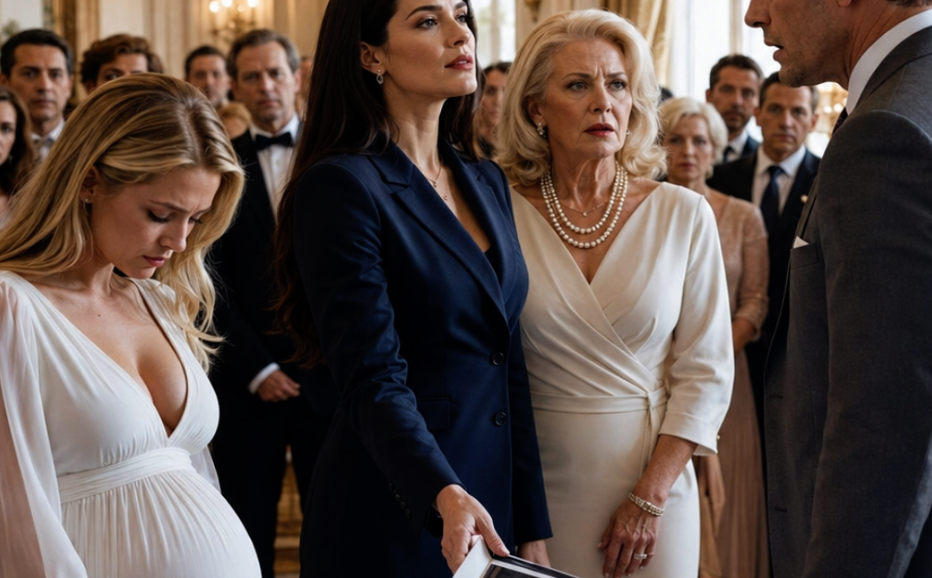
The boardroom on the 52nd floor of the Willis Tower was a sanctuary of glass, steel, and high-frequency data. Outside, the Chicago skyline was a charcoal sketch against a bruising May sky, but inside, the air was climate-controlled and smelled faintly of expensive espresso and the ozone of high-end server racks. My assistant, Michael, knew the protocol: unless the building was on fire or the SEC was on line one, you do not interrupt a Q3 expansion meeting.
Yet, there he was, knocking discreetly on the glass. I held up a single, sharp finger—five minutes—as I finished grilling the VP of Operations on our latency issues in the Singapore hub. When I finally stepped out, Michael looked uncharacteristically apologetic as he handed me my phone.
“Your sister, Emma. She’s called four times in twenty minutes. She sounds… stressed.”
I stepped into my corner office, where the floor-to-ceiling windows offered a panoramic view of Lake Michigan. I played the voicemail. Lauren’s voice, usually a polished instrument of suburban social grace, was strained, hovering somewhere between embarrassment and condescension.
“Hey, Emma, it’s me. So, about the baby shower next Saturday. I’ve been thinking, and okay, this is awkward, but the shower’s at Greenbryer Country Club. Daniel’s family is hosting. His mom basically planned the whole thing. Everyone’s going to be there—his parents’ friends, his colleagues from the firm, the ‘old guard.’ And I just think, you know, given where you are right now with the whole startup thing and everything, it might be better if you sit this one out. You’d feel uncomfortable anyway. All the other guests are, like, established. You know what I mean? Anyway, call me back. Love you.”
I replayed it. “Given where you are right now.” “Established.”
An hour later, the follow-up text arrived.
Lauren: “Did you get my message?”
Me: “Yes.”
Lauren: “So, you understand, right? It’s not personal. Daniel’s family is just… they’re very particular. His mom keeps talking about how elegant everything needs to be. Target clothes and startup stress just wouldn’t fit the vibe.”
I looked down at my own reflection in the glass. I was wearing a bespoke charcoal suit that cost more than Lauren’s first car. I wasn’t angry; I was fascinated by the sheer, durable density of her ignorance.
Me: “Okay.”
The Empire of Silence
For seven years, I had lived a double life. In one world, I was Emma Chin, the MIT-educated founder and CEO of Catalyst Financial Technologies. We didn’t just trade; we built the algorithmic architecture that allowed institutional giants to move billions of dollars with the surgical precision of a laser. My personal net worth was approaching nine figures, and Catalyst was valued at $3.2 billion.
In the other world—the world of Sunday roasts and family group chats—I was “the other daughter.” I was the one who had “thrown away” a stable, six-figure career at Goldman Sachs to chase a “pipe dream” in a studio apartment.
My father’s voice still echoed from that Thanksgiving seven years ago: “You’ll be back begging for your old job within a year, Emma. Finance isn’t a playground for girls with laptops.”
I never went back. But I also never corrected them. When Lauren married Daniel Whitmore—a man whose family name was etched into the stone of Northwestern University—the family narrative was finalized. Lauren had “won” the game of life by marrying into old money. I was the cautionary tale of what happens when you don’t settle down.
At Lauren’s wedding, Victoria Whitmore, the matriarch of the Whitmore clan, had looked at me with the pity one usually reserves for a three-legged dog. “It’s so brave,” she’d said, “trying to start a little computer business in this economy. I hope it works out for you, dear.”
I had just closed a $180 million Series C funding round. I simply nodded and said, “Thank you, Victoria. I hope so too.”
The compartmentalization was a survival mechanism. My family didn’t want to know about my work because it didn’t fit their internal map of who I was. To them, “tech” meant fixing a printer or posting on Instagram. They had no conceptual framework for high-frequency algorithmic liquidity. So, I stopped trying to build a bridge. I just let them believe I was struggling in my “Target clothes.”
The Magazine on the Table
The shift happened on a Thursday. The Wall Street Journal released its annual “Power Women in Finance” issue.
The photographer had spent hours in my office. They captured me in a navy Tom Ford suit, standing before the glass walls of our trading floor, where 200 monitors displayed the pulse of global markets. The headline was bold: “Emma Chin: The Algorithm Queen Revolutionizing Wall Street.”
It was a five-page spread. It detailed the $22,000 I’d saved from my Goldman salary, the two years of sleeping four hours a night, the proprietary code that had outperformed the S&P 500 for five consecutive years. It quoted the CEOs of three major investment banks who called Catalyst “the future of institutional trading.”
My phone stayed silent for the first twenty-four hours. My family’s group chat was busy discussing the color of the napkins for Lauren’s shower. It wasn’t until Friday afternoon that the first tremor hit.
My mother called, her voice breathless. “Emma? Carol from my book club just sent me a photo of a magazine. She said you’re on the cover. Why didn’t you say anything?”
“I mentioned the interview last month, Mom. You said you hoped it wouldn’t make me late for Lauren’s cake tasting.”
“Well… I didn’t realize it was this magazine. It says here you have a billion-dollar company. That can’t be right, can it? You’re in a startup.”
“The startup is worth $3.2 billion, Mom. It’s been that way for a while.”
There was a long, hollow silence. “I have to go,” she whispered. “I’m forwarding this to your father.”
Lauren’s text arrived shortly after.
Lauren: “Mom sent the WSJ thing. You look so different. Why didn’t you tell us you were successful?”
Me: “I didn’t think it fit the vibe, Lauren.”
The Country Club Collision
Saturday morning arrived with the clinical beauty of a Chicago spring. While the baby shower was commencing at the Greenbryer Country Club, I was in the office with my CFO, David Park.
“You’re an enigma, Emma,” David said, looking at the family photos I kept on a small shelf—photos where I was always the one slightly out of focus. “You’re worth half a billion dollars personally. You’re on every ‘Most Powerful’ list in the country. And yet you’re sitting here on a Saturday reviewing Q4 projections while your sister is having a party at a country club five miles away.”
“I wasn’t invited,” I said, not looking up from the spreadsheet. “My clothes aren’t right for the Whitmores.”
David laughed, thinking I was joking. I wasn’t.
At 2:45 PM, my phone rang. It was Victoria Whitmore. I answered, curious.
“Emma? Emma Chin?” Her voice was thin, stripped of its usual regal certainty.
“Yes, Victoria.”
“I’m at the club. My friend Margaret… she’s a collector of periodicals. She brought the new Journal to show me an article on interest rates. And there you are. On the cover. Standing in an office that looks like the bridge of a starship.”
“It’s the Catalyst trading floor,” I said.
“I asked Lauren about it. I asked her why her sister, the woman the Journal calls a ‘titan of finance,’ wasn’t here today. And she told me… she told me you were ‘still figuring things out.’ She told me you couldn’t afford to be here.”
I could hear the chaos in the background—the clinking of crystal, the hushed, frantic whispering of socialites who had just realized they’d snubbed a billionaire.
“Lauren made a choice based on what she wanted to believe about me, Victoria. It happens.”
“Emma,” Victoria’s voice became sharp, “everyone is looking at her. They’re looking at me. They’re asking why we’ve been treating a leader of industry like a charity case. It’s… it’s humiliating.”
“I imagine it is,” I said, and then I hung up.
The Aftermath of the Storm
The “Power Women” issue didn’t just change my family’s perception; it shattered it. Lauren called me thirty minutes later, sobbing.
“You ruined it!” she wailed. “Victoria is furious. She’s telling everyone I lied to her about you. All her friends are googling you, Emma. They’re not even looking at the gifts. They’re talking about your IPO valuation. This was supposed to be my day!”
“I didn’t do anything, Lauren. I stayed at work, just like you asked. You’re the one who told them I was a failure to make yourself feel more ‘established.’ Don’t be mad that the truth has a better publicist than you do.”
I didn’t attend the makeup dinner. I didn’t respond to the flurry of “we’re so proud of you” texts from aunts and cousins I hadn’t heard from in years. I waited.
On Sunday night, my mother showed up at my penthouse. It was the first time she’d ever seen where I lived. She stood in the entryway, her eyes scanning the 20-foot ceilings and the original Rothko on the far wall.
“You lived like this?” she asked, her voice small. “While we were worried about your ‘little computer business’?”
“I lived like this because I worked for it, Mom. But you never came to see. You never asked. You were too busy helping Lauren pick out curtains.”
“We didn’t know how to talk to you,” she said, tears forming. “You were always so… serious. So focused. We thought you were unhappy.”
“I was focused because I was building a world where I didn’t have to rely on anyone else’s approval. And it turns out, that’s exactly what happened.”
A New Equilibrium
A week later, I received an email from Victoria Whitmore. It wasn’t the usual stiff social invitation. It was an apology—a real one. She admitted that she had judged me by a “pedigree” that she now realized was obsolete. She asked if I would consider joining the board of a nonprofit she chaired, one focused on tech literacy for girls in underserved communities.
“Not because of your wealth,” she wrote, “but because I realized that I am part of the problem. I’ve spent my life valuing what people have inherited rather than what they’ve built. I’d like to learn from you.”
I accepted the lunch. Not because I needed her friendship, but because I saw an opportunity to change the culture of that country club from the inside out.
Three months later, when Lauren’s daughter, Clare, was born, I was the first person in the room. Lauren was quiet as she handed me the baby. The “Target clothes” comment was never mentioned again, but it hung in the air like a ghost.
“I want her to be like you,” Lauren whispered, her eyes weary. “I want her to have something of her own. Something that no one can take away.”
I looked down at my niece. She was small, fierce, and entirely unaware of the billion-dollar shadow I cast.
“I’ll teach her,” I promised. “I’ll teach her that the world will always try to tell her who she is. And I’ll teach her how to tell the world they’re wrong.”
The following year, Catalyst went public. The IPO was the largest tech offering of the season, valuing the company at $7.2 billion. I stood on the balcony of the Stock Exchange, the bell ringing in my ears, a sound that drowned out seven years of being “the other daughter.”
My family was there. They were dressed in their finest, smiling for the cameras, finally proud. But as I looked at them, I realized I didn’t feel the need to gloat. The real victory wasn’t the money or the fame. It was the fact that I no longer needed them to understand what I did.
I had built my own country club. And the dress code was simple: Show up as yourself, or don’t show up at all.