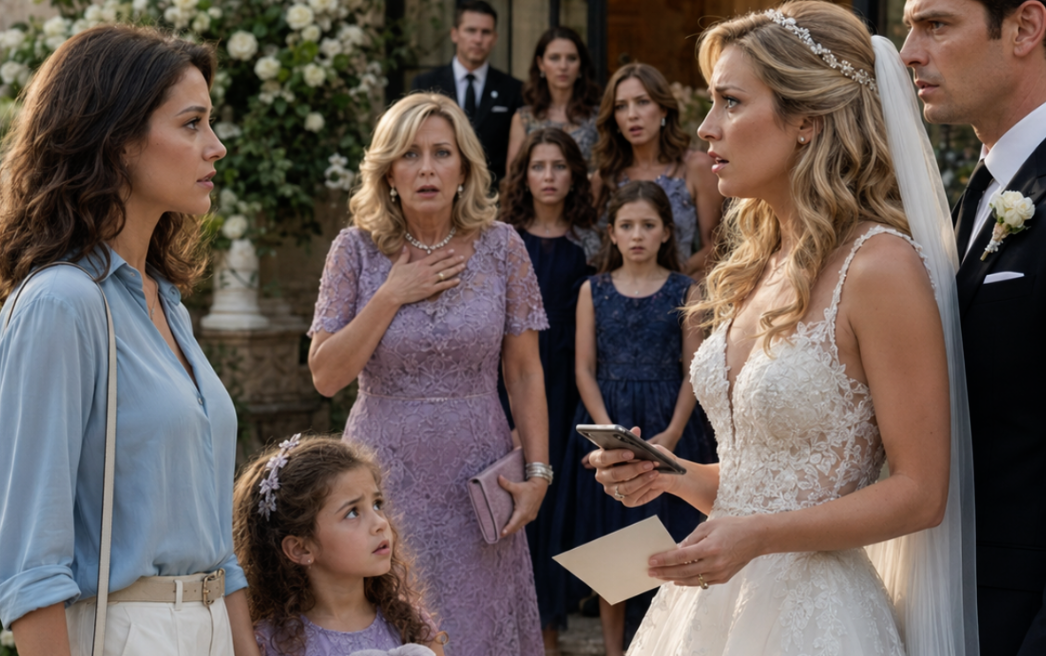
The precise moment the ambient lighting in my sister’s extravagant reception hall was extinguished was exactly 1:47 in the afternoon.
I am certain of this chronological detail because my smartphone was resting in my palm when the first frantic voicemail materialized. I was seated on a remarkably small, wrought-iron hotel balcony in Lisbon, my bare feet pressed against the sun-warmed tiles. A porcelain cup of dark espresso was slowly cooling on the table beside me, and just inside the glass doors, my six-year-old daughter, Nora, was sound asleep beneath a pristine white cotton blanket. The mighty Tagus River was gradually turning a brilliant, molten gold in the late afternoon sun, and somewhere in the labyrinthine streets below us, a vintage tram bell rang twice before its metallic clatter disappeared around a narrow cobblestone corner.
The voicemail that shattered the trans-Atlantic quiet was from the estate’s senior event director. Her voice possessed that artificially calm, overly measured cadence that seasoned professionals adopt when the environment surrounding them is actively descending into absolute chaos.
“Ms. Hayes, this is Margaret Ellison calling from Waverly House Events. We are contacting you regarding the final payment authorization for the Crawford-Hayes wedding reception. At this present time, we have not received the required confirmation from the administrative account holder. Per the stipulations in our contract, we absolutely cannot continue the full reception setup or open the doors until this balance is entirely resolved. Please return this call immediately.”
I listened to the recording once. Then, allowing the silence of the European afternoon to wash over me for a brief second, I pressed play and listened to it again. Inside the shadowed hotel room, Nora shifted peacefully in her sleep, wrapping her small arms tighter around her worn stuffed rabbit. For months, she had been speaking with unbridled wonder about airplanes and international travel, and that very morning, as our flight descended through the atmosphere, she had pressed her little face against the scratched acrylic window as though the passing clouds were a private, orchestrated miracle.
My phone screen illuminated once more. Mom. Then Aunt Carol. Then an unrecognizable local area code. Then my mother again, her persistence flashing in silent, digital desperation.
I did not answer a single one. Instead, I deliberately set the device face down on the balcony table and turned my gaze back out toward the shimmering river. Conditioned by decades of family dynamics, I fully expected an overwhelming wave of guilt to crash over me. I braced for panic. I anticipated the familiar, hollow ache—the persistent phantom pain that had shadowed me through most of my adult life whenever a family member required something and I failed to instantly provide it.
But the guilt never arrived.
What materialized in its place was a stillness so profound, so utterly complete, that it momentarily frightened me. Then, with sudden and breathtaking clarity, I recognized the sensation for what it truly was. It was relief. It was the specific, intoxicating relief one experiences when they have spent agonizing years single-handedly carrying a heavy table, entirely convinced that if they ever dared to set it down, the entire world would fracture into pieces—only to finally drop the burden and discover the table was never theirs to carry in the first place.
My name is Serena Hayes. At the time of this incident, I was thirty-four years old, a devoted single mother, a self-made business owner, and, according to the meticulously curated narrative maintained by my younger sister, Diane, I was the walking complication that no one in the family wanted to properly explain.
Diane was twenty-nine. She possessed that astonishing, effortless beauty—the kind of beauty that observers call “effortless” only when everyone in the background has spent exhaustive years carefully arranging the lighting to make it appear so. She had inherited our mother’s striking green eyes, our absent father’s high, aristocratic cheekbones, and a remarkably soft, lilting voice that unconsciously forced people to lean in just to hear her speak. Throughout our formative years, the family established a firm taxonomy: Diane was labeled “sensitive.” In our household lexicon, this meant she was permitted the luxury of tears whenever she encountered disappointment. I, conversely, was labeled “practical.” This meant I was strictly expected to dismantle and fix the source of the disappointment before anyone else had to endure the discomfort of witnessing it.
For an embarrassingly long portion of my life, I accepted this assigned role without rebellion.
I was the older daughter. The stoic anchor. I was the reliable archivist who kept track of the receipts, the chauffeur who drove relatives to distant medical appointments, the human vault who memorized every forgotten password, and the diplomat who knew precisely which second-cousin was deathly allergic to shellfish. I was the one who could unearth a critically important legal document buried deep within a kitchen junk drawer while the rest of the family was still pacing the floor, loudly arguing about who had misplaced it.
Diane was always the daughter our mother proudly introduced first.
“This is Diane,” my mother would announce at bustling church picnics, manicured neighborhood barbecues, and elaborate holiday brunches—anywhere the “right” kind of influential people might happen to be watching. “She’s our little star.”
Then, following a perfectly timed, dramatic pause, she would place a heavy hand on my shoulder. “And this is Serena. She’s the responsible one.”
In the Hayes household, responsible was never intended as a compliment. It was a lifelong job assignment, handed down without a contract.
After our father abruptly abandoned the family when I was in my sophomore year of college, my mother leaned even more aggressively into the preservation of appearances. We collectively agreed to never discuss his new, much younger wife. We never addressed why his meager child support checks arrived weeks late, nor did we speak of the haunting nights I would find my mother standing motionless in the laundry room, the dryer rumbling loudly to mask the sound of her muffled weeping. We simply carried on with terrifying precision. The front lawn remained flawlessly mowed. The embossed Christmas cards were consistently mailed on the first of December. Diane’s glittering dance recital photographs continued to be proudly displayed in polished silver frames on the living room mantel.
My achievements, meanwhile, were quietly packed into cardboard boxes in the attic.
By the time I gave birth to Nora, my family had collectively learned to discuss my life with a certain careful, hushed softness—as if my beautiful daughter and I were not a profound joy, but rather a regrettable medical diagnosis. Nora’s biological father and I had mutually separated long before she was born. There was no scandalous affair, no dramatic cinematic betrayal; we were simply two fundamentally incompatible people. The result, however, was one extraordinary child whom I loved with a fierce, gravitational force that permanently rearranged the entire architecture of my life.
I built my financial consulting practice from scratch, operating out of a rented, slightly drafty two-bedroom apartment situated on the quieter, less fashionable side of the city. In the early days, I worked exclusively during Nora’s afternoon naps. As she grew, I shifted my hours to the dark quiet after her bedtime, and eventually, to the structured windows of her preschool schedule. I began by organizing rudimentary financial planning systems for struggling local companies, graduated to developing complex budgeting models for expanding mid-sized firms, and eventually mastered long-term vendor and cash flow strategies for demanding corporate clients. They valued my services because I remained unflappable under intense pressure.
By the time Diane proudly announced her engagement, I maintained four highly lucrative corporate retainers, earned a highly respectable income, and had meticulously cultivated a life I was fiercely proud of. It was not flashy. It certainly did not photograph well when placed adjacent to sweeping marble foyers and generations of old family money. But it was authentic, and more importantly, it was entirely mine.
Then, Diane was introduced to Clifford Crawford.
Clifford originated from the specific, rarefied echelon of society that utilized words like “legacy” and “summered” without a trace of irony. His parents held title to sprawling commercial properties spanning two distinct states. His mother perpetually chaired exclusive philanthropic committees. His father spoke in soft, vague numbers that always implicitly suggested significantly more wealth existed secured in offshore trusts. Upon first glance, they were not outwardly cruel people. They were simply hyper-polished. In many ways, that is far more dangerous, because polished individuals possess the terrifying ability to make systemic exclusion look exactly like polite etiquette.
Diane fell passionately in love with Clifford with breathtaking speed—or, perhaps more accurately, she fell in love with the impenetrable, gilded world that accompanied him. Her weekends transformed into elegant dinners at private, members-only clubs. Their engagement photographs were staged on the sprawling, manicured lawns of his parents’ waterfront estate. Family brunches suddenly featured imported linen napkins and hushed conversations centered around architectural renovations, blind trustees, and elite preparatory schools bearing names that sounded suspiciously like prestigious corporate law firms.
My mother was utterly mesmerized by the proximity to such power. She rapidly began pronouncing the phrase “the Crawfords” with a reverent, breathless little lift in her voice.
Simultaneously, Diane began an aggressive campaign of editing herself. Shortly thereafter, she began editing us. She gently suggested that our mother replace the perfectly functional living room curtains before Clifford’s parents arrived for an introductory dinner. She nervously requested that Aunt Carol refrain from sharing her famously boisterous “big family stories” because Clifford’s mother purportedly preferred a more “refined, intellectual” atmosphere.
The most cutting moment occurred one afternoon in my apartment. Diane was standing in my modest kitchen, her eyes scanning the vibrant, chaotic crayon drawings Nora had proudly taped to the refrigerator door. With a tight, practiced smile, she informed me that the Crawfords were “very traditional.”
“Traditional in what sense?” I inquired, pausing my work.
Diane offered a hollow, breathless laugh, casually opening one of my cabinet doors without seeking permission. “They just have a certain, specific way of viewing family structure. They prefer things… organized.”
Family structure. With those two carefully chosen words, my daughter ceased to be a human being and was officially categorized as a public relations vulnerability that needed to be managed.
Eighteen months prior to the wedding date, my mother called me at precisely nine o’clock on a Tuesday morning. I recall the exact hour because I was deeply engrossed in preparation for a major client presentation, standing at my kitchen island with my laptop glowing while half-packing Nora’s school lunchbox.
“Serena,” my mother announced, dispensing with any preliminary greetings. “Diane needs your help.”
This was the customary overture to our familial transactions. Never “How are you?” Never “How is my granddaughter?” Only the immediate presentation of Diane’s latest crisis.
“What exactly happened?” I asked, my fingers hovering over the keyboard.
“The initial venue deposit is due by this Friday. They have selected Waverly House, the historic estate down near the river basin. It is beyond perfect, Serena. Absolutely breathtaking. However, the venue requires a twelve-thousand-dollar deposit to secure the date, and Clifford’s family is graciously handling several other substantial financial obligations right now.”
I closed my eyes and massaged my temples. Other obligations. The Crawford family was perpetually occupied with mysterious “other obligations” whenever hard liquid currency was required from our side of the aisle.
“Why is Diane selecting a venue she clearly lacks the capital to secure?” I asked.
A heavy, judgmental silence hung on the line. “Please do not be unkind, Serena.”
“I am not being unkind. I am asking a basic, practical logistical question.”
“You are the practical one,” my mother countered, her tone implying this incontrovertible fact settled the debate. “That is precisely why I am calling you.”
I looked down at Nora’s lunchbox. I stared at the bright orange slices meticulously arranged in a reusable silicone cup, and the simple peanut butter sandwich I had carefully sliced into neat triangles, purely because she had recently declared that rectangular sandwiches tasted “boring.”
“Does Diane know you are calling me to ask for this money?”
“Yes.”
“Did she explicitly ask you to ask me?”
Another pause, noticeably longer and heavier than the first. “We are all family, Serena.”
And there it was. The ultimate trump card. The manipulative phrase that magically transmuted a highly inappropriate financial request into a sacred moral obligation, simultaneously transforming any logical questioning of that obligation into an act of supreme rudeness.
I paid the twelve-thousand-dollar deposit.
I rationalized the decision to myself. I framed it as a singular, generous wedding gift. An act of sisterly kindness. I foolishly believed that Diane would eventually pull me aside in a quiet moment, long after the wedding stress had dissipated, and offer a genuine, heartfelt thank-you.
She never did.
Four months later, the aggressive catering deposit materialized. My mother called again, her voice tight with manufactured anxiety, explaining that Diane was utterly overwhelmed and the artisan caterer demanded a massive upfront payment to lock in the seasonal menu. Clifford’s family, she noted, maintained exceptionally high culinary expectations, and it would be “profoundly embarrassing” if our side of the family could not contribute properly to the feast.
I transferred the funds.
Then arrived the elite florist’s initial invoice. Following that, the expansive garden lighting deposit. Soon I was covering two solid months of vendor coordination fees simply because the high-end planner Diane had hired charged an exorbitant premium for “family-side management”—a vague administrative burden that, inexplicably, had become my sole financial responsibility. At one particularly absurd juncture, I paid a substantial balance on the luxury hotel room block because my mother frantically explained that several extended relatives on our side could not afford the exorbitant nightly rates, and Diane was allegedly “too emotionally fragile” to endure yet another stressful conversation regarding money.
Throughout this entire ordeal, no one ever uttered the word loan. No one ever whispered a syllable about repayment. The capital simply flowed out of my accounts, passing through my hands, and became entirely invisible the exact second it attached itself to the wedding machinery.
In total, I injected sixty-one thousand dollars into the foundation of Diane’s perfect day.
I obviously kept this staggering figure hidden from Nora. I kept it hidden from my professional clients. I barely possessed the psychological courage to admit the total to myself. To manage the hemorrhage of cash, I aggressively drained my hard-earned savings, indefinitely delayed a much-needed office technology upgrade, and entirely postponed hiring the part-time administrative assistant my growing business desperately required. I fed myself comforting lies: I told myself this financial strain was strictly temporary, that loving families naturally stretch their resources for one another during monumental life events, and that Diane would surely recognize the sheer magnitude of my sacrifice once the chaotic fog of wedding planning lifted.
But beneath the surface of those lies, my subconscious already grasped the brutal truth.
The most agonizing aspect of the situation was not the loss of the money itself. It was the fact that everyone in the family knew exactly what I was sacrificing, yet they collectively allowed me to stand entirely alone, bearing the crushing weight of the cost in silence.
Aunt Carol was fully aware. She called me one evening while I was mindlessly folding a mountain of laundry and softly declared, “You’re the one holding this entire family together, honey.”
I slowly sat down on the edge of my mattress, staring blankly at one of Nora’s tiny, brightly colored socks clutched in my fist. “I don’t recall ever submitting a resume for that particular job,” I replied, my voice hollow.
She merely sighed, a sound rich with complicit resignation. “You know exactly how your mother gets when Diane is upset.”
Yes. I knew exactly.
The email that finally shattered the illusion arrived on an otherwise unremarkable Thursday afternoon in early May.
I was hastily eating dry crackers over my kitchen sink between intense client consultations, having entirely forgotten to consume a proper lunch. A notification chimed. The subject line was sterile and corporate: Wedding Weekend Logistics — Please Read Carefully.
The sender was Diane. Not our mother. Not the overpriced wedding planner. Diane herself.
For some inexplicable, foolish reason, seeing her name in the sender field filled me with a brief, soaring sense of hope that lasted precisely five seconds. I naively assumed she was finally taking a moment to acknowledge my unseen labor. I imagined the email contained a thoughtful private schedule and a profound expression of gratitude. I believed she had finally experienced an epiphany regarding just how much of her impending fairy tale had been quietly subsidized by my depleted bank accounts, my sacrificed weekends, and my exhausting late nights.
I clicked open the message.
The text was clinically organized into rigid bullet points. That structural choice was the first element that struck me like a physical blow. It was not composed in the warm, conversational tone of a sister speaking to her sibling. It read identically to a sterile internal memo distributed by a corporate committee that had already concluded its final vote behind closed doors.
The very first bullet point coldly dictated that both the wedding ceremony and the ensuing reception would be strictly adult-only affairs.
I stared unblinking at the glowing pixels on my monitor. Nora was only six years old. She adored her Aunt Diane. She had spent the last three weeks enthusiastically practicing her “special wedding dancing” in our living room, twirling in her socks across the hardwood floors with her battered stuffed rabbit securely tucked under one arm. Although I had not yet purchased her formal attire, she had meticulously drawn her dream dress in purple crayon and proudly taped the artwork to the wall beside her bed.
My heart hammered a slow, heavy rhythm against my ribs as I forced my eyes to keep reading.
Diane’s text smoothly pivoted into defensive justifications. She wrote that she sincerely hoped I would be understanding, but Clifford’s distinguished family held very specific, unyielding expectations regarding the sophisticated atmosphere of the event.
Then came the sentence that permanently altered the trajectory of our relationship—a string of words I will vividly remember until the day I die.
Children from unconventional family situations can unintentionally become a distraction.
I read the sentence once. I read it a second time.
The air in my apartment seemed to instantly evaporate, leaving behind a ringing, absolute silence. Outside the window, a heavy delivery truck rumbled down the asphalt. Somewhere down the long hallway, a neighbor’s dog let out a sharp bark. The radiator in the corner clicked once, a metallic pop, even though the heating system was completely turned off. They were the painfully ordinary sounds of an entirely ordinary afternoon. But my entire universe had violently contracted, narrowing down to that single, venomous line radiating from the screen.
Children from unconventional family situations.
My beautiful daughter. My sweet, imaginative Nora. Reduced to a “distraction.”
This mandate was not issued because she had a history of misbehavior. It was not born out of genuine concerns regarding venue capacity, physical safety, or budget constraints. It was executed purely because she belonged to me. It was because my complex, entirely self-sufficient life did not slide neatly into the pristine, two-dimensional portrait Diane was so desperately trying to present to the Crawford dynasty.
Operating with a strange, disconnected calm, I gently closed the laptop screen, setting the machine softly on the dining table. I walked down the hall to the bathroom, turned the silver faucet, and simply allowed the freezing water to rush over my hands, even though they were perfectly clean. I stood there for what felt like hours, watching the clear water spiral down into the white porcelain drain until the suffocating pressure expanding inside my chest finally reduced to a manageable ache I could breathe through.
I returned to the table. I opened the laptop. I read the remainder of the manifesto.
The subsequent bullet points transitioned back to financial demands with an ease that was genuinely breathtaking in its audacity. The final, massive venue balance had unexpectedly increased due to a miscalculation, and it urgently needed to be resolved before the strict Friday payment deadline. The luxury hotel block required an immediate, supplemental cash guarantee. The elite florist had abruptly tacked on a “seasonal availability premium.” Furthermore, Diane casually referenced a “honeymoon contribution,” formatting it not as a polite request, but as an absolute necessity that belonged naturally alongside the vendor invoices.
Then, my eyes reached the final section. It was entirely about me.
To ensure the flawless execution of a “cohesive family presentation,” Diane formally requested that I arrive at the venue entirely separate from the main family procession. She explicitly instructed me to sit at a designated table located in the far back corner of the reception hall, safely grouped alongside a collection of her peripheral work colleagues. Furthermore, she suggested it would be “best for everyone” if I aggressively avoided discussing my successful financial consulting practice unless directly questioned, because Clifford’s elderly relatives might find my financial independence “confusing and difficult to contextualize.”
I sat immobilized in my chair.
The message was impossibly clear. She desperately wanted my money present in that opulent room. But she absolutely did not want my daughter. She did not want my history. She did not even want me, not in any whole or recognizable form. She merely required my quiet, continuous funding, safely hidden out of sight behind the imported linen tablecloths and the towering floral arches.
Later that evening, I walked to the elementary school to pick Nora up from her after-school program. She spotted me across the courtyard and ran toward me at full speed, her heavy backpack bouncing against her spine and a brightly colored paper crown resting slightly askew on her head. Her class had spent the afternoon crafting crowns for a storybook festival, and she was bursting with pride over the lopsided, glitter-covered star she had glued to the very front.
“Mommy, can I please wear my special crown to Aunt Diane’s beautiful wedding?”
My feet stopped moving for a fraction of a second. I looked down into her wide, impossibly bright, deeply trusting eyes.
I reached out, gently brushing a stray wisp of hair from her warm forehead. “We will have to see about that, sweetheart,” I murmured.
When we returned home, I stood frozen by the living room window, pulling up the devastating email on my phone once more while Nora sat happily at the kitchen table, lost in a world of crayons and coloring books. She was softly humming to herself as she worked, a sweet, slightly off-key melody that embodied the pure, unadulterated sound of a child who feels entirely safe in her universe.
Watching her, the immense hurt blossoming inside me finally calcified into something fundamentally different. It was not anger. Anger implies a loss of control. What I felt was pure, blinding clarity.
I did not dial Diane’s number. I did not call my mother to negotiate.
I picked up the phone and dialed the direct line of Patricia Bell, my fiercely competent corporate attorney.
Patricia had meticulously reviewed and managed my complex business contracts for over six years. She was unflappable, hyper-precise, and profoundly allergic to emotional manipulation or ambiguity. When I swiftly forwarded Diane’s email to her inbox and calmly explained the massive web of payments I had quietly sustained, she asked me only three highly specific questions.
“How, exactly, were these extensive vendor payments structured on paper?”
“They were all routed exclusively through the blind payment trust your firm established for me last year,” I replied.
“And who is currently listed as the primary administrative contact for that specific trust?”
“Your office holds the administrative authority.”
Patricia was silent for a brief moment. “And does the language within the foundational trust agreement allow for the unilateral withdrawal of financial authorization before these final, pending balances officially clear the bank?”
I could hear the crisp, sharp sound of thick paper pages turning rapidly on her end of the line.
Then she spoke a single, definitive syllable. “Yes.”
It was one word, but to my ears, it sounded precisely like the heavy, rusted lock of a prison door finally turning open.
The payment trust had not been originally created as an instrument for dramatic leverage. It had been established purely as an administrative convenience, primarily because my mother was deeply paranoid that Clifford’s aristocratic family would discover I was the sole financial engine behind so many crucial elements of the event. I had readily agreed to remain securely behind the scenes, entirely failing to comprehend just how far behind the scenes they ultimately intended to bury me.
Patricia methodically walked me through the stark legal reality of my position. If I chose to formally revoke the final payment authorization before the massive venue balance cleared the financial institution, the Waverly House estate possessed the ironclad contractual right to immediately suspend all services. Both the elite florist and the artisan caterer held nearly identical penalty clauses for any unpaid final balances. Furthermore, the high-end vendor coordination agreement would freeze instantly the moment confirmed funds were no longer guaranteed.
“The exact timing of this action matters immensely, Serena,” Patricia warned, her tone shifting to grave professionalism.
“The wedding ceremony is scheduled for this Saturday at precisely two in the afternoon.”
“And what is the absolute final payment deadline mandated by the venue?”
“This Friday, by five o’clock in the evening.”
She allowed a heavy silence to settle between us. “Serena, from a strictly legal standpoint, you are entirely within your rights to withdraw your financial support immediately. But you must understand that, emotionally and relationally, the fallout from this decision will be catastrophic and permanent.”
I slowly turned my head, my eyes locking onto the new drawing Nora had proudly affixed to the refrigerator. It depicted a vibrant purple dress. Bright yellow stars. Three cheerful stick figures carefully labeled Mommy, Nora, and Aunt Diane. In her boundless, innocent generosity, Nora had even drawn a beautiful crown resting on Diane’s head.
“I am fully aware of the consequences,” I stated softly.
“I advise you to take a full twenty-four hours to consider this.”
“I genuinely do not believe I require that time.”
“Take the twenty-four hours anyway,” she insisted firmly.
And so, respecting her counsel, I did.
The following evening, after school dismissed, I took Nora to our favorite, unassuming Italian restaurant located just two blocks from our apartment building. It was a comforting, unpretentious establishment featuring worn red vinyl booths, thin paper placemats, and a jovial waiter named Marco who unfailingly ensured Nora received an extra, heaping bowl of grated parmesan cheese. She happily ordered her standard plate of buttered noodles and launched into a highly detailed, winding narrative regarding a playground dispute that had apparently erupted and peacefully resolved itself entirely before the recess bell rang.
I sat quietly, watching her small hands expertly twirl the pasta around her fork.
She remained blissfully unaware that a group of supposed adults had convened in a room somewhere, actively debating whether her mere existence would make an opulent wedding appear slightly less refined. She possessed no concept that anyone could possibly look at her joyful face and see a “situation” that needed to be managed, hidden, or avoided entirely.
I paid the modest restaurant check in cash. My decision was cemented with absolute finality before our shoes even touched the concrete sidewalk outside.
On Friday morning, I arrived at Patricia’s sleek downtown office. Brilliant, unyielding sunlight streamed through the massive floor-to-ceiling glass wall behind her expansive desk, illuminating tall, organized stacks of blue legal folders and a heavy silver fountain pen placed with geometric precision beside a crisp stack of documents.
“This is your final opportunity to pause the mechanism,” Patricia noted, sliding the paperwork across the polished mahogany.
I picked up the silver pen and signed the revocation authorization without a tremor in my fingers.
With those strokes of ink, the trust’s immense financial commitment to the Waverly House final venue balance, the massive catering balance, the sprawling floral installation, and the exorbitant vendor coordination fees was permanently and legally revoked, strictly effective as of Saturday morning at 7:00 a.m.
Exactly seven hours before the first string quartet was scheduled to play.
I executed the signatures slowly, deliberately, my cursive name bold and unwavering on every single line. I did not initiate this action because I possessed a malicious desire to orchestrate chaos. I signed those papers because I was fundamentally, permanently finished with actively financing my own erasure.
Late that Friday evening, under the cover of darkness, I drove my car to the perimeter of the Waverly House estate.
The rehearsal dinner had clearly just concluded. In the fading, bruised twilight, the historic estate looked undeniably magnificent—a sprawling vision of ancient stone steps, meticulously manicured ivy walls, sculpted hedges, and hundreds of pristine white garden chairs aligned in mathematically perfect rows upon the lawn. Through the towering, illuminated glass windows of the grand reception hall, I could observe the venue staff bustling through the space, carefully polishing expensive glassware and precisely measuring the distance between elegant table setting cards.
From my vantage point near the iron gates, I spotted Diane standing near the illuminated garden entrance. She was wearing a pale, flowing rehearsal dress, her head thrown back in joyous laughter as she conversed animatedly with Clifford’s wealthy sister. She looked impossibly radiant, enveloped in absolute certainty, resembling a woman who truly believed that tomorrow’s happiness had already been securely purchased and paid in full.
I made no attempt to approach her.
I had brought a small, thick cream-colored envelope with me. Tucked inside was a brief message, written entirely by hand.
I sincerely hope you get exactly the life you have built. I will not be in attendance tomorrow. Neither will my financial support. Take care of yourself, Diane.
I quietly slipped through the side entrance door, locating the heavily laden coat rack holding the bridal party’s belongings. Identifying Diane’s familiar designer coat, I slid the cream envelope deep into the silk-lined pocket, turned on my heel, and vanished into the night.
My hands did not begin to tremble until I was safely locked back inside my vehicle.
The shaking was not born of regret or panic. It was the overwhelming, entirely unfamiliar physiological sensation of finally choosing to protect myself without asking a single person for permission to do so.
Nora and I boarded a commercial flight departing at precisely 6:45 the following morning.
She was adorned in her favorite bright pink noise-canceling headphones, clutching her battered rabbit tightly against her chest as the massive engines roared to life during takeoff. The moment the plane broke free of gravity, she let out a delighted gasp and immediately grabbed my hand.
“Mommy, look! We’re flying high above the clouds!”
“Yes, my love,” I replied, staring out the scratched window at the sprawling, shrinking world far below us. “We absolutely are.”
By the precise moment Diane triumphantly arrived at the grand gates of Waverly House to begin her morning preparations, the legal withdrawal of the financial authorization had already been executed.
I possess knowledge of the subsequent, spectacular unraveling only through a chaotic tapestry of frantic voicemails, Patricia’s impeccable legal documentation, and my aunt’s incredibly reluctant, whispered recounting of events three days later.
At exactly ten o’clock that morning, the estate’s increasingly panicked event director formally informed Clifford’s mother that an impenetrable financial hold had been placed upon the primary account. By eleven o’clock, the artisan catering team decisively halted all kitchen preparations. At noon, the elite florist abandoned the half-finished floral arches and walked off the property. By one-thirty in the afternoon, the first wave of bewildered guests was already beginning to arrive at the estate, only to discover the massive wooden doors of the main reception hall remained firmly locked because the final, six-figure payment had failed to clear the bank.
Diane repeatedly insisted to anyone who would listen that a terrible administrative error had occurred.
My mother frantically contacted her personal bank, only to endure the humiliating revelation that she possessed nothing remotely close to the staggering amount of capital required to salvage the day. Clifford’s icy parents immediately demanded to know exactly who had been secretly managing our family’s designated portion of the financial obligations. Diane, cornered and desperate, initially stammered something about “family resources.” Then she shifted the narrative to “a private account.” Ultimately, she could offer nothing useful or truthful at all.
At precisely 1:47 PM, the brilliant crystal chandeliers in the grand reception hall went entirely dark because the venue management officially suspended all active setup operations.
At 1:50 PM, Diane finally reached into her coat pocket and discovered my cream envelope.
According to Aunt Carol’s solemn testimony, Diane collapsed onto a cold stone garden bench, the note clutched in her shaking hand, and remained entirely motionless for several agonizing minutes.
Clifford stood silently near the grand stone steps, his hands hanging uselessly at his sides.
His mother stood several yards away, maintaining a terrifying physical distance. According to my aunt, Clifford’s mother did not raise her voice. She did not engage in a vulgar, public scene. She merely looked down at Diane with an expression that was profoundly quieter than anger, yet infinitely more permanent than mere disappointment.
By the time this implosion reached its zenith, I was thousands of miles away in Lisbon, peacefully observing Nora sleep off the jet lag while my muted phone erupted with endless digital notifications beside a cooling cup of espresso.
My mother’s first frantic text message demanded: Serena, call me immediately. Her second message pivoted to shame: This is absolutely not the way a decent family behaves. Her third, and final message for the day simply read: What in God’s name did you do?
I deliberately ignored every single one of them.
Instead, as the early evening settled over Portugal, Nora and I strolled down the ancient cobblestones toward the waterfront. She gripped my hand tightly, enthusiastically pointing at the intricate blue-tiled buildings, the brightly painted yellow trams, and the dark water shimmering brilliantly beneath the suspension bridge. We stopped at a tiny, fragrant bakery near our hotel and consumed warm custard tarts, leaving powdered sugar dusted across our fingertips. Looking up at me with wide eyes, she innocently asked if we could make this trip a yearly tradition.
“We will certainly see,” I told her, smiling.
But this time, unlike all the times before, the phrase did not feel like an empty, exhausted postponement. It felt like an ironclad promise.
On the fifth day of our escape, while we were sitting in a sun-drenched plaza, Nora finally asked why we had suddenly traveled to Portugal instead of attending Aunt Diane’s wedding.
I had prepared for this inevitable question terribly. In the dark hours of the night, I had mentally drafted long, convoluted explanations regarding complex adult decisions, the nature of adult-only events, and complicated lectures about how broken people sometimes cause profound hurt without truly comprehending the magnitude of their actions. But she was only six years old. She did not need a philosophical thesis; she required the truth presented in a shape small enough for her to safely carry.
So, looking into her clear eyes, I simply said, “Because I realized that you and I desperately needed a trip just for us.”
She silently considered this logic for a moment, slowly licking a trace of cinnamon sugar from her thumb.
“Did Aunt Diane still get married?”
I turned my gaze outward, watching a massive ship slowly navigate the river. “No, sweetheart. She did not get married that day.”
“Oh,” Nora replied, accepting the fact with minimal fuss.
A moment later, she cheerfully asked what we were planning to eat for dinner. Children possess a miraculous, inherent ability to move forward with grace, provided adults simply stop demanding they carry emotional burdens that were never theirs to bear.
My mother persistently called my phone for eleven consecutive days.
I finally answered the device on the twelfth day.
When she spoke, her voice had lost its furious edge. Anger, I realized, would have been infinitely easier to combat. Instead, she sounded completely, structurally exhausted, and I instantly recognized that specific, hollow tone. It was the desperate sound she always made when an elaborate fiction she had spent grueling months pretending was stable finally and spectacularly collapsed.
“Serena,” she whispered into the receiver. “Why on earth didn’t you just speak to your sister?”
“I did speak to her.”
“When? When did you speak to her?”
“Her email was the conversation, Mom.”
A long, suffocating pause stretched across the transatlantic connection. “Diane… Diane could have certainly phrased things much better.”
Could have phrased things better.
That pathetic, fragile sentence was the flimsy bridge my mother desperately attempted to construct between the unforgivable cruelty of what Diane had actually done, and the sterile, sanitized version of reality she was psychologically capable of admitting.
I sat firmly on the edge of the hotel mattress while Nora happily constructed a towering, precarious structure out of glossy postcards on the carpet.
“She referred to my child as a distraction, Mom.”
“Serena, please—”
“She demanded that I bankrupt myself to finance a celebration where my own daughter was explicitly forbidden to exist. She commanded me to hide my physical presence in the back of the room, to conceal my professional achievements, to aggressively mask the very fact that I was funding the entire charade. Tell me, exactly how much better would you prefer the phrasing to be?”
My mother fell completely silent.
“She was operating under immense pressure,” she finally offered, her voice weak.
“We are all operating under pressure.”
“She merely wanted her special day to be perfect.”
“So she attempted to build that perfection using money she fundamentally disrespected, surrounded by people she actively wished to render invisible.”
“That is an incredibly harsh assessment.”
“No,” I replied, my voice steady and cold. “It is an accurate assessment.”
For the first time in my memory, my mother lacked an immediate, defensive rebuttal.
When she finally spoke again, her voice had shrunk to a frightened whisper. “The Crawford family is asking intense questions.”
“They absolutely should be.”
“Clifford is profoundly upset.”
“I would imagine he is.”
“Diane is entirely devastated, Serena.”
I closed my eyes, a dull ache throbbing behind my temples. The agonizing truth was that I did not hate my sister. That was the most excruciating complication of the entire ordeal. In my mind’s eye, I could vividly picture her sitting in a dark corner of our mother’s guest bedroom, her elaborate makeup completely washed away, her wildly expensive wedding dress hanging unused in a plastic garment bag like a ghost. I could see her utterly failing to comprehend how the narrative of her life had violently derailed without her explicit permission. I took absolutely no joy in visualizing her pain.
But I had finally learned that carrying sympathy is not synonymous with accepting responsibility.
“I genuinely hope she is all right,” I stated, and I truly meant it. “But I am absolutely not going to apologize for decisively stopping payment on an elaborate theatrical production in which I was explicitly being commanded to disappear.”
My mother inhaled sharply, a ragged, wet sound. “You ruined everything, Serena.”
“No,” I corrected her, feeling the heavy, invisible table finally slip completely from my shoulders. “I simply stopped financially subsidizing a reality that was already fractured.”
We ultimately terminated the transatlantic call without reaching any form of resolution.
And for the first time in my life, that lack of closure felt perfectly acceptable. In our family, the concept of “resolution” was entirely overrated. Historically, achieving resolution merely meant that I quietly absorbed all the systemic injury, everyone else received immediate absolution and relief, and we collectively agreed to label the resulting dead silence as “peace.”
When Nora and I finally returned to our apartment, the space looked exactly as we had left it. Her tiny, scuffed shoes were parked neatly by the front door. My thick client folders remained perfectly stacked on my desk. The small potted plant resting on the kitchen windowsill was still stretching its green leaves hungrily toward the sunlight.
My demanding work was waiting for me. My loyal clients were waiting. My life—modest, relentlessly sturdy, and unequivocally mine—was waiting to embrace me.
Unsurprisingly, no member of the Crawford family ever attempted to contact me. Diane did not reach out.
According to whispered updates from Aunt Carol, Clifford and Diane remained nominally together for a brief, tense period, but the grand wedding they had envisioned never materialized. Exactly six weeks later, quietly and without public fanfare, the engagement was permanently dissolved. There were allegedly intense, behind-closed-doors interrogations regarding family finances—conversations I was blessedly excluded from. The Crawfords asked piercing questions that Diane could not cleanly answer, and raised concerns that my mother could not magically soften with better “phrasing.”
I never asked for the gritty details of the breakup. I already possessed the only piece of information that truly mattered. The very first time Diane was placed in a position where she could no longer obscure the true source of her apparent wealth, the gilded world she had sacrificed her own family to enter looked at her, saw through the illusion, and coldly discarded her.
Months slowly bled into a year.
The chaotic family group chat gradually grew quiet, devolved into awkward, stilted exchanges, and eventually went completely dormant. Aunt Carol faithfully mailed Nora a bright birthday card containing a crisp twenty-dollar bill and a brief, carefully worded note that managed to convey volumes of support without explicitly saying a word. My mother called my phone precisely once in late November, tentatively inquiring about our plans for Thanksgiving dinner.
I asked her, quite calmly, if Nora was explicitly invited to the table.
She paused.
Then she finally whispered, “Yes.”
I then asked her exactly where we would be seated.
Another agonizing pause stretched across the line.
Then she replied, “With the family. You will sit with the family.”
We chose not to attend the dinner that year. It was not an act of petty vengeance; I had no desire to punish her. But true healing does not commence with superficial adjustments to holiday seating charts. It must begin with absolute truth, and my mother still navigated truth as though it were a dangerous, darkened room she was only willing to enter when physically shoved through the doorway.
Eventually, Diane retreated from the elite social circles and moved back into her old, modest apartment downtown. I learned through the family grapevine that she had secured employment with a small nonprofit arts organization, coordinating low-budget donor events for a mere fraction of the salary and prestige she had once believed was her destiny. I thought this was a positive development. Honest, unglamorous work possesses a profound ability to humble a person. It forces them to interact with reality.
One quiet evening, nearly twelve full months after our escape to Lisbon, an email arrived from Diane.
There were no sterile bullet points. There were only dense, emotional paragraphs.
She confessed that she had forced herself to reread that original logistics email, and the sheer cruelty of her own words had made her physically ill. She admitted that she had spent months lying to herself, claiming she was merely a helpless victim buckling under the immense pressure exerted by Clifford’s demanding family, but she finally recognized that no amount of external pressure could ever excuse the vile things she had written about Nora. She concluded by stating she had no idea whether I would ever consider repairing our shattered relationship, but she desperately needed me to know one incontrovertible fact: she finally understood that I had not destroyed her wedding.
She wrote: I attempted to construct a wedding that could only physically exist if you paid for it and then completely disappeared. I see that terrible truth now.
I read that single sentence three separate times.
Then, I quietly closed the laptop, walked into the kitchen, and began preparing dinner for Nora. I did not type a response for four full days.
When I finally formulated a reply, I kept it brief, honest, and unadorned.
Thank you for having the courage to name what happened. I still need time.
And I truly did need time. I required time to observe whether her newfound honesty could survive the painful absence of immediate, unearned forgiveness. I needed time to determine whether our mother was truly capable of learning how to speak plainly, without manipulative filters. Most importantly, I needed time to firmly establish exactly what level of access any of these people would be granted to Nora and me, now that I had permanently ceased confusing self-sacrifice with genuine love.
Exactly one year after the day the Waverly House lights went dark, Nora and I returned to Lisbon.
This time, our departure was not a frantic flight from Diane’s cruelty. We returned simply because Nora had enthusiastically taped a sprawling, chaotic crayon drawing of the city to her bedroom wall, proudly writing Our Special Place in wobbly letters beneath it.
We booked a room in the exact same hotel. Interestingly, the wrought-iron balcony felt noticeably smaller than I had remembered, though perhaps the truth was that I had finally grown large enough to fully inhabit my own life. Nora was seven years old now—visibly taller, endlessly more curious, vastly less impressed by the mere mechanics of airplanes, and significantly more impressed by the infinite variety of Portuguese pastries.
On our second night in the city, long after she had succumbed to exhaustion and fallen asleep, I sat outside on the small balcony with my laptop open, casually reviewing complex client financial reports while the vibrant city glowed softly in the valley below. My phone rested silently on the table beside me.
There were no frantic, missed calls from my mother demanding compliance. There were no hysterical, demanding messages from Diane. There were no panicked voicemails from unpaid luxury vendors. There was absolutely no one demanding that I break my own spine to hold up an artificial life they had constructed without bothering to make any room for me inside it.
There was only profound, beautiful quiet.
Staring out at the water, I thought about the cavernous reception hall suddenly plunging into absolute darkness. I visualized Diane sitting frozen on the stone bench, my cream envelope clutched in her trembling fingers. I remembered my mother weaponizing the word family, desperately wielding it as if the noun itself possessed the magical authority to automatically sign massive checks. And then, I thought about the brilliant, fierce little girl sleeping peacefully just inside the glass doors—the child they had so callously labeled a distraction, entirely failing to comprehend that she was, and always will be, the absolute clearest, most defining truth of my entire existence.
I did not destroy my sister’s fairy-tale wedding.
I simply refused to continue paying the admission fee for a room where my daughter was explicitly forbidden to enter.
Those are two fundamentally different actions.
For countless years, I had functioned as the invisible stagehand, quietly and desperately holding up the heavy painted backdrop so that everyone else in my family could stand brilliantly illuminated in the spotlight. I had dutifully paid the secret invoices no one dared mention, I had instantly solved the catastrophic problems no one ever thanked me for, and I had repeatedly made myself impossibly small just so Diane’s life could maintain the illusion of being entirely seamless.
But I had finally learned the hardest lesson of all: a life constructed entirely upon the foundation of someone else’s forced, quiet disappearance is not a beautiful life.
It is merely a staged, fragile room operating on dangerously faulty wiring.
And inevitably, when the unseen person who is silently paying the utility bill finally decides to stop, the lights always go out.
That night in Lisbon, I gently closed my laptop, walked back inside the warm hotel room, and checked on Nora. She was sleeping soundly, her beloved rabbit securely tucked under one arm, her dark curls fanned out across the white pillowcase, her expression utterly peaceful in the soft, ambient glow of the city lights bleeding through the window.
I reached out and softly brushed a curl from her warm forehead.
“You are not a distraction,” I whispered into the quiet room.
She did not stir.
I stepped back out onto the small balcony and watched the dark, moving waters of the river until the distant city lights blurred into a brilliant, continuous ribbon of gold.
For the first time in years, I was not holding the universe together for people who never bothered to ask what the effort cost me. I was simply standing there. A devoted mother. A strong woman. An entirely intact human being, finally standing in the light of a life that belonged solely to me.