For three agonizing years, every Friday morning unfolded with the exact same quiet devastation. I would sit in the dim light of our cramped kitchen, open my banking application, and watch as $550 vanished from our account. It was an automatic transfer, but it felt like a deliberate extraction of our livelihood. That money was never truly mine, or at least, I had been conditioned to believe it wasn’t. It represented missed opportunities, crushing overtime shifts for my exhausted husband, Marcus, and grocery runs where I silently returned necessities to the shelves. It meant my daughter, Lily, wore outgrown, secondhand sneakers while I convinced myself that bankrupting my own family was simply what a dutiful daughter was supposed to do.
They were my parents. In the narrative I had faithfully carried since childhood, they had loved me, raised me, and sacrificed everything for my well-being. So, when the tearful phone calls began, detailing a seemingly endless parade of emergencies—a leaking roof, a broken transmission, medical bills, shifting hours at my mother’s salon—my heart folded. I never questioned what kind of daughter I would be if I said no, because saying no was a linguistic impossibility in our family dynamic. I opened my wallet repeatedly, normalizing their survival over my own family’s basic needs.
Marcus, perceptive and infinitely patient, saw the unraveling long before I did. I vividly remember a night under the flickering overhead light of our tiny two-bedroom apartment. Our monthly bills were spread across the wobbly kitchen table like a terrifying mosaic: rent, utilities, Lily’s school fees, and a credit card statement bloated with groceries we couldn’t afford with cash. He traced his finger down to the recurring $550 transfer. With immense gentleness, he suggested we ask my parents to manage with a little less, just temporarily. The mere suggestion made my stomach clench with anxiety. “They gave me life,” I countered, utilizing the shield I always raised. Marcus didn’t push; he merely looked toward the living room where four-year-old Lily was diligently building a tower of blocks. He knew the guilt wrapped around my throat was tighter than any logical argument.
The truth I continually evaded was that love in my childhood home had always been highly conditional. Good behavior bought temporary warmth; mistakes summoned a freezing silence. My mother possessed a unique talent for transforming standard parenting duties—providing food, shelter, clothing—into a lifelong, insurmountable debt. My father, outwardly gentler, served as her silent enforcer, nodding along to every judgment. When I became pregnant with Lily at twenty-three, unmarried and working retail, their primary concern was not my well-being, but how my status reflected on them. “How could you do this to us?” my mother had asked. Yet, because they eventually showed up at the hospital, I eagerly swallowed the illusion of a supportive family. When their financial complaints began two years later, I didn’t hesitate. Marcus and I slashed our lives to the bone. We canceled every minor luxury, shopped exclusively at thrift stores, and surrendered our peace of mind to build a bridge for my parents—a bridge that, unfortunately, had no end.
The illusion violently shattered on a crisp Saturday in October, the day of Lily’s fifth birthday. We had planned the modest celebration for weeks. She desperately wanted a chocolate cake with pink frosting, purple balloons, and, most importantly, her grandparents. I had baked the cake from scratch, and Marcus had hung streamers at midnight so she would wake up to a transformed apartment. It wasn’t extravagant, but it was brimming with pure joy. The day before, I had called my mother to confirm. She had promised, brightly and enthusiastically, that they would be there “with bells on.”
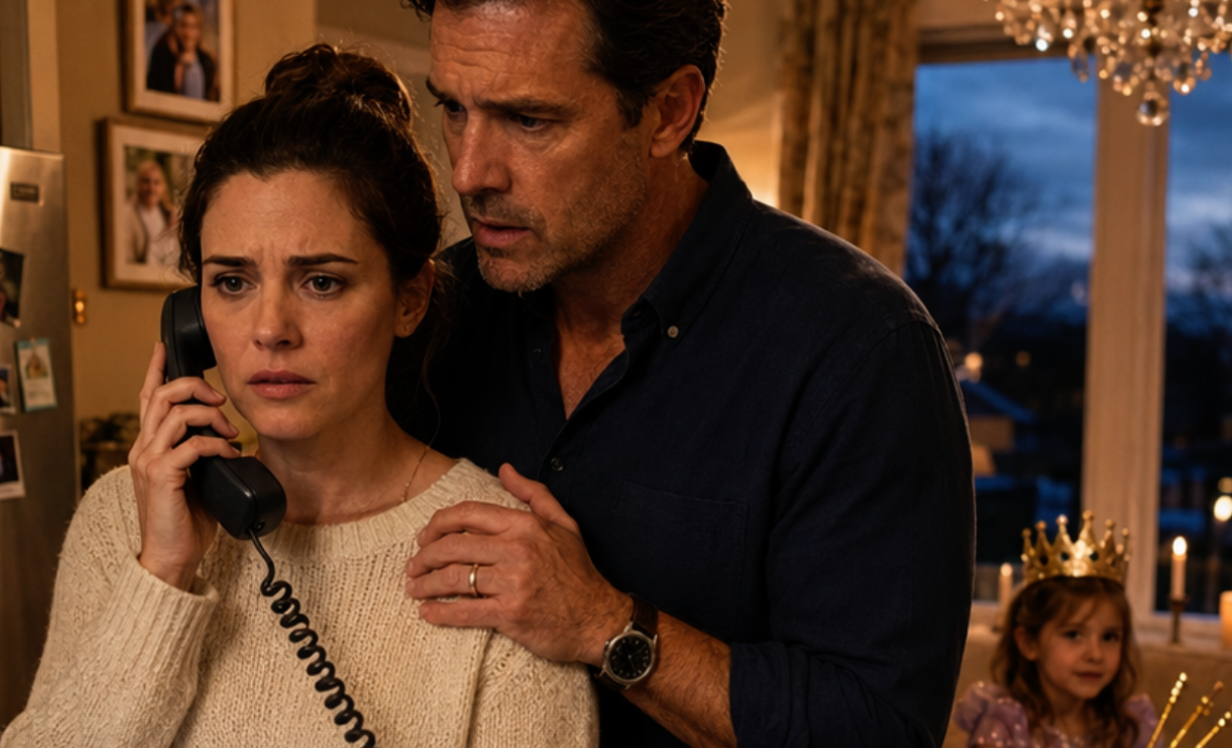
At two o’clock, our small apartment began filling with kindergarteners, juice boxes, and chaotic laughter. Lily, radiant in a purple dress and sparkly shoes, kept sprinting to the window, searching the parking lot for her grandparents. By two-thirty, I checked my phone. Nothing. By three, as the children devoured the pink-frosted cake, Lily’s face fell with every opening of the door. “Mommy, where are they?” she whispered, her lower lip trembling. I dialed my mother, then my father. Both went straight to voicemail. By four o’clock, the party had dissolved into a quiet mess of torn wrapping paper and tired balloons. Lily sat completely still on the sofa, silent tears tracking down her cheeks, whispering, “They forgot about me.” Marcus pulled us both into his arms, his eyes burning with an anger that was entirely justified.
Later that evening, after Lily finally cried herself to sleep, I called my father again. This time, he answered. The background noise was unmistakable: the clinking of wine glasses, boisterous laughter, the unmistakable ambiance of a dinner party. When I asked him where he had been, he responded with genuine, terrifying distraction. “Oh, that was today?”
The cold reality washed over me as he casually explained they had flown out to Phoenix to visit my brother, Danny. Danny was the undisputed golden child. He possessed the six-figure salary, the immaculate house with a pool, the perfect wife, and the children my parents never seemed too fatigued to visit. Danny was never asked to fund their existence; he already possessed their unconditional approval. When I confronted my father about how they could afford plane tickets and phenomenal steak dinners while I starved my own household to send them $550 a week, his tone turned icy. He claimed they had “saved up” the money. The money I was bleeding to give them for basic survival.
“You told me you were struggling,” I said, my voice trembling. “Marcus works two jobs. I work extra shifts. We haven’t taken a vacation in three years. And you are eating expensive steaks while my daughter cried waiting for you.”
My father dismissed my pain as dramatic, but when I pressed him for the actual truth, he finally delivered the fatal blow. He admitted that visiting Danny was simply “easier.” Danny’s life was established and pleasant; visiting our cramped, financially stressed apartment was “depressing.” When I reminded him that our financial stress was a direct result of funding their lives, he coldly stated that I had offered the money, and nobody had forced me.
Then, he uttered the sentence that permanently severed the bond: “We don’t count your family the same way, Sarah. Danny’s family is different. Better established. You have to understand that.”
We didn’t count. My daughter, my husband, my sacrifices—we were lesser. I hung up the phone, collapsing into Marcus’s arms, weeping with a grief that felt bottomless. But as the tears subsided, the lifelong fog of guilt suddenly evaporated, replaced by a blinding, absolute clarity.
I wiped my face, pulled away from Marcus, and asked for my laptop. Sitting at the very kitchen table where we had agonized over utility bills to ensure my parents were comfortable, I began the systematic dismantling of my financial abuse.
I logged into my banking portal. I stared at the automatic transfer that had drained over $85,000 from our family over three years—money that should have been Lily’s college fund, a reliable vehicle, or a down payment on a home. With a single click, I canceled it. I then logged into the loan portal for the car they drove—a vehicle registered in my name, paid for with my credit. I initiated the process to revoke their access. I moved to the cellular provider, disconnecting their lines from my family plan. Finally, I terminated the credit card I had provided for their “emergencies,” which had long since become their personal slush fund. In fifteen minutes, I severed every financial artery connecting them to me.
Forty minutes later, the anticipated explosion occurred. My phone rang, displaying my mother’s name. When I answered, her voice was raw with panic. “What did you do?” she demanded.
I calmly informed her that I had removed her from my accounts. She erupted, calling me ungrateful, reciting the archaic ledger of everything they had supposedly sacrificed to raise me. But I was no longer the frightened girl terrified of their displeasure. “What did you sacrifice today, Mom?” I countered. “What did you sacrifice when you chose a vacation to Phoenix over your granddaughter’s birthday?”
She attempted to pivot, weaponizing my father’s words, claiming they loved both their children equally. But the evidence was overwhelming. For three years, I had subsidized their lifestyle while they treated me as an inferior citizen in my own family. I told her I was done. No more money, no more cars, no more phone bills. When she panicked about the mortgage, I told her to get a job or sell the house. I was unyielding.
“Turn your back on your parents when we need you most,” she spat, her voice laced with venom. “But don’t come crying to us when you need help. We’ll remember how you threw us away over one missed party.”
“One missed party, three years of lying, and a lifetime of making me feel like I’m never good enough,” I corrected her. I hung up, silenced the subsequent barrage of calls, and placed the phone face down. Marcus wrapped his arms around me, affirming that I had not ruined anything; I had saved our actual family. The people who truly counted.
The immediate aftermath was surreal. I anticipated a tidal wave of regret, but instead, I experienced the strange, buoyant sensation of breathing room. Marcus created a spreadsheet outlining our new financial reality. Without the $2,200 monthly hemorrhage, our lives transformed. We could build savings. Marcus could drop his second job. We could finally breathe.
However, my parents did not surrender easily. A couple of weeks later, Danny called, attempting to play the role of the oblivious peacemaker. My parents had fed him a sanitized narrative, claiming I was acting erratically over a mixed-up date. When I informed Danny of the $550 weekly payments—a fact they had conveniently hidden from him—he was stunned. I realized then that my parents had kept my financial support a secret so they could maintain the illusion of success with their favorite son. I told Danny that our parents were now his responsibility, and I blocked his number.
The escalation from my parents quickly moved from desperate to alarming. Three months after the birthday incident, I received a certified letter from an attorney. My parents were demanding compensation for the car, falsely claiming it was a gift. My friend Jennifer, a family law attorney, swiftly dispatched a cease-and-desist letter, reminding them that I held the title and all payment records. They withdrew the claim, but their tactics merely shifted.
They called Marcus’s workplace, fabricating a family emergency to bypass the receptionist, attempting to manipulate him into forcing me to communicate. The most terrifying breach occurred at Lily’s kindergarten. My mother attempted to pick Lily up early, falsely claiming she had a doctor’s appointment. The diligent school secretary flagged the unauthorized attempt and called me immediately. I rushed to the school, my heart hammering against my ribs, and permanently revoked all access. We were forced to install security cameras at our apartment.
The camera proved its worth a week later. At nearly midnight, my phone buzzed with a motion alert. I watched the live feed in horror as my parents stood on our porch, knocking persistently for five minutes before abandoning a wrapped package. It was an expensive doll for Lily—a cruel irony, considering they were supposedly destitute. I donated the doll to charity and threw the card in the trash.
Soon after, Jennifer informed me that my parents had officially filed for bankruptcy. The safety net I had woven for them had only delayed the inevitable consequences of their own financial mismanagement. Predictably, they moved into Danny’s spacious home. And predictably, Danny called me again, practically begging me to take them in. They were disrupting his perfect life, criticizing his wife, and taking over his house.
“You take care of them,” I told him, feeling a strange sense of poetic justice. “You were always the favorite. You got the proud parents at soccer games. I got the parents who made me feel like an ATM. You have no idea what it was like.” I hung up, leaving the golden child to finally carry the burden I had borne for years.
Navigating the complex emotional debris required professional intervention. I began seeing a therapist, Dr. Reeves, who helped me dismantle the profound psychological conditioning of my childhood. I had to learn that setting boundaries was not an act of cruelty, but an act of self-preservation. I was not responsible for managing my parents’ emotions or saving them from their financial ruin.
As the months passed, the guilt finally began to recede, replaced by a deep, stabilizing peace. Our family thrived. Marcus was present, rested, and happy. Lily flourished, no longer burdened by the unspoken tension of a household living on the razor’s edge of financial collapse. When she occasionally asked why her grandparents didn’t visit, I told her the simple, age-appropriate truth: sometimes, the safest choice is to take space from people whose choices hurt us.
The definitive conclusion arrived ten months after that fateful birthday party. I received a long, vitriolic email from my mother, detailing my endless ungratefulness and ending with a curse: she hoped Lily would grow up and treat me exactly as I was treating them. That venomous message extinguished any lingering flicker of guilt.
With Dr. Reeves’s guidance, I crafted a final, unbreakable boundary. I wrote a concise email outlining the undeniable facts of their betrayal—the financial exploitation, the blatant favoritism, the workplace harassment, and the ultimate truth that they did not value my family. I explicitly stated that I did not hate them, but I fundamentally lacked trust in them. I demanded they never contact me, Marcus, or Lily again. I pressed send, blocked their emails, and changed our phone numbers.
The silence that followed was not empty; it was expansive. It was the sound of freedom.
Six months later, Marcus and I utilized our newfound financial stability to purchase a home. It was a beautiful three-bedroom house with hardwood floors and a sprawling backyard. We painted Lily’s room purple and adorned the ceiling with glow-in-the-dark stars. We planted flowers by the front steps and built a life entirely free from the shadow of conditional love.
A year after the birthday that shattered everything, we hosted Lily’s sixth birthday in our new backyard. It was filled with twenty children, an abundance of laughter, and Marcus’s genuinely supportive parents, who had driven three hours just to be there. As the evening wound down and the fireflies began their slow dance across the lawn, Marcus and I sat on the porch, sipping wine.
He looked at me, the warmth of the porch light reflecting in his eyes, and asked a profound question. “Do you ever regret it?”
I looked through the window, catching a glimpse of Lily’s star-lit bedroom door. I thought of the eighty-five thousand dollars, the agonizing overtime, the thrift store clothes, and the sheer audacity of being told my family did not count.
“No,” I replied, my voice steady and resonant with truth. “I regret that it took me so long.”
For the first time in my existence, the crushing weight of being an inadequate daughter was entirely gone. I was a mother fiercely protecting her child. I was a wife building an empire of peace with her husband. We had finally stopped paying a premium for a seat at a table where we were never truly welcome. We were not abandoned; we were remarkably, unapologetically free.