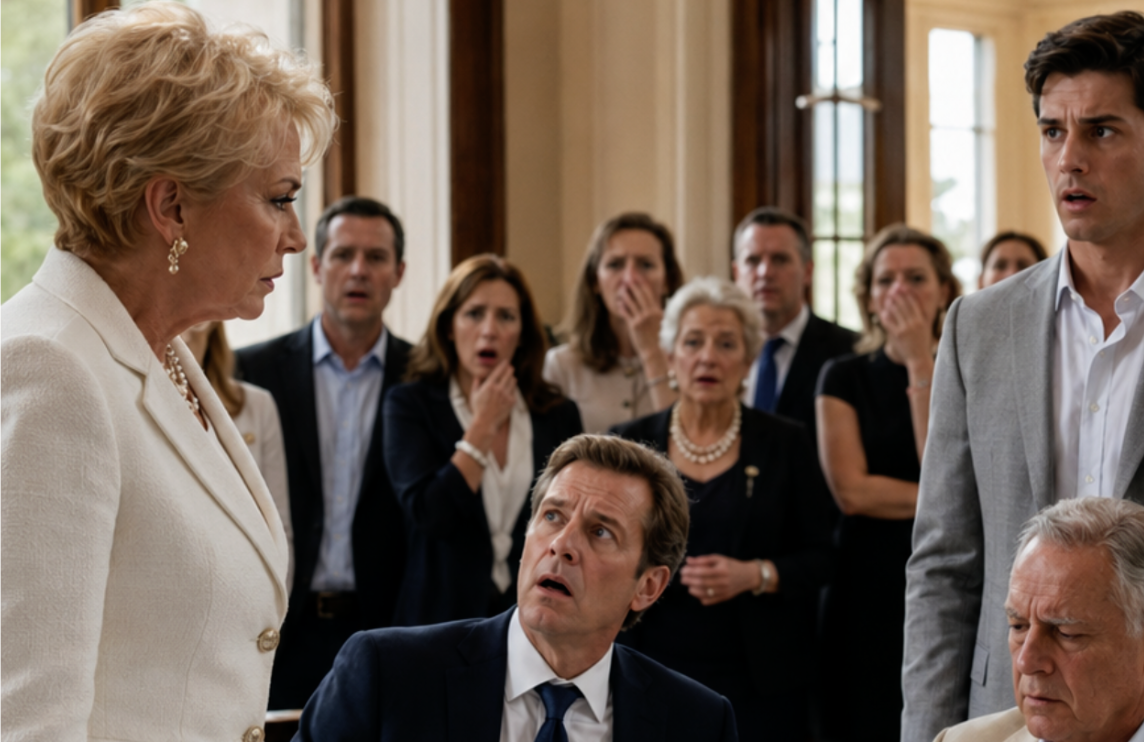
At my retirement party, my grandson took the microphone and joked that I was “finally too old to boss anyone around.” The room erupted into polite, country-club laughter, including my son, who had been secretly borrowing against my name and my life’s work for three years. I laughed along with them, playing the part of the gracious, fading matriarch. Then, deliberately, I placed a single manila folder on the white tablecloth. Two chairs away, the lender—a man named Howard Pike—suddenly stopped smiling.
He had been introduced to me as “an old friend from the club,” the kind of polite fiction people tell when they are desperately trying to make money smell like fellowship. He possessed the comfortable, heavy stillness of a man who had spent years letting other people sweat first. But when his eyes locked onto that folder, he stopped looking comfortable. It was the first honest thing he had done all afternoon.
My name is Eleanor Whitcomb. I was sixty-eight years old that day, though my grandson had just announced my age to the room as if it were a punchline. For forty-two years, I ran Whitcomb Interiors, a highly respected design and restoration firm in Lancaster County, Pennsylvania. We were not a glamorous, magazine-cover agency with champagne in the conference room. We were practical. We restored centuries-old farmhouses, saved historic mantels from being ruined by people with more money than sense, and turned tired, hollow houses into places where families could stand in the kitchen and feel entirely at home.
I knew rooms. That was my specific gift. Some women notice flowers; others notice shoes. I notice who takes the chair facing the door. I notice who reaches for the bill and who lets the silence grow until someone else does. I notice who smiles right before delivering an insult, and who looks at the floor when money is mentioned. That is design too, in its own psychological way. A room tells you what people want the world to see, but the people inside it tell you what they are desperately trying to hide.
So, when my son Nathan planned my retirement party at the Briarwood Country Club, I knew almost immediately that the celebration was not really for me. It was for him. Nathan had always loved a room full of witnesses. As a boy, he did not care if he hit the baseball unless someone important was watching. My husband, Frank, saw it long before I did. “That boy doesn’t want attention,” Frank used to say, half amused and half deeply worried. “He wants confirmation.”
Frank had been gone six years by the day of that party. Cancer took him slowly enough to let us say everything, yet fast enough to still feel like a profound theft. I had learned to live with his absence the way one learns to live with an old floorboard that creaks every time you pass; it startles you, but you simply stop expecting it to be silent. Frank would have hated Briarwood. He distrusted places where a hamburger cost twenty-two dollars and arrived with a pickle arranged like modern art. Nathan, however, loved the white columns, the polished brass, and the staff who said “Mr. Whitcomb” with careful, purchased respect. He loved the appearance of success far more than the discipline of actually earning it.
I had brought Nathan into the business after his second real estate partnership collapsed. At the time, I called it helping. A mother can completely ruin herself with that word. He was undeniably charming with clients, able to sit across from a nervous couple and make them feel like their backsplash choices mattered to the future of civilization. But the details bored him. Invoices, permits, vendor deposits, insurance renewals, lien waivers—all of it gave him the wounded expression of a teenager asked to take out the trash.
For years, I balanced him out. He sold the dream, and I kept the dream from becoming a lawsuit. But after Frank died, Nathan began subtly changing the language around me. Men like Nathan rarely walk straight into cruelty; they stroll there, whistling something familiar. “You’ve earned a rest, Mom. You shouldn’t have to worry about every little thing. The next generation has to step up.”
I hesitated to retire, not out of a desire for absolute control, but because whenever Nathan said “next generation,” he was exclusively talking about himself. My daughter, Claire, a pragmatic nurse practitioner, had never wanted the business. Two weeks before the party, Claire called me. Her son had been spending time with Nathan’s son, Jake.
“Jake said something strange,” Claire warned me, her voice tight. “He said, ‘Dad’s basically going to own the whole thing after Grandma’s party.’ He also mentioned some lender. Some man from Briarwood.”
I did not confront Nathan immediately. Instead, I called Roger Bell, my accountant of twenty years, and asked for a full, unvarnished review of everything Nathan had touched. Within three days, the numbers began forming a shape I despised. There were short-term bridge payments, late vendor payments concealed under project adjustments, and an expanded line of credit. And then, there was the name: Keystone Bridge Capital, leading directly to a private lending network managed by Howard Pike.
When Nathan casually mentioned in my kitchen that Howard Pike might attend the party, claiming he was “very helpful with business transitions,” I knew the rot had reached the surface. That night, I took everything to my attorney, Marianne Bellamy.
Marianne laid the documents across her table. The worst of it involved the downtown warehouse, a building Frank and I had bought in 1987 when everyone said that part of Lancaster was dead. It was proof that we had seen worth where others saw decay. Nathan had used it as a poker chip. Through a private agreement, he had given Howard Pike a path to claim the building if Nathan’s debt collapsed.
Marianne pushed a page toward me. My signature—Eleanor M. Whitcomb—sat near the bottom. It looked almost right, but whoever had forged it had studied the shape and missed the soul.
“That is not mine,” I said.
My son had borrowed hundreds of thousands of dollars against my name for three years. Now, he had planned a grand retirement party where the lender would sit in the very same room, watching Nathan publicly step into the future he had already attempted to steal. Marianne asked if I wanted him warned privately. I thought of every time he had called my caution old-fashioned, every time he had made me feel like I was in his way.
“No,” I told her. “Let him talk.”
The party at Briarwood was exactly the atmosphere Nathan had orchestrated: celebration with a heavy hand on the back of my chair. I sat quietly, the manila folder tucked safely between the table leg and my handbag.
Nathan eventually took the microphone, offering a toast bathed in manufactured warmth. “My mom built something extraordinary,” he announced to the room. “She has spent decades telling contractors what they did wrong, telling clients what they actually wanted, and telling me to stand up straight. And now, she finally gets to rest. The next generation will carry things forward.”
He handed the microphone to his son, Jake. My grandson, wearing a light gray suit and a rehearsed grin, looked at me. “Grandma has always been a legend,” Jake said smoothly. “But don’t worry, everybody. She’s finally too old to boss anyone around.”
The laughter came fast. Nathan laughed. Howard Pike smiled into his glass. I let out a brief, small laugh of my own, just enough to let them believe I had fully accepted my role as the old, bossy, finished matriarch.
Before the toast could completely land, I stood up. A woman my age should never waste a good entrance by rushing. The room turned toward me with fond, patronizing expectation, anticipating sweetness and gratitude. I picked up the manila folder. Nathan’s smile instantly stiffened.
“I’d like to say something,” I said, projecting my voice clearly. I did not need a microphone; I had spent forty-two years making myself heard over tile saws and delivery trucks. “I want to thank my grandson Jake for reminding me so publicly of what some people believe age means. That is the useful thing about jokes. They show what people believe they are allowed to say.”
The laughter died completely. I placed the folder on the table. Howard Pike’s eyes dropped to it, the first visible crack in his facade.
“Three weeks ago,” I announced to the silent room, “I learned that my son Nathan had been borrowing money against my name and my company for three years.”
A fork clattered against a plate in the back. Someone gasped. Nathan lunged toward me, whispering frantically, “Mom, not here.”
I looked him dead in the eye. “Here is where you brought your lender.”
Heads whipped around, not toward Nathan, but toward Howard Pike. I opened the folder and began reading the devastating inventory of my son’s deceit. “Eighty-five thousand dollars. One hundred forty thousand. Two hundred sixty thousand. Fees rolled into extensions. And finally, a contingent claim involving the downtown warehouse Frank and I bought in 1987.”
Nathan’s face darkened, reverting to his old tactic of dismissing me. “Mom, you don’t understand what you’re looking at.”
I removed the first document and held it up. “This signature is not mine.” I pulled another. “This one is not mine. This notary stamp was applied on a day I was standing inside a client’s home on King Street with twelve people present.”
Roger, my accountant, stood up from his table. “I can confirm the accounting irregularities and the dates.” Marianne stood beside him. “And I can confirm that formal notices have already been filed with the bank, insurer, registered agent, and appropriate legal authorities.”
Howard Pike carefully set his glass down. “Mrs. Whitcomb, I was assured all parties had consented.”
“By whom?” I asked. He remained silent.
I pulled the final page from the folder. “This notice removes Nathan Whitcomb from all operational, financial, banking, and managerial authority within Whitcomb Interiors, effective immediately. The downtown warehouse has been placed into a protected trust. It cannot be used as collateral by anyone in this room. And any claim based on documents bearing a forged signature will be answered not with quiet settlement, but with aggressive litigation.”
Howard Pike looked at Nathan, not like a friend or a partner, but like a man rapidly recalculating the severe cost of association. Pike pushed his chair back, announced his counsel would be in touch, and walked out. Nathan realized then that the room had entirely changed sides. The man he had invited as proof of his power had fled as confirmation of his fraud.
“You set me up,” Nathan hissed, looking at me with pure hatred.
“You forged my name, borrowed against my business, invited the lender to my retirement party, let your son humiliate me into looking harmless, and you still believe you are the injured party,” I replied coldly.
Jake sat down slowly, the microphone slipping from his hand. He looked pale, shaking his head. “I didn’t know,” he whispered. “I thought you were stepping back. I thought Dad had everything handled.”
“Then learn this before it costs you more than your pride,” I told my grandson. “Never joke that someone is too old to matter while standing on everything they built.”
The week following the party was relentlessly ugly. Truth rarely cleans a room without stirring up suffocating dust first. Nathan attempted to spin the narrative, telling clients I had suffered a “stress episode” and telling vendors not to panic. But paper is wonderfully unsentimental. Roger froze every account Nathan could access.
Nine days later, Nathan appeared on my porch, looking exhausted. Not humbled, just tired—there is a profound difference. Humility looks outward to the damage done; exhaustion only notices its own discomfort. I opened the door but kept the glass storm door firmly locked between us.
“I made mistakes,” he pleaded. “I was trying to save the business.”
“No,” I corrected him. “You committed fraud. You were trying to save the version of yourself you sell to other people.”
He begged for my help, asking me to validate a portion of the debt to keep his actions from becoming criminal. It was the same tactic he had used his entire life: breaking a window, making a bad investment, needing a bridge loan, and expecting me to quietly absorb the cost of his failures.
“You want me to pay the man who accepted forged documents bearing my name so that you can avoid the consequences of forging them,” I said. “I am your mother, Nathan. I am not your hiding place.”
I closed the door. The legal system moved slowly, but it moved. Howard Pike settled before trial, releasing every claim connected to the fraudulent documents and handing over enough records to make Nathan’s guilt undeniable. Nathan barely avoided prison, facing heavy restitution, probation, and the permanent loss of his real estate and financial licenses.
Without Nathan’s constant, chaotic noise, Whitcomb Interiors stabilized. I discovered a staff full of highly competent people who had just been waiting for permission to be honest. I brought in a brilliant outside operations manager and placed Claire on the advisory board.
Jake asked to meet me at a roadside diner three weeks later. Stripped of his tailored suits and superficial charm, he looked remarkably young. He apologized deeply, admitting that he had thought his joke at the party was harmless because “old people don’t get embarrassed the same way.”
“Listen to me carefully,” I told him over the cracked vinyl table. “The skin gets thinner. The knees complain. The hearing may go. But embarrassment does not retire. Neither does dignity.”
Jake took the lesson. He quit his father’s firm and took an apprenticeship at a local cabinet shop, sweeping floors and learning actual, calloused work.
A year after the disaster at Briarwood, I held my true retirement gathering. We did not host it at a country club, but in the beautifully restored front room of the downtown warehouse. There was no microphone, no sycophants, and no rehearsed jokes. Just the employees, close friends, and the people who had remained steady when the foundation shook. Jake arrived late, smelling of fresh sawdust, and handed me a small, imperfectly jointed wooden box he had made himself. Carved inside the lid was a single sentence: Dignity does not retire.
That evening, I announced that I would retain ownership for five more years, after which Whitcomb Interiors would transition into an employee-owned company. The people who had faithfully protected the work would inherit it.
I still live in the house Frank and I bought decades ago. I still keep the manila folder locked in my office safe. Not because I need the legal documents anymore, but because occasionally, when maternal doubt creeps in, I need the physical reminder that love is never a valid reason to ignore hard evidence. On the front of that folder, I wrote one sentence in heavy black ink: The day I retired from being used.
That was my actual retirement. I did not retire from work, leadership, or responsibility. I retired from rescuing people who repaid my sacrifices with contempt. I retired from pretending that age made me less aware, less capable, or less entitled to the empire I had built with my own two hands.
Sometimes I think back to Jake holding that microphone, declaring that I was finally too old to boss anyone around. I laughed that day, but not because the joke was funny. I laughed because I knew something my ambitious, foolish son did not. The bossy old woman had read the documents. She had called the lawyer. She had meticulously protected the warehouse, the company, and the family name. And when the critical moment arrived, I did not shout, throw a glass, or beg my family to respect me. I simply placed one manila folder on a table and watched the right man stop smiling. At sixty-eight years old, I learned that true power does not require a microphone; it only requires irrefutable evidence, and a woman steady enough to open the folder.