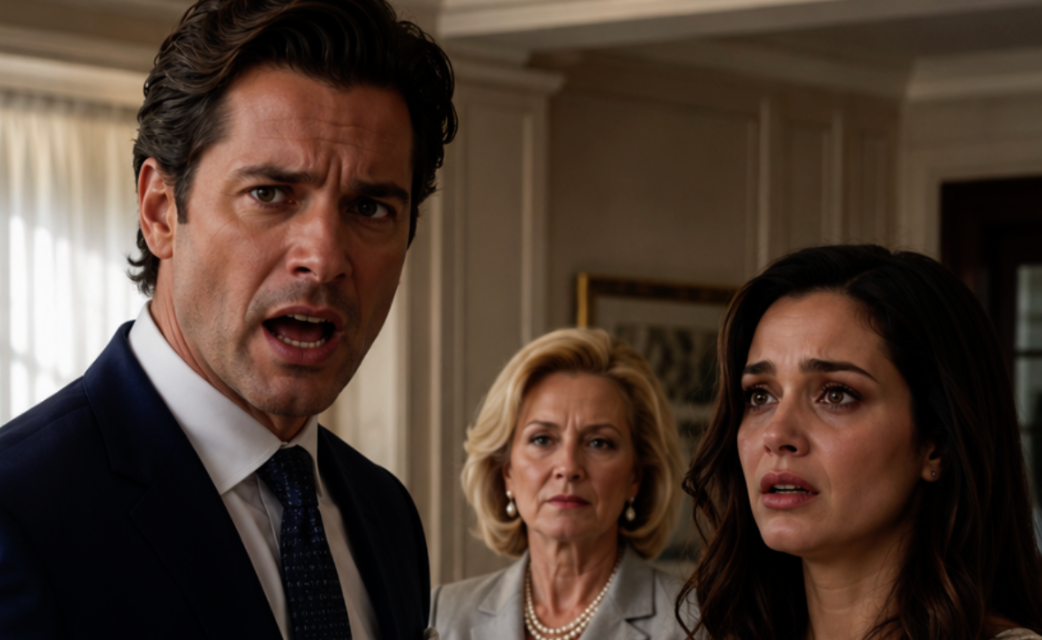
It was exactly five minutes after I signed the final divorce papers when I truly understood the profound, echoing silence of a dying marriage. It was not a cinematic silence. There were no shattered glasses, no theatrical screaming matches, no rings violently hurled across a marble floor. Instead, it was the suffocating, engineered quiet that emerges only after years of being relentlessly spoken over, strategically dismissed, and perpetually managed. Silence, over the course of nine years, had mutated into my primary language. The mediator professionally capped her fountain pen. The legal assistant methodically stacked the printed copies into precise, sterile piles. From the Manhattan street below, the muted groan of traffic and a distant siren bled through the thick glass, entirely indifferent to the collapse of my life.
Directly across the polished mahogany table, Ryan finalized the dissolution of our family with the exact same hand he used to tap impatiently against our imported kitchen counters whenever a meal was delayed. He did not bother to read the final page of the settlement. He did not look up. He did not look at me. He simply signed his name, slid the heavy packet back across the table, and immediately reached for his phone before the black ink had even fully dried. At precisely 10:07 a.m., nearly a decade of shared history terminated in a generic Midtown conference room smelling of artificial lemon scent, stale coffee, and the dying potted ficus in the corner. I remained seated for one extra, deliberate second, my palms resting flat against the cool wood, purely to feel the sheer gravitational weight of the moment. I felt no grief. Grief was an exhausted currency, entirely spent over the preceding twelve months in pathetic, hidden corners. What I felt in this sterile room was pure, unadulterated release.
Ryan’s phone vibrated violently against the table before the mediator could even launch into her mandated closing monologue regarding compliance and legal next steps. He glanced at the illuminated screen and smiled. It was the arrogant, victorious smirk of a man who had already mentally vacated the premises. “Yeah, babe,” he answered loudly, stripping away any pretense of embarrassment. “I’m finished here. I’ll head straight over.” He leaned back effortlessly in his ergonomic chair. “The whole family’s coming?” he asked, letting out a pleased, arrogant laugh. “Of course they are. They wouldn’t miss it. Our boy’s the future of this family now.”
I remained absolutely motionless. To his immediate left, his older sister Sophia fluidly crossed her legs, smirking over the rim of her overpriced oat milk latte. She had aggressively insisted on attending the mediation, citing the need for “family support.” Sophia was the precise breed of wealthy Manhattan woman who had weaponized etiquette, capable of making profound cruelty sound like a casual observation on the weather. “Well,” she announced lightly, “that’s that. Honestly, Elena, this is entirely for the best. Ryan deserves to move forward with a partner who actually aligns with his trajectory.” From the far end of the room, Ryan’s aunt Marlene chimed in. “Men operating under immense pressure require peace,” she declared, aiming a look of moral judgment directly at me. “Not complications.”
Complications. It was their preferred, sanitized vocabulary for my children whenever Mia and Leo failed to seamlessly blend into the background of Ryan’s curated aesthetic.
Turning to the mediator, I asked with glacial composure if my signature was required on any further documentation. “No. We’re done.”
“Good,” Ryan barked, rising abruptly and reaching for his custom navy suit jacket. Reaching into my leather handbag, I slowly extracted my heavy ring of house keys and laid them deliberately on the polished mahogany. The sharp metallic clink commanded the attention of the entire room. “The Gramercy house keys,” I stated coldly. I ignored Sophia’s scoffing. Then, I unzipped an interior compartment and withdrew two pristine blue passports and a slim leather document folio. Ryan’s arrogant posture suddenly faltered. “What is that supposed to be?” he demanded.
“It means,” I replied softly, returning the passports to my bag, “that the children and I are departing for Paris this afternoon.”
The atmospheric pressure in the conference room seemed to plummet instantaneously. Ryan barked a hollow, unconvincing laugh. “Paris? With what money?” It was a deeply revealing first question. Not an inquiry about the children’s welfare, but a panicked assessment of capital. Looking at his flushed face, I experienced a moment of total, merciful clarity: there was absolutely nothing left inside me worth saving for this man.
“Mine,” I answered simply.
Taking a threatening half-step toward me, Ryan growled, “You cannot legally remove my children from the country without my explicit authorization.”
I held his gaze without flinching. “I suggest you read page eleven of the custody addendum you just blindly signed.” For the first time in nine years, uncertainty fractured his flawless mask. The international travel authorization had been meticulously buried by my attorney, Marcus, within a dense section flagged merely as standard summer scheduling logistics. It was a brilliant tactical maneuver, relying entirely on the predictable arrogance of a man who assumed control was his unalienable birthright.
The mediator meticulously reviewed her copy of the document. “It is included,” she confirmed, her voice perfectly neutral. “Temporary international relocation for a period of ninety days pending a school transition review. You initialed it directly on the line.”
Ryan’s face drained of color before hardening into a mask of pure fury. “You meticulously planned this.”
I stared at him, letting the silence stretch. I thought of the late-night text messages from Vanessa illuminating his nightstand. I thought of his mother justifying his infidelity. “Yes,” I said smoothly. “I did.” Before his rage could manifest into words, the heavy oak door swung open, revealing my driver. I picked up my bag. “From this precise moment forward,” I informed Ryan, my voice dropping to a whisper, “we will no longer exist in your way.”
Settling into the quiet, leather-scented sanctuary of the Audi, I allowed myself exactly three seconds of closed-eyes exhaustion before reaching for the thick cream envelope resting on the seat beside me. It bore the embossed seal of Marcus Bennett’s law firm. I reviewed the devastating arsenal he had assembled over six months of quiet, forensic investigation. The envelope contained flawlessly documented bank transfers, obscured property deeds, and a comprehensive forensic accounting memorandum detailing marital funds illicitly routed through shell consulting firms. Ryan had arrogantly assumed I would never notice the discrepancies because he had buried the invoices under complex vendor categories—categories that I myself had architected years prior when I was building the operational backbone of his supposedly self-made empire.
Alongside the financial autopsy were copies of three separate, lethal letters. One was dispatched to the central bank handling Ryan’s corporate accounts. The second went directly to Ryan’s board of directors. The third was distributed to the compliance departments of his three largest anchor clients. As the Audi merged into the heavy Manhattan traffic, my phone illuminated with a brief message from Marcus: Everything is strategically in place. Children are checked in. Clinic appointment should be commencing shortly. Brace for the inevitable noise.
I typed a single-word response: Understood.
While my vehicle navigated steadily toward the private aviation terminal, Ryan was arriving at a wildly overpriced fertility clinic on the Upper East Side. The clinic was a masterclass in the performance of wealth: cream bouclé seating designed to soothe anxious billionaires, intricately cut-glass dispensers filled with artisanally filtered lemon water, and framed abstract artwork meant to signify modern, unbothered affluence while masking the deeply transactional nature of the space.
The hollow pageantry of the Holloway family was operating at peak efficiency. They had aggressively transformed Vanessa’s pregnancy into a royal coronation, utilizing the unborn child as the ultimate weapon to justify Ryan’s betrayal. Vanessa sat in the center of the room draped in camel cashmere, expertly utilizing her slight physical condition to command the room’s undivided attention. Surrounding her was the entire sycophantic court: Diane clutching a silver-ribboned gift bag, Sophia aggressively typing on her phone, and Howard aggressively scanning international market headlines on his phone as though overseeing a hostile corporate acquisition rather than a mistress’s routine ultrasound.
Ryan burst into the waiting area, flushed and triumphant, kissing Vanessa with performative passion. “Is everything on schedule?” Diane demanded instantly. “Perfect,” Vanessa beamed.
The entourage proceeded into the dimly lit examination room. However, medical professionals possess a distinct, terrifying stillness when they encounter biological data that fundamentally contradicts the patient’s narrative. The ultrasound technician scanned the monitor, paused, adjusted the angle, and then stopped entirely. “I am going to get the attending physician,” she announced, utilizing the sterile language of impending disaster.
When the doctor returned, the atmospheric pressure in the room collapsed. “There appears to be a significant mathematical discrepancy between the gestational measurements and the conception timeline provided on your intake documentation,” the physician stated clinically.
Ryan’s brow furrowed in genuine confusion. “Meaning what, exactly?”
Turning the high-resolution monitor slightly, the doctor delivered the fatal blow. “Based on developmental markers, conception likely occurred approximately five weeks earlier than the provided dates. This falls well outside any standard margin of error.”
The silence that descended upon the examination room was absolute and suffocating. Vanessa’s meticulously curated confidence evaporated, leaving her pale and visibly trembling. “Whose child is it?” Ryan demanded, his voice dropping an octave, pivoting violently toward the woman who was supposed to be his compliant salvation.
Before the family could fully process the humiliation of Vanessa’s infidelity, Ryan’s corporate phone began to aggressively ring. It was his Chief Financial Officer. Her voice was uncharacteristically panicked, delivering a rapid-fire sequence of catastrophic updates. Three major anchor clients had unilaterally suspended their contracts pending immediate compliance reviews. “I am talking about forensic packets that hit the board’s desks this morning,” the CFO yelled over the line. “I am talking about fraudulent shell invoices and unreconciled offshore transfers. Furthermore, the central bank just notified us of a sweeping court order legally freezing multiple accounts—personal, joint, and corporate—pending a comprehensive asset review.”
Ryan leaned heavily against the clinic wall, the color draining from his face as the brutal architecture of his own destruction became overwhelmingly apparent. “Who filed the injunction?” he whispered.
“Elena’s counsel,” the CFO replied.
Returning to the chaotic examination room, Ryan found his family in absolute shambles. Vanessa was weeping hysterically. Diane was desperately demanding a private consultation, trying to purchase her way out of an anatomical reality. Howard’s face was locked in a deadly, humiliated grimace. When Diane screeched, demanding to know what else had happened, Ryan could only manage a single word: “Elena.”
He finally understood the catastrophic cost of his arrogant blindness. He had conveniently forgotten exactly who had built the intricate vendor maps his company relied upon. He had forgotten who possessed the intellectual capacity to trace anomalous financial behavior. Most importantly, he had fatally forgotten that when a highly intelligent woman is systematically dismissed for long enough, she entirely stops wasting her energy trying to be heard, and quietly begins gathering devastating, incontrovertible receipts.
High above the Atlantic Ocean, ensconced in the quiet luxury of the private jet, I watched my children sleep peacefully while the frantic voicemails began to violently populate my phone. Sophia’s voice was the first to arrive, pitched at an octave of pure, hysterical rage, hurling accusations of vindictiveness and maternal alienation. I deleted it without a second thought. Ryan’s inevitable message followed—a panicked, hyperventilating plea insisting that the board was overreacting. I deleted that one as well.
The final transmission was a text from Diane, dripping with her signature brand of toxic, passive-aggressive manipulation, declaring that my sensitive son, Leo, was “too fragile” to be subjected to the brutal disruption of adult revenge. I stared at the illuminated screen in the darkened cabin and actually laughed out loud. The unmitigated, breathtaking audacity of a woman who had eagerly facilitated her son’s infidelity suddenly weaponizing my child’s emotional wellbeing was staggering. I permanently blocked her number and returned my serene gaze to the endless blanket of clouds below.
Paris welcomed us with the pale, elegant light of early evening and the profound, cleansing exhaustion that uniquely accompanies irreversible life decisions. The temporary apartment Marcus had secured in the prestigious 16th arrondissement was an absolute oasis of tasteful, international neutrality: expansive oak floors that groaned softly underfoot, soaring ceilings adorned with intricate molding, and a quiet wrought-iron balcony overlooking an avenue of majestic chestnut trees. Mia and Leo seamlessly adapted, their resilient nervous systems intuitively recognizing the abrupt absence of ambient hostility. There were no more hyper-critical mothers-in-law policing their posture, no more distracted fathers prioritizing a glowing screen over a conversation. For the first time in nearly a decade, the suffocating atmospheric tension that had characterized our sprawling New York brownstone was completely, irrevocably eradicated. We were simply a mother and her children, existing safely in a sunlit space where absolutely no one was waiting in the periphery to undermine our peace or diminish our collective joy.
By the end of the summer, as the Holloway empire continued its highly public, deeply humiliating collapse under the weight of audits and lawsuits, my own life aggressively expanded. A European consulting firm offered me a lucrative contract focusing on strategic operational restructuring. They sought discretion, extreme analytical competence, and strategic vision without the burden of male corporate vanity. Returning to a boardroom, I immediately recognized the familiar dynamic of men attempting to co-opt my insights. But the crucial difference was that I no longer shrank to accommodate their fragile egos. “With respect,” I interjected smoothly during a strategy session, utilizing the calm, authoritative tone that commands absolute silence, “that is the precise implementation model I outlined on page four. I will gladly walk you through the secondary phases now.” The room immediately yielded the floor.
In late September, Ryan finally transmitted a message containing a fraction of actual accountability: I know I did this. Just a raw admission of guilt. I read the words, felt absolutely nothing, and placed the phone face down to help Leo construct a sprawling architectural marvel out of wooden blocks. Because the ultimate lesson I extracted from the wreckage of my marriage is that closure is virtually never handed to you by the architect of your destruction. Confession devoid of consequence is merely another selfish iteration of narcissistic self-interest. True closure is an independent structural project; you must meticulously build it yourself out of the repetitive routines of a quiet life, physical distance from the source of the trauma, and the slow, agonizing, but inevitable resurrection of your own internal self-respect.
The world remains hopelessly addicted to explosive revenge narratives. People crave the dramatic boardroom gasp, the sudden freezing of offshore accounts, the highly public social humiliation of the mistress. And yes, all of those deeply satisfying elements materialized with flawless execution. Ryan lost the enabling audience that chronically excused his behavior; he lost the financial architecture that shielded him from consequence; and he violently lost the comforting illusion that the woman he betrayed was too weak to orchestrate his absolute ruin.
But the spectacular implosion of Ryan Holloway was entirely secondary. The paramount victory was discovering Leo sleeping deeply and peacefully through the night without waking up in a cold sweat. The true triumph was observing Mia’s tense shoulders permanently drop, realizing she no longer needed to aggressively scan my facial expressions to predict the emotional weather of our household.
Years from now, if my children ever inquire about the exact moment our true life officially commenced, I will not point to the chaotic unraveling in a Manhattan fertility clinic. I will not reference the frozen bank accounts, the fleeing clients, or the emergency board votes. I will describe a quiet moment in the back of an idling Audi outside a Midtown office building, clutching two blue passports and a devastating legal dossier. I will explain that occasionally, the most profoundly important action a mother can execute is to consciously, deliberately, and permanently stop standing in the exact location where she is being systematically erased.
Was I terrified as I dismantled the only life I had known for nine years? Absolutely. But I have learned that fear is merely the required entry fee for walking bravely toward your own authentic existence. And I paid it, in full, with absolute gladness.