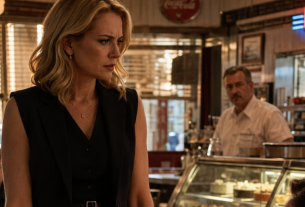
The truth did not arrive clad in the dramatic garments of a tearful confession, nor was it delivered via a hastily scribbled note abandoned on a mahogany desk. It descended, instead, through the mundane conduit of a careless technological error. A forgotten gesture. An unpressed button. My father had failed to terminate a phone call, and through the crisp audio of my earbuds, seated in the ambient hum of an Austin coffee shop, the reality of my existence crystallized.
“She’s stupid enough to let us stay.”
I remained perfectly motionless. My fingers hovered over the keyboard, casting shadows across a half-finished healthcare UX proposal. The syllables settled in my chest, heavy and frigid, like iron weights sinking into an abyss.
My name is Skyler Bennett. At twenty-eight, I was the sole proprietor of a custom brick ranch estate sprawled across three acres of Texas hill country. The property was a bequest from my Aunt Alice—the singular figure in my lineage whose affection was not a transactional currency, unburdened by invoices or latent guilt. When she passed, she bequeathed her sanctuary to me.
Two years later, my parents arrived. The arrangement was draped in the guise of temporary sanctuary. Three months, they promised. Six at the absolute maximum.
Arthur and Kate Bennett had hemorrhaged their own assets through my father’s penchant for “investment opportunities”—a euphemistic tapestry for reckless stock wagers, toxic loans, and hollow handshakes. My mother, entirely unversed in the grammar of household administration, wept through the phone receiver. They needed time. I, still brittle from grief and harboring the naive hope that boundless generosity might finally secure their unconditional love, opened my doors.
They entrenched themselves. Over two years, they commandeered the master wing, reconfigured the architecture of my daily life, and treated my credit card as a communal fountain for their refined tastes.
I spent months weaving elaborate psychological excuses for their parasitic occupation. They were family; they were weathering an economic storm; kin sustained kin. This fragile mantra shattered on a Tuesday evening when I returned exhausted from a grueling ten-hour debugging session, only to find the soul of the property surgically removed.
Aunt Alice’s rose garden—a meticulously curated expanse of pale pink Eden climbers, deep crimson blooms, and swaying bourbon roses—had been reduced to bare, violated earth. The fragrant air, once a botanical symphony, now reeked of torn roots and diesel exhaust. A miniature bulldozer sat idling adjacent to stacked rolls of synthetic turf.
My father, Arthur, stood surveying the devastation with the triumphant posture of a conquering general. He was sixty-two, possessing a silver-haired vitality and a deeply ingrained belief that every space he occupied belonged to him by divine right.
“Upgraded the property,” he announced, gesturing to the grave of my aunt’s legacy. “Those thorny bushes were a liability, Skyler. A putting green is refined. Successful.”
My mother, Kate, emerged with iced tea, her wrists heavy with jewelry she had vehemently refused to pawn during their financial ruin. “Don’t gape, sweetheart. Your father worked hard. Alice left you a house, not a museum of dead plants.”
The sheer audacity paralyzed me. When I demanded restitution—when I ordered the cessation of the labor and the replacement of the heritage roses—my father’s paternal mask slipped, revealing the tyrant beneath.
“I am your father,” he warned, his voice a low, gathering storm. “That does not make this your property. I want you both out.”
Rather than erupting, Arthur Bennett offered a smile that chilled the marrow of my bones. With the casual cruelty of a seasoned litigator, he outlined their defense:
Established Residency: They had occupied the premises for twenty-four consecutive months.
Mail Reception: Their legal and financial addresses were now tethered directly to my deed.
Medical Protections: My father’s degenerative knee condition provided a protective shield against expedited removal by local law enforcement.
“We have spoken to an attorney,” my mother added softly, sipping her tea. “A judge will not throw elderly people onto the street because you are throwing a tantrum over flowers.”
They had weaponized my sanctuary. They were plotting a protracted legal siege. I retreated to my office, allowed myself exactly ten minutes of fractured weeping, and then sealed my emotions behind a wall of cold, pragmatic calculus.
The following afternoon demanded my absolute focus. I was scheduled to deliver a culmination presentation for a healthcare application redesign—a six-month endeavor valued at a forty-five-thousand-dollar contract. This capital was no longer merely a metric of professional success; it was my survival fund. The exorbitant property taxes and the staggering weight of subsidizing three adult lives had severely eroded my savings.
At 2:00 p.m., I initiated the video conference with eight senior executives. The flow of information was seamless, detailing simplified user onboarding and crucial accessibility improvements.
At 2:15 p.m., the sanctity of my workspace was violently breached.
My father did not knock. He thrust the door open, ushering in a cadre of country club acquaintances. “Look at this view,” he boomed, parading through my office as though I were merely part of the furnishings.
When I requested privacy, citing the professional nature of the call, his pride flared. Before an audience of his peers, he refused to be corrected by his offspring. With a swift, harsh motion, he shoved my shoulder. I collided with the edge of the mahogany desk, my chair skidding away, pain radiating through my hip. The webcam captured the entire humiliating spectacle.
The contract was terminated via email five minutes later. The rationale was clinical: Unprofessional environment. Concerns regarding stability.
That evening, exiled to a downtown Austin coffee shop, my phone rang. My father, demanding urgent technical support for his newly installed, illicitly funded irrigation system. I guided him through the menus, my voice a hollow automaton. It was then, upon his failure to sever the connection, that I became the silent auditor to my own destruction.
“Amateur setup,” my father scoffed to my mother in the background. “Did she cry about the roses?” my mother asked, her tone laced with malicious glee. “Like a baby. Once we return from Italy, I want that upstairs office cleared for a cigar room. She can work from the kitchen.”
They discussed their attorney’s advice. They outlined their timeline to drag out the eviction, drain my remaining resources, and ultimately coerce me into adding their names to the deed. Then came the fatal sentence:
“She’s stupid enough to let us stay.”
I terminated the call. The daughter they had known—the compliant, desperate creature perpetually yearning for parental validation—evaporated in the scent of roasted Arabica beans. In her place, a tactician was born.
I immediately contacted Roman Thorne, the probate attorney who had flawlessly executed Aunt Alice’s estate. My inquiry was brutally specific: Could a sole deed-holder sell a property encumbered by hostile, non-leaving occupants?
Roman’s answer was affirmative, though he warned that traditional buyers would flee from the risk. He directed me to Lone Star Holdings, a distressed-asset investment firm notorious for swift, cash-based acquisitions, aggressive legal departments, and unyielding physical security protocols.
I established contact with Stella Wright, the firm’s acquisitions director. I laid out the parameters of the asset. When I revealed that the hostile occupants would be departing for an extended Italian vacation in forty-eight hours, leaving the estate completely vacant, the negotiation crystallized. She offered nine hundred eighty thousand dollars in cash, provided the premises were empty at closing. Lone Star would assume immediate physical control.
I accepted without hesitation.
To flawlessly execute this maneuver, I partitioned my existence. I procured a secondary cellular device—Phone B—which became the secure repository for my finances, legal communications, two-factor authentications, and authentic life. My original device—Phone A—was relegated strictly to the role of bait.
The next morning, I stepped into the role of the devoted, vanquished daughter. I purchased their business-class tickets, secured a lavish Tuscan villa overlooking sprawling vineyards, and transferred three thousand dollars directly to their accounts for leisure.
My father practically purred with satisfaction as I handed him the printed itinerary over morning coffee. “Family takes care of family,” he declared, leaning back in his chair.
“Yes,” I agreed softly, staring into my mug. “It does.”
I delivered them to the Austin-Bergstrom International Airport under the veil of a heavy, pre-dawn Texas sky. As my father patted the very shoulder he had physically bruised days prior, instructing me to meticulously water his synthetic lawn, I offered a perfectly compliant smile.
The moment their flight ascended over the Atlantic, the deconstruction of my former life commenced.
The contracted moving crews arrived like a precision strike force. Items designated with blue painter’s tape—my personal technological infrastructure, Aunt Alice’s antique writing desk, her cherished landscape oil paintings, and the silver-framed photographs—were routed directly to a high-rise apartment I had leased electronically in Dallas. By mid-afternoon, my physical presence in the house was entirely spectral.
The following day, specialized junk removal teams secured the remainder. I did not discard my parents’ possessions; malice is sloppy, and I required absolute legal insulation. Their furniture, seasonal wardrobes, flat-screen televisions, and trivialities were carefully relocated to a climate-controlled storage facility an hour past the city limits, paid in full for twelve consecutive months.
My father had left his prized, custom-fitted golf clubs in the garage to avoid excess international baggage fees. He loved those clubs with a tender reverence he had never afforded his own blood.
I laid the heavy leather bag on the cold concrete. I took Phone A, tethered it to a high-capacity camping power bank, engaged the ringer to maximum volume, and cocooned the assembly in dense layers of bubble wrap. I submerged this electronic beacon deep within the darkest recesses of the golf bag, burying it beneath a cage of steel shafts and leather grips. When Arthur Bennett attempted to dial the daughter he thought he had broken, his clubs would sing a maddening, unanswerable song in the dark.
I placed the bag in the deepest back corner of the storage unit, securely locked the door, and drove away.
On Friday at 2:51 p.m., sitting in a sterile title company conference room, my phone vibrated. The financial wire had materialized: $947,382.19. The deed transferred. Lone Star Holdings immediately dispatched a tactical asset management team to change every physical lock, electronically scrub the smart-home logs, and erect commercial security signage. The architectural cage my parents had constructed around me now belonged to a corporation entirely devoid of a central nervous system.
Fourteen days later, I sat by the floor-to-ceiling windows of my new Dallas apartment, calmly monitoring my old home’s dormant Ring camera feed. At 10:05 p.m., a taxi deposited my tanned, exhausted parents onto the familiar driveway.
My father marched to the digital keypad and inputted his birthdate. The console flashed a solid red. Denied.
He tried my mother’s code. Denied.
Irritation rapidly morphed into panic as they circled the perimeter of the property, discovering freshly deadbolted doors and drawn shades. Through the front living room window, they cupped their hands against the glass and peered into an echoing, cavernous void completely stripped of all domestic familiarity.
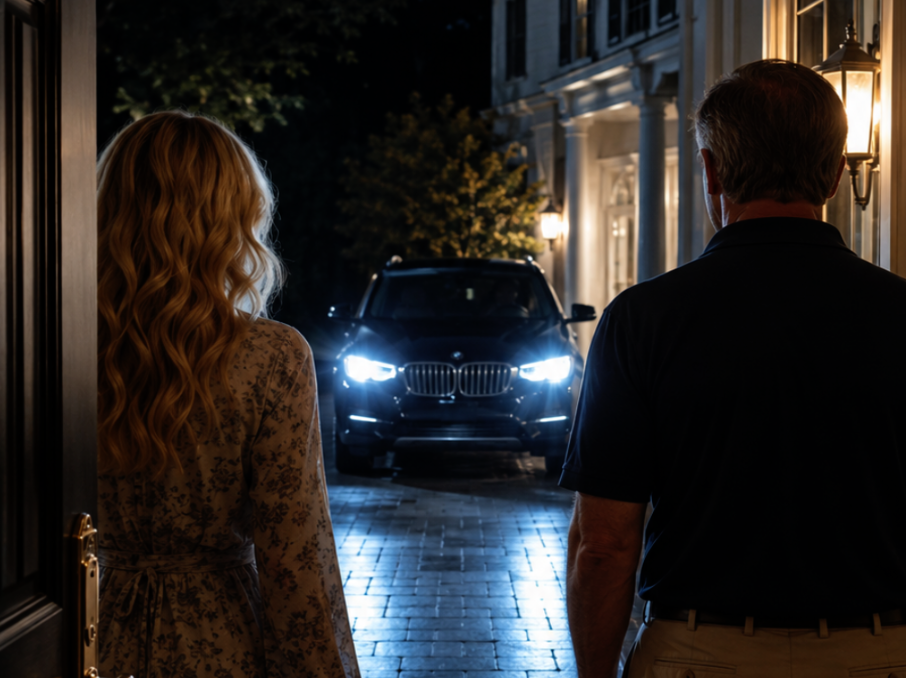
Before comprehension could fully anchor in their minds, a black SUV severed their retreat, pulling directly behind their luggage. An asset manager, flanked by private security contractors in dark suits, stepped out and formally informed them of the property’s new corporate ownership. When my father blustered, loudly invoking his paternal status and threatening immediate litigation, the manager remained glacially unbothered.
“That has no bearing on the deed. Do not return to this property, or law enforcement will be immediately notified.”
Desperate, Arthur dialed my old number. In a pitch-black storage unit miles away, beneath layers of steel and leather, a phone began to ring. I watched through the digital feed as the ultimate realization broke my father’s posture: he was no longer negotiating with an obedient daughter. He was trespassing on corporate soil.
I allowed them precisely one hour to secure a hotel before dispatching my final correspondence from Phone B.
Dear Arthur and Kate,
By now, you are aware the ranch house has been sold. I sold it to Lone Star Holdings, an investment firm that specializes in distressed properties. They are not entities you can manipulate, guilt, or bully.
I heard your conversation regarding the eviction strategy. I heard you call me stupid enough to let you stay. You were profoundly wrong. Your belongings are secured in the storage unit listed below. The phone you are attempting to dial is located inside the golf bag.
Do not search for me. Do not send messages. This is not a negotiation. This is goodbye.
I attached the pristine audio recording of their coffee-shop confession and permanently severed all ties. The ensuing avalanche of vitriol, apologies, pleading, and threats was systematically blocked. The following morning, operating with absolute clarity, I secured a thirty-thousand-dollar UX contract—the initial financial bedrock of Bennett Design Co.
Four months have since evaporated. My former neighbor informs me my parents now reside in a third-floor walk-up apartment on the east side of Austin, a punishing daily ascent for my father’s degenerative knee. They were forced to sell their Tuscan wine to make rent.
I inhabit the sky above Dallas, an anonymous silhouette against an amber horizon. I feel grief, occasionally, for the parents I deserved to have, and for the heritage roses that were mercilessly sacrificed to vanity. But I harbor absolutely no guilt.
On my balcony, six massive ceramic pots cradle a new botanical lineage: pale pink Eden climbers, a creamy David Austin variety, and deep crimson Munstead Wood. They are not Aunt Alice’s original garden, but they are a living continuation of her spirit. I water them at dawn, my hands coated in the dark, rich soil of a life entirely my own. I did not sell her legacy to inflict pain; I sold the prison they built upon it to rescue myself.
Every door around me is securely locked. And I am the only one who holds the code.