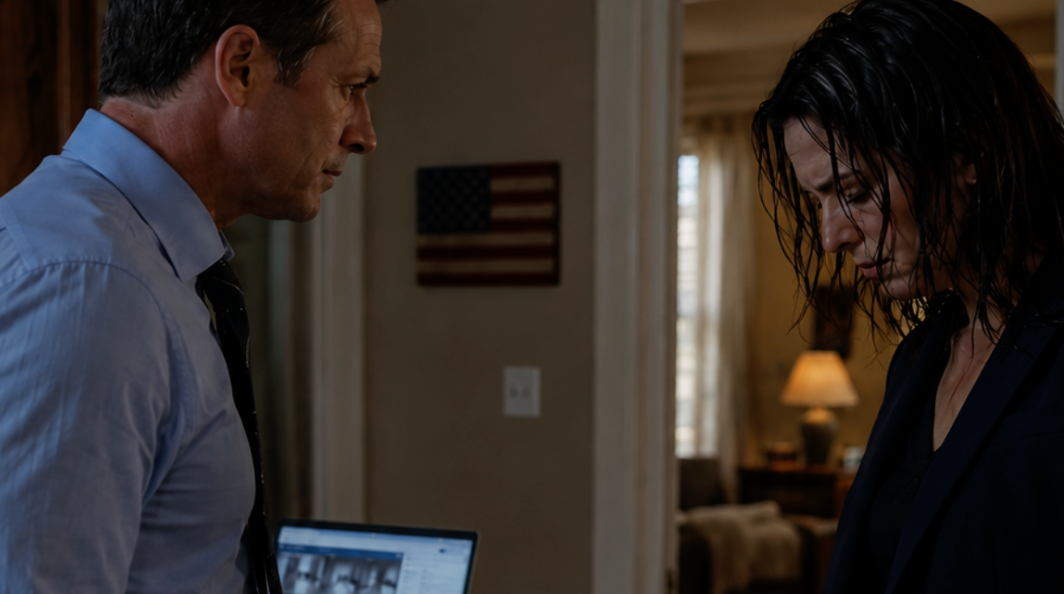
Marta walked into the kitchen at 7:12 that morning, stopping with such sudden, jarring force that the heel of her pump scuffed sharply against the pristine tile.
“You didn’t leave?” she asked, her voice tight and unspooling.
Outside, the rain drummed a relentless, rhythmic tattoo against the glass over the sink. Our quiet suburban Chicago neighborhood was slowly stirring to life—headlights sweeping over manicured lawns and rain-slicked mailboxes. I sat motionless at the breakfast bar. My hands were wrapped around a mug of black coffee, my laptop sitting firmly shut, and her leather work tote resting like a territorial boundary line on the cold granite between us.
“The trip is canceled,” I replied.
Her gaze flicked nervously from my face to the tote, and then to the barren charging station beside the espresso machine.
“Where are my phone and laptop?”
“In the safe.”
She blinked, a momentary glitch in her meticulously composed exterior. “Why would you do that?”
I slid a perfectly pressed printout of a hotel confirmation across the cool stone counter.
“Because Room 412 was never a client dinner.”
For a breathless, agonizing second, all the air vanished from the room. She looked like a woman who had fundamentally forgotten the mechanics of respiration.
Just two days prior, I had inhabited a comfortable, tragic delusion: that our marriage was merely fatigued, not fatally wounded. I was Will Drayton, forty-two years old, a senior financial analyst at Morrison & Associates. I was the absolute archetype of a man who measured safety in routines. I was the kind of husband who checked tire pressure before long drives, meticulously balanced accounts before the month’s end, and foolishly equated a quiet, conflict-free home with a secure one. Marta once smiled at this trait.
You make life feel safe, she would whisper to me in the dark.
I had catastrophically misidentified her relief for love.
The collapse of my reality began on a highly mundane Tuesday. Marta had left her phone unattended on the kitchen counter while showering—an anomaly for a woman whose device was virtually a biological appendage. It went from the bed to the bathroom to the car without ever leaving her grip. But that morning, as I rinsed a coffee mug, the screen illuminated.
J.T. I keep thinking about last night.
My hand spasmed. The ceramic mug slipped, shattering against the floor into three jagged, loud fragments. As the dark liquid seeped across the pale grout, a second notification glowed maliciously:
Tonight. Marriott. 412. Wear the one I bought you.
I stood paralyzed, my socks soaking up the bitter coffee. I did not confront her. I did not march upstairs and demand answers like a better man in a simpler story might have. Instead, I picked up the phone. She had left it unlocked, and I easily observed the architecture of her betrayal. There were six months of meticulously curated deceptions:
Fabricated itineraries: Weekend “retreats” and endless, hidden long lunches.
Encrypted logistics: Calendar invites disguised as marketing pitches.
Intimate receipts: A note thanking her for a designer cologne she had given me for Christmas. A fragrance, I now realized with a sickening lurch, she had selected simply to remind her of him.
The man was Jake Turnbull. He was a local fixture in Riverside Oaks—a former college football player turned morning radio host and insurance salesman. He was a man who consumed all the oxygen in a room, married to Dana, a brilliantly precise prosecutor whom nobody dared cross. I had watched Marta laugh excessively at his jokes during neighborhood barbecues, explaining it away with the willful, protective blindness that husbands perfect over long, stagnant marriages.
I systematically photographed the evidence, forwarded nothing, swept up the broken glass, and sat reading the Wall Street Journal. When Marta descended ten minutes later, damp-haired and smelling of vanilla, she kissed my cheek.
“I’ll be late tonight,” she lied smoothly, hiding a small smile behind her cup. “Client dinner. Henderson Industries.”
“Don’t work too hard,” I replied, staring flatly into her eyes.
That was the exact moment the fissure cracked open my world.
At the firm that morning, the paralyzing shock crystallized into rigorous, unfeeling procedure. Emotion makes people sloppy; procedure ensures survival. Just as I would dissect a fraudulent corporate ledger for a client, I began to relentlessly audit my own life. I cross-referenced Jake’s public social media presence—charity galas, golf tournaments—with Marta’s supposed business trips. I studied the employee handbook of her marketing agency, noting the strict clauses regarding company resources and corporate card misuse.
I created a secure folder on my desktop and named it 412. It was no longer merely a room number; it was the empirical proof of my obsolescence.
That evening, as she modeled a black wrap dress and my grandmother’s pearls—heirlooms I had gifted her on our tenth anniversary because I believed family jewelry belonged with the woman I planned to grow old beside—she spun around.
“How do I look?” she asked.
“Like you’re not going to Henderson Industries,” I said evenly.
She paused, desperately searching my stoic face, but I offered her nothing to decipher.
Once she was gone, I poured a bourbon I never drank, and the real excavation began. Line by line, I dissected our joint checking accounts, credit card statements, and investment portfolios. The story revealed itself in forensic detail:
A restaurant charge on an evening she claimed to be drafting pitches.
A boutique receipt for lingerie that never entered our bedroom.
Siphoned funds diverted from our savings into a solitary, undisclosed bank account we did not use.
Small anomalies, individually invisible, but aggregated, they formed a staggering sum. Thirty thousand dollars. She was silently draining our foundation to finance her potential exit, letting me underwrite the life she was actively planning to abandon.
I hired Reena Kowalski, a hardened former detective turned private investigator operating out of a strip mall in Oak Park. I handed her a thumb drive containing my preliminary audit.
“Do you want proof for divorce, leverage, or peace of mind?” she asked, her eyes sharp.
“All three,” I admitted.
“A dangerous answer,” Reena warned, leaning back. “Document. Protect yourself. But if you act from humiliation instead of strategy, you become the problem.”
Her counsel echoed my best friend Greg Morrison, a formidable divorce attorney who dispensed brutal truths along with his legal advice. In his smoke-filled basement, Greg laid out the rules of engagement. “We protect the assets. We do not threaten. We do not humiliate for sport. Your job is to get out clean, Will, not to become a headline.”
By Sunday, Reena had delivered the final, indisputable dossier. Photographs of Marta and Jake entering the Marriott separately and leaving minutes apart. Reservation records explicitly tied to her corporate email. Six months of consecutive, deliberate choices. This was not a drifting heart that stumbled once; it was a sustained campaign of infidelity.
When I casually inquired about the missing funds during a strained Sunday dinner, Marta barely flinched. “It’s a higher yield account,” she deflected, slicing her chicken. “I meant to add you. It’s not that much when you spread it over time.”
I marveled at her absolute audacity. That night, I took the folder labeled 412, locked it inside my fireproof office safe alongside the deed to our cabin and our passports, and waited for the dawn.
Returning to the quiet rain of Monday morning: Marta sat at the kitchen table, her defenses completely crumbling as she realized the sheer magnitude of my knowledge. I had trapped her, yes, but only because I had finally stopped trapping myself.
“I want my phone,” she demanded, her voice wavering.
“You’ll get it back when Greg’s office receives a copy of the records for the asset file.”
I turned her work tote toward her, the zipper facing her chest. “Open it.”
Beneath her planner lay a small black garment pouch and a travel-sized bottle of that damned cologne. She closed her eyes—the first moment of genuine authenticity she had displayed in months. “I can explain,” she whispered.
“I know about Jake. I know about Room 412. I know about the six months, the restaurant charges, the transfers, and the thirty thousand dollars. You wanted me to keep paying for your life until you decided whether he was exciting enough to replace it.”
The accusation struck her physically, forcing her heavily into the chair.
“Did you send anything?” she asked. The immediate pivot to damage control was agonizing to witness. Not an apology. Not a plea for us. Only terror for the external consequences.
“Not yet,” I said, opening my laptop. “I have drafted letters. Richard Steinberg gets the company-card documentation. Dana Turnbull gets the timeline involving her husband. The bank gets a freeze notice.”
“You can’t tell Dana. She’s a prosecutor. This could ruin him.”
“It amazes me,” I said, leaning back, my voice completely devoid of warmth, “how many consequences people only recognize when they are standing outside their own door.”
She wept, begging me to delay, but Room 412 was scheduled for that very day. With methodical precision, I clicked send. Greg. Richard. Dana. The digital arrows flew, striking their targets irrevocably.
“Call him,” I instructed. “Tell him it’s over.”
Her hands trembled as she dialed Jake on speakerphone. When he answered with a casual, sickeningly familiar “Hey, baby,” she flinched visibly.
“It’s over,” she choked out. “Will knows. Dana is being notified. Don’t call me again.”
“Marta, what did you do?” Jake’s voice spiked with raw panic.
She looked at me, her face breaking into a mosaic of sorrow and profound realization. Not what happened, but what did you do. “I did what I should have done before,” she replied. “I told the truth.”
By noon, the fallout was catastrophic. Richard Steinberg suspended Marta pending an internal investigation into her corporate card misuse. Dana Turnbull called, requesting an immediate meeting downtown.
Dana’s office was a veritable fortress of legal accolades. She was composed, her gray eyes radiating a tired, terrifying resilience. She read my file in twelve minutes flat. “I suspected other relationships,” she admitted, closing the folder with a sharp snap. “I did not have documentation. Daylight is useful. Fire is less useful than angry people think.”
“What will you do?” I asked.
“I will decide whether my marriage is over. And Jake will learn the difference between charm and character.”
When I returned home, Marta was a hollowed-out shell, suspended from her job and ordered to pay restitution. “I lost my job today,” she wept.
“You lost the assumption that your job would protect you from what you did during it,” I replied. I felt a terrifying coldness where my empathy used to reside. I did not cross the room to comfort her. I let the silence stretch, heavy and unforgiving.
The subsequent weeks transformed our shared life into a demilitarized zone. Greg filed a legal separation. Marta retreated to the guest room, securing remote, menial employment to begin the arduous process of financial restitution. The thirty thousand dollars was unceremoniously returned to a monitored joint account. Strangely, the effortless return of the money inflamed my anger—it proved that the funds were always highly malleable, whereas the broken trust was permanent and absolute.
Jake, desperate and cornered, called me from a blocked number.
“You ruined my life,” he spat. “Marta told me you were boring. A sanctimonious accountant with a God complex.”
Boring. Predictable. Safe. Words that I had worn as badges of honor were weaponized as insults.
“Dana is behind Dana,” I told him calmly. “You should have learned that by now.”
The social fabric of Riverside Oaks tore exactly as expected. Whispers followed me at the country club; neighbors offered pity masked as Christian concern. Sharon Kellerman told me I was a “good man,” a platitude that offered absolutely zero comfort. Being the hero in someone else’s tragedy still required living permanently inside the ruins.
Marta began folding clothes at a discount retailer, bringing home twelve dollars an hour and an exhausted, quiet resignation. One night, I found her drafting a meticulous repayment spreadsheet.
$30,000 returned to the joint savings.
$8,412 in marital charges to repay.
$14,780 in company restitution.
“I’m figuring out how long it takes to pay back a life,” she said softly. She wasn’t seeking pity. “Because I hid money from you. If I’m going to tell you I’m sorry, I should start by not hiding numbers.”
Real remorse is violently inconvenient. Fake apologies are easy to reject, but when remorse begins to look real, it forces you to acknowledge the lingering humanity of the person who broke you.
By summer, Dana had filed for divorce, effectively dismantling Jake’s radio career and insurance agency through meticulous audits. He arrived on my porch during a heavy thunderstorm, drenched and defeated, accusing me of handing his wife the match to burn him down.
“No,” I corrected him, watching the rain wash away the debris in the gutters. “I gave her the light.”
Inside the house, Marta and I existed in a state of fragile, painful honesty. She confessed that she didn’t miss Jake; she missed the illusion of the woman she was with him—unburdened, desired, existing outside the mundane reality of laundry and mortgages.
“I should have asked if we could still become people who wanted each other instead of people who only managed a house together,” she admitted in the dim light of the kitchen.
Betrayal doesn’t merely shatter trust; it retroactively stages every ordinary memory, rendering the past utterly artificial.
By September, the house was drowning in its own oppressive quiet. I sat in my office at one in the morning, the safe open, staring at the folder marked 412. The papers that had once empowered me now felt like dead ashes pretending to be order. I realized my hesitation to file for divorce wasn’t rooted in a noble quest for forgiveness. I was terrified of losing the moral high ground, profoundly afraid of who I would become once I was no longer defined by her transgression.
The safe had protected the documents, but it had not protected me.
The next morning, I called Greg and ordered the papers filed. “Clean,” I insisted. “Equal division where the law requires it.”
When Marta returned from her retail shift wearing a tired gray cardigan, I placed the divorce decree on the table. She read through the terms, offering no resistance. She was relocating to Portland to live with her sister and rebuild in obscurity.
As she signed the final page, she paused, setting the pen down with a heavy, final click.
“I’m sorry,” she said, her voice completely stripped of all calculation. “I’m sorry I used your steadiness like it was something dull instead of something rare. I’m sorry I let you become the last person to know the truth about your own marriage.”
“Why?” I asked, needing the ultimate truth.
“I was unhappy and selfish. I liked being seen without having to be honest. I was preparing a door before I knew if I would walk through it.”
It was the most devastatingly honest sentence she had ever spoken. Fifteen years ended with a sound no louder than a light switch.
When the paperwork was finished, she packed her life into two suitcases and three boxes. At the front door, she hesitated. “I left the pearls in your office,” she said. “They belong with your family. And the blue mug—I replaced the broken one.”
As she stood on the porch waiting for her rideshare, the crisp autumn sun cut sharply through the canopy of maple trees. We exchanged brief, hollow goodbyes, and then she was gone, leaving behind a house that immediately felt cavernous and breathless.
I retreated to my office and opened the fire safe. The 412 folder was emaciated now, containing only legal decrees and bank letters. Beside it sat the small velvet box holding my grandmother’s pearls.
The folder had documented the clinical mechanics of the lie. The thirty thousand dollars had quantified the escape plan. But the pearls—they measured the true, immeasurable weight of the loss. Mine and hers.
I had spent six months believing that a perfectly clean ledger equated to a clean conscience; that once everyone paid what they strictly owed, absolute order would be restored. Jake paid his price. Marta paid hers. But a marriage is not a balance sheet, and some debts, even when perfectly settled, leave a room profoundly bankrupt.
That night, the rain returned to Riverside Oaks. I poured a single glass of bourbon and carried it to the kitchen. I raised it in the empty air—not to victory, not to vengeance, but to the man I was before the betrayal, and the man I still desperately hoped to become. Then, I returned to the office, placed the pearls inside the safe, and closed the heavy steel door, easing it shut gently instead of letting it click.