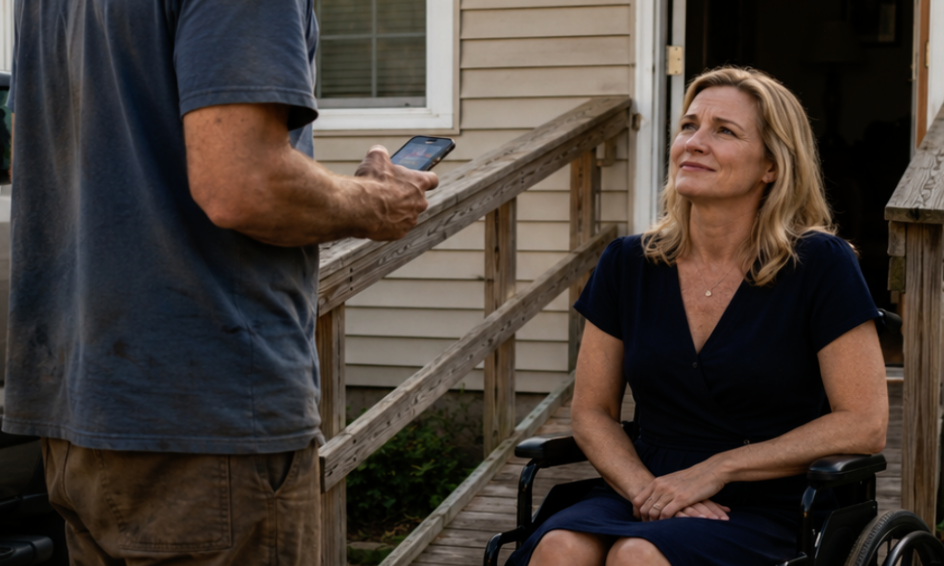
The morning my marriage officially ceased to exist, I was standing in the cold driveway of our Canton, Ohio home, clutching a garden hose in one hand and my wife’s smartphone in the other. It was barely seven o’clock. The morning air was sharp and biting, cold enough that the water cascading over the concrete driveway sent up thin, ghostly ribbons of steam. In front of me sat Tara’s heavily modified Honda—a vehicle I had painstakingly financed through three exhausting months of overtime following the highway accident that had irrevocably altered our lives. I had merely been rinsing a fine dusting of pollen from the windshield when a stray spray of water arced through the open passenger window, landing directly on her phone.
I reached inside to dry the screen before the water could seep into the casing. That was the entirety of my intention.
Then, the screen illuminated, casting a pale, clinical glow against my calloused fingers.
Can’t wait to be alone with you again tonight. Will’s working late, right?
The sender’s name etched at the top of the screen was Rick.
For a profound, suspended moment, I was immobilized. The garden hose slipped from my grip, the water continuing to rush over the heavy leather of my work boots. Somewhere down the block, the mundane machinery of the world ground on—a neighbor’s garage door groaned open; a yellow school bus hissed its air brakes at the corner. The world was behaving normally, completely indifferent to the fact that mine had just violently split open.
My name is Will Bright. At the time, I was a thirty-nine-year-old electrician. Within my social circles, I was the archetype people pointed toward when they needed tangible proof that steadfast, decent men still walked the earth. Yet, I never viewed myself through the lens of martyrdom. I was simply a man who had made solemn vows and spent every waking hour attempting to honor them.
Tara and I had been married for eight years. Three years prior, a catastrophic highway collision had shattered our trajectory. She returned from the hospital in a wheelchair, burdened with limited mobility in her legs, a punishing schedule of physical therapy, and a haunting fear in her eyes that made me feel deeply ashamed of my own fatigue. Consequently, I did what a devoted husband is conditioned to do: I systematically dismantled my own life to construct a sanctuary for hers.
For three years, I measured my love in the bleak metrics of caregiving: meticulously organized pillboxes, faded gas receipts from hospital trips, therapy schedules, and the precise, careful way I quartered her sandwiches because she claimed her hands cramped too easily to hold them whole.
I entirely renovated our home. I tore out the bathroom to install a roll-in shower and heavy-duty grab bars. I lowered the kitchen cabinetry so she could reach the plates. I widened the doorways until our house felt less like a shared marital home and more like a clinical rehabilitation center. I even sold my prized possession—a red motorcycle I had rebuilt from a mangled frame in my twenties—simply to cover the exorbitant costs of specialized medical equipment that our insurance stubbornly refused to expedite. I declined a lucrative supervisor position because the required overnight travel would leave her alone. My evenings belonged exclusively to her, as she frequently expressed that the twilight hours were when her helplessness felt most suffocating.
Standing in the driveway, with her phone pressed against my damp T-shirt, I absorbed the devastating revelation that the entire infrastructure of my life—a life built meticulously around her suffering—was constructed upon a foundation of absolute deceit.
Because Tara never utilized a passcode, claiming she had nothing to hide beyond mundane grocery lists, the screen remained unlocked. I stood there, battling the agonizing urge to look away, to preserve the illusion for just a moment longer.
But I looked.
Rick Donnelly was not a faceless stranger. He had once been a friend. While not my closest confidant, he had eaten meals at my table, watched football in my living room, and, most gut-wrenchingly, had physically helped me attach the first temporary wooden wheelchair ramp to our front porch when Tara returned from rehab. He owned a boutique physical therapy studio on the east side of town—the very facility Tara visited three times a week. I had spent the better part of two years quietly thanking God for Rick’s professional intervention.
The messages between them stretched back for months. This was not a fleeting misunderstanding. It was not a momentary lapse in judgment birthed from vulnerability. It was a prolonged, calculated era of private jokes, explicit photographs, intimate planning, and cruelly dismissive remarks about me that turned the blood in my veins to ice.
Yet, the group chat was infinitely more damaging.
The participants were Tara, Gina, and April. Gina Martinez was the compassionate nurse who had brought Tupperware containers of soup following the accident. April was the bartender from Murphy’s, a woman who consistently hugged Tara a little too tightly and repeatedly lauded me as an absolute saint for shouldering such a heavy burden.
Saint Will is at it again, Tara had typed just days prior. Made me breakfast in bed like I’m some tragic little princess.
April’s response was a digital sneer: Does he actually think you still love him?
Tara’s reply sat on the illuminated screen like a sharpened blade resting on a table: He’s useful. Free help, clean house, steady insurance, and he believes anything if I make my voice soft enough.
Beneath that, Gina inquired: Does he know you can walk short distances now?
Tara’s final, devastating verdict: Absolutely not. Why ruin a setup that works?
Three years. Three years of lifting heavy laundry baskets, managing tedious pharmacy refills, abandoning my work early, preparing specialized meals, and sleeping with one ear open to the darkness in case she required assistance in the night. Three years of her watching me exhaust myself, willingly allowing me to believe she required every ounce of my sacrifice.
I do not recall making the conscious decision to continue reading, but the device grew heavy in my palm. The scent of wet concrete filled my lungs just as the front door creaked open. Tara rolled onto the porch in her chair, adorned in a soft blue dress I had purchased for her just the week before because she lamented that nothing made her feel feminine anymore.
“Will?” she called out, her voice dripping with practiced fragility. “Honey, are you okay? You look pale.”
I smoothly turned the phone face down. “Your phone got wet,” I replied, my voice shockingly steady. “I was drying it off.”
She propelled herself down the ramp with a swiftness that directly contradicted her recent complaints of severe shoulder weakness. “Oh, thank you. You’re always taking care of me.” She offered that familiar, soft smile—the precise tilt of the head that had flawlessly conditioned me to feel needed before I could ever feel tired.
“Tara,” I said, handing the device back, “do you remember Rick Donnelly?”
Her eyes remained entirely vacant of panic. “Of course. From your old work crew, right?” Rick had never been on my crew; he had never worn a toolbelt or pulled electrical wire. She was carefully testing the structural integrity of the floor beneath her.
“Right,” I agreed smoothly. “I was thinking about stopping by his gym sometime. Maybe start working out again.”
Her smile widened fractionally. “That’s a great idea. You’ve been so stressed with work and everything here.”
Everything here. That was her casual summation of the prison I had built for myself to keep her safe.
Later that afternoon, after she departed for “therapy,” I stood in our bedroom and crossed a line I never thought I would. I opened her private drawers. Inside a small metal lockbox, beneath folded sweaters she never wore, I discovered two thousand dollars in cash, a spare key, and a handwritten note: Freedom Fund. Rick says by Christmas we can get our own place. Need to figure out how to handle W.
Not leave him. Not tell him. Handle him.
Numbers are peculiar entities. Before that morning, numbers were strictly practical to me: volts, amps, mortgage payments, wire gauges. But suddenly, numbers became irrefutable proof. They stood before me without weeping, without defending themselves, without altering their narrative.
I am an electrician by trade. When a circuit sparks and threatens to burn down a structure, my profession dictates that I do not panic. My job is to isolate the fault, shut off the power at the breaker, and systematically dismantle the danger. I applied this exact methodology to my collapsing marriage. I did not scream; I did not shatter plates. Instead, I called Frank, my brutally honest work partner of six years, who confirmed he had seen Tara walking around town. Then, I called Jim Morrison, a seasoned family attorney.
Jim listened to my findings and delivered a stark directive: “Do not threaten her. Do not touch the accounts. Let the facts do the work.” He instructed me to build a sterile, chronological timeline. No adjectives. No drama. Just the cold, hard geometry of the deceit.
By the end of the week, the facts had assembled themselves into a damning fortress. Tara claimed she attended therapy three evenings a week; Rick’s studio closed at six. Tara frequently claimed to be out late with Gina; a call to the hospital confirmed Gina was regularly working double shifts on those exact nights.
But the most agonizing number of all was six. Tara had been capable of walking short distances for six months. Three years represented the crushing weight of what I had freely given; six months represented the exact duration of what she had actively stolen after she could have offered me the truth.
Thursday night, I installed subtle security cameras covering the driveway and porch. Friday night, I followed her.
I parked half a block away from Rick’s apartment building—situated above a closed print shop—and watched from the shadows. Tara’s modified Honda pulled to the curb. I watched as my wife opened the door and stepped out. There was no wheelchair. There were no braces. Her gait was careful, perhaps slightly uneven, her hand grazing the brick facade for balance, but she walked. She opened the rear door with her spare key and vanished inside.
A moment later, my phone vibrated in the dark cab of my truck. Therapy running late. Don’t wait up. Love you.
I documented the time in my notebook. Just facts.
The climax of the illusion arrived on a Friday evening. I recruited Frank to follow me, serving as my stoic, silent witness. We parked outside Rick’s building. I dialed Tara’s number. She answered, breathless and feigning innocence, claiming she was just arriving home.
“That’s strange,” I said, staring directly at her car. “I’m outside our house, and the driveway is empty. I am, however, looking at your car outside Rick Donnelly’s building. Why don’t you both come downstairs?”
Minutes later, the heavy door opened. Rick emerged first, attempting to project the irritated bravado of a former college linebacker. Tara followed, walking down the concrete steps without assistance, her face pale under the harsh yellow streetlamp. Frank leaned against his truck in the distance—a silent guarantor of peace.
“How long have you been able to walk?” I demanded, my voice stripped of all emotion.
Tara looked to Rick for salvation, but he averted his gaze. “Six months,” she whispered, her voice fracturing in the cool night air.
“And how long have you two been seeing each other?”
When Tara finally confessed to eight months, the mathematics of the betrayal clicked perfectly into place. Rick had known the truth before I did. He had watched me carry the agonizing weight of a phantom malady he knew was a fabrication.
“From now on, you speak to me through my attorney,” I told her, my voice echoing slightly against the brick buildings. “You are not coming back to the house tonight. Go to your mother’s.”
She began to weep—messy, desperate tears. “I did love you once,” she pleaded.
“Once does not cover three years,” I replied. That was the exact moment the marriage definitively died.
Unbeknownst to me, a neighbor had filmed the entire exchange from a balcony. By Saturday morning, the footage of the “devoted husband exposing a fraud” was circulating rapidly online. Justice, I quickly discovered, feels remarkably akin to mere noise when exposed to the public arena. The digital crowd cheered for my vengeance, but they did not understand the quiet, devastating geometry of the caregiving I had lost.
The final, brutal revelation arrived three weeks later in Jim Morrison’s austere office. The financial betrayal was not limited to the two thousand dollars in the lockbox.
“It’s all gone,” Jim stated, sliding a stack of banking documents across his mahogany desk. “The joint checking, the savings, the disability deposits. Forty-seven thousand dollars.”
I was paralyzed. “How?”
“Power of attorney,” Jim explained grimly. “Tara signed paperwork six months ago naming Gina Martinez for medical and financial emergencies. Gina emptied the accounts the morning after Tara made bail for the fraud charges. And it gets worse: Gina drained Rick’s business accounts, too. She handled his bookkeeping.”
Gina. The woman who had brought casseroles to my kitchen and praised my saintly devotion. She was not a mere accomplice to an affair; she was the architect of a comprehensive financial ruin, arranging the room so she could rob everyone blind the moment the lights went out.
The ultimate confrontation occurred in the stark daylight of a community center parking lot, facilitated by Frank, who had already notified Detective Martinez from the fraud unit. Tara, Rick, and I stood as a fractured triad of victims and perpetrators when Gina arrived in a silver Mercedes, wrapped in an aura of calculated, untouchable calm.
“Am I supposed to be intimidated?” Gina mocked, surveying the wreckage of our lives. When pushed about the stolen funds, she pivoted with lethal precision, aiming her psychological weaponry directly at me.
“Did that hurt?” she asked, her eyes devoid of empathy. “You all want me to be the villain because it makes your parts cleaner. But you, Will—you never wondered why Tara’s progress was so slow? You never wondered why everyone kept calling you a saint? You liked the role. The patient husband. The martyr. You got to be good without ever risking being ordinary.”
Her words landed with the devastating force of absolute truth. I had wondered. I had simply chosen to ignore the inconsistencies because my identity had become completely entangled in the nobility of my sacrifice.
Gina’s triumph was short-lived; Detective Martinez’s cruiser pulled into the lot moments later. As the police confiscated her phone and escorted her to the station for questioning regarding the fraudulent transfers, the sheer gravity of the collapse settled over the remaining three of us.
The ensuing months were a slow, bureaucratic grind of plea agreements, frozen assets, and the methodical dismantling of the lie. I systematically stripped the house of its accessible modifications. I ripped out the shower seat. I raised the kitchen counters. I watched a tow truck haul the modified Honda away, transforming an object of immense sacrifice back into mere metal and rubber.
My notebook remained on my bedside table, a ledger of cold facts: Three years. Six months. Eight months. Forty-seven thousand dollars.
Yet, none of those numbers truly articulated the holistic failure of our lives. Tara lied because she was a coward, terrified of relinquishing the absolute center of attention. Rick betrayed me because he was weak, prioritizing easy gratification over fundamental decency. Gina exploited us all because she possessed the cold sociopathy to view human frailty strictly as a financial opportunity.
And me? I was forced to confront the darkest truth of all: I missed the warning signs because seeing them would have required me to abdicate my throne as the unimpeachable, self-sacrificing hero.
If love becomes a geographical space where one person bleeds themselves dry while the other meticulously conceals the truth, where exactly should loyalty end and self-respect begin?
The answer, I eventually realized, lies in the recognition of reality. Loyalty demands a shared, objective truth to anchor itself. When that truth is unilaterally shattered, continued devotion ceases to be an act of love; it becomes an act of self-destruction.
Late that autumn, I stood alone in the driveway where the water had once spilled over the phone. I shut off the porch light and locked the door. I stood in the hallway and listened to the profound, absolute silence of the house. There was no hum of a wheelchair. There was no soft, manipulative voice demanding my labor.
For the first time in years, the silence did not feel empty. It felt entirely, undeniably earned.