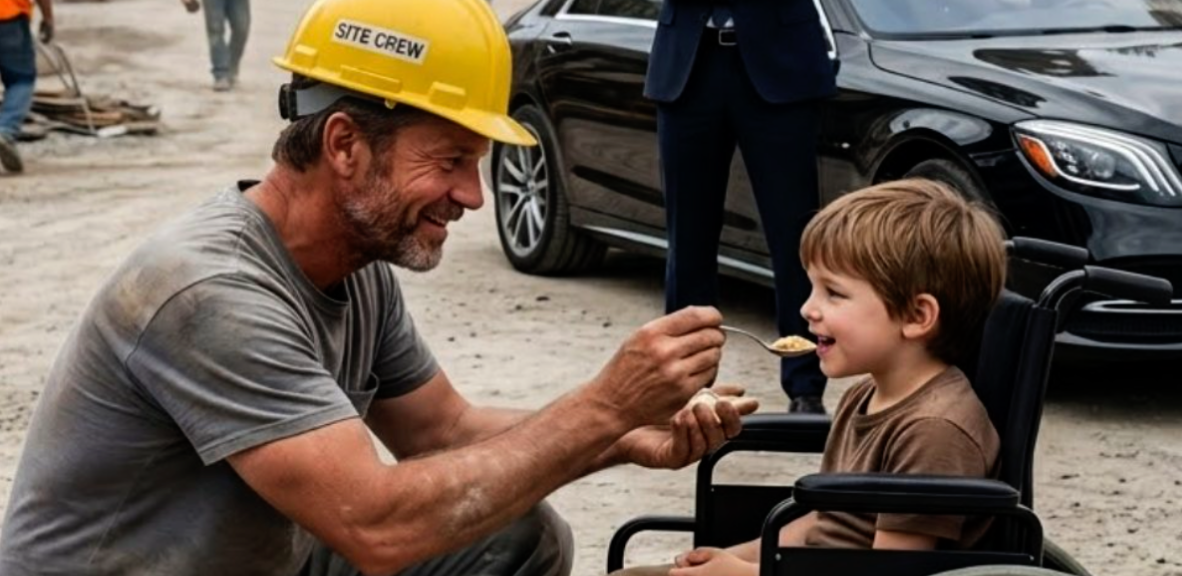
HE GAVE HIS FOOD TO A CHILD IN A WHEELCHAIR WITHOUT KNOWING WHO HE WAS, BUT WHEN A LUXURY CAR ARRIVED, HIS LIFE CHANGED FOREVER
The morning sun in the city could be merciless. It was not the gentle warmth that invites people to stroll through a park, but a thick, sticky heat mixed with brick dust, the smell of rusty metal, and the constant roar of machines.
For Cicero, that smell was simply the smell of life. His skin had been toughened by years spent under the open sky, his hands rough like carved wood, and yet his eyes still held a quiet, almost childlike clarity despite the exhaustion of long workdays.
He had never been a man of many words. Instead, he let his straight walls and the solid beams he lifted—strong enough to support entire buildings—speak for him. Cicero was a traditional mason: the kind who arrived before the foreman, treated his tools like treasures, and at the end of the day wiped the sweat from his forehead with quiet satisfaction. His clothes rarely changed: a flannel shirt faded by countless washes, trousers stained with lime, and a worn cap that barely covered his gray hair.
On that vast construction site, where the rumble of cement mixers and the shouts of workers formed a constant chorus of controlled chaos, Cicero found a small refuge during lunch. While the younger workers rushed to the corner bar—complaining about wages or talking about football—he walked toward a quiet spot near the fence that separated the site from the sidewalk outside.
There, sitting on an overturned paint bucket, he opened his old dented aluminum lunchbox. His meals were always modest: rice, beans, and on better days, a piece of chicken or a fried egg lovingly prepared by his wife, Maria, before dawn. Cicero ate slowly, watching the city through the gaps in the fence, feeling like a silent observer in a world that was always rushing somewhere.
It was on one of those suffocating Tuesdays that he noticed the boy for the first time. On the other side of the fence, where the sidewalk widened slightly, sat a child in a wheelchair. He looked small—perhaps ten years old—wearing a loose blue T-shirt that seemed too big for him.
His gaze remained fixed on the construction site, almost fascinated. He was not playing, begging, or talking to anyone. He simply sat there, motionless like a porcelain figurine surrounded by concrete and noise. His hands rested quietly on his knees, and his large dark eyes followed the crane moving through the air with a fascination that deeply touched Cicero.
The mason wondered why a child like that was alone in such a harsh place. He looked around for an adult—a distracted parent or a caretaker—but the street showed no sign of one.
The next day, the boy appeared again. He was sitting in exactly the same place, under the merciless sun, watching just as he had the day before. Cicero felt a tightness in his chest. He thought of his own grandchildren, who filled his home with laughter and hurried footsteps, and the sight of this quiet child confined to a wheelchair awakened a pain he could not ignore.
Slowly, carefully—as if approaching a frightened animal—Cicero walked toward the fence.
“Are you thirsty, little one?” he asked in his rough voice, though it carried a surprising kindness.
The child did not answer right away. He looked at Cicero with a gaze so deep it seemed to pass right through him. Then, slowly, he nodded.
Cicero passed his water bottle through the metal bars. The boy drank eagerly and handed it back with a gesture of gratitude that needed no words.
“I’ll bring you more tomorrow,” Cicero said.
The boy gave a tiny smile, barely visible, but bright enough to warm that dusty corner of the construction site.
What Cicero did not realize, as he returned to work feeling strangely lighter, was that this simple moment would set something much greater in motion. The quiet peace of his lunches was already beginning to change. He had no way of knowing that behind the fragile child and his worn wheelchair lay a secret powerful enough to shake the very foundations of the construction company where he worked—or that an approaching tragedy was silently drawing near, waiting for the right moment to strike.
In the days that followed, a new ritual formed between them. Cicero asked Maria to put a little extra food in his lunchbox.
“I have a new friend at the construction site,” he would say.
Without asking questions, Maria always added a little more—another portion of stew, a slice of homemade bread—small pieces of love tucked into the metal box.
Cicero even set up a tiny “table” near the fence using a wooden plank placed across two bricks, so the boy—whom he had started calling “champion”—could set his things down comfortably. Together, they shared lunch in a peaceful silence that, somehow, said everything.
Cicero talked about how buildings were made, how every brick mattered because if one weakened, the whole structure could collapse. The boy listened with complete attention, his eyes shining whenever Cicero showed him his rough hands, marked by years of work.
However, Cicero’s kindness did not go unnoticed by his coworkers—but not in the way he would have hoped. Human cruelty often appears in the presence of simple goodness.
“Look at old Cicero!” shouted one of the younger workers. His name was Roberto, a man swollen with pride. “Now you’re feeding beggars, old fool? What’s next, opening a daycare on the construction site?”
Mocking laughter echoed between the steel beams. They made fun of the boy, calling him “the mute one” and “the nuisance,” and ridiculed Cicero for wasting his food and time on someone who, according to them, could offer him nothing in return.
“You’re losing your mind, Cicero. That kid is just dead weight, like his chair. You’d be better off finishing the wall,” they sneered.
But the mason did not lower his head.
“A man’s dignity is measured by how he treats those who have nothing to give him,” he answered firmly, silencing the shouting for a moment, even though the mockery continued behind his back.
One Friday, the heat became almost unbearable. The dry air seemed to burn the lungs. Cicero noticed that the boy was paler than usual, with a cold sweat on his forehead. Alarmed, he dropped his tools and went to find a spare tarp among the roofing materials.
With surprising skill, he made a small canopy over the sidewalk, tying it to the fence so the child could sit in the shade.
“You’ll be better here, champion. Don’t let this sun beat you down,” he said, placing an old cushion he had brought from home.
The child squeezed his hand. The grip was weak, but filled with such sincere gratitude that Cicero felt tears rise in his eyes. His coworkers started mocking him again, calling him “the architect of the poor,” but he barely heard them anymore. His only concern was making sure the boy was all right.
Suddenly, the powerful roar of an engine and the sharp screech of expensive brakes cut through the tense air of the construction site. A flawless black luxury sedan—the kind that looked completely out of place in a working-class neighborhood—skidded to a stop in front of the main gate.
The workers froze.
A tall man stepped out, dressed in a suit worth more than any worker there earned in a year. His face was twisted with panic and sweat. It was Daniel Valadares, the powerful owner of the multimillion-dollar company financing the project, a man famous for his ruthless drive for success and his immense fortune.
“Miguel! Miguel, my son!” he cried, his voice broken by desperate sobs.
At the sound of that voice, the boy in the wheelchair struggled with all his strength to turn around. For the first time in weeks, he made a sound—a faint cry of recognition and joy. Daniel Valadares ran across the dusty ground, ignoring the mud staining his polished shoes, and knelt to embrace the child beneath Cicero’s makeshift shelter.
“Thank God! We’ve been looking for you everywhere! Why did you run away again, my son?” the father said, weeping as he kissed the boy’s head.
The workers who had mocked Cicero stepped back, pale and shaken. The “nuisance” was the only son of the most powerful man in the region.
Daniel slowly stood and looked around. He noticed the open aluminum lunchbox with leftover rice, the bottle of water, the old pillow—and above all, the improvised tarp protecting his son from the brutal heat. His eyes settled on Cicero, who stood quietly with his cap in his hands, his heart pounding.
“Was it you?” the millionaire asked, his voice no longer commanding but deeply humble. “You’ve been looking after him all this time, haven’t you?”
Cicero swallowed and nodded shyly.
“He was just hungry and hot, sir. I didn’t know who he was. I only saw a child who needed a friend.”
Daniel stepped closer and, to the astonishment of everyone watching, firmly shook the mason’s hand.
“You have no idea what you’ve done. Miguel has severe autism and partial paralysis. He rarely communicates, but my driver lost sight of him hours ago near here. He runs away because he feels suffocated by nurses and therapists who only see him as a patient. But here…”
Daniel looked at the lunchbox.
“…you saw him as a person. You gave him something I, with all my money, failed to give him: a true human connection without labels.”
The millionaire pulled a thick envelope from his pocket, but Cicero stepped back with calm dignity and shook his head.
“No, Mr. Valadares. Kindness has no price. If I accepted money for it, my wife’s cooking would lose its flavor. I did it because it was the right thing to do.”
Daniel Valadares remained silent, deeply moved by the honesty of this simple man. He placed the envelope back in his pocket, but his eyes now carried a new determination.
That same day, he took his son home. But before getting into the car, Miguel did something that left everyone speechless: he raised his trembling hand and clearly waved goodbye to Cicero.
Then came a faint “Thank you,” almost a whisper, a sound that echoed in the mason’s heart like a bell from heaven.
Cicero’s coworkers later tried to approach him, offering awkward pats on the back and hollow compliments, but he simply put his cap back on, picked up his lunchbox, and climbed onto the scaffolding.
For him, the work was not finished.
A few weeks later, unexpected news shook the entire project. By direct order of the company president, the design of the office building was changed. Daniel Valadares announced that half of the structure would become a complete care center for children with disabilities—entirely free of charge.
But that was not the only change.
On the day of the inauguration, Cicero received an official letter. It was not a dismissal. It was an appointment. Daniel wanted him to become head of maintenance and director of human resources at the center.
“I need someone who understands that the true foundations of life are not built with concrete, but with love,” the letter said.
Cicero accepted, not for a better salary, but because it meant he would be able to see Miguel every day. The boy no longer sat alone behind a fence; now he had a garden where he could play and therapists who treated him with the same respect Cicero had always shown him.
The mason, his hands still marked by lime, often sat beside Miguel in the center’s garden. There were no more fences, no more insults, no more burning sun without shade. Just two friends sharing a piece of bread and the quiet certainty that sometimes the smallest gestures build the greatest miracles.
Cicero learned that you never know when you are feeding an angel, and the world discovered that true wealth is not what sleeps in a bank account, but what you are willing to give when you believe you have nothing left.
And so, among walls of hope and roofs of kindness, the old mason and the miracle child proved that the human heart is the only structure capable of reaching the sky.