The summons for a Sunday afternoon family gathering should have been the initial harbinger of disaster.
My father is a man of rigid, unyielding routines; he does not spontaneously “do” Sunday afternoons. In his meticulously curated world, Sundays are reserved for his own leisure—for the golf course, for expansive newspaper spreads dominating the dining room table, and for sports commentary blaring from the television at a volume designed to preclude conversation. Whenever he deliberately interrupts this sacred schedule, it is never to solicit genuine input or foster a democratic dialogue. It is because he requires an audience for a unilateral decree.
I found myself seated on my parents’ floral sofa, a scratchy relic that had anchored their living room since my twelfth birthday. I cradled a mug of coffee that had already settled into a tepid, uninviting lukewarm state. The room was heavy with a familiar olfactory tapestry: the savory, heavy scent of a slow-cooked pot roast, the sharp, artificial sting of lemon cleaner, and the faint, powdery perfume my mother has worn for as long as I can recall.
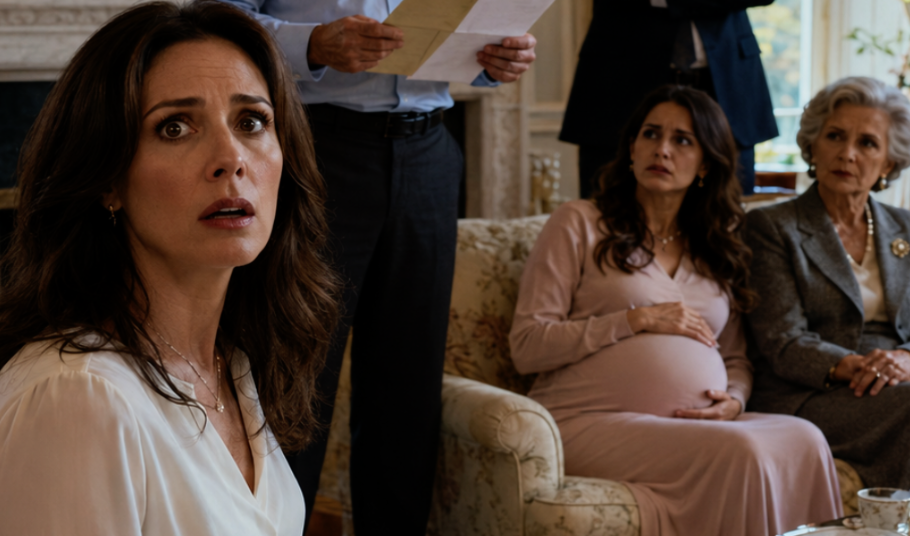
My father stood stationed near the brick fireplace, his posture evoking a corporate executive preparing to deliver a pivotal quarterly earnings report to his shareholders. My mother was perched nervously on the very edge of her armchair, her fingers anxiously twisting and punishing the hem of her knit cardigan. My older brother, Eric, paced the perimeter of the room, a coil of restless, entitled energy betraying itself in the rhythmic clenching of his jaw. Beside my mother sat Eric’s wife, Shannon, her posture impeccably straight, both hands resting protectively over the unmistakable curve of her pregnancy.
Though no one had explicitly spoken of it yet, the impending grandchild was the undisputed gravitational center of the room. Every decision, conversation, and family resource lately had been warped and bent toward the arrival of Eric’s child.
“Thank you all for making the time,” my father began, his tone draped in the smooth, practiced cadence he utilized in boardrooms—a tone that falsely implied attendance was voluntary. “We need to discuss the downtown apartment situation.”
A cold, heavy dread plummeted into my stomach.
### The Decree
The “downtown apartment situation.” He did not immediately articulate the specific address, but the architecture materialized instantly in my mind’s eye: the weathered red brick façade of 1247 Westbrook, the narrow entryway paved with vintage checkerboard tile, the slightly crooked silver mailbox bearing the stenciled name *Morrison*. It was my grandfather’s building.
More importantly, it was *my* building.
My father cleared his throat, an oratorical pause designed to command absolute attention. “As you are all keenly aware, the two-bedroom unit at 1247 Westbrook has remained within our family portfolio since your grandfather acquired the property in 1987.”
He cast a deliberate glance toward me, and then toward Eric, pantomiming the assumption that we had somehow forgotten the foundational mythos of our family’s moderate wealth. We had grown up saturated in the narrative of our grandfather scrimping, saving, and sacrificing to purchase a literal “piece of the city.” We had heard ad nauseam how Grandpa had dragged my father, then merely a college student, to the closing signature, imparting the definitive lesson: *Real wealth is the asset that pays you while you sleep.*
I required no history lesson. I knew the visceral reality of that building—every creaking floorboard, every drafty window frame, every idiosyncrasy of the aging plumbing. I had resided in that exact two-bedroom unit for four years.
I took a sip of the bitter coffee I did not want. The ceramic mug rattled a faint, betraying tremor against its saucer. “I have lived there for four years, Dad,” I stated, my voice tight, already bracing against the inevitable trajectory of this summit.
“Exactly,” he countered, weaponizing my own timeline against me as if my prolonged residency were a moral failing. “You have occupied the two-bedroom unit for four years, covering merely the utilities and a nominal monthly maintenance fee to the family trust that technically holds the deed.”
*Technically.* I nearly choked on the arrogance of the word.
He clasped his hands behind his back, assuming his ultimate patriarchal stance. “Eric and Shannon are anticipating their first child.” He gestured magnanimously toward Shannon’s midsection, prompting a fragile, nervous smile to flutter across her lips. “Their current one-bedroom apartment is wholly inadequate for a growing family. Conversely, Cassie, you occupy two bedrooms entirely alone.”
I set my mug upon the coffee table with deliberate, exaggerated care, primarily because my extremities had grown freezing and unreliable. “I utilize the secondary bedroom as a dedicated home office,” I reminded him, injecting as much unshakeable logic into the room as possible. “I manage a software project team. I work remotely three days a week. I require absolute privacy for client calls and—”
“Eric has a family to start,” my father bulldozed forward, entirely unconcerned with the mechanics of my livelihood. “The apartment makes infinitely more sense for their situation. We have decided that you will vacate the premises by the end of the month. A four-week window is more than sufficient for a single woman to secure alternative accommodations.”
The sheer audacity of the proclamation rendered the English language temporarily incomprehensible to me. The words felt like a script from a television drama I was only passively observing—a tragedy befalling some other unfortunate woman bound by blood to these people.
“*You* have decided,” I repeated, latching onto the singular phrase that illuminated the profound malfunction of this family dynamic.
“The *family* has decided,” he corrected smoothly, instantly cloaking his unilateral dictatorship in the guise of a democratic consensus. “We are obligated to prioritize what yields the greatest benefit for everyone.”
Eric ceased his pacing and leaned casually against the fireplace mantel. A familiar, deeply entrenched smirk settled over his features—a mask of weaponized sibling superiority he had perfected in our adolescence. “Come on, Cass. Don’t make this an agonizing process.”
My head snapped in his direction. “An agonizing process?”
“Look at the facts,” Eric said, ticking off bullet points on his fingers as if presenting irrefutable empirical data. “You are single. You have no dependents. You maintain a lucrative career. You possess the mobility to rent literally anywhere in the metropolitan area. Shannon and I fundamentally require the square footage for a nursery, and we simply cannot afford current market rates for a comparable two-bedroom.”
“And you presume that I can?” I challenged, my voice dropping to a dangerous register.
“You earn significantly more than we do,” Shannon interjected, her cheeks instantly suffusing with a blotchy crimson as the room’s collective attention pivoted to her. “Eric calculated your estimated salary bracket. You are doing perfectly fine.”
A hot, electric fury sparked behind my ribs. The muscles in my jaw screamed in protest as I clamped my teeth together. Eric had never once inquired about my compensation. I had certainly never disclosed a single financial metric to him. The vivid mental image of my brother and his wife sitting at their cramped kitchen table, treating my livelihood as a speculative parlor game to justify their entitlement, was profoundly nauseating.
“My personal finances,” I articulated with surgical precision, “are strictly exempt from communal family debate.”
“When your personal situation directly impacts the allocation of family resources, they absolutely are not,” my father retorted, his tone sharpening into a blade. “That apartment is the property of the family trust. Your grandfather’s explicit intent was for those assets to serve the most pressing needs of the lineage. At this current juncture, Eric and Shannon’s needs mathematically supersede yours.”
I took a slow, grounding breath. “Has anyone in this room actually reviewed the specific legal language my grandfather authored in the trust documentation?”
My mother waved a dismissive, fluttering hand, attempting to wave away the friction. “Your father administers the trust, Cassandra. He possesses the inherent authority to determine appropriate allocations.”
“Nevertheless, I am formally requesting to review the actual, physical documents,” I insisted.
“Cassie, cease being obstinate.” My father’s voice plunged into the gravelly, warning register that used to terrify me into submission when I was a child. “The ruling has been made. Eric and Shannon shall take possession of the unit on November first. You are expected to initiate your relocation arrangements immediately.”
I stood up. My legs felt hollow, yet my mind had never been more crystallized. Engaging in a shouting match within this living room was a tactical error; it was a theater designed to break me, and I refused to play the assigned role.
“Very well,” I said softly. “If that is your position, then I formally request certified copies of the trust documents, the building’s current deed, and any legal paperwork establishing your authority to terminate my residency.”
A creeping flush of dark red invaded my father’s collar. “You do not require paperwork. I am giving you a directive as your father and as the designated executor.”
“And as the current, lawful resident of that unit,” I countered, stepping toward the entryway, “I require standardized, legal documentation of this eviction.”
“It is not an eviction!” my mother cried shrilly, horrified by the introduction of an ugly, legalistic vocabulary into her pristine home. “It is simply family assisting family!”
“Then there should be no hesitation in documenting the terms of that assistance,” I replied.
I collected my coat, the static of their collective, boiling irritation prickling against my skin. No one attempted to impede my exit. By the time I breached the crisp, autumnal October air, my phone was already vibrating with the first wave of punitive text messages. By the time I unlocked the door to the apartment they intended to strip from me, the family group chat had swelled with seventeen unread notifications.
*Eric: Stop being so incredibly selfish, Cass.*
*Mom: I raised you to possess more grace than this. You are breaking my heart.*
*Dad: We are acting in the best interest of the family. I am profoundly disappointed by your adversarial attitude.*
Three distinct variations of the exact same command: *Submit.*
### The Ghost’s Will
I discarded my phone onto the granite kitchen counter, actively suppressing the violent urge to hurl it through the drywall. The apartment enveloped me in its quiet, familiar geometry. Late afternoon sunlight pooled in golden, geometric shapes across the original hardwood floors. The door to the secondary bedroom stood slightly ajar, offering a glimpse of my impeccably organized mahogany desk and the color-coded project management calendar anchoring the wall above it.
They truly believed this sanctuary was theirs to distribute.
I traversed the living room and knelt before the heavy steel filing cabinet tucked inconspicuously beside the television stand. The top drawer invariably required a specific, practiced strike of the palm against its side to disengage the faulty track—a quirk I knew intimately. It slid open, revealing an interior defined by rigorous categorization. I am the archetype of a woman who utilizes label makers, chronological indexing, and protective plastic sleeves for vital records.
It was precisely this meticulous, unromantic trait that had endeared me to my grandfather.
Four years prior, when I was abruptly summoned to his hospital room, I had braced myself for a final farewell. The corridor had reeked of that inescapable, institutional blend of bleach and decay. The fluorescent lights overhead emitted a perpetual, maddening hum. My mother had pre-warned me that Grandpa was experiencing a rapid decline, but upon entering the room, I found him sitting upright. His eyes were startlingly lucid, sharp as cut glass beneath the halo of his oxygen cannula.
“Close the door,” he had commanded the moment my silhouette broke the threshold.
I complied, and the rigid lines of his weathered face softened into profound affection. “Ah. There she is. My absolute favorite property manager.”
I forced a laugh through the tightening constriction in my throat. “I am a project manager, Grandpa. I oversee software development, not real estate.”
He waved away the distinction with a frail but decisive flick of his wrist. “You manage chaotic human variables. You manage infinitesimal details. The underlying architecture is identical. Sit down.” His fingers, retaining a surprising, sinewy strength despite the intrusive IV lines, locked around my wrist and pulled me into the bedside chair.
“I am completely restructuring the trust,” he announced without preamble.
“Grandpa, please, you need to conserve your energy,” I protested gently. “We have plenty of time to discuss—”
“Listen to me.” His grip intensified, a physical manifestation of his urgency. “Your father operates under the delusion that he controls the universe. He always has. He possesses adequate intentions, but he suffers from a terminal inability to read the fine print. He assumes. He dictates. He forcibly projects his own desires onto others and demands they recognize it as benevolent guidance.”
I possessed no counterargument. My entire existence had been an observational study of my father unilaterally fabricating decisions and retroactively branding them as a “family consensus.”
“The Westbrook building,” Grandpa continued, his breathing shallow but steady. “I am severing it from the broader portfolio.”
My pulse accelerated. “I don’t understand.”
“The building goes to you. Direct, unencumbered transfer, immediately effective upon my passing. The legal instrumentation has already been executed and filed.”
I stared at him, paralyzed by the magnitude of the statement. “What?”
“Your father shall inherit the remaining properties,” he explained, steamrolling my shock with pure pragmatic momentum. “He receives the commercial high-rise downtown, the riverside duplex, and the Oakmont retail strip. Given his psychological profile, he will automatically assume he exercises dominion over Westbrook as well. Why? Because he will categorically refuse to read the amended legal addendums. But he will possess zero legal claim. It is entirely yours. All six residential units.”
My brain scrambled desperately to process the logistical and emotional ramifications. “But… why me? Why cut it out?”
A slow, knowing smile crinkled the corners of his eyes, an echo of the vital, mischievous man he had been my entire life.
“Because, Cassandra, you are the singular entity in this bloodline who actually asked me what I desired, rather than lecturing me on what I *should* do,” he said, his voice dropping into a register of profound sincerity. “Because you prioritized visiting me every single week, unprompted by financial necessity or crisis. Because when my cognitive recall began to slip, you didn’t infantalize me or attempt to force me into an assisted living facility; you simply came over and meticulously labeled every drawer and cabinet in my kitchen to help me maintain my dignity.”
I swallowed hard, fighting the sting of tears.
“And fundamentally,” he concluded, his tone softening, “I trust you to steward the asset properly. You are intrinsically careful. You obsess over the fine print. You actually listen to people. I could abandon this building to the general trust and watch your father use it as leverage to manipulate everyone, or I could place it in the hands of the one person who will treat it as a profound responsibility rather than a toy.”
He passed away exactly fourteen days later.
Approximately a month following his interment, a heavily sealed, manila envelope bearing the insignia of his estate attorney materialized in my mailbox. The contents were irrefutable: the fully executed, notarized trust amendments and the finalized deed of transfer. The dense legal lexicon, the embossed seals, the precise dates—everything was perfectly aligned with my grandfather’s hospital-bed prophecy. The building was mine. Sole ownership. Completely sovereign from the family trust.
I had collapsed onto my living room floor that evening, surrounded by a fortress of paperwork, feeling the sheer, crushing gravity of the secret settle over my shoulders.
I never informed my family.
I am capable of admitting that a fraction of this silence was rooted in cowardice—a deep-seated aversion to triggering my father’s volcanic wrath. A significant portion was basic self-preservation. However, the overwhelming motivation was a profound desire to honor my grandfather’s explicit strategy.
*“He will assume it remains in the trust,”* he had predicted. *“He will not read the amended documents. Do not initiate a war over it prematurely. Simply do right by the building.”*
And so, I adhered to the mandate.
I systematically contacted the tenants occupying the other five units, formally introducing myself as the new proprietor and property manager. I collaborated with a razor-sharp attorney to establish a legitimate corporate LLC, opened dedicated business banking accounts, and updated all existing leases. I ensured that every insurance policy, municipal permit, and tax obligation was flawlessly maintained. I personally oversaw cosmetic painting and critical infrastructure repairs, consistently funneling a disciplined percentage of the monthly rental yields into a robust emergency maintenance reserve.
Over the span of four years, 1247 Westbrook metamorphosed from merely my personal residence into a stable, thriving micro-enterprise. It was a living, breathing entity that I diligently cultivated.
And now, my family, blinded by their own assumptions, was attempting to legally evict me from my own kingdom.
I extracted the voluminous folder demarcated *1247 WESTBROOK – LEGAL PROCEEDINGS* and deposited it onto the coffee table. The deed rested at the forefront, bearing my legal name. The amended trust documents were present, displaying my grandfather’s precise signature adjacent to the attorney’s seal. Furthermore, the file contained copies of the formal registered letters that had been demonstrably dispatched to my parents four years ago—letters my father, acting as the primary executor, had clearly never bothered to read.
### The Legal Shield
On Monday morning at precisely 9:00 AM, I initiated a call to Patricia.
I had secured Patricia’s representation three years prior, acting upon the fervent recommendation of a corporate colleague who had survived a labyrinthine, brutal landlord-tenant dispute. *“She is terrifying in the most spectacular way imaginable,”* my coworker had testified, his eyes wide with retroactive awe. *“She possesses the unique ability to smile warmly while verbally disemboweling an opponent in a court of law.”*
Seated within the austere, minimalist confines of her conference room, I found myself profoundly grateful for her fearsome reputation.
“Let me summarize to ensure absolute clarity,” Patricia stated, steepling her impeccably manicured fingers after I concluded my recitation of the Sunday family ambush. “Your immediate family is attempting to forcefully evict you from a property of which you are the sole legal owner.”
“Correct.”
“And they are operating under the entirely false assumption that the property remains governed by a family trust overseen by your father?” A glimmer of dark, predatory amusement flared in her gaze.
“Yes. Because my father never actually read the finalized estate amendments.” I slid the pristine copy of the deed across the polished mahogany table. “My grandfather executed a direct transfer prior to his death. The chain of title is absolute.”
Patricia’s eyes swept over the documentation with microscopic precision. She offered a sharp, confirming nod. “Indisputable. The title is clear as polished glass.”
“Consequently, they possess zero authority to—”
“They possess absolutely zero authority to dictate anything,” she interrupted crisply. “They maintain no ownership stake. They cannot terminate your residency. Any attempt to physically remove you, alter the property locks, or commandeer the premises constitutes a blatant violation of established landlord-tenant statutes. And that is before we even broach the catastrophic legal errors they are committing regarding estate law.”
I exhaled a breath I felt I had been holding since Sunday afternoon. “There is an additional complication,” I confessed reluctantly. “My brother texted me yesterday, claiming he is ‘assisting me in initiating the packing process.’”
Patricia’s posture instantly shifted from relaxed amusement to aggressive vigilance. “Has he physically entered your private unit?”
“I have not visually confirmed it myself,” I admitted, “but he possesses a physical key. My mother historically maintained an ‘emergency access’ key in her kitchen drawer. He evidently appropriated it.”
“That constitutes illegal entry,” Patricia stated, her voice dropping into a lethal, pragmatic register. “It potentially escalates to burglary or theft, contingent upon his actions within the dwelling. You previously mentioned you installed comprehensive security surveillance in the building’s common corridors?”
“Yes. The building security apparatus automatically archives logs and visual feeds.”
“Procure them immediately,” she commanded. “Instruct the security firm to isolate the exact dates and timestamps aligning with your brother’s messages. We require unassailable documentation of every singular instance of unauthorized penetration.” She leaned forward, the predatory smile returning. “Cassie, I require you to define the exact parameters of your desired outcome. Are we seeking to gently educate your family? To orchestrate a polite mediation where we softly guide them toward reality? Or are we establishing impenetrable, punitive legal boundaries?”
A rapid succession of mental images assaulted me: Eric’s smug superiority as he calculated my unearned salary; my father holding court by the fireplace, dictating the trajectory of my life without a singular inquiry into my wellbeing; my mother reducing my complex career to the status of a frivolous hobby. I thought of the countless, unglamorous hours I had spent negotiating with roofing contractors and repairing boilers while they basked in the ignorant assumption that my father was silently managing the portfolio.
“Impenetrable legal boundaries,” I declared.
Patricia’s smile widened, sharp and immensely satisfied. “Exceptional. Here is our exact sequence of operations.”
By Wednesday afternoon, the family group chat had rapidly devolved from self-righteous outrage into chaotic, unadulterated panic.
It commenced with an incoming call from my father, which I deliberately routed to voicemail. This was rapidly followed by frantic attempts from Eric, and then my mother. When I maintained total radio silence, the text messages erupted.
*Dad: What in the name of God is this legal correspondence?*
*Eric: You retained a litigator? Have you completely lost your mind?*
*Mom: How could you possibly subject your own blood to this? I am physically shaking.*
I reviewed the escalating hysteria while leaning against my kitchen counter, Patricia’s drafted correspondence illuminated on my laptop screen. The document was a masterpiece of beautiful, brutal brevity.
It explicitly stipulated that I, Cassandra Morrison, stood as the sole, unencumbered legal owner of the parcel and structure located at 1247 Westbrook. It codified that absolutely no other party possessed the legal authority to dictate occupancy, execute leases, or cross the threshold of any unit without my expressed, prior written consent. It contained a stark warning that any unauthorized attempt to displace my belongings or alter the hardware of the premises would immediately be prosecuted as an illegal eviction and criminal trespassing.
Crucially, it included a secondary, highly specific cease-and-desist mandate addressed directly to Eric. It explicitly referenced the time-stamped security footage confirming his unauthorized utilization of a key to breach my private domicile on three separate occasions within the preceding week.
Apology or mitigation was entirely absent from the text.
### The Confrontation
On Thursday morning, my father’s voice possessed the brittle, fragile quality of glass under immense pressure when he finally reached me.
“We are convening another meeting,” he dictated, the authority in his tone severely compromised. “Today. Eleven o’clock sharp. My office.”
“Acknowledged,” I replied evenly.
Historically, this summons would have induced a paralyzing wave of dread. The younger iteration of myself—the girl who instinctively flinched at the slightest elevation of his volume—would have been terrified. Yet, my current emotional state was defined by an eerie, profound tranquility. It was the specific, insulated calm of standing within a heavily reinforced bunker while observing a hurricane make landfall outside. Their rage was entirely impotent against the bulwark of legal reality.
My father’s home office was a chaotic testament to his disorganized mind—a state of affairs that would have induced apoplexy in my grandfather. Bank statements hemorrhaged from overstuffed file boxes. Precarious towers of manila folders threatened to collapse across the credenza.
Eric was already present upon my arrival, his arms defensively crossed across his chest, nervously rotating his wedding band. Shannon was sequestered in an upholstered corner chair, her posture radiating extreme tension. My mother stood rigidly behind my father’s imposing leather chair, anchoring a hand to the backrest as if preparing for a physical impact.
Patricia’s devastating letter rested precisely in the geographical center of my father’s mahogany desk, radiating the energy of an unexploded ordinance.
“Explain this absolute fabrication,” he demanded, physically shoving the document across the polished wood toward me.
“The building belongs to me,” I stated, eschewing any preparatory softening. “Grandpa transferred the deed to my name prior to his passing. I have been the legal owner for forty-eight months.”
“That is a logistical impossibility,” my father snapped, desperation fracturing his confidence. “The master trust—”
“The master trust was formally amended,” I countered. I reached into my leather tote and extracted high-resolution copies of the critical addendums, depositing them directly atop Patricia’s letter. “You were served with these exact copies in 2020 by his estate attorney. You simply chose never to read them.”
My father snatched the documents, glaring at the heavily textured paper as if it had committed a personal offense against him. His eyes skittered erratically across the legal prose, desperately searching for a loophole that did not exist.
“Your grandfather would never, under any circumstances, excise me from the hierarchy like this,” he muttered, his worldview actively short-circuiting.
“He did not excise you,” I corrected calmly. “You received the lion’s share of the portfolio. The downtown commercial property, the Riverside duplex, and the Oakmont retail center. 1247 Westbrook was the singular asset allocated to me.”
My mother leaned precariously over his shoulder, her eyes wide with horrified comprehension as she silently mouthed the specific paragraph: *The residential building at 1247 Westbrook Avenue is hereby transferred to Cassandra Morrison, effective immediately upon the death of Harold Morrison.*
She looked at me, utterly bewildered. “Why on earth would you conceal this from us?”
“Because Grandpa explicitly requested that I do so,” I answered truthfully. “He prophesied that Dad would refuse to read the legal filings, and he was entirely accurate. For four consecutive years, you have all operated under the assumption that the property was lingering in a familial trust, while I have been independently managing the logistics, financing the maintenance, paying the municipal taxes, and collecting the rental yields.”
“Rent?” My father’s head snapped upward, his eyes locking onto a new, terrifying variable. “What rental yields?”
“The remaining five units are fully occupied,” I reminded him, adopting the tone of a patient instructor explaining basic arithmetic. “They have maintained occupancy the entire duration. Those revenues finance the building’s operational costs, the insurance premiums, and the capital improvements.”
“You have been quietly siphoning money from family property?” he demanded, attempting to reframe my labor as theft.
“I have been collecting revenue from *my* property,” I corrected, my tone dropping to an absolute zero. “My physical building. My generated income. My unilateral responsibility.”
Shannon suddenly lunged forward in her chair. “But we desperately need that specific apartment,” she pleaded, her voice strung tight with anxiety. “For the baby. Our current footprint is completely unworkable.”
“The metropolitan area contains thousands of two-bedroom apartments,” I offered practically. “I am more than willing to compile a list of comparable real estate listings for you.”
“We cannot afford current market valuations,” she admitted, sounding thoroughly defeated.
“That is not my financial responsibility to solve,” I replied. The declaration hung in the air, colder and more absolute than I had perhaps intended, but I steadfastly refused to retract it.
Eric slammed his open palm against the desk, a sudden explosion of physical aggression. “This is a perversion of what Grandpa would have wanted!” he shouted. “He treasured this family! He desired collective security! He never would have endorsed you hoarding a vital asset like some greedy—”
“Grandpa specifically, legally codified exactly what he wanted,” I interjected, cutting through his tantrum. “He documented it in writing. He executed it through proper legal channels. He meticulously ensured his attorney documented his absolute cognitive capacity. He understood the precise ramifications of his actions.”
My father’s complexion had transitioned to a mottled, dangerous hue—somewhere between bruised purple and an ashen gray. “He was gravely ill,” he argued desperately. “His cognitive functions were severely compromised.”
“He was entirely, terrifyingly lucid when he authorized the amendment,” I countered effortlessly. “And he remained so for months subsequently. His primary physician documented it. His attorney testified to it in the file. Patricia possesses the entire medical and legal dossier.”
My mother’s voice thickened with impending tears. “So you intend to simply… hoard it all for your own selfish benefit? While your own brother and his pregnant wife struggle to survive?”
“I intend to continue managing my independent property exactly as I have been,” I stated, entirely unswayed by the emotional manipulation. “If Eric and Shannon desire to lease one of the units, they are welcome to submit an application matching any other prospective tenant.”
My father stared at me, his reality entirely inverted. “You expect them to pay rent. To their own sister.”
“I expect them to pay rent to the legal property owner, who coincidentally happens to be their sister,” I clarified. “There is currently a waitlist for vacancies, but I would be willing to expedite a family application if you are genuinely interested.”
“What is the financial requirement?” Eric demanded, his tone sullen.
“Current market valuation for a two-bedroom in my structure commands $2,400 monthly,” I recited smoothly. “Which frankly represents a below-market rate for the surrounding neighborhood. I intentionally suppress the rent to attract and retain highly stable, long-term occupants.”
“That is absolute insanity,” Shannon whispered, retreating into her chair.
“That is basic macroeconomic reality,” I shrugged. “I can easily provide the comparable neighborhood data.”
My father was still furiously rotating through the trust copies, desperately hunting for an imaginary escape clause. “You have been operating this facility for four years,” he said, his voice slow and calculating. “The accumulated rental income… you had a moral obligation to disperse those profits among the family.”
“Under what logical framework?” I asked.
“Because we are a family,” he stated, as if this nebulous concept superseded property law.
I met his gaze with unblinking intensity. “Biological relation does not automatically manufacture financial obligation. You do not mandate profit-sharing from your properties with me. You do not deposit fifty percent of the Oakmont retail profits into my checking account. Grandpa allocated assets to you. He allocated one specific asset to me. I have managed my inheritance with rigorous discipline. Have you?”
He offered no response.
### The Final Boundary
The profound inability of my father and brother to absorb reality manifested violently on Friday afternoon.
Returning to my apartment following an external client consultation, I discovered Eric entrenched in the center of my living room, surrounded by an armada of flattened cardboard boxes. He was aggressively cramming my clothing into the corrugated spaces, handling my carefully preserved cashmere sweaters as if they were industrial rags.
“What exact activity are you engaged in?” I demanded, the shock ripping the question from my throat.
He paused, his face flushed with physical exertion and an intoxicating, delusional sense of triumph. “I am expediting your packing,” he announced. “Given your persistent stubbornness, Shannon and I have unilaterally decided we are occupying the space regardless. You possess two options: vacate the premises peacefully, or we will guarantee this becomes an agonizing ordeal.”
My neurological system flooded with a simultaneous wave of ice and fire.
“Eric,” I articulated with slow, lethal precision, “you are required to exit this domicile immediately.”
“Or what consequences will follow?” he scoffed, dripping with condescension. “You’ll complain to Dad? He entirely endorses my actions.”
“No,” I replied, calmly extracting my smartphone from my blazer pocket. “I will request police intervention. You are actively committing criminal trespass within my private residence, in direct violation of a formally served cease-and-desist mandate.”
He emitted a harsh, disbelieving laugh. “You wouldn’t dare escalate this.”
I bypassed hesitation and engaged the emergency dial. “Hello,” I stated clearly when the dispatch operator connected. “I am reporting an active, hostile trespassing incident at my primary residence. An estranged family member has illegally breached my apartment and is aggressively refusing to vacate. Yes, I am currently physically safe. I am positioned near the primary exit.”
The manufactured bravado instantly drained from Eric’s posture. “Cassie, terminate the call. Do not act like a lunatic. This is an internal family dispute.”
“This is a strictly codified legal violation,” I corrected.
After confirming my location, the dispatcher assured me law enforcement was actively en route. I maintained my tactical position in the hallway threshold, effectively barricading Eric from exiting with any of my personal property. He began to physically agitate, shifting his weight erratically, the reality of the situation finally penetrating his entitlement.
“You are genuinely executing this,” he muttered, horrified.
“You forcefully breached my home,” I replied, unyielding. “For a second documented time. Following explicit, written legal warnings not to do so. What alternative universe did you anticipate inhabiting?”
Twelve agonizing minutes later, a loud, authoritative cadence of knocks rattled the door frame. The knot of tension in my chest instantly unspooled. Two uniformed officers occupied the hallway, their posture a blend of casual readiness and practiced neutrality.
“Ma’am? You initiated a trespassing complaint?”
“Affirmative,” I responded, stepping laterally to grant them an unobstructed view of Eric standing amidst my half-packed existence.
Eric instantly activated his defense mechanism, layering on a desperate, charming veneer. “Officers, this is merely a profound misunderstanding between siblings,” he projected smoothly. “This specific apartment is legally intended to transition to my ownership. We are simply navigating the complex logistical details.”
“Sir, do you currently hold primary residency at this address?” the lead officer inquired, thoroughly unimpressed.
“I will be occupying it,” Eric insisted. “Imminently. My father is the owner of the overarching structure—”
“I am the sole legal proprietor of this building,” I interrupted, my hands exhibiting a faint tremor that my voice completely betrayed. “Here is the recorded deed, my government identification, and the formalized legal injunction my attorney executed against this individual regarding prior unauthorized entries.”
The officer accepted the documentation, executed a rapid but comprehensive scan of the legal jargon, and shared a weary, communicative glance with his partner—a silent acknowledgment of the exhausting reality of family entitlement disputes.
“Sir, you are mandated to vacate these premises immediately,” the secondary officer instructed, his tone devoid of negotiation. “If you re-enter this property without the expressed, documented authorization of the deed holder, you will be placed under immediate arrest for criminal trespassing.”
Eric’s complexion flared to a dangerous crimson. “You cannot possibly be serious. She is my biological sister!”
“And this constitutes her legally recognized private property,” the officer countered with absolute serenity. “Her identity is codified on the deed. You have received formal notification prohibiting your presence. At this exact moment, we are extending you the courtesy of leaving without handcuffs. I strongly advise you to accept the offer.”
For a terrifying, suspended second, I believed Eric’s pride would demand he physically resist. Then, the fight evaporated from his frame. His shoulders collapsed. He aggressively discarded the sweater he was clutching and stormed toward the exit, brushing forcefully past me.
“This conflict is far from resolved,” he hissed venomously as he crossed the threshold.
“Actually,” I murmured quietly, “I believe it has reached its definitive conclusion.”
### The Verdict and Beyond
The ensuing months were consumed by an aggressive, desperate legal campaign waged by my father. He formally petitioned the courts to invalidate the trust transfer, anchoring his strategy on the insulting premise that my grandfather was either cognitively incompetent or victimized by my undue manipulation.
Patricia systematically dismantled his argument. We possessed an impenetrable fortress of evidence: comprehensive medical evaluations confirming Grandpa’s lucidity, sworn affidavits from his estate attorney, and a flawlessly executed legal timeline. When we finally entered the courtroom, the presiding judge—a stern, pragmatic man who exhibited zero tolerance for my father’s emotional theatrics—reviewed the overwhelming documentation and decisively dismissed the petition.
“The evidence is absolute,” the judge declared, his gaze locking onto my father. “Your father’s wishes were explicit, legally sound, and final. Disagreement with an estate allocation does not equate to its invalidity.”
Outside the courthouse, in the bitter chill of winter, my father attempted one final maneuver. “This is destroying our family, Cassie,” he accused, his voice stripped of its usual authority.
“No,” I corrected him, the realization settling into my bones with total clarity. “Your pathological inability to accept a reality you did not unilaterally dictate is destroying the family. Grandpa desired a steward who would listen to his wishes, rather than overrule them. That is why he chose me.”
He stared at me, visibly disoriented, incapable of comprehending a narrative where he was not the supreme architect.
Years progressed. The family dynamics permanently realigned. Eric and Shannon secured an inferior apartment further from the city center, their pride precluding them from ever accepting my later, heavily discounted offer to lease them a unit in my building. My father maintained a cold, distant orbit during obligatory family functions.
Yet, as I painted the hallways of 1247 Westbrook and watched new families breathe life into its architecture, I experienced no regret. The structure was never merely an asset to be bartered in my father’s games of control. It was an inheritance of autonomy—a domain that was unequivocally, irrevocably mine.