
In the quiet, dusty corners of a local thrift store—a place where the discarded fragments of lives are sold for silver and copper—there exists a thin line between a transaction and a transformation. We often view commerce as a cold, mathematical exchange of value, a rigid adherence to the numbers printed on adhesive tags. But every so often, the sterile beep of a barcode scanner becomes a heartbeat, and a simple lie becomes the most profound truth a person can offer. This is a story about a girl, a blue sequined dress, and the sixteen dollars that bridged the gap between despair and a final, flickering moment of grace.
The Anatomy of Hope and the Geometry of Loss
She stood at my counter, not as a customer, but as a supplicant at an altar she wasn’t sure would accept her offering. Over her arms lay a blue sequined dress, draped with a reverence usually reserved for holy relics or infant children. It was not the high-fashion, “fancy-rich” blue of a gala on the coast; it was “Hope Blue”—a shade that shimmered with the desperate possibility of a different reality. In the harsh, fluorescent hum of the store, those sequins caught the light like tiny, jagged stars.
The tag was unequivocal: $25.00.
In the world of the comfortable, twenty-five dollars is a fleeting thought, the cost of a mediocre lunch or a monthly streaming subscription. But in the world of the girl standing before me, twenty-five dollars was a mountain. I watched her hands. They weren’t the soft, idle hands of a teenager preoccupied with social media; they were the hands of someone who understood the tactile reality of labor. She emptied her fist onto the Formica counter, and the sound of her wealth was a soft, muffled thud of paper and the metallic clink of struggle.
There were crumpled one-dollar bills, smoothed out so many times the ink was fading. There were two five-dollar bills, folded into tight squares. Finally, she produced a small, silver pile of quarters she had tucked into her jacket pocket, perhaps scavenged from the depths of a sofa or saved from a tipped jar.
She counted once, her lips moving silently. She counted again, hoping, perhaps, that the math would change through sheer force of will.
Then came the look. It is a specific expression familiar to anyone who has worked behind a counter in a struggling town. It is the look of a person whom life has taught not to ask for mercy because mercy is a luxury they cannot afford. It is a preemptive bracing for impact, a quiet withdrawal of the soul to protect itself from the inevitable “no.”
“I only have fourteen,” she said, her voice barely a whisper, yet steady with the dignity of the defeated. “It’s okay. I can put it back.”
She tried to smile. That was the singular detail that broke the air in the room. It wasn’t a smile of happiness, but a social mask—a courtesy extended to me so that I wouldn’t feel uncomfortable for having to reject her. She wasn’t angry at the price, nor was she performing a drama for a discount. She was simply embarrassed, as if her poverty were a personal failing she had to apologize for. To her, disappointment wasn’t an event; it was a routine she knew by heart, a familiar rhythm of “not quite enough.” I looked down at the dress. It was a mass of plastic and thread. Then I looked at her. I saw her sneakers, worn down to a ghostly white at the toes from miles of walking. I saw the school patch on her backpack—the public high school down the road, a place where the kids are often forced to grow up before they’ve even finished growing tall. She couldn’t have been more than seventeen, but her eyes held the fatigue of a woman of fifty.
“Hang on,” I said, my voice sounding louder than I intended in the sudden silence of the shop.READ THE FULL STORY BELOW.
In the quiet, dusty corners of a local thrift store—a place where the discarded fragments of lives are sold for silver and copper—there exists a thin line between a transaction and a transformation. We often view commerce as a cold, mathematical exchange of value, a rigid adherence to the numbers printed on adhesive tags. But every so often, the sterile beep of a barcode scanner becomes a heartbeat, and a simple lie becomes the most profound truth a person can offer. This is a story about a girl, a blue sequined dress, and the sixteen dollars that bridged the gap between despair and a final, flickering moment of grace.
She stood at my counter, not as a customer, but as a supplicant at an altar she wasn’t sure would accept her offering. Over her arms lay a blue sequined dress, draped with a reverence usually reserved for holy relics or infant children. It was not the high-fashion, “fancy-rich” blue of a gala on the coast; it was “Hope Blue”—a shade that shimmered with the desperate possibility of a different reality. In the harsh, fluorescent hum of the store, those sequins caught the light like tiny, jagged stars.
The tag was unequivocal: $25.00.
In the world of the comfortable, twenty-five dollars is a fleeting thought, the cost of a mediocre lunch or a monthly streaming subscription. But in the world of the girl standing before me, twenty-five dollars was a mountain. I watched her hands. They weren’t the soft, idle hands of a teenager preoccupied with social media; they were the hands of someone who understood the tactile reality of labor. She emptied her fist onto the Formica counter, and the sound of her wealth was a soft, muffled thud of paper and the metallic clink of struggle.
There were crumpled one-dollar bills, smoothed out so many times the ink was fading. There were two five-dollar bills, folded into tight squares. Finally, she produced a small, silver pile of quarters she had tucked into her jacket pocket, perhaps scavenged from the depths of a sofa or saved from a tipped jar.
She counted once, her lips moving silently. She counted again, hoping, perhaps, that the math would change through sheer force of will.
Then came the look. It is a specific expression familiar to anyone who has worked behind a counter in a struggling town. It is the look of a person whom life has taught not to ask for mercy because mercy is a luxury they cannot afford. It is a preemptive bracing for impact, a quiet withdrawal of the soul to protect itself from the inevitable “no.”
“I only have fourteen,” she said, her voice barely a whisper, yet steady with the dignity of the defeated. “It’s okay. I can put it back.”
She tried to smile. That was the singular detail that broke the air in the room. It wasn’t a smile of happiness, but a social mask—a courtesy extended to me so that I wouldn’t feel uncomfortable for having to reject her. She wasn’t angry at the price, nor was she performing a drama for a discount. She was simply embarrassed, as if her poverty were a personal failing she had to apologize for. To her, disappointment wasn’t an event; it was a routine she knew by heart, a familiar rhythm of “not quite enough.” I looked down at the dress. It was a mass of plastic and thread. Then I looked at her. I saw her sneakers, worn down to a ghostly white at the toes from miles of walking. I saw the school patch on her backpack—the public high school down the road, a place where the kids are often forced to grow up before they’ve even finished growing tall. She couldn’t have been more than seventeen, but her eyes held the fatigue of a woman of fifty.
“Hang on,” I said, my voice sounding louder than I intended in the sudden silence of the shop.
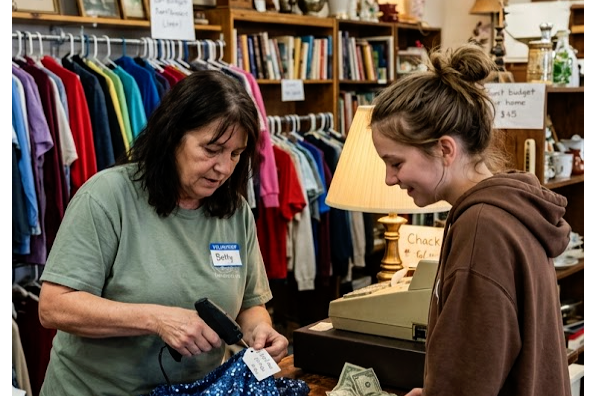
I picked up the scanner. I didn’t just scan it; I performed. I made a show of squinting at the flickering green text of the monitor, tilting my head as if deciphering a complex code. I needed the lie to be seamless. I needed it to be a “fact” of the system so she wouldn’t feel like a charity case.
“Oh,” I said, injecting a note of feigned surprise into my tone. “Well, would you look at that. Blue tag clearance. It just dropped to ten dollars today.”
The transformation of her face was instantaneous and visceral. It wasn’t just the arrival of happiness; it was the departure of a crushing weight. It was the look of someone who had been held underwater and was suddenly pulled up for a lungful of air.
“Really?” she breathed.
“Really.”
Her hands began to shake—a delayed reaction to the stress—as she pushed the fourteen dollars toward me. “Are you serious? Are you serious?” she kept asking. She was terrified that if she stopped questioning it, the universe might realize its mistake and snatch the miracle away.
I rang it up. Total: $10.00.
I handed her the four dollars in change—money that likely represented several meals or a bus pass—and she clutched that blue dress to her chest so tightly I thought the sequins might leave imprints on her skin. I expected her to leave then, to run out before I changed my mind. But she lingered. Sometimes, when a person has been carrying a secret burden, a single act of kindness acts as a key, unlocking the gate to everything they’ve been holding inside. “My mom thought I wasn’t going to go,” she said suddenly.
I leaned against the counter, giving her the only thing I had left to give: my attention. “To prom?”
She nodded, but her gaze was fixed somewhere far beyond the walls of the thrift store. “She used to love dancing,” the girl continued. “Before she got sick.”
The story spilled out then, a quiet torrent of reality. Her mother had been confined to a hospital bed set up in the center of their living room since January. To pay for the mounting bills, they had sold their belongings piece by piece. The girl had been juggling school, caretaking, and weekend shifts at a local diner, saving for this specific dress one dollar at a time.
“I know prom is stupid when bills are what they are,” she said, her voice shrinking. “But she kept saying she wanted to see me dressed up just once. She said I should have one normal night.”
In that moment, the blue dress ceased to be a garment. It was a beacon. It was a daughter’s attempt to provide a terminal mother with a final image of beauty, a way to prove that the illness hadn’t erased the joy of the family. It was a desperate grab at “normalcy” in a life that had become a battlefield of prescriptions and debt. My throat felt like it had been cinched shut. This wasn’t about a dance; it was about the sacred duty of the living to honor those they are losing.
She thanked me three times, her gratitude far outweighing the ten dollars she’d paid. At the door, she turned back one last time, her eyes bright.
“You made my mom’s week,” she said.
Then she was gone, a small figure in a secondhand coat, carrying a plastic bag containing a ten-dollar miracle that she treated like it was worth a million. That evening, as the sun dipped below the horizon and the store grew cold, I performed the closing ritual. I counted the drawer. As expected, the register was short fifteen dollars. In the eyes of a corporate auditor, this was a discrepancy, a failure of protocol, a “loss.”
I took fifteen dollars out of my own wallet and tucked it into the till.
It was the best fifteen dollars I have ever spent. It wasn’t an expense; it was an investment in the idea that the world doesn’t have to be as cruel as it often is. I thought that would be the end of the chapter. I thought I would carry that secret satisfied feeling and eventually forget the girl’s name.
I was wrong. Three days later, just as the “Closed” sign was being turned, she returned.
She wasn’t the tired girl in the worn sneakers anymore. Her hair was styled, her makeup was simple and elegant, and she was wearing the blue sequined dress. She looked beautiful, but not in the hollow, polished way of a magazine cover. She looked proud. She looked like a person who had reclaimed her right to shine.
She held out her phone. “My mom wanted me to show you this,” she said.
The image on the screen is one I will never forget. It was a photo taken in a dimly lit living room, dominated by the sterile steel of a hospital bed. In the bed lay a woman, pale and gaunt, the shadows of illness heavy beneath her eyes. But she was smiling with a radiance that seemed to defy the very laws of biology. Beside her stood the girl in the blue dress, radiant and strong.
On the blanket across her mother’s lap was a sign, handwritten in thick, bold black marker: I found myself laughing and crying simultaneously, standing there amidst the smell of old books, chipped coffee mugs, and used lamps. The girl’s voice dropped to a whisper as she told me the rest: her mother had passed away the following morning. The photo was their final moment together.
“She told me I still had to go to the dance,” the girl said, wiping a stray tear. “She said no daughter of hers was staying home to mourn in a pretty dress.”
Then, she gave me a watery smile that felt like a benediction. “She also said whoever sold it to me was an angel with a barcode scanner.” I am not an angel. I am a woman who works in a thrift store, a woman who sees the underside of the American dream every single day. I see the kids who grow up too fast because their parents are working three jobs; I see the elderly who have to choose between heat and medication; I see the quiet dignity of those who are breaking under the weight of a world that values profit over people.
We are taught from a young age that rules are the foundation of society. We are told that “fairness” means treating everyone exactly the same, following the ledger to the decimal point, and never deviating from the script. But there is a higher law than the one printed in employee handbooks.
Sometimes, the most “correct” thing you can do is be technically wrong. Sometimes, the most honest thing you can do is tell a lie that restores a person’s faith in humanity. In a world that is constantly breaking people down—shredding their confidence, their health, and their bank accounts—the smallest act of rebellion is to be kind.
The fifteen dollars I “lost” that day didn’t show up on any tax return, and it didn’t win me any awards. But it bought a mother a final smile and gave a daughter a memory that will act as a shield against the hardships to come. If that makes me a “liar” in the eyes of the register, then I will gladly accept the title. In the end, we aren’t remembered for how well we followed the rules, but for how well we loved the people those rules were meant to serve.