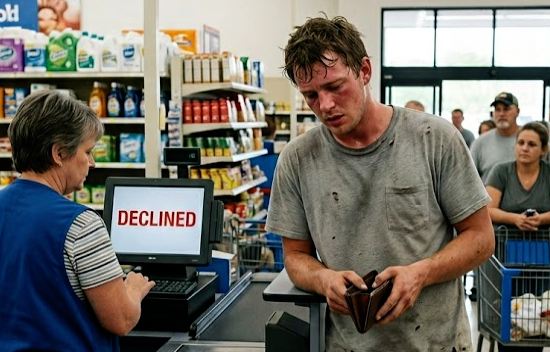
The fluorescent hum of the supermarket is a peculiar kind of silence. It is a sonic vacuum filled with the rhythmic thud of plastic on rubber conveyor belts, the digital chirp of scanners, and the heavy, collective breath of a dozen strangers bound together by the mundane necessity of consumption. On this particular Tuesday, the air felt thick, charged with the stagnant energy of a late afternoon. I stood in Lane 4, my own exhaustion a physical weight behind my eyes. My cart was a modest testament to a life lived in the narrow margins: frozen peas already softening in their bags, a carton of eggs handled like porcelain, and the mental calculator in my brain whirring, subtracting every cent from a checking account that was currently a fragile ecosystem.
Several feet ahead of me, the rhythm of the line faltered. The mechanical “chirp” of the credit card reader was replaced by a harsh, discordant buzz—the sound of a door slamming shut.
The young man at the register froze. He was a study in monochromatic fatigue. His work shirt, once a standard charcoal gray, was torn at the shoulder and mapped with the salt-stains of evaporated sweat. His jeans were stiffened by dried sludge, and as he shifted his weight, flakes of clay-heavy mud crumbled from his steel-toe boots, marring the pristine, waxed linoleum of the store floor. He looked less like a shopper and more like a man who had been unearthed from a trench.
“Run it one more time,” he whispered. The words didn’t command; they pleaded. His voice had the brittle quality of dry glass.
The cashier, a woman whose face had been weathered into a mask of professional indifference by years of retail warfare, didn’t look up. She swiped the card again with a practiced, cynical flick of the wrist. The machine waited, deliberating over his worth, before emitting that same guttural rejection.
Declined.
To understand the tragedy of that moment, one had to look at the altar of the conveyor belt. His offerings were not luxuries. There was no celebratory bottle of wine, no premium cuts of meat, no frivolous snacks. The items were the skeletal remains of a survival plan:
Two cans of infant formula: The heavy, metallic cylinders that represent the literal lifeblood of a household with a newborn.
A jumbo pack of diapers: The bulk-buy desperation of a parent trying to outrun a biological clock.
A loaf of white bread and a jar of peanut butter: The universal cuisine of the broke—calories stripped of joy, designed only to keep an adult upright long enough to work another shift.
Infant cough medicine: A small orange box that hinted at sleepless nights and the terrifying heat of a baby’s fever.
A pack of heavy-duty sanitary pads: A mundane item that, in this context, felt like an intimate wound exposed to the public.
The total on the glowing red screen was negligible to most. It was the cost of a mediocre dinner out, or a couple of shirts from a clearance rack. But wealth and poverty are not measured in absolute numbers; they are measured in the distance between what you have and what you need. For this man, the twenty-odd dollars he lacked might as well have been a million. The decimal point was a canyon he could not leap. Behind him, the “humanity” of the line began to curd. In a grocery store, time is the only currency people guard more jealously than money. We are a society of micro-aggressions.
A woman two spots back, dressed in an immaculate yoga set that likely cost more than the man’s entire cart, pointedly checked her gold watch. She sighed—a sharp, aspirated sound that meant, My time is being stolen by your incompetence. Beside her, a man in a business suit muttered a low, guttural “Come on,” his foot tapping a restless, impatient staccato.
I felt it too. I am not a saint. I felt the irritation prickling at my skin. I thought of my thawing peas. I thought of my aching knees, the legacy of a double shift of my own. We see the “interruption” long before we see the “human.” We see the obstacle, the delay, the broken cog in the machine of our day. We forget that every person standing at a register is a protagonist in a story we haven’t read. The young father began the ritual of the defeated: the systematic removal of items. This is the ultimate public stripping of dignity.
“Take off the peanut butter,” he said, his eyes fixed on the scanner. The cashier hit a key. The total dropped by four dollars. “Take off the bread.” Another key. Two more dollars.
Then he stopped. His hand hovered over the pack of sanitary pads. He looked at them with a mixture of reverence and agony. He swallowed a jagged movement of his Adam’s apple that looked painful.
“And those too,” he choked out.
The cashier actually paused then. Even her indifference had a limit. He looked up, his eyes bloodshot and unfocused, addressed to the air between the aisles. “My wife had the baby six days ago,” he said. It wasn’t an excuse; it was an overflow. When shame reaches a certain pressure, it leaks. “She’s still bleeding pretty bad. We ran out. I just… I thought the check was cleared.”
He began to speak faster, the words tumbling out like a confession. He spoke of the feverish baby, the double shift he’d just finished, the fact that his wife was home alone, unable to drive, trapped in the physical aftermath of birth while he stood here failing at the most basic level of provision.
He swiped the card one last time, a Hail Mary into the void of the banking system. Declined. I looked at his hands then. Truly looked at them. They were the hands of a laborer in the brutal heart of winter. The knuckles were swollen and split into red, angry fissures. The skin around his fingernails was stained with a grime that soap wouldn’t touch for weeks. They were raw, honest, exhausted hands.
And suddenly, the supermarket floor dissolved.
The fluorescent lights faded into the dim, flickering yellow of a cramped apartment from thirty years ago. I wasn’t looking at a stranger; I was looking at a ghost. I saw my husband, his face gaunt from three jobs and four hours of sleep, standing in a similar line. I remembered the exact shade of his panic when our son’s colic wouldn’t break and the bank had snatched the utility payment before he could buy the medicine.
I remembered the coldness of the world in those years. No one had stepped in. No one had “dropped” a twenty. I remembered the visceral humiliation of tearing our old, frayed bath towels into squares because we had run out of diapers and the “emergency fund” was a jar of pennies. That memory didn’t make me bitter; it made me recognize the smell of a drowning man. There is a specific kind of pride that belongs to the working poor. It is a brittle, defensive thing. If you offer it charity, it often shatters into anger. To help a man like this, you cannot give a gift; you must provide an escape hatch that allows him to keep his head up.
I reached into the secret compartment of my wallet. Tucked behind my driver’s license was a crisp hundred-dollar bill. It was my “in case of fire” money—the cash I had painstakingly hoarded for my own blood pressure medication refill later that week. Without it, I would be skipping doses. Without it, my own margin for error vanished.
I stepped forward and tapped the side of his mud-streaked cart. “Sir,” I said, my voice steady, “you dropped this.”
I held out the bill. He turned, his brow furrowed in confusion. He looked at the money, then at my face. The realization hit him—not that he had dropped it, but that I was lying. His eyes, already red from labor and lack of sleep, filled with a sudden, glassy sheen.
“I didn’t drop that,” he whispered, his voice trembling.
“Yes, you did,” I insisted, raising my volume just enough to let the people behind us know that this was a factual transaction, not an act of pity. “It fell right out when you pulled your wallet. I saw it hit the floor.”
The silence in the line was now absolute. The woman with the gold watch looked away. The man in the suit stared at his shoes. The atmosphere had shifted from irritation to a heavy, sobering realization of what was actually happening.
He looked at the hundred dollars—a piece of paper that represented three days of my life and an entire week of his sanity. His mouth tightened into a hard, thin line. He knew. And I knew he knew. But he looked at the formula, the medicine, and the pads on the belt. He chose his family’s survival over his own ego. He took the bill. His hand shook so violently that our fingers brushed, and his skin felt like sandpaper against mine. He turned back to the cashier, his posture subtly different. “Put the bread back on,” he said. He paused, his voice gaining a tiny bit of its foundation back. “And the peanut butter.” He gestured toward the sanitary pads. “And those.”
The cashier processed the items in a silence that felt holy. There was no more huffing from the line. The “time” we were losing suddenly seemed like a very small thing to give.
When the bags were packed, the young man gripped the plastic handles until his white knuckles turned even paler. He began to walk toward the automatic doors, his steel-toe boots still shedding the earth of his labor onto the floor. As he passed me, he didn’t offer a grand speech. He didn’t have the breath for it.
He gave me a single, sharp nod. His chin was tucked low against his chest, his eyes shimmering with unshed tears. That nod was a symphony. It said I see you. It said Thank you for the lie. It said My wife will be okay tonight. I stood there for a moment after he left, watching the doors hiss shut. I was a hundred dollars poorer. I was looking at a week of skipping my own medication and eating nothing but clear broth and crackers. My knees still ached, and my peas were definitely ruined.
But as I stepped up to the register to pay for my meager groceries, a strange sensation settled over me. It was a profound, humming peace—a lightness that felt incongruous with my empty wallet.
In the grand architecture of the world, we often think that power is found in accumulation. We think that security is a high number in a digital ledger. But standing in that supermarket, I realized that true power is the ability to bridge the gap for someone else, even when your own bridge is creaking.
I ate soup for the next three nights. It was thin, salty, and lacked any substance. Yet, as I sat in my quiet kitchen, the steam rising into my face, I found that every spoonful possessed a richness I couldn’t explain. It tasted like the bread he put back on the belt. It tasted like the medicine that would break a baby’s fever. It tasted like the dignity of a man who could go home and look his wife in the eye.
Wealth is what you keep, but peace is what you give away. And in the economy of the soul, that hundred dollars was the best investment I had ever made.