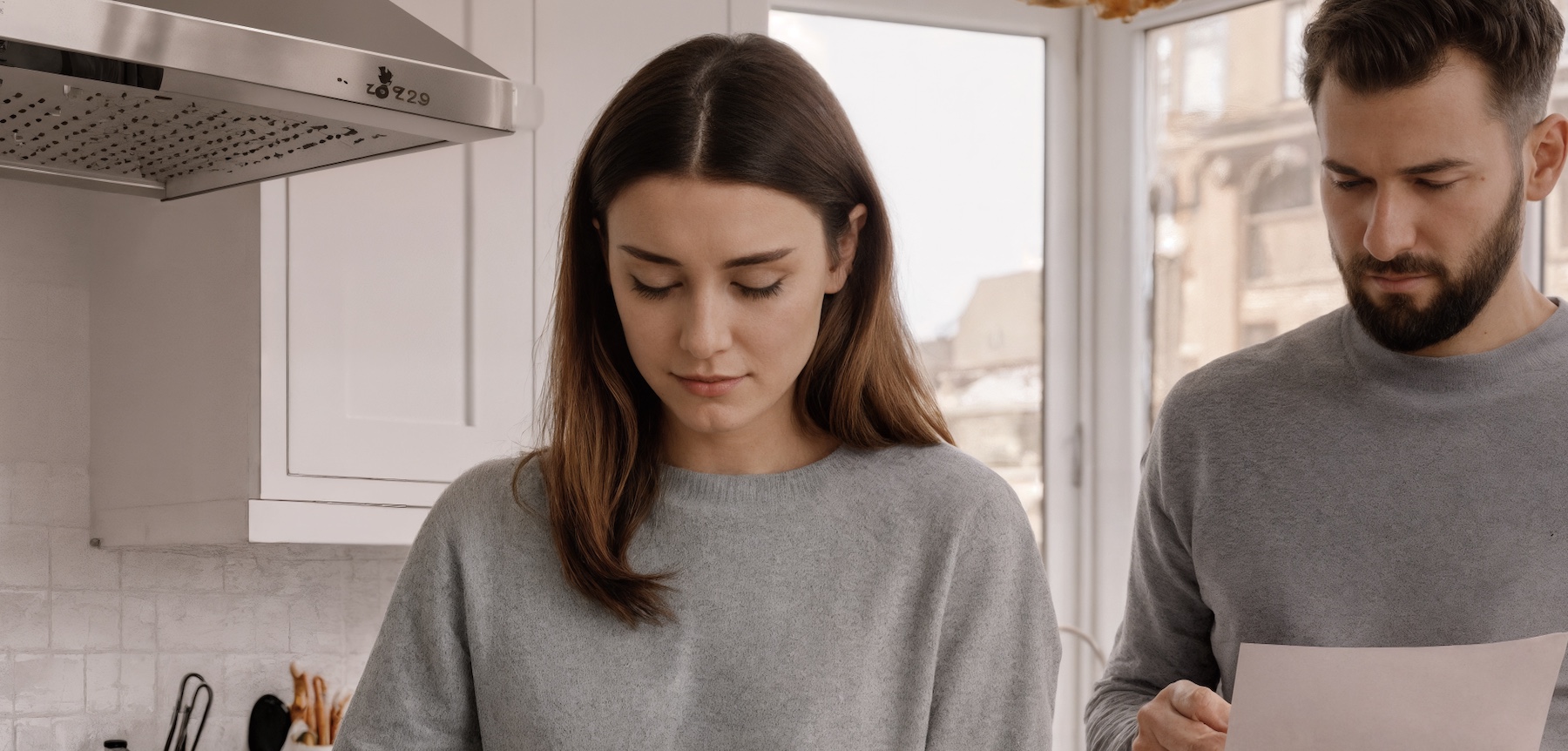
“I’m not buying the act—I saw everything,” Igor said, planted in the middle of the kitchen, hands on his hips, eyes narrowed. “It’s all in your name. The apartment, the documents, even that damn bank account! What are we—roommates who barely know each other?”
“Don’t you feel any shame?” Arina turned from the stove, her skimmer shaking in her hand. “Seriously, Igor? You’re starting this again?”
“Again, not again… I just want us to live honestly,” he grumbled. “Are we a family or not?”
“A family is built on trust. Not on someone snooping through someone else’s papers,” she replied evenly, though her insides churned. “The apartment is mine. I bought it before we married. I’ve told you that a hundred times.”
“‘My apartment,’ ‘my money,’ ‘my life,’” Igor twisted his mouth. “So what am I here—some tenant who answered an ad?”
Arina exhaled and turned away so she wouldn’t snap. October beyond the window was the color of cold steel. Night fell fast. The kitchen was lit by a weak bulb that flickered like it couldn’t decide whether to stay alive. She noted, automatically, that she should finally replace it—then almost laughed. “Should” had become a forever word. Just like her talks with Igor: the same loop, over and over.
“You know,” she said, leaning over the pot, “if it’s that tight around your neck, go live with your mother. Seems like nothing’s ‘divided’ there—maybe you’ll find the honesty you’re looking for.”
Igor smacked the table with his palm. The sound cracked through the room; a plate jumped.
“There you go again with my mother!” he barked. “At least at her place people live by conscience—not like you, where it’s every man for himself.”
Arina set the skimmer down hard, turned, and met his eyes.
“Conscience?” she said, voice sharp. “You call it conscience to eavesdrop, dig through a drawer full of documents, ask where I keep the safe? That’s ‘honest,’ in your world?”
He looked away and said nothing. The silence grew thick and sticky. Somewhere a faucet dripped. The wall clock ticked like thunder.
Arina understood: this wasn’t random. He’d been working up to it. Waiting for the right moment.
Lately he’d turned… clingy. Always nearby, always making “jokes” about “our property,” “our capital,” “our future.” Only the longer it went on, the clearer it became—greed hid inside those jokes. And nerves.
She stepped back from the stove, leaned against the counter, folded her arms.
“Alright. No lace, no poetry. What do you want? Bullet points.”
“Just… well…” Igor scratched the back of his head, hesitated, then blurted it out. “I want the apartment registered to both of us. We live together anyway. It’s not like you’re planning to kick me out.”
Arina gave a short, dry laugh.
“Not yet. But conversations like this make the timeline move faster.”
“There—again with the threats,” he rolled his eyes dramatically. “I’m just saying what I think. Any normal wife would understand.”
“And any normal wife, in your opinion, should hand over everything she earned just because her husband feels ‘uncomfortable’?” Iron rang in Arina’s voice. “Maybe I should sign it over to your mom while I’m at it—so you can both sleep peacefully.”
He tried to answer, but couldn’t. He just paced the kitchen as if searching for something to tear into.
“You’re a robot,” he snapped. “Everything’s calculated, in spreadsheets, like a report. Even feelings—scheduled.”
“Yeah,” she said with a crooked smile. “That’s what you get when you marry an accountant. And if I hadn’t counted every ruble, we wouldn’t have an apartment, a safety cushion, or anything resembling a decent life.”
“‘We’?” he raised his eyebrows. “That’s rich. ‘We’ implies it’s shared. But everything is always ‘mine’ with you.”
Arina went quiet. For a second she thought she might cry, but she pressed her lips together, took a breath, and let it out through her teeth.
“You want the truth?” she said. “Yes—mine. I earned it. I worked for years, without weekends. And I put it in my name because I know how fast people change when money gets involved.”
He turned away like she’d offended him.
“Fine. Don’t be surprised if I start thinking about myself too.”
“Think all you want,” Arina cut in. “Just not at my expense.”
After that, the air in the apartment changed—like someone else had moved in. Not a person, not an object. Distrust. It sat in every sentence, every look, every “Where are you going?” and “Why do you need to know that?”
Igor became careful. Softer—too soft. One day he brought roses “just because.” Then he started taking out the trash, doing dishes. Arina tensed. People like him didn’t change that fast without a reason.
She watched him out of the corner of her eye: the way he lingered over his phone, the way he took calls on the balcony, the way he’d casually ask, “So, where do we keep a copy of that contract again?” as if it meant nothing.
Once, when he opened his laptop, a tab was there—Rosreestr’s website—either by accident or on purpose. Arina noticed and said nothing. Let him keep playing innocent.
That Sunday Igor announced that his mother, Tatyana Pavlovna, would be coming “for a couple of days.”
Arina sighed. His mother was a woman with claws. Outwardly friendly, but every phrase carried poison-tipped needles. The very first time they met, Tatyana Pavlovna had said, without blinking:
“Well, at least my son didn’t pick someone up off the street. An apartment—already a plus.”
Since then, Arina had kept her distance.
When Tatyana Pavlovna appeared on the doorstep in a wool coat, carrying a heavy bag and that familiar superior smile, Arina felt her whole body tighten.
“Arishenka, hello,” her mother-in-law purred. “How are my lovebirds? Same as always?”
“Yes, everything’s wonderful,” Arina replied with a stretched smile. “Come in.”
“I keep thinking,” Tatyana Pavlovna continued as she took off her shoes, “it’s time for you to expand. A two-bedroom is small for a family. Especially if children happen.”
“We’re fine as we are,” Arina said, opening the closet.
“Mhm,” her mother-in-law hummed. “Though if you sold this place, you could buy something bigger, renovated. I looked—there are great options.”
Arina turned sharply.
“Excuse me—sell this place?”
“Sure,” Tatyana Pavlovna shrugged. “Why sit in an old building? Panel blocks are cramped. You sell, you buy a new one. And my realtor friend can help, by the way.”
Arina froze. She couldn’t believe they’d steered the conversation there so quickly—too smoothly.
“Thank you,” she said calmly. “But I’m not selling anything.”
“As you like,” Tatyana Pavlovna drawled, with that look Arina had learned to hate—evaluating, like she was pricing someone else’s property. “Just saying—later it’ll be too late, prices will drop…”
Arina turned and went to the kitchen just to avoid saying something she’d regret. Her heart hammered as if she’d been running.
And that was the first time the thought flashed clearly through her mind: They’ve planned something.
That evening Igor and his mother sat in the living room watching TV. Arina was making tea when she heard them talking.
Tatyana Pavlovna spoke quietly, but with pressure behind every syllable:
“You’re too soft, Igoryok. She spins you around her finger. If you were a real man, you would’ve had everything registered long ago.”
“Mom, stop,” he whispered. “Not now.”
“Why stop?” she shot back. “She’s not a stranger. The apartment should be shared—by law and by conscience.”
Arina stood behind the door, holding her breath.
“Just try it,” she thought. “Just try to touch my papers.”
A few evenings later, Igor tried again, casual as dust.
“Listen, Arin,” he said, as if it were nothing, “where do we keep those… apartment papers? I want to show a friend. He’s dealing with a mortgage and asked how yours is set up.”
Arina didn’t look up from her laptop.
“Which papers, exactly?”
“You know—proof it’s yours, all that stuff. He just doesn’t understand what documents you need when you finish paying off a mortgage.”
“Then why does the internet exist?” she replied flatly. “Everything’s written there.”
“I could look it up, sure, but it’s easier to show an example. You don’t mind, do you?”
Arina lifted her eyes. His gaze was too direct. Too calm.
“Funny,” she said. “You usually hate paperwork, and suddenly you’re fascinated.”
He shrugged. “Just want to help. What’s the big deal?”
Arina closed her laptop slowly.
“The papers are in the safe,” she said. “And they’re staying there.”
“Arin, you’re acting like you don’t trust me,” he said, wounded on purpose. “We’re family.”
“Did I say I don’t trust you?” she replied coolly. “I just don’t see a reason to show someone documents for my apartment.”
“Our apartment,” he corrected softly.
“No,” she cut him off. “Mine.”
Igor exhaled, got up, paced.
“You know you’re destroying us with this,” he said, staring out the window. “You’re getting paranoid. I wanted to help a guy, and you turn it into an interrogation.”
“Mhm,” Arina hummed. “Except here’s the interesting part: you never cared where the documents were before. And now suddenly you do.”
He went quiet, then muttered, “Do what you want.”
The next morning Arina went to work with a heavy feeling in her chest. Everything in her screamed that something was wrong.
For weeks Igor had been different: joking that “everything in this house is in the wife’s name,” complaining that living in “someone else’s place” made him uneasy, then switching to roses and tenderness, and now circling back to documents.
“I don’t believe in coincidences like this,” she thought, crushed into a crowded bus. “First curiosity, then fake kindness. This is preparation.”
At the office she looked composed, but her mind spun: What are you plotting? The apartment wasn’t marital property—she’d owned it before marriage. But if he managed to get her signature somewhere—through a power of attorney, for example—then things could get ugly fast.
And his mother is in on it, she realized, remembering that late-night conversation. Tatyana Pavlovna had lived by one rule her whole life: everything should be equal—especially when someone else has more.
By evening Arina was coming home ready for a fight. But the apartment was quiet. Too quiet.
Dinner was set. Igor wore an apron. The oven smelled like roasted meat.
“Hi, love!” he said brightly. “Surprise.”
“Uh-huh,” Arina answered, wary. “What for?”
“I just wanted to make peace. You were upset yesterday, and I… I was an idiot. I snapped.”
He came up, hugged her, kissed her temple.
“I don’t want us to fight.”
Arina smiled carefully. “Sure. You don’t want to. Yet somehow you keep doing the opposite.”
They sat down. The food was good—he’d clearly tried. They ate in silence for five minutes before he started again:
“Listen… if you ever decided to sell the apartment—purely theoretically—how would you do it?”
“Theoretically?” Arina squinted. “Why do you need to know that?”
“Just curious. Sergey from my department is selling his place. Says brokers scam people, slip in fake papers. I want to warn him.”
“Right,” she nodded. “And how are you going to ‘warn him’ when you don’t understand any of it yourself?”
He shrugged, but irritation flickered in his eyes.
“That’s why I’m asking. I want to figure it out.”
Arina put down her fork and looked straight at him.
“Igor, tell me honestly. Is this really about Sergey?”
“Yes,” he frowned. “Who else would it be about?”
“Maybe you.”
“Here we go again…” He stood abruptly and went to the window. “I’m sick of you turning everything into a cross-examination.”
Arina watched him silently, then rose and put her plate into the sink.
“Fine,” she said calmly. “But hear me: if I hear one more word about documents, we’ll be having a different kind of conversation.”
“Are you threatening me?”
“I’m warning you.”
A couple of days later he called her at work.
“Arin, will you be late today?” His voice sounded normal, but there was a strange pressure beneath it.
“I’ll be home in about two hours. Why?”
“No reason. Just wanted to meet you.”
Arina’s alarm bells rang.
“Everything okay?”
“Of course. I just miss you.”
“Miss me, sure,” she thought. “From you, that’s quite the performance.”
But when she got home—there really were fruit baskets in the entryway, candles on the table, dinner, everything perfect. Only it lacked sincerity. It all felt… staged.
The next day was Saturday. Arina decided to tidy up while Igor slept.
She opened the living room cabinet, slid out the bottom drawer—and froze.
Inside were copies of her documents. Passport pages. A Rosreestr extract. A copy of the loan agreement. Neatly stacked in a clear plastic folder.
Cold ran down her spine.
She pulled them out, checked—yes, all real, just not originals. So he’d been making copies. Without asking.
“Well,” she murmured, “so that’s how the story begins.”
At that moment she heard a yawn from the bedroom. Igor was awake.
She shoved the papers back, sat on the sofa, and pretended to flip through a magazine.
“Morning,” he said, heading toward the kitchen. “Why do you look so gloomy?”
“Just thinking.”
“About what?”
“About trust,” Arina said softly, not looking up. “It’s funny—sometimes you live with someone and then you stumble onto something you were never meant to find.”
He froze.
“What do you mean?”
“Nothing,” she smiled thinly. “Just thinking out loud.”
He went to the window and lit a cigarette. You could see it—he’d tensed.
That evening Tatyana Pavlovna showed up again. Unannounced.
“So, Igor and I decided,” she started cheerfully the second she crossed the threshold, “that you need to discuss something.”
Arina folded her arms.
“Like what?”
“Your future plans,” her mother-in-law said, sinking into the sofa like she owned it. “You’re young—think ahead.”
“We already do,” Arina snapped.
“Clearly,” Tatyana Pavlovna said with a sigh and a theatrical eye-roll. “The apartment’s old, the furniture is Soviet, the renovation is begging for help. I think you should sell and buy a new-build. Igor said his realtor acquaintance can help.”
Arina turned to her husband.
“He said that?”
Igor hesitated. “I just… mentioned it.”
“Interesting,” Arina said, looking her mother-in-law straight in the eye. “Why am I the last to hear about it?”
“Because you always react like a porcupine,” Tatyana Pavlovna huffed. “You assume we’re trying to cheat you.”
“You are,” Arina said calmly. “You’re just bad at hiding it.”
Tatyana Pavlovna snorted.
“Ungrateful. We’re wishing you well and you—”
“Thanks, I’ll manage,” Arina cut her off. “I can handle my ‘well’ without you calculating it for me.”
Igor stood between them like a schoolboy at assembly, not knowing where to look.
“Mom, enough,” he breathed. “Not now.”
“I think it’s exactly the time,” she said, unblinking. “While you have documents handy, you can do everything quickly—before prices crash.”
Arina walked to the door and said, ice-cold:
“Tatyana Pavlovna, the exit is the same way you came in.”
Her mother-in-law stood, adjusted her bag.
“You’ll regret this, girl,” she said, and left.
The door slammed. Silence. A ringing in Arina’s ears.
She stared at Igor.
“Alright, Igor. No mom, no drama. Tell me the truth: did the two of you decide to sell my apartment?”
“Are you insane?” he flared. “That’s her fantasy!”
“Fantasy?” Arina clenched her hands. “Then why were you making copies of my documents?”
He jerked like she’d hit him.
“How do you—”
“Doesn’t matter. Answer.”
A long silence. He lowered his head.
“I just wanted to protect myself. In case something happened…”
“What?” Arina laughed without humor. “In case I stopped trusting you? Too late, Igor. I already did.”
He tried to speak, but couldn’t.
Arina looked at him for a long moment, exhausted and hurting.
“That’s it,” she said quietly. “Now I know who you really are.”
Only she still didn’t know that it was just the beginning.
That what was coming wasn’t just a fight—it was a real war for her home, her life, and her right to trust anyone at all.
“Arin, wait—don’t do this,” Igor stood in the middle of the room, pale as chalk. “Let’s talk calmly.”
“Calmly?” Arina scoffed. “You call this ‘calm’? When someone undermines me behind my back? Makes copies? Brings in his mother? And now it’s ‘let’s talk calmly’? No, Igor. Now you listen.”
She stood facing him, arms crossed, voice level—no shouting. But there was ice in it.
“I see what you were trying to pull,” she continued. “A power of attorney, right? Trick me into signing, then rush it through a realtor—and goodbye apartment, hello cash split with Mommy?”
Igor blinked like a man with no words left, and whispered:
“What are you talking about… that’s insane.”
“Insane?” Arina stepped closer. “Then explain why you made copies. Why Tatyana Pavlovna already knows the realtor’s name—and even the amount you ‘could get for it.’”
He looked away.
“It’s her… she made it up. I just listened.”
“Sure,” Arina smiled thinly. “You always ‘just listen.’ And then somehow you do exactly what she says.”
For three days she lived like she was lying in ambush. Barely slept. Went to work on autopilot. Came back and waited for the trap. She checked the safe, counted documents, moved keys, changed hiding places. Igor acted like everything was “fine,” but his eyes darted like a student caught cheating.
And then he disappeared.
No warning.
In the morning he left “to run errands”—and didn’t come back for lunch, or by evening. His phone didn’t pick up.
Arina didn’t panic, but she knew: he was doing something. She checked bank alerts—he’d withdrawn twenty thousand “for car repairs.” Only he didn’t have a car. He’d sold it a month ago.
Late evening, rain already misting the windows, he returned smiling like nothing happened.
“Oh, hey,” he said casually. “Why do you look like that?”
“Where were you?” Arina asked quietly.
“Just met up with Sergey. Remember I told you about him?”
“The one selling his apartment?” she pressed.
He blinked. “Well… yeah.”
“So now he’s your business partner?”
“What are you talking about?”
“About the fact that you withdrew money and clearly spent it somewhere.”
He lifted his eyebrows.
“You tracking me now?”
“No,” Arina said. “I just don’t like being treated like an idiot.”
He exhaled and rubbed his face, annoyed.
“God, you’ve lost it! I just wanted to… I don’t know… make a surprise!”
“What kind, Igor?” she asked, cold. “A surprise power of attorney with my signature on it?”
He spun to her.
“Have you completely lost your mind? Nobody cares about you and your apartment!”
“Then why do you and your mother talk about it nonstop?” Arina asked. “Why does she call and ask, ‘So—did it work?’”
He flinched.
“You were listening in?”
“No,” Arina said. “You forgot to turn off your call. It was on speaker.”
His face twisted.
“You’re sick!” he spat. “You imagine things!”
“At least I’m not stupid,” Arina said softly. “And do you know what I did this morning?”
He narrowed his eyes.
“What?”
“I went to a lawyer. He explained everything. How to protect my property. How to revoke any power of attorney—even if someone tries something.”
Igor turned white.
“You… you think I’m capable of…?”
“I don’t think,” Arina cut in. “I know.”
The next morning she left “for errands,” then returned earlier on purpose—quietly.
She unlocked the door and walked in—and saw it.
Igor stood by the safe, her folder in his hands. He didn’t hear her enter.
“Interesting,” Arina said calmly. “Déjà vu.”
He jolted and dropped the folder.
“I—I just wanted to look…”
“Sure,” Arina smiled. “The way a predator ‘just wanted to talk.’”
He lifted his hands.
“Wait! I wanted to make sure everything’s okay!”
“Okay?” Arina let out a short laugh. “It is now. Because you don’t have keys anymore. And you don’t have access.”
He frowned.
“What, you changed the code?”
“Yep. Yesterday. And I installed an alarm too. So if you decide to ‘check,’ the police will arrive faster than your mother can put on her robe.”
Igor stepped toward her. Arina stepped back.
“Don’t come closer,” she said firmly. “We’re done talking.”
“Arin, I can explain—”
“You’ll explain to my attorney.”
He froze.
“You’re serious?”
“Completely. I’m filing for divorce tomorrow.”
He looked at her like he was seeing her for the first time.
“And for what? Over an apartment?”
“No,” Arina said. “Over my dignity.”
He packed fast. No argument. Before he left, he threw one last line at her:
“You destroyed everything yourself. I was trying to do what’s best. I wanted us to have a future.”
“A future is shared when both people are honest,” Arina answered. “Not when one person builds plans on the other person’s back.”
He hovered in the doorway as if waiting for her to say, Stay. She didn’t.
“Fine,” he snapped. “Life will be easier without you.”
“I’m sure it will,” Arina said, and shut the door.
After he left, the apartment became strangely quiet. Not instantly easier—just different.
No jangle of his keys. No constant grumbling. No cheap cigarette smell from the balcony.
Arina sat in the kitchen for a long time, staring out the window. October—gray, wet, wrung out like a rag. People hurried under umbrellas. Someone carried shopping bags. Someone laughed. Life kept moving.
On the table sat his mug, cracked down the side. Arina picked it up, looked at it, and tossed it into the trash. The old safe key followed.
“That’s it,” she said out loud. “Curtain down.”
A week later Tatyana Pavlovna called. Her voice was cold, pressing hard.
“Arina, I don’t know what you’ve imagined, but you behaved disgracefully.”
“Disgracefully?” Arina repeated. “Me?”
“Yes! My son is left with no home, no money, no family!”
“He’s left with no conscience,” Arina replied. “Everything else is his problem.”
“You’ll regret this,” her mother-in-law hissed. “Women with principles like yours end up alone.”
“Better alone than surrounded by people who betray you,” Arina said—and hung up.
Two weeks passed.
Arina finalized the divorce, changed the locks, and installed an extra deadbolt.
In the evenings she made tea, put on music, and for the first time in a long while the apartment felt peaceful. Not perfect. Not joyful. But truly peaceful.
She didn’t regret it. Sometimes she only thought about how close she’d come to losing everything—not even the apartment, but her self-respect.
Now she knew for sure: trust isn’t a romantic fairy tale. It’s something that has to be earned.
And if someone wants your signature more than they want your soul, then they were never yours.
One cold evening Arina walked home past shop windows reflecting city lights. Inside her it was quiet. Her phone buzzed—Igor’s number.
She looked at the screen, then at the rainy street.
Her finger hovered. Then she simply tapped Delete contact.
No tears. No hysterics.
She turned toward home, adjusted her scarf, and thought:
“That’s it. From now on—only forward.”
She opened the building door, climbed to her floor. The key turned in the lock smoothly, as if it belonged there.
Her apartment. Her life.
No performances. No lies. No чужие hands in her safe.
Silence greeted her like an old friend.
She took off her coat, walked into the room, sat on the sofa, switched on the light—
and, for the first time in a long time, she smiled.
The end.