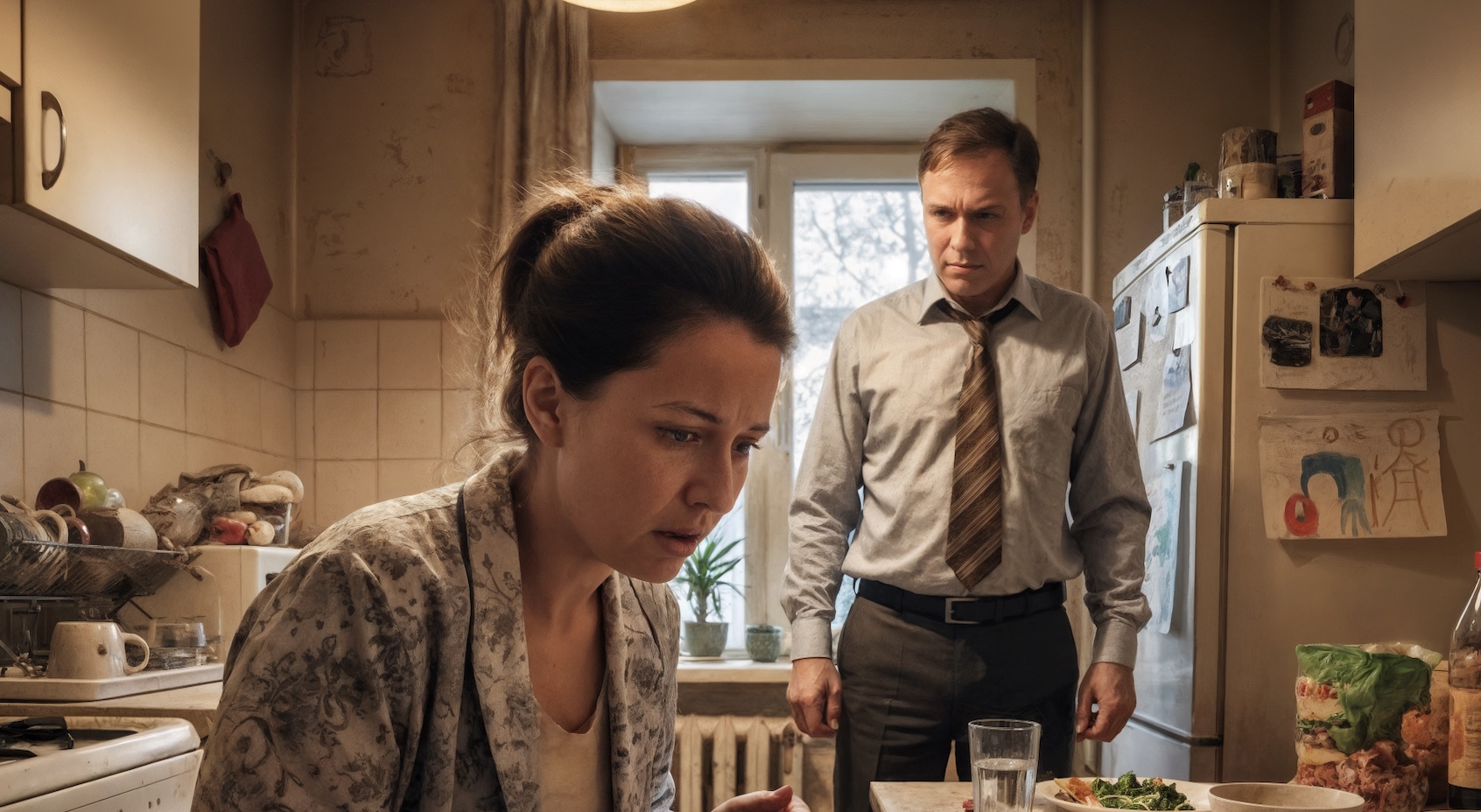
“My parents will finish the dacha, and your little cakes can wait.” I looked at my husband and didn’t recognize him. Seven years of marriage, thousands of shared dinners, dreams we once spoke about like they were already real—gone in a single moment. He said it as casually as if he were asking me to pass the salt, not as if he were ripping my heart out along with my dream and the 250,000 rubles I’d saved. That night I understood: the man I’d called my support didn’t see a beloved woman in me. He saw a convenient tool for fixing his family’s problems. And that tool had just said, “No.”
Our tiny panel-building two-bedroom always smelled like vanilla and fried chicken—an odd mix that had become the soundtrack of my life. Vanilla came from my nights: hunched over the table, making another custom dessert like it was a work of art. Chicken came from my attempt to be a “normal” wife who cooks dinner for her husband.
I pulled a golden tray from the oven and gave a tired smile. Marina, thirty-two: accountant in a dull office by day, pastry chef obsessed with a dream by night.
The lock clicked. Andrey walked into the kitchen—my husband, my “rock,” as I’d believed for the last seven years. He dropped his jacket on a chair, came over, and kissed the crown of my head.
“Smells great,” he said, peering into the pot of mashed potatoes. “I’m exhausted.”
We sat down to eat. Andrey ate with appetite, talking about a new client and a boss who wouldn’t stop nitpicking. I listened with half an ear, already making a shopping list in my head for tomorrow’s “Red Velvet” anniversary cake. I still needed fresh raspberries and Belgian chocolate.
“Marin, I talked to my parents today,” he said suddenly, pushing his empty plate away. His voice turned serious—almost solemn. “You remember they’re adding a veranda to the dacha?”
I nodded. How could I forget? That veranda had been the center of every family conversation for the last year. His mother, Tamara Igorevna, had already planned where the rocking chairs would go and exactly where she’d plant her beloved petunias.
“Well, materials got expensive. They’re short,” Andrey looked me straight in the eyes. “So we need to help them.”
Something unpleasant flicked inside my chest. I knew our finances. We lived from paycheck to paycheck, and every ruble I earned on the side from cakes went straight into my savings.
“Help… how?” I asked carefully.
“Your savings. The money you’ve been putting away for your cake project. You’ll give it to my parents, Marin. They need it more right now,” he said as easily as if he’d asked for the salt.
My fork slipped from my hand and clattered against the plate. I stared at him, not believing what I’d heard. Two hundred and fifty thousand rubles. Almost a year of saving, refusing myself everything. The sum that was my ticket into another life—my little pastry shop called Sweet Story.
“What do you mean, ‘you’ll give’?” I whispered.
Andrey frowned like I was being ridiculous.
“I mean exactly that. They’re my parents. Family is sacred. They’re building that dacha for us—for future grandkids. And your pastry shop… it’s not urgent. It can wait. Your little cakes aren’t going anywhere.”
Your little cakes. He said it with such a light, patronizing smirk that my vision darkened. Not “your business.” Not “your dream.” Just “cakes.” Something small, childish, unserious—something you could pause anytime for something “real,” like his parents’ dacha.
“Andrey, it’s my money,” my voice shook as my fists tightened under the table. “I worked nights. I didn’t sleep to save it. It’s for equipment, rent—”
“Marin, don’t start,” he snapped, waving me off. “Equipment? Rent? Are we a family or not? Money should work for the family, not lie there like a dead weight while you wait for some… hazy dream. My parents need help now. This isn’t up for discussion.”
He stood up, making it clear the conversation was over, took his jacket, and walked out of the kitchen.
And I stayed at the table, surrounded by the smell of vanilla and cooling chicken. For the first time in seven years, I felt like a complete stranger in my own home.
I went into the bedroom and opened the old wardrobe. On the top shelf, inside a shoebox from my mother’s boots, my dream was stored. Not all of it—most of the money was in the bank—but the symbols were here: a squared notebook packed with recipes and a rough business plan, printed photos of cozy little European café interiors, a folder of customer reviews, and the first “cash” I’d earned.
I took out the thick notebook. On the first page, in my crooked handwriting, it said: “Sweet Story” Pastry Shop.
I remembered how it began: a simple apple cake for coworkers. Then someone asked for a birthday cake. Then another. Word of mouth did more than any advertisement.
I started waking up at four in the morning to bake layers before my day job. I went to bed after midnight, decorating cakes with fondant or fresh berries. My hands always smelled of cinnamon and chocolate, and shadows settled under my eyes.
At first, Andrey was proud. “My wife makes masterpieces!” he’d brag to friends, showing them photos. He tasted new creams, gave suggestions, acted like my biggest fan. But the moment my hobby turned into steady, noticeable income, something changed. When my savings climbed past 200,000, his support turned into quiet irritation.
Two hundred and fifty thousand. To me it was thousands of hours without sleep, hundreds of cancelled meetups with friends, dozens of “no’s” I’d told myself when I wanted a new dress or a seaside trip. Every ruble smelled of sponge cake and fatigue. I’d already chosen a professional stand mixer that cost half my official salary, found small-business courses, even spotted a tiny space for rent on the ground floor of a new building.
I saw everything clearly: small round tables, a pastry display case, the aroma of fresh coffee. I saw myself—tired, but happy—in a snow-white apron with the Sweet Story logo.
And now Andrey—the man who’d promised to be there “in sorrow and in joy”—was offering me a simple eraser: cross it all out. Hand my dream over for boards, roofing sheets, and plastic windows for his parents’ veranda. A veranda where I would always feel like a guest.
I closed the box and put it back on the shelf. The hurt was so sharp it was hard to breathe. This wasn’t just about money. It was about betrayal. He didn’t merely want my savings—he wanted my future, my faith in myself, swapped for a sense of duty to his relatives. He wanted me to shrink back into being “just Marina”: an accountant with a predictable salary, a convenient wife who bakes “little cakes” on weekends for fun.
And I didn’t want that anymore. I’d outgrown that part.
Andrey’s family… I always tried to please them. From the first day I met them, I felt like I was taking an exam designed for me to fail.
His mother, Tamara Igorevna, had a soft voice and a steel stare. She never said anything openly nasty to my face. Her weapon was compliments with barbs.
“Marinochka, you’re such a good girl—you manage work and still keep the house so clean,” she would say, running a finger along a shelf in the living room. “Not like our Svetochka, Aunt Galya’s daughter—she’s all about kids and family, no time for a career. To each her own, of course.”
And in that “to each her own,” I clearly heard: You’re doing it wrong. You don’t put family first.
Andrey’s father, Viktor Semyonovich, mostly stayed quiet, but his silence was louder than any words. He looked at me like an exotic bird that had flown by accident into their simple, understandable world.
I especially remember Tamara Igorevna’s birthday two years ago. I stayed up all night making a difficult mousse cake with mirror glaze—lilac and white, her favorite colors. I arrived glowing with pride. Everyone gasped. Tamara Igorevna tasted a tiny bite, smiled, and said:
“Beautiful, of course, dear. A piece of art. But it’s probably all chemicals. An apple charlotte—that’s simple, the way we like it: good for the soul and good for your health.”
And everyone at the table—including Andrey—nodded along. “Yes, Aunt Tamara, your charlotte is something special!”
My cake, my sleepless night, my wish to make her happy—erased with one sentence.
Andrey saw my face later and told me, “Come on, Marin, don’t be upset. Mom just likes simple food. You know old people.”
But they weren’t old. They were people who had built a wall between “their own” and “outsiders.” And I was always outside it. I was “too independent,” the one who bakes “chemical” cakes and dreams about a “pastry shop” instead of having babies and planting cucumbers at their precious dacha.
The dacha was their shrine: six plots of land they tended with fanatical devotion. Every weekend Andrey drove off to “help his parents.” I went with him for the first couple of years, tried weeding and watering tomatoes. But every time I ran into patronizing looks and advice that sounded like accusations. “Marinochka, you’re holding the hoe wrong.” “Oh dear, you can’t even tell a weed from a useful plant.” In the end I stopped going, blaming orders. It was met with quiet disapproval.
And now they wanted me—the “outsider,” the “not-our-girl”—to pay for improving their shrine. With the money I’d earned from those same “chemical” cakes.
The irony was so bitter it left a taste of bile in my mouth.
I sat on the couch and scrolled through old photos on my phone. There we were at the beginning: a park, rides, Andrey trying to win me a giant plush bear at the shooting booth. Laughing. His eyes were bright back then.
He used to be my biggest fan. When I first started baking, he was my taster, my critic, my promoter. He drove my early, not-quite-perfect cakes to his friends and proudly announced, “My Marina baked this! She’s talented!” He listened to my ideas about opening a shop, nodded, said, “Yes, Marin, you’ll do it. I believe in you.”
I floated on that belief. I thought together we could move mountains.
So what broke?
Looking back over the past year, I saw the answer clearly. Everything cracked the moment I stopped only dreaming and started acting. The moment my “little cakes” began bringing in income comparable to his salary as a sales manager.
His career stalled. He was good at his job, just not ambitious. A stable paycheck, clear duties, Friday beers with coworkers—he was fine with that. But my growth, my passion, my eyes shining against his routine began to irritate him.
“The whole kitchen is covered in flour again,” he started grumbling whenever I stayed up late.
“You’re obsessed with your cakes—you don’t have time for the family,” he accused, even though I managed to work, cook, and keep the apartment clean.
Once I won a small grant for new entrepreneurs in our city—50,000 rubles. I ran home waving the certificate, happy like a child. Andrey looked at the paper, snorted, and said:
“Well, good for you. At least your fuss is useful for something. Buy yourself a new mixer.”
Not “we did it.” Not “I’m so proud of you.” Just “buy yourself.” Even then, he’d already separated my success from our life together. My victory wasn’t shared joy—it was my private, almost suspicious achievement. It made him insecure, and instead of growing with me, he tried to shrink me back down—to the level of a “normal” wife whose interests shouldn’t stretch beyond the kitchen and the bedroom.
I closed the gallery. The man I’d fallen in love with was gone. Or maybe I’d invented him. Maybe he’d always been like this, and I—blinded by love—saw only what I wanted to see.
He didn’t believe in my dream. Worse: it frightened him. And now he’d found the perfect way to crush it, hiding behind what he considered sacred—“helping his parents.” This wasn’t just selfishness. It was revenge for my success.
Andrey sat in the car outside our building, smoking one cigarette after another. He didn’t want to go upstairs. He knew Marina would be there with that heavy, silent stare. Why was she making everything so complicated?
Was he asking for something impossible? Help his parents. His father, Viktor Semyonovich—who almost never asked for anything—had called the day before and said in a rough, tired voice, “Son, help us out. Your mother’s beside herself—money’s not enough. We just want to finish it already, sit like normal people. It’ll all be for you anyway… for the grandkids…”
Those words squeezed something inside Andrey. A grown man, a son—unable to help his parents finish one miserable veranda. Shame.
He ran through options: a loan? The bank had rejected him last time because of some stupid issue in his credit history. Borrow from friends? Embarrassing. And who would lend that much?
And then he remembered Marina. Her shoebox. Her savings account. Two hundred and fifty thousand. It sounded huge—and at the same time, so available. It was family money, wasn’t it? Yes, she earned it. But what would she do with it—some pastry shop? Ridiculous. A business that could collapse in a month. Risks, rent, taxes… As a manager, he “understood” that nine out of ten of those “businesses” shut down in the first year.
But the dacha—that was solid. Land. Walls. Something you could touch. Something their future kids would run around in. He couldn’t understand why Marina didn’t see it.
Her stubbornness infuriated him. Her independence. When they married, she’d been different—soft, admiring, looking at him like he was the center of her world. Then the cakes began. At first it was cute. But soon her world spun around sponge layers, creams, and fondant. She spoke in a strange bird language: “ganache,” “isomalt,” “velvet spray.” She started earning more, and even though she never rubbed it in, he felt exposed. He was supposed to be the head of the family, the provider. And his wife was making more than him at night with a “hobby.”
His mother added fuel. “Watch it, Andrey—your Marina is turning into a business lady. Family will come second.” He brushed it off, but deep down he agreed.
Demanding the money wasn’t only about solving a financial problem. It was a way to put everything back in its “proper place.” To show who was in charge. To prove that real, grounded values—like the parents’ home—mattered more than her airy castles made of sugar and cream.
He stubbed out his cigarette and got out of the car. She had to understand.
A week passed. We barely spoke. Andrey came home from work, ate in silence, then buried himself in the TV or his phone. He waited. He was sure I would “cool down” and agree. That quiet pressure was worse than shouting. Every day I felt myself losing strength. Baking at night turned into torture—I worked on autopilot, without a drop of inspiration.
On Saturday I couldn’t take it anymore and called Sveta, my best friend since school. We met in a small café—the kind I’d always used as my ideal.
“What happened to your face?” she asked instead of hello.
And I burst into tears right there by the window. I told her everything: Andrey’s ultimatum, “little cakes,” the dacha, Tamara Igorevna and her charlotte. Sveta listened silently, holding my hand. No interruptions. No instant advice. When I finally finished and wiped my eyes, she ordered my favorite lavender latte and a slice of cheesecake.
“Eat,” she said gently. “And now let’s think. Tell me, Marin—over all these years, has Andrey ever sacrificed something for your dream? Not supported you with words—actually given something up. Skipped a fishing trip with his friends so you could take an urgent order? Spent his bonus on your decorating course instead of a new rod?”
I thought about it. And the answer was no. Never. My dream had always been only my responsibility. His world—fishing, friends, helping his parents—always came first.
“There’s your answer,” Sveta said quietly. “That’s not a family, Marin. That’s a one-way game. He’s not your partner. He just wants you convenient. And you stopped being convenient. You grew up, and he didn’t. Now he’s trying to cut your wings so you don’t fly too high. Don’t let him.”
Her words hit like cold water. Simple. Obvious. I sat there staring at the beautiful dessert on my plate and realizing she was completely right.
That evening Andrey came home earlier than usual. He was clearly ready for a final talk.
“So?” he asked from the doorway, not even taking off his shoes. His voice was hard, impatient. “Have you decided? My parents are waiting. I promised them.”
I stood up from the couch and looked him straight in the eyes. No tears left—only a cold, ringing calm.
“Yes, Andrey. I decided. Your parents are not getting my money.”
He froze for a second, then his face twisted with rage.
“What?! Are you out of your mind? You’re going against my family! You’re humiliating me! I told them we’d help!”
“You told them, not me. You can help as much as you want. Take a loan. Sell your car. Get a second job. But you will not touch the money I earned with my own back—those sleepless nights while you were asleep. That money is for my dream.”
“Oh, enough with your ‘dream, dream’!” he shouted. “What dream at your age? Selling cakes? You’re putting your stupid pastries above my parents! Above our family!”
“No, Andrey,” I said, my voice steady. “I’m putting myself above your ego. I refuse to be a resource for solving your relatives’ problems. I’m a person—with my own goals and desires. And if you can’t see that, that’s your problem.”
He stared at me with his mouth half open, like he was seeing me for the first time. In his eyes: anger, shock—and, I think, fear. He understood I wasn’t bluffing. The old, convenient Marina was gone.
“Fine,” he spat at last. “So that’s how it is. Family means nothing to you.”
He turned, grabbed his car keys, and stormed out, slamming the door so hard the dishes rattled in the cupboard. I stood in the sudden silence—and for the first time in a week, I could breathe fully.
Two months passed. Andrey never came back. He moved in with his parents. At first he bombarded me with furious messages: “You ruined everything,” “Mom’s heart is acting up because of you,” “I’ll never forgive your betrayal.” I read them and deleted them without replying. It didn’t hurt anymore. It felt empty—and light.
A month later I saw photos on social media posted by his cousin: the dacha, a brand-new veranda gleaming with fresh varnish, a table set for the whole family. Tamara Igorevna poured tea with a proud smile. Andrey sat beside her—thinner, with dull eyes. He smiled for the camera, but it didn’t reach his face.
I found out he’d taken out a loan at a brutal interest rate just to keep the promise he’d made his parents. He saved face for them—and lost everything else.
That same day, I signed a rental agreement. A small space on the ground floor in a new neighborhood, with a huge window—exactly what I’d always imagined. I poured almost all my savings into the renovation, and I didn’t regret a single ruble. I chose the wall color myself: a soft, creamy shade. I ordered the furniture. Sveta drew me a beautiful logo: a little bird holding a cherry in its beak, and the words Sweet Story.
Today was the first day I opened my pastry shop. In the morning I baked several kinds of cupcakes, made my signature honey cake, and prepared a few individual cheesecakes. I was terrified—my hands trembled as I arranged everything in the display case.
My first customer was a young mother with a stroller. She bought two chocolate cupcakes. An hour later she came back and took four more.
“This is the best thing I’ve ever eaten,” she said.
By evening the display case was almost empty. I sat at one of the tables with a coffee, watching people hurry home through my big window. I was more tired than I’d ever been in my life. But it was a happy kind of tired.
My phone rang.
“Marina? This is Tamara Igorevna,” my former mother-in-law said, her voice tense.
I stayed silent.
“I just wanted to say… Andrey told me… maybe you’ll come back? Family is family…”
“No, Tamara Igorevna,” I interrupted gently, but firmly. “I have a different family now. My Sweet Story.”
I ended the call. Outside, the lights were coming on. I pulled my old notebook from my bag, opened it to a blank page, and wrote:
Chapter One. A New Beginning.
And for the first time in a long while, I smiled—not for someone else, but for myself.
And that smile was sweeter than any dessert I’ve ever made.