’The empty manila envelope resting on my scratched mahogany coffee table weighed significantly more in my mind than the forty thousand dollars that had recently inhabited it.
I held the thick paper between my trembling fingers and stared at the neat, deliberate crease along the flap. It was the precise, careful fold I had made myself several months earlier, on a Tuesday afternoon when the silence of the house had driven me down to the basement. I had divided my life’s emergency cash into four plain envelopes and tucked them securely into the locked metal lockbox hidden behind the false oak panel near the water heater. One envelope had been designated for catastrophic medical surprises, the kind that arrive in the night. One was for inevitable house repairs—a collapsing roof or a shattered furnace. One was for a nebulous future I had never quite dared to name. And the last was for the kind of rainy day my late wife, Elaine, used to warn me about when we were young and foolish enough to believe that rainy days always announced themselves on the horizon before the storm broke.
They do not.
Sometimes, they arrive wearing your only son’s face.
My name is Eugene Kirk. I am sixty-eight years old, and for the vast majority of my existence, I operated under the fundamental delusion that being exceedingly careful was synonymous with being protected. For thirty-five years, I worked as a property insurance appraiser across the sprawling suburbs and aging districts of Kansas City. I spent decades walking through the charred remains of burned kitchens, wading through flooded basements, inspecting broken garages, and evaluating collapsed porches with a heavy clipboard resting in my hand. Through this morbid profession, I developed a sharp, inescapable habit of noticing exactly what people tried the hardest to hide. A heavy armchair moved two inches from its usual faded spot on the carpet to cover a burn mark. A drawer shut entirely too carefully. A damning receipt left carelessly in the wrong trash receptacle. Most people believe that lies are monolithic, grand, sweeping things. In my extensive professional and personal experience, lies usually begin as infinitesimal, mundane things that someone simply hopes you are too exhausted to notice.
I had become profoundly tired in the five agonizing years since Elaine succumbed to her illness.
Grief was my heavy, woolen blanket. It was my universal excuse for a multitude of sins. I excused the invasive weeds and aggressive ivy growing wildly where her prized flower garden used to bloom in a riot of color along the east side of the property. I excused the porcelain coffee cup I still, on occasion, absentmindedly set out for her on quiet Sunday mornings before reality crashed down and I remembered she was not coming down the carpeted hallway in her blue robe. I excused the painful creaking in my aging joints, the thick layer of dust gathering on the heirloom dining room hutch, and, most destructively, the way I allowed my only son, Bryce, to speak to me as if I owed him a debt infinitely larger than the life I had already given him.
This two-story house in Overland Park had once felt bursting with life. I still heard echoes of Elaine’s bright, sudden laugh ringing out from the kitchen. I remembered Bryce, all knobby knees and endless energy, running through the living room clutching a plastic tyrannosaurus. I recalled the rich, savory smell of pot roast slowly braising on cold Sunday afternoons, and the muffled, comforting crackle of a radio playing Kansas City Royals baseball games in the garage while I tinkered with lawnmowers and broken bicycles. Now, the house held entirely too much silence and far too many framed photographs. Bryce still came by, certainly, but lately, those brief, sporadic visits felt significantly less like familial bonding and more like tactical inspections.
He and his wife, Polly, arrived on a humid Sunday afternoon in early June, just as dark, bruised clouds were beginning to gather ominously over the suburban neighborhood. The doorbell chimed loudly while I was standing motionless by the kitchen sink, gazing out at Elaine’s dead, overgrown flower bed, telling myself for the hundredth time that I should finally clear the rot. When I pulled open the heavy front door, Bryce stood on the porch enveloped in a denim jacket that had grown noticeably tight across his softening midsection. Polly stood half a step behind him, a brand-new, impeccably tanned designer leather bag tucked possessively under one arm.
“Hi, Dad,” Bryce said, his voice entirely too bright.
He hugged me quickly and stiffly, utilizing that specific, hollow embrace men employ when their minds have already moved aggressively forward to the true reason they came. He smelled faintly of stale cigarette smoke and cheap, sharp drugstore cologne.
“Hello, Eugene,” Polly chimed in, leaning forward to kiss the empty air an inch from my cheek. “You look remarkably well.”
Polly had always said empty, performative things like that. She spoke not out of genuine care, but because she firmly believed that weaponized politeness was a kind of social skeleton key. She worked as a boutique florist by trade, though she carried herself with a rigid posture that suggested arranging overpriced peonies gave her absolute, unquestionable authority on taste, socioeconomic status, and how everyone else ought to conduct their lives. She possessed clever, calculating eyes, impeccably manicured soft hands, and a distinct habit of looking around my dated living room that inevitably made me feel as though my worn furniture had clearance price tags dangling from the upholstery.
“Can I get you both some coffee?” I offered, already stepping back into the foyer.
“Of course, that would be lovely,” she replied, immediately stepping past me and taking ownership of the space.
While I stood in the kitchen measuring out grounds and waiting for the coffee maker to hiss and spit, I heard their hushed voices drifting from the living room—low, urgent, and intensely private. The frantic whispering ceased the exact millisecond I walked back through the archway with the loaded tray. Bryce was standing awkwardly near the brick mantel, feigning deep interest in a framed photograph of Elaine at Silver Lake, her chestnut hair blown wildly across her face while one hand shielded her squinting eyes from the summer sun. Polly perched rigidly on the absolute edge of the floral sofa, her expensive bag resting securely on her lap, her long fingers drumming a silent, anxious rhythm on the brass clasp.
I set the tray down on the coffee table with a soft clatter.
Bryce picked up a ceramic cup, stared into the black liquid for a long, pregnant moment, and finally spoke. “Dad, are you still keeping most of your money tied up in those municipal bonds?”
I raised my eyes slowly, letting the silence stretch. It was the third time in less than a month he had aggressively probed about my financial portfolio.
“Some of it,” I answered evenly. “Some is kept elsewhere.”
“The market is incredibly volatile and strange right now,” Polly interjected smoothly, forcing her tone to remain light and conversational. “A lot of our friends are moving things around to protect their assets. Cash. Gold. Significantly safer, tangible options.”
I took a slow, deliberate sip of my black coffee. “At my age, changing long-established financial habits feels like taking on a full-time job. I think I’ll leave things as they are.”
Bryce let out a laugh that was entirely too loud and arrived entirely too quickly. He shifted his weight nervously from foot to foot.
Then he asked, with practiced nonchalance, “You still go bowling down at the alley on Tuesdays and Thursdays?”
“Yes, I do.”
“With Ted and Roy?”
“Usually. If Ted’s arthritis and his bad knee decide to behave.”
“What time do you usually get home on those nights?”
Polly looked down at her coffee immediately after he asked the question, attempting to make it appear as if the inquiry had simply wandered out of his mouth by pure, innocent accident.
“Around nine o’clock,” I said, keeping my gaze fixed on my son. “Sometimes closer to ten if we stay for a beer.”
Bryce and Polly exchanged a lightning-fast glance. It lasted less than a fraction of a second. But it was long enough. When you have spent the better part of four decades entering devastated homes after catastrophic fires and brutal storms, investigating insurance fraud, you learn to read the silent, expansive language of stolen glances. Some glances communicate profound worry. Some radiate immense relief. Some scream, He noticed. The specific, loaded look Bryce and Polly shared communicated something dark and hollow that my heart stubbornly refused to name just yet.
Shortly after the coffee was finished, Bryce thoroughly surprised me by suddenly offering to fix the notoriously leaky faucet in the downstairs guest bathroom.
“I can take a look at it for you,” he insisted, already rolling up his sleeves. “Save you the trouble of calling out a plumber and paying an exorbitant weekend fee.”
Bryce had spent the entirety of his adult life aggressively avoiding any form of physical effort unless it yielded a direct, immediate benefit to himself. His sudden, intense interest in my plumbing should have been the final, glaring red flag required to make me halt him right there in the hallway. But a grieving father is frequently the very last person on earth willing to accept the absolute worst truth about his own child.
We walked to the bathroom together, and I handed him my battered red metal toolbox. While Bryce crouched awkwardly beneath the porcelain sink, wrestling loudly with a wrench, Polly began to wander aimlessly through the corridors of the house.
“I’m just opening some windows to get a cross-breeze,” she called out loudly from the adjacent room. “It’s awfully stuffy in here, Eugene.”
I heard the distinct sound of a wooden window sash sliding up in the formal dining room. Then another in the spare guest bedroom. And then, faintly, but unmistakably, I heard the soft, metallic click of my master bedroom door latch engaging.
I snapped my head toward the hallway. Beneath the sink, Bryce suddenly fumbled and dropped a heavy steel wrench onto the tile floor with a deafening clatter.
“Sorry, Dad! Slipped out of my hand,” he called out quickly, entirely too loudly.
By the time I finally walked into my bedroom hours later, long after they had pulled their car out of the driveway, everything looked almost exactly the same. And that was precisely what made my stomach turn over. Almost is the exact liminal space where guilty people hide their carelessness. My leather wallet still sat on the oak dresser, but it was positioned slightly closer to the brass lamp than I ever left it. The small, hand-painted porcelain dish where I habitually dropped my car keys had been rotated a few degrees to the left. The heavy top drawer of my dresser was pushed closed, but not fully seated on its tracks. Inside, my crucial documents were still present: the original house deed, the bulky insurance policies, Elaine’s certified death certificate, and stacks of old, reconciled bank statements. Nothing was missing. Nothing was glaringly obvious.
But someone had meticulously looked.
That same evening, as the house settled into darkness, Bryce called my landline.
“Dad, listen to me,” he said, his voice tight and vibrating with that specific, practiced frequency adult children deploy when they desperately want a financial bailout but demand you label it ‘parental help.’ “We’re in a really tight spot right now.”
I sat heavily in my worn leather recliner, staring across the dim room at Elaine’s radiant photograph illuminated by the mantel light.
“Exactly how tight?” I asked softly.
“Just a couple of thousand dollars. It’s strictly temporary, I promise. We’ll pay you back in full right after our vacation.”
“Vacation?” I echoed, the word tasting bitter in my mouth.
“Yeah, to Mexico,” he said, his tone artificially brightening in an attempt to sell the narrative. “Polly has been dreaming about going to the Riviera Maya forever. We found an incredible, unbeatable deal online.”
“You are calling to ask me for money to fund a vacation?”
“No, no, Dad, not for the vacation itself. The resort and flights are mostly paid for already. We just need walking-around money. Cash for excursions. Emergencies. You know how unpredictable international travel can be.”
I closed my eyes, rubbing the bridge of my nose as a headache bloomed behind my temples. The very first time Bryce had come to me asking for money after Elaine passed away, I had written the check without a second thought. Then came the second time. Then the third. It was an endless, draining parade of crises: a lapsed car payment, a chronically missed rent check, a brilliant business venture that never materialized beyond a website, an unexpected dental bill for Polly, a supposedly guaranteed investment with a friend. They were never without a compelling reason. They were never without a solemn promise of repayment. And the money, naturally, never once returned to my accounts.
“I can give you three hundred dollars,” I said flatly.
A thick, suffocating silence filled the receiver.
“That’s it?” he asked incredulously, completely forgetting the script that required him to sound humble and grateful.
“That is absolutely all I can spare for a luxury vacation.”
“I know for a fact you have way more than that, Dad.”
“Watch your tone with me, Bryce.”
I heard him exhale a long, frustrated breath. “I’m sorry. I’m just under an immense amount of stress right now.”
Stress had long ago become Bryce’s favorite and most frequently utilized currency. He spent it lavishly in every single conversation we shared.
The very next afternoon, they stopped by the house again, and I handed them exactly three hundred dollars in crisp, folded cash. Polly’s bitter disappointment registered visibly on her face before her social training could suppress it. Her painted mouth tightened into a microscopic, bloodless line masquerading as a smile, and she snatched the bills, shoving them carelessly into her designer bag without bothering to offer a proper word of thanks.
Just before walking out the front door, she paused, her hand resting on the knob. “Are you still planning on going up to Des Moines next week to visit your sister?”
“No,” I said slowly, watching both of their faces with the intensity of a hawk. “I decided I’m staying home this year.”
Bryce immediately broke eye contact, staring intensely at the floorboards.
Polly casually adjusted the leather strap of her heavy bag. “Oh, well, that’s really too bad, Eugene. A change of scenery would probably do wonders for your mental health.”
After the heavy wooden door clicked shut behind them, the atmosphere inside the house felt fundamentally altered. It did not feel emptier. It felt violated. It felt watched.
I walked slowly through each room of the house, letting my fingertips brush the walls. In the hallway, I stopped and stood silently before the framed, fading school portrait of Bryce at eight years old. In the picture, his front teeth were comically large for his small face, and his hair was plastered flat to his scalp with tap water because Elaine had rigorously insisted he look presentable for picture day. I closed my eyes and vividly remembered that exact boy sitting triumphantly on my shoulders at the county fair, pointing excitedly at the towering, glowing Ferris wheel as if it were the most magnificent structure in the history of the world.
Somewhere in the vast, turbulent years between the capture of that innocent photograph and the evasive, calculating man who had just stood in my foyer probing for my travel itinerary, the foundational bridge of our relationship had utterly washed away in a flood of entitlement.
I decided, with a heavy heart, to test my mounting, terrible fear.
A few days later, when Bryce inevitably called to complain about his landlord, I casually dropped into the conversation that I might go out to the lake to fish with Ted and Roy on the specific morning of their scheduled flight.
“Oh, that’s really good, Dad,” Bryce said, his response coming entirely too fast. “You really should get out of that house more often.”
“Yes. Maybe we’ll take the boat out and be gone the entire day.”
“That’s great, Dad. Really great.”
Great. He was undeniably, palpably relieved.
That evening, as dusk settled over the neighborhood, I walked down the creaking wooden stairs into the basement.
The sprawling, unfinished room smelled distinctly of decomposing cardboard, cold concrete dust, and the pervasive summer dampness that Elaine had always despised and battled with a noisy dehumidifier. Towering stacks of cardboard boxes lined the perimeter walls: tangled Christmas lights, Bryce’s tarnished childhood baseball trophies, rusted gardening supplies, and heavy leather photo albums I could scarcely bring myself to open anymore. My chest tight, I slid my heavy red metal toolbox to the side. I reached out and firmly pressed a small, inconspicuous spot in the faux-wood paneling directly behind the water heater. The false panel clicked softly and swung open on hidden hinges.
Behind it, resting in the shadows, sat the heavy gray metal lockbox.
I unlocked it with the small brass key I kept on my ring. The four manila envelopes were sitting exactly where they belonged.
For one profound, beautiful moment, I felt like a ridiculous, paranoid old fool. I was a suspicious, bitter old man inventing shadowy conspiracies to explain away his own profound loneliness. If Elaine were here, she would have smiled that sad, gentle smile of hers and tenderly reminded me that deep, unresolved grief possesses a cruel tendency to make people hear phantom footsteps echoing in empty rooms.
But my appraiser’s instincts overrode my hope. I pulled the envelopes out and counted the thick stacks of bills anyway.
Forty thousand dollars.
It was cash I had meticulously, painfully saved over the span of three decades. It came from late-night side jobs. From years of relentless, careful budgeting. From overtime checks earned during brutally hot summers long past. It was by no means the entirety of my life savings, but it was the specific, tangible portion I desperately needed to keep close. The portion that felt unmistakably real and secure against my fingertips. Elaine used to tease me mercilessly about my doomsday hoarding, but she never once mocked the underlying, profound fear that drove it. She knew I had spent my career watching too many good, hardworking people lose their comfort and dignity overnight simply because they placed blind trust in institutions and systems they fundamentally did not comprehend.
“Your rainy day fund,” she used to call it, patting the wall affectionately.
I slid the cash back into the envelopes, locked the box, and pushed the false panel shut until it clicked seamlessly into the wall.
Two days before Bryce and Polly were scheduled to fly to Mexico, I found the crumpled travel agency receipt.
It was buried deep in the kitchen trash can, deliberately shoved beneath a soggy, coffee-stained paper filter and a glossy, discarded grocery store circular. I fished it out, carefully smoothed the wrinkled paper flat against the oak kitchen table, and put on my reading glasses to scrutinize the printed details.
Del Mar Luxury Resort & Spa. Riviera Maya, Mexico. Seven days, six nights. Premium first-class flights included. Upgraded ocean-view honeymoon suite.
Total: $6,380.00. Paid in full.
I stared at the astronomical number printed at the bottom of the page for an eternity. Bryce and Polly were chronically, hopelessly behind on basic utilities. Their rent was late more often than it was on time. Bryce had just sat in my house begging for spending money because they were supposedly in a desperate “tight spot.” Yet, somehow, miraculously, they had managed to prepay over six thousand dollars for a lavish, elite luxury resort vacation.
I flipped the receipt over. On the back, written hastily in Polly’s distinctive, looping blue ink, were four words:
Transfer immediately after landing.
It could have meant a dozen innocuous things. But I knew in my bones that it did not.
The morning of their grand departure broke gray, sullen, and damp. Cold rain tapped a relentless, dreary rhythm against the kitchen window glass while the expensive coffee maker Elaine had purchased for our very last wedding anniversary hummed quietly on the granite counter. I had not slept a single minute. My entire body ached violently, radiating the specific, deep-bone pain that occurs when advanced age and profound dread agree to occupy the same physical space.
I muttered aloud that I was being completely ridiculous, even as I zipped up my windbreaker and forced my exhausted legs to carry me down the stairs into the basement.
The false panel swung open smoothly. The metal lockbox was sitting right there in the dark recess.
The four manila envelopes were still inside.
But they were completely empty.
Every single one of them. Flat, weightless, and hollow.
For several agonizing seconds, my brain absolutely refused to process the visual information. I desperately convinced myself that I had somehow opened the wrong box, even though there was unequivocally no other box in the house. I frantically rationalized that perhaps I had moved the cash in a senior moment of forgetfulness, though my memory of counting it just days prior was crystal clear. Then, I reached out and touched the limp paper of one envelope. I felt how meticulously, how mockingly carefully it had been folded and returned to its exact position, as if the thief had intentionally wanted to laugh at my misplaced trust.
My knees buckled, refusing to bear my weight any longer, and I collapsed onto the bottom wooden step of the basement stairs.
Bryce had taken it.
He had not borrowed it. He had not asked for a loan. He had not tearfully confessed to a crippling debt.
He had simply stolen it.
My only child, the boy I had raised, had walked into my sanctuary, systematically searched the rooms while his wife ran interference, discovered my hidden vault, and callously removed forty thousand dollars from behind my walls.
My first, instinctual thought was to dial 911 and summon the local police. But then my mind, trained by decades of insurance litigation, began rapidly running through the inevitable, exhausting interrogations. Where did this undocumented cash originate? Why was such a large sum hidden in a wall instead of a bank? Exactly who else had access to the house? Can you definitively prove the exact amount was there? Do you possess any physical evidence tying your son to the theft? The resulting investigation would be incredibly messy, highly emotional, and ultimately inconclusive. The authorities would inevitably write it off as a tragic but unprosecutable family dispute. They would view me as a confused, senile old man misplacing his pension, while my smooth-talking adult son vigorously denied everything, backed by his polished, alibi-providing wife.
No. I would not subject myself to that humiliation.
I had spent my entire adult life meticulously proving difficult claims. I knew beyond a shadow of a doubt that definitive proof was the only currency that mattered in this world.
The first piece of undeniable proof would be written plainly on their faces in the form of terror.
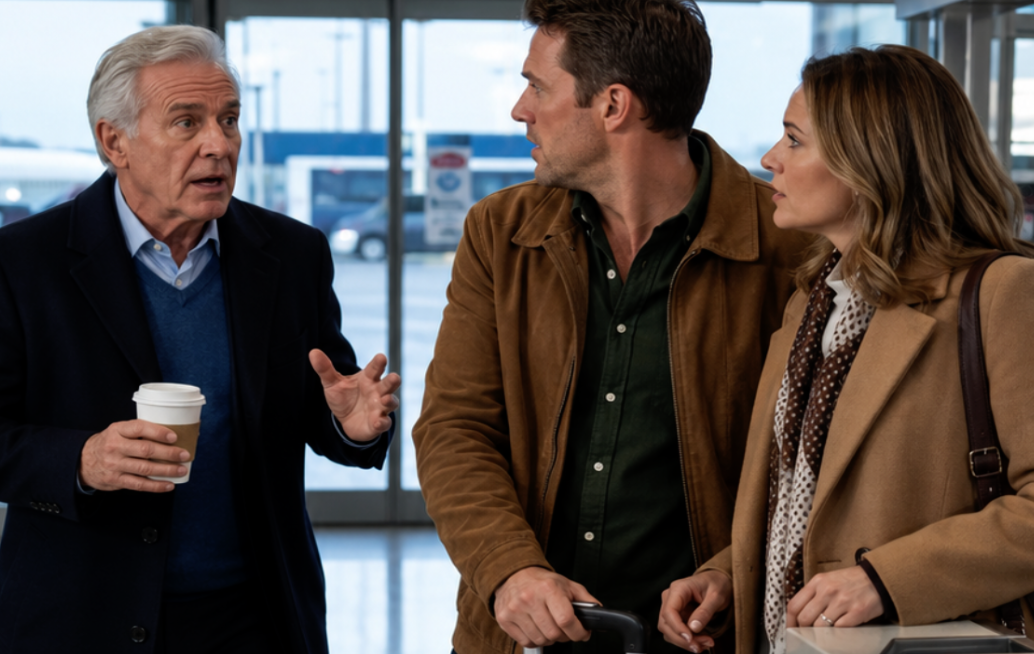
I drove my sedan through the driving rain to Kansas City International Airport, pulling into the sprawling long-term parking structure long before the sun even attempted to rise. The cavernous terminal was just beginning to stir to life: the rhythmic clacking of rolling suitcases on tile, the whining of exhausted toddlers, the serpentine lines forming at the coffee kiosks, the influx of business travelers already checking their watches with impatience. I purchased a bitter black coffee I had no intention of drinking, took a seat at a high-top table on the mezzanine overlooking the international check-in counters, and waited.
At precisely 5:20 AM, they materialized from the revolving doors.
Bryce was heavily dragging a massive, hard-shell gray suitcase marked with a glaringly bright red luggage tag. Polly walked briskly beside him, rolling a smaller, matching carry-on and absurdly wearing dark, oversized designer sunglasses despite the harsh, artificial fluorescent lighting of the terminal. They did not look like an excited, deeply-in-love couple embarking on the romantic vacation of a lifetime. They radiated immense tension. Their shoulders were rigid, their steps hurried and panicked. They looked exactly like fugitives desperately trying to squeeze through a rapidly closing doorway before the absolute truth caught up and crushed them.
They bypassed the automated kiosks and went directly to the desk to check the large, heavy gray suitcase first.
My life savings was packed inside that plastic shell. I knew it with absolute, unwavering certainty in that moment. I did not need an X-ray machine to see the banded stacks of bills. I knew it simply by observing the terrified, unblinking way Bryce stared at the digital scale as the agent hoisted the bag onto the belt. I knew it by the white-knuckle death grip Polly maintained on the strap of her expensive purse. I knew it by the suffocating, heavy silence that enveloped them until the airline employee finally handed over the printed baggage claim slip.
I remained seated, watching them turn away from the counter, allowing them to walk halfway toward the TSA security checkpoint before I finally stood up and let my voice carry over the din of the terminal.
“Bryce!”
He stopped walking so violently and abruptly that Polly crashed hard into his shoulder, nearly losing her balance.
When he slowly rotated to face me, all the blood had completely drained from his face, leaving him looking like a terrified ghost.
“Dad?” he choked out.
I forced the muscles in my face into a warm, paternal smile, projecting the illusion that absolutely nothing in the universe was amiss. “I thought I’d surprise you and come down to see you both off.”
Polly, ever the actress, recovered her composure first. She always did. “Eugene! Oh, my goodness. That is so incredibly sweet of you. You really shouldn’t have driven all this way in this awful weather.”
“Oh, you know me,” I chuckled softly. “At my age, I really don’t sleep much past four in the morning anyway.”
Bryce attempted to produce a casual laugh. It emerged from his throat sounding like dry leaves crushing under a boot.
“Are you feeling okay, son?” I asked, taking a step closer, watching his eyes dart wildly.
“I’m fine. Yeah, fine. Just… you know, just a little nervous about flying.”
That, at least, was a singular truth. When he was a little boy, Bryce had gripped Elaine’s hand with terrifying strength on every single airplane flight we had ever taken as a family. She would lean close and softly whisper absurd, made-up facts about the clouds outside the window until he completely forgot to be terrified of the altitude. But standing here now, a grown man, he looked utterly petrified of a consequence much closer and far more devastating than falling from the sky.
I looked pointedly at the baggage carousel behind them. “That certainly is a massive amount of luggage for a simple one-week getaway.”
Polly’s synthetic smile tightened until her lips were white. “Oh, you know how I am, Eugene. I just absolutely have to have my wardrobe options.”
“Yes,” I said slowly, letting my eyes lock onto hers. “I certainly have noticed that about you.”
The automated overhead PA system suddenly chimed, echoing a final boarding announcement for a different flight. Bryce violently flinched at the noise.
“Dad, we really should get going to the security line,” he stammered, already taking a step backward.
“Of course, of course. Don’t let me hold you up.” I stepped forward and wrapped my arms around him. His entire body was as stiff as a wooden board, practically hovering to avoid making full contact with me. I turned and hugged Polly next, and she endured the embrace like a trapped aristocratic woman being forced to accept a loathsome favor from a peasant she utterly despised.
“Make sure you call me the minute you land safely,” I said, stepping back.
“We will. Promise,” Bryce answered breathlessly.
He turned and practically sprinted toward the security queue, but he made the critical error of looking back over his shoulder just once before disappearing into the labyrinth of stanchions. The profound, crushing guilt written so clearly across his pale face made him look exactly eight years old again. For one brief, heartbreaking second, it nearly shattered my resolve.
After watching their flight physically lift off the tarmac and vanish into the low-hanging rain clouds, I walked slowly back to my cold car. I sat in the absolute quiet of the parking lot for a long time, watching the heavy rain streak and blur the windshield glass. Finally, I reached into my coat pocket, pulled out my cellular phone, and dialed Edward Null’s private number.
Edward and I had known each other since our undergraduate days. He had dedicated his entire professional career to international travel compliance and federal financial review—the exact kind of bureaucratic, relentless work that made him infinitely patient with endless mountains of paperwork, and remarkably impatient with arrogant people who genuinely believed federal regulations only applied to the lower classes. Decades ago, I had utilized my industry connections to quietly assist his own son when a devastatingly complicated insurance liability issue had threatened to bankrupt him entirely. Edward had gripped my hand then and said, “One day, Eugene, you are going to ask me for a massive favor. And I will grant it.”
I honestly never thought the day would come when I would collect on that debt.
“Eugene,” Edward answered after the second ring. “Good God, man, you sound absolutely awful.”
“Edward, I need your professional advice,” I said, my voice barely a rasp. “And, depending on what you say, I may need that favor.”
I gave him only the sterile, necessary information. I omitted the decades of emotional pain, the crushing weight of the memories, the tragic state of Elaine’s beloved flower garden, and the haunted, guilty way my son had just looked at me in the terminal. I just gave him the cold, hard facts. An adult son. A massive sum of missing cash from a home vault. Extremely large, undeclared funds highly likely to be vacuum-sealed and packed in a checked suitcase currently en route to a foreign nation. The exact flight number. The scheduled arrival time at customs. A hard-shell gray suitcase. A bright red luggage tag.
Edward remained dead silent on the line for a very long, uncomfortable minute.
“Eugene… this is your own flesh and blood,” he said softly.
“I am entirely aware of that, Edward.”
“You need to understand the gravity of this. Once you officially pull the trigger and I flag this in the system, the process becomes entirely out of our hands. It becomes a federal and international matter. They will be aggressively detained. They may face staggering fines. The entirety of the money will be immediately seized and held indefinitely in escrow until its exact source can be legally and rigorously reviewed. There will be massive, inescapable consequences.”
I closed my eyes, pressing the phone hard against my ear.
“There absolutely should be consequences,” I whispered.
“Are you absolutely, one hundred percent sure you want to do this?”
Outside the fogged windshield, anonymous travelers hurriedly dragged their rolling suitcases through the pouring rain, rushing toward complicated lives that had absolutely nothing to do with mine.
“No,” I admitted, a single tear cutting a hot path down my weathered cheek. “I’m not sure at all. But I need you to do it anyway.”
Edward exhaled heavily. “Alright, Eugene. Read me the flight number one more time.”
By noon, the rain had stopped, and I was back inside my silent house, sitting motionless in Elaine’s floral upholstered chair positioned near the large front picture window. I had a heavy, dusty photo album resting open on my lap, but I was not actually turning the thick pages. I was just staring. Little Bryce proudly riding a red tricycle in the driveway. Bryce standing tall in his muddy Little League baseball uniform. Bryce at twelve years old, standing on a dock at Lake Jacomo, holding up a shimmering silver fish he had caught himself, grinning into the camera as if the universe had just handed him the most wonderful, magical gift imaginable.
The phone rang sharply at exactly 12:37 PM.
It was Edward.
“It’s done, Eugene,” he said, his voice clipped and strictly professional.
My hands gripped the padded arms of the chair so hard my knuckles turned white.
“They were pulled out of the customs line for a random, intensive financial review immediately upon arrival,” Edward reported. “Security opened the checked luggage. The gray suitcase contained exactly thirty-eight thousand, six hundred dollars in banded United States currency. They utterly failed to declare it on their customs forms, and when interrogated in the holding room, they could not clearly or legally establish the provenance of the cash.”
Thirty-eight thousand, six hundred.
They had already spent fourteen hundred dollars. On the flights. On the resort deposit. On Polly’s new designer bag.
“What exactly happens to them now?” I asked, my voice hollow.
“The funds are seized and held in federal review. They are currently being interrogated. They’ll be forced to answer endless questions, provide impossible documentation proving the money is legally theirs, and pay steep international penalties if they fail to establish a lawful transfer—which they can’t. Furthermore, their travel visas have been suspended pending the investigation. Their luxury vacation is effectively, completely over. They are being put back on a plane to the States.”
I leaned my head back against the chair, staring blankly at the ceiling plaster.
For hours, I had vividly imagined that this exact moment would bring me a profound, righteous sense of satisfaction. I thought vengeance would feel like justice.
Instead, I felt nothing but a vast, echoing emptiness.
“Will they know it was me who tipped off customs?” I asked quietly.
“Not officially, no. Your name is nowhere in the file. But, Eugene… people aren’t stupid. They usually figure these things out eventually.”
After Edward and I ended the call, I sat frozen in that chair until the harsh afternoon light filtering through the window slowly shifted from a dull gray to a brilliant, bruised gold. As the sun began to dip below the tree line, I forced myself up and walked out onto the wooden back porch. Elaine and I had spent countless peaceful evenings sitting in these two rocking chairs, drinking tea and watching the sky change colors. She used to squeeze my hand and say that because no sunset ever truly repeats itself, even the most ordinary, mundane day inherently deserves our attention and respect.
“What would you say to him right now, El?” I whispered to her empty chair as the first stars appeared.
The empty chair, of course, did not answer.
The first frantic, panicked phone call from Bryce came just after ten o’clock that night.
The caller ID displayed an unfamiliar, international routing number, and when I finally picked up the receiver, his voice sounded impossibly strained, tight, and smaller than I had ever heard it in his entire thirty-four years of life.
“Dad,” he gasped, clearly crying. “Dad, we have a massive problem.”
I let the heavy, judgmental silence stretch across the thousands of miles of fiber-optic cable.
“What kind of problem, Bryce?” I asked, my voice devoid of any comforting warmth.
“They… they stopped us at the airport down here. Security pulled us into a back room. Dad, they took all the money.”
“What money are you talking about?”
He hesitated, the gears in his head visibly grinding as he tried to construct a plausible lie while in a state of absolute panic.
“Our savings, Dad. Our life savings.”
I slowly turned my head and looked down the dark, empty hallway, my eyes settling on the closed door that led down to the basement.
“All of your life savings?” I repeated smoothly.
“Yes! Yes, all of it,” he babbled frantically, speaking too fast. “We were going to use it for a down payment on a house later this year. Polly read on a financial blog that we could legally move it into a high-yield offshore account while we were down here. It was an investment strategy, Dad.”
“Bryce.”
“What? I know! I know how incredibly stupid it sounds now, but we were just trying to get ahead! We desperately need your help to fix this.”
For the next twenty minutes, he pleaded. He begged for me to wire them emergency cash. He demanded I hire an international financial advisor. He pleaded for me to leverage my old insurance contacts to reach out to the customs office holding their case. He desperately, tearfully wanted me to do exactly what I had done for his entire pathetic adult life: grab a mop, clean up his catastrophic mess, shield him from the consequences of his own actions, and generously label my enabling as ‘fatherly love.’
I listened to his entire, pathetic performance without interrupting once.
When he finally ran out of breath, I spoke. “Bryce, I am a sixty-eight-year-old retired widower living on a fixed pension. What, exactly, do you expect me to magically do about the Mexican government seizing your supposed savings?”
The resulting silence on his end of the line was not empty. It was intensely busy. I could practically hear the desperate, frantic calculations firing in his brain as he searched for an angle.
“You… you have your own savings, Dad,” he said, his voice dropping to a careful, dangerous whisper.
“What savings?”
Another agonizing pause.
That brief, cowardly hesitation was the absolute closest he came to offering a genuine confession that night.
Their humiliating return to the United States was severely delayed by bureaucratic red tape. The luxury resort unceremoniously canceled their non-refundable suite. The thirty-eight thousand dollars remained locked tight under federal review. For three miserable days, they were forced to sleep in uncomfortable airport chairs, sign endless stacks of intimidating legal forms, endure aggressive interrogations by customs agents, pay exorbitant processing fees they absolutely could not afford, and ultimately beg and borrow just enough money from a distant, reluctant cousin on Polly’s side of the family to secure two miserable coach tickets back to Kansas City.
In the meantime, the real world did not pause for their crisis. Bryce missed three unexcused days of work and was placed on unpaid suspension. Polly missed crucial floral deliveries and enraged her best client. Their furious landlord left increasingly hostile voicemails about their bounced rent check. Past-due utility bills continued to pile up mercilessly in their tin mailbox. The crushing weight of real consequences, I was learning, does not arrive all at once like a sudden explosion. It arrives slowly, silently, and destructively, like dark water seeping under a locked door until you are drowning.
Two full weeks later, I drove my sedan back to Kansas City International Airport to pick them up from the arrivals curb.
They eventually emerged through the sliding glass doors, notably lacking the massive gray suitcase. Bryce looked physically degraded, as if he had aged five years in fourteen days. He was not necessarily any wiser, but he was undeniably, thoroughly worn down to the bone. Polly’s normally immaculate hair was tied back in a greasy, careless knot, her face was completely bare of her usual armor of expensive makeup, and her beloved, status-symbol designer bag was conspicuously absent—likely pawned or abandoned to pay a customs fee. They both spotted my idling car at the exact same moment.
“Dad,” Bryce said as he pulled open the passenger door, collapsing onto the upholstery.
His exhausted voice held profound relief and lingering, vibrating fear in absolutely equal measure.
“Come on,” I said gruffly, putting the car into drive without looking at him. “Let’s just get you home.”
The forty-minute drive back to Overland Park was suffocatingly quiet. I mechanically offered them food because, despite the betrayal, my biological programming as a father still functioned; I was a parent even when my soul desperately wished to resign from the position. Back at the house, I wordlessly heated up leftover meatloaf and canned soup. They sat at the kitchen table and devoured the meal with the ravenous, desperate intensity of people who had not felt a moment of safety or comfort in a very long time. Polly aggressively kept her eyes glued to the table, refusing to look at me. Bryce murmured quiet, broken ‘thank yous’ between mouthfuls.
After the dishes were cleared, we moved to the living room and sat down.
Elaine’s photograph watched the three of us silently from her perch on the brick mantel.
“Alright,” I said, crossing my arms over my chest. “Tell me exactly what happened.”
Bryce took a shaky breath and launched back into the exact same fabricated narrative. He spun the ridiculous fairy tale about their hard-earned life savings, the genius idea for a house down payment, the tragic confusion at the customs border, the aggressive, unyielding foreign agents, and the impenetrable mountain of unfair paperwork.
I sat perfectly still and allowed him to spin the entire web to the very end.
When he finally finished, the room descended into silence. I slowly reached out and set my ceramic coffee cup down on the table.
“You are still lying to my face.”
Polly went instantly, rigidly still, like a rabbit spotting a hawk.
Bryce’s head snapped up, his bloodshot eyes widening in shock.
“Dad, what are you talking about—”
“I know about the cash behind the false basement panel, Bryce.”
The atmosphere in the room violently, instantaneously shifted. The air did not get louder; the room simply seemed to shrink, the walls rapidly closing in around us.
Polly’s face lost every single drop of remaining color, turning the shade of old parchment. Bryce stared at me with an expression of pure, unadulterated horror, looking exactly like a man who had just watched a reinforced steel door slam shut and lock from the outside.
“You… you knew it was there?” he whispered, his voice cracking violently.
“Yes, Bryce. It was my money. I put it there.”
“Then you…” His chest heaved as his brain finally connected the catastrophic dots. “You called them. You reported us to customs.”
“Yes. I did.”
Polly let out a strangled gasp and clamped both of her hands tightly over her mouth to muffle a sob.
Bryce started to stand up in a surge of defensive anger, made it halfway to his feet, and then immediately collapsed back onto the sofa as if his muscles had liquefied.
“You intentionally let us go through all of that hell,” he accused, tears of fury and shame welling in his eyes. “Your own son. You turned in your own flesh and blood.”
“My own son methodically staked out my house, waited for me to leave, invaded my private sanctuary, tore apart my basement until he found my life savings, and calmly carried forty thousand dollars of my money through an international airport in a suitcase so he could drink margaritas on a beach.”
“We were eventually going to pay it back, Dad! I swear to God!”
“No, Bryce, you absolutely were not.”
“You don’t know that! You don’t know me!”
“I know that you stood right there on that rug and casually interrogated me about my weekly bowling schedule to secure an alibi. I know you deliberately distracted me with a wrench while you let your wife ransack my bedroom drawers looking for valuables. I know you lied straight to my face about the trip, the tickets, the fake savings, and the imaginary down payment. And I know, with absolute certainty, that you only came crying to me for help when you were trapped in a foreign country and had literally no one else left in the world to con.”
Bryce’s eyes finally spilled over, the tears tracking through the dirt on his face, but the sight of his weeping did not move my heart the way it once would have. The well of my sympathy had finally, permanently run dry.
Polly finally found her voice, dropping her hands from her face. “Eugene, you have to understand, we were desperate! We are drowning in debt!”
I turned my head and looked at her with eyes like chips of flint. “No, Polly. You were incredibly ambitious, deeply entitled, and completely devoid of discipline. Do not ever confuse those traits with desperation.”
Her jaw clamped shut, her mouth tightening into a furious, humiliated line.
Bryce leaned far forward, resting his elbows heavily on his knees and burying his face deep into his hands.
“I messed up, Dad,” he sobbed into his palms. “I really messed up.”
The words were pitifully small.
They were entirely too small, too weak, and too childish for the massive weight of the betrayal they desperately needed to carry.
“You didn’t ‘mess up,’ Bryce,” I corrected him, my voice devoid of anger, perfectly calm and devastatingly cold. “Messing up is forgetting to change the oil in your car. What you did was execute a premeditated plan. You stood in the center of my living room, drank my coffee, and probed for my schedule. You allowed your wife to search the house of a grieving widower. You stole the money that your mother and I sacrificed and saved over decades of hard labor. You smiled directly into my face, hugged me at the airport, and walked away knowing your suitcase was packed with my stolen security.”
His shaking shoulders hitched violently with a loud sob.
Deep within my chest, my battered heart involuntarily softened for a fraction of a second, and I profoundly hated myself for the weakness. I hated it because unconditional love is not a simple mechanical faucet that you can twist off at the main valve. It stubbornly refuses to stop flowing just because the recipient has thoroughly proven themselves completely unworthy of drinking from it. It just keeps running, secretly, somewhere deep underground, silently eroding the foundation and making the earth beneath your feet dangerously unstable.
Bryce looked up, wiping his nose with the back of his hand. “So… what happens to us now?”
“You both have exactly three days to sleep in your old bedroom upstairs,” I said, standing up from my chair to signify the absolute end of the discussion. “Then you will pack your remaining belongings, and you will leave my house.”
Polly’s head snapped up, her eyes flashing with genuine panic. “Three days? Eugene, be reasonable! Where are we supposed to go?”
“You are supposedly grown adults,” I said, looking down at them both. “You deliberately made adult, criminal choices. Now, for the first time in your lives, you are going to experience how the rest of the world lives with adult consequences.”
“Dad, seriously, where are we supposed to go?” Bryce pleaded, his voice rising in panic.
“I honestly do not know, Bryce. Nor do I care.”
He sat there, utterly paralyzed, staring up at me as if I had just morphed into a terrifying, unrecognizable alien creature.
For the very first time in his thirty-four years of life on this earth, his father did not reach into his pocket and magically solve the problem.
The very next morning, the house was completely silent.
They were gone.
They did not stay for the allotted three days. There was no explosive, secondary argument in the morning light. They had packed their meager belongings and fled like thieves in the night long before I even came downstairs to brew my coffee. Their old bedroom was starkly empty. The heavy quilt on the guest bed was neatly, almost clinically folded. The bathroom counters were wiped completely clear of their toiletries. Sitting squarely in the center of the oak kitchen table was a piece of torn notebook paper bearing Bryce’s sloppy, hurried handwriting.
We decided it’s best if we don’t stay. My old house keys are on the hall table. Please don’t try to look for us.
I picked up the scrap of paper and read the pathetic, cowardly words twice.
Then, without a sigh or a tear, I walked into the living room, placed the note gently on the mantel right next to Elaine’s smiling photograph, and walked back to the kitchen to brew a fresh pot of coffee for one.
The large house was silent again, but the fundamental texture of that silence had miraculously changed. It felt significantly cleaner in some of the darker corners. It was perhaps a bit crueler and colder in others, but it was honest. Over the next few days, I wandered slowly through the rooms, occasionally finding small, pathetic artifacts they had forgotten in their hasty retreat: a half-empty bottle of Polly’s cloying, cheap floral perfume, a faded gray sweatshirt Bryce used to wear in high school, a dusty cardboard box shoved in a closet containing cheap plastic participation trophies from his childhood. I picked up one of the dusty trophies and held it in my weathered hands for a long time, running my calloused thumb thoughtfully over the cheap gold plastic of the little batter poised on top.
I had never intended to raise a boy who would eventually grow into a man capable of robbing his own father.
But I realized, with a heavy, sickening wave of clarity, that somewhere along the winding path of parenting, I had systematically taught him that no matter how severely he damaged the world, I would always be standing there, wallet open, willing to absorb the devastating cost of his actions.
That era of my life was officially, permanently over.
A month later, the telephone rang. It was Edward Null calling to officially inform me that the seized funds had finally been cleared and released back into my legal custody. It had required weeks of exhausting work: submitting my original ATM withdrawal receipts, signing a sworn, notarized federal affidavit, and digging up decades-old, yellowed bank records to prove the origin of the savings. I did not get all of it back. Bureaucratic administrative fees, international penalties, and the fourteen hundred dollars they had managed to spend had eaten a painful chunk out of the total. But the vast majority of the forty thousand was returned. It was enough to ensure that my life’s rainy day fund had not vanished entirely into the ether.
When the heavy cashier’s check arrived securely in the mail, I immediately drove it down to the local bank branch.
This time, I did not hide it behind a false wooden wall in a dark basement. I handed it to the teller and deposited every single cent into an interest-bearing account.
On the drive back to the empty house, I impulsively pulled the sedan into the strip mall and parked in front of a small, brightly lit travel agency.
For the entirety of our long marriage, Elaine and I had talked endlessly, dreamily about taking a grand tour of Italy. We planned to see the ancient ruins of Rome first, then take a train to the art of Florence, and finally float through the canals of Venice, provided our aging knees could still handle the cobblestones. We had postponed the dream a dozen times. First, we drained the travel fund to pay for Bryce’s disastrous, extended college career. Then, we drained it again to cover a mountain of unexpected household bills. Finally, we drained every last penny to pay for Elaine’s aggressive, ultimately futile medical treatments. By the time the dust settled, there was no ‘we’ left to take the trip.
The woman sitting behind the desk at the travel agency was remarkably kind. She was comfortably middle-aged, wearing thick reading glasses attached to a silver chain around her neck, and possessed a towering stack of glossy, colorful brochures fanned out beside her keyboard.
“Will this be your very first time traveling to Europe, sir?” she asked with a warm, encouraging smile.
I looked down at the vibrant, glossy photograph of the Colosseum bathed in bright blue sky resting on her desk.
“Yes,” I said quietly, tracing the edge of the paper. “And no.”
She smiled politely, clearly not understanding the profound weight of the contradiction.
And that was perfectly alright. Some deep, complex truths are simply not meant for strangers to understand.
During the final week before my scheduled departure, I dedicated myself to clearing Elaine’s ruined flower bed. It took two grueling afternoons in the brutal sun, three long breaks to ice my throbbing knees, and significantly more physical effort than my pride wanted to admit. I ripped up the suffocating, invasive weeds with my bare hands until my knuckles bled and my muscles screamed. I ruthlessly pruned back the dead, rotting stems of the old bushes. Finally, I knelt in the fresh, dark soil and planted neat rows of fragrant lavender and bright, resilient white daisies, simply because Elaine had always found far more beauty in simple, unpretentious flowers than in rare, expensive orchids.
On the very last evening before my international flight, I sat peacefully on the back porch with a steaming cup of coffee and watched the sunset burn a brilliant, bruised orange over the shingled roofs of Overland Park.
My phone suddenly buzzed in my jacket pocket, shattering the quiet.
For one brief, terrifying moment, my stomach dropped, and I thought it might be Bryce finally calling to beg for absolution or cash.
It wasn’t.
It was merely an automated text message from the airline, confirming that my first-class check-in was complete.
I let out a long breath and looked over at Elaine’s empty rocking chair sitting motionless beside me.
“We’re finally going, El,” I whispered into the twilight.
A warm evening wind rustled gently through the newly planted white daisies.
I honestly do not know if Bryce and I will ever manage to repair the shattered, ruined bridge between us. Perhaps, several years from now, he will eventually grow up and call me simply to hear my voice, without demanding I wire him money. Perhaps, someday, I will be able to answer his call without immediately hearing the damning, hollow crinkle of empty manila envelopes echoing in his tone. Perhaps his wife, Polly, will eventually learn the hard way that a shallow life built entirely on deceit and stolen shortcuts usually leads directly to locked, impenetrable doors.
Perhaps not.
But I have definitively decided that I can no longer afford to live my remaining years inside the agonizing prison of maybe.
I am sixty-eight years old. My joints creak loudly when it rains. My hands tremble slightly when the barometric pressure drops. I still, occasionally, absentmindedly brew enough coffee for two people on quiet Sunday mornings before the cold reality of my solitude catches up with me.
But tomorrow morning, I will board a massive transatlantic plane with Elaine’s smiling photograph safely tucked into my breast pocket, sitting right next to a first-class ticket to Rome.
I am not boarding that plane as a broken, betrayed father running from his failures.
I am not boarding it as a pathetic, lonely widower drowning in his memories.
I am boarding it as a man who finally learned—painfully, brutally, and remarkably late in life—that truly loving your family does not require you to stand still while they completely empty you of everything you have left to give.
The house will be securely locked.
The new flower bed will be blooming in the morning sun.
And for the very first time in my long life, the money I spent decades sacrificing to save will safely carry me toward a beautiful, hard-won dream, instead of being desperately thrown into the fire to rescue someone else from the entirely predictable consequences of their own selfish choices.