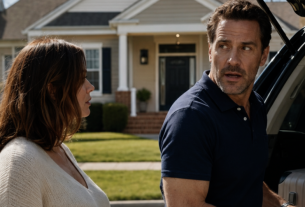
At precisely ten o’clock in the morning, the metallic rasp of my brother’s key scraped against the lock of the lakehouse. It was a sound I had bought with twelve years of my life, paid for in seventy-hour workweeks, missed holidays, and the slow, systemic erosion of my youth.
The initial sound was small, almost polite—a tentative metal-on-metal friction, followed by a confused, frustrated twist. Then came a second attempt, far more aggressive. Through the heavy cedar door, I heard Gavin Anderson mutter a sharp curse. I heard the shifting leather boots of a hired mover on the porch boards, and then my mother, Marlene, clearing her throat. It was that delicate, theatrical cough she deployed whenever she wanted to remind the world that her disappointment was a tragic, beautiful cross to bear.
I stood motionless in the entryway, my palm resting on the polished oak console table I had oiled only the night before. The scent of lemon and beeswax still hung in the air, a clean, sharp fragrance of fresh beginnings. Next to my hand lay a cream-colored folder containing the deed, four sealed envelopes, and printouts of the text messages my family had sent me after midnight—communications written as though my private property were a joint family asset I had simply failed to manage properly.
Behind me, Leah Moreno, my real estate attorney, stood near the kitchen island. She wore a pair of reading glasses low on her nose, casually holding a travel mug. A few paces behind her stood two county civil officers. They were quiet, imposing, and entirely detached. They were not there to settle a family dispute; they were there as state-sanctioned witnesses to ensure that a boundary I had drawn in black ink remained uncrossed.
Gavin rattled the knob again. This time, the key turned completely in the cylinder, but it met absolutely no resistance. The deadbolt remained stubbornly engaged.
“Khloe!” he called out, his voice rising, shedding its casual veneer. “Open up. The movers are billing us by the hour.”
“Sweetheart, please,” my mother chimed in, her voice pitched for the benefit of the
neighbors. “Don’t embarrass us in front of strangers.”
My father, Victor Anderson, said nothing. He never wasted his opening moves. He preferred to let the silence stretch, forcing everyone else to adjust to his gravity before he deigned to speak.
I stared at the brass faceplate of the new deadbolt, installed just before sunrise, and felt an unexpected, icy calm settle over me. It was not the theatrical courage of a confrontation; it was the quiet, immovable certainty of a woman standing inside her own walls, realizing that the door would only open if she chose to turn the lock.
The siege had begun at 11:18 p.m. the previous evening. I was unpacking a cardboard box marked KITCHEN when Gavin’s name lit up my phone. I was holding a white ceramic mug from my old Chicago condo—the one with a hairline blue fracture near the handle. Outside, the lake was a sheet of black glass beneath a silver crescent moon, and the pines were whispering in the dark.
I had walked away from my corporate career in financial operations six weeks prior. For over a decade, I had been the reliable one, the daughter who turned corporate chaos into pristine spreadsheets and family emergencies into structured rescue packages. By thirty-four, I possessed a healthy bank account, a timely condo sale, and a nervous system that flinched at every late-night notification. The lakehouse was my sanctuary—a modest, cedar-sided retreat with a screened porch, three bedrooms, and a small study overlooking the water. I had bought it entirely with my own funds. I had signed the deed alone. I had deliberately withheld the address from my family until the keys were in my hand.
I had wanted a single piece of reality that they could not revise.
“Hey,” I had answered, balancing the phone on my shoulder.
“There she is,” Gavin said, his tone jovial, backgrounded by the aggressive tear of packing tape. “Quick update. We’re moving in tomorrow morning.”
I let out a dry laugh, expecting a punchline. “What?”
“Dad cleared it,” Gavin replied, entirely unbothered. “Mom’s already packing her linens. I’ll take the downstairs office, they’ll take the master, and you can have the loft upstairs until you figure out your next move.”
My fingers tightened around the ceramic mug. I set it down carefully on the counter. “Gavin, this is my house.”
“Don’t start, Khloe,” he sighed, sounding genuinely exhausted by my apparent selfishness. “You bought a massive place for one person, and the family needs it. Dad handled the paperwork. The truck is booked. We’ll be there at ten.”
“You booked a truck?”
“Mom and Dad gave notice on their place, and I broke my lease. We’re committed. If you don’t like the arrangement, you’re free to live elsewhere.”
The silence that followed was so thick I could hear the hum of my refrigerator. I stared at the cracked mug, realizing with absolute clarity that they were not seeking shelter; they were claiming a territory they believed they had a right to inhabit.
In the past, I would have begged, explained, or offered a compromise. But I finally understood that they didn’t lack information—they lacked respect.
“What time did you say you were arriving?” I asked, my voice dropping to a flat, even register.
Gavin chuckled, assuming my quietness was surrender. “Ten sharp. Try to be normal about this, okay?”
After he hung up, my phone buzzed with a succession of texts:
Don’t make this ugly. Dad handled the paperwork. Once we’re established there, you can’t just throw us out.
That last sentence was their fatal mistake. It transformed a messy family drama into a cold, legal threat. They were planning to establish residency, knowing that once their boxes crossed my threshold, tenant laws and my own guilt would make it nearly impossible to evict them.
I immediately opened my laptop. My hands shook, but my mind was perfectly clear. I compiled the deed, the title policy, the closing statement, the home insurance, and the utility bills. I sent them all to Leah Moreno.
She answered on the fourth ring, her voice rough with sleep but instantly sharp. “Khloe? What’s wrong?”
I read her the texts. I explained my father’s ominous reference to “paperwork” and their plans to occupy the rooms.
Leah didn’t hesitate. “Do not let them cross the threshold. Not a single suitcase. Not a single box. Not even a potted plant. Once their physical property is inside, the police will call it a civil tenancy dispute and refuse to intervene.”
She drafted a formal, binding notice of non-consent and sent it to my family via email and certified text. Gavin sent back a laughing emoji. My mother replied with six paragraphs invoking family duty, sacrifice, and my alleged cruelty. My father sent a single line:
You don’t understand what you signed.
I spent the rest of the night coordinating with a twenty-four-hour locksmith and calling the county sheriff’s department. Because of the written evidence of a planned forced entry, the department agreed to dispatch two civil standby officers to keep the peace.
As dawn broke, I paced the empty rooms, photographing every corner of the house. I documented the pristine, vacant closets, the empty shelves of the kitchen, and the untouched bedrooms. I was building a photographic record of the home’s vacant state before any potential intrusion.
At 6:30 a.m., I walked down the gravel driveway to the mailbox. The air was damp and cold, mist rising off the lake. Inside the metal box, I found two envelopes that did not belong to me.
The first was a change-of-address confirmation from the postal service, transferring Gavin Anderson’s mail to my address, effective three days prior.
The second was a commercial statement addressed to Anderson Lake Retreats LLC at my home address.
Leah joined me on the driveway. She took photos of the envelopes and instantly pulled up the state’s business registry. Gavin had registered the LLC six weeks before my closing date. The day after I received my keys, he had updated the entity’s principal address to my lakehouse.
By 8:15 a.m., Leah found the active listing on a popular short-term rental platform.
The listing used the staged marketing photos from the real estate site. The headline read: Private Lakefront Escape, Now Accepting Summer Reservations. The calendar showed four weekends already booked and paid for. The description detailed a “family-run retreat” with my father listed as property manager, my mother as hospitality director, and Gavin as founder.
My name appeared once at the very bottom: Silent financial partner.
I had been written out of my own purchase, reduced to a nameless bank account.
And then came the final blow: a credit monitoring alert popped up on my phone. A commercial credit application for $85,000 had been submitted under Anderson Lake Retreats LLC, listing my property as an operating asset and myself as the personal guarantor. My name had been typed into the signature field.
At 9:42 a.m., the driveway cameras chimed. A massive white moving truck pulled in, followed by my father’s polished black sedan.
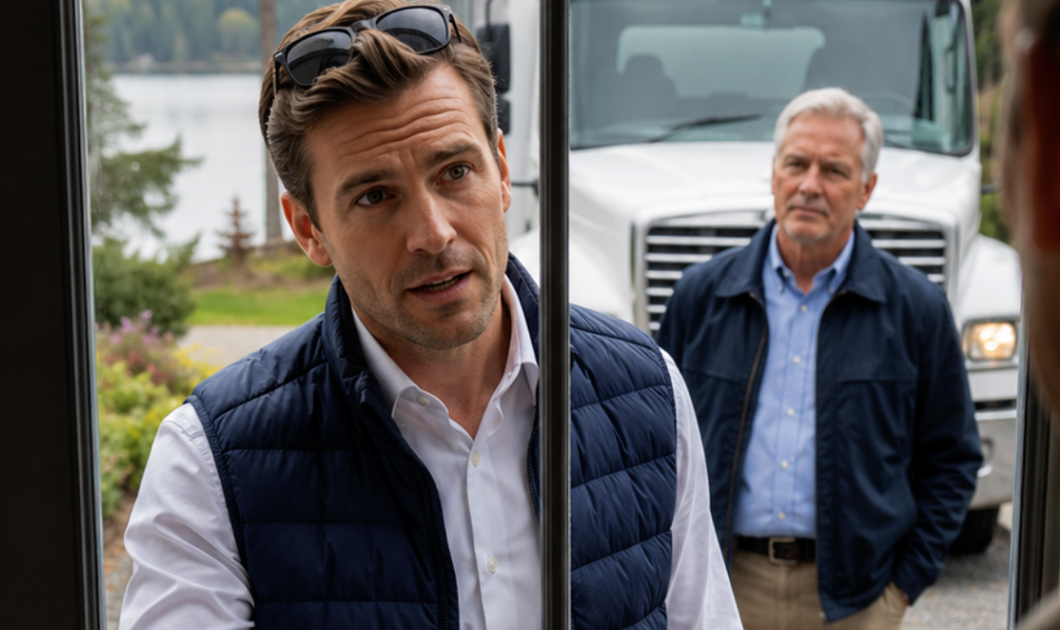
Gavin climbed out of the truck first, wearing an expensive quilted vest and designer sunglasses. He was twirling a ring of keys on his finger. My mother stepped out of the sedan, cradling a potted purple hydrangea wrapped in brown paper—a calculated prop of domestic peace. My father emerged last, tall and imposing in a tailored sport coat, carrying a thick manila envelope.
Two movers opened the back of the truck, revealing stacks of boxes labeled in thick black marker: MASTER BEDROOM, OFFICE, LINENS, FAMILY ROOM.
Gavin marched up the steps, inserted his key, and met the silent refusal of the deadbolt.
I opened the door only as far as the heavy brass security chain allowed. “You were told in writing not to come,” I said through the gap.
Gavin pushed his sunglasses up. “Khloe, don’t do this. We’re all exhausted. Let us in.”
“Let us in, sweetheart,” my mother pleaded, gesturing to the plant. “We brought you something beautiful for the porch.”
My father stepped forward, his heavy boots creaking on the pine. “Enough of this childishness, Khloe. Open the door.”
I looked at him, remembering the cold dread I felt at fifteen when he took the door off my bedroom hinges because I had locked it to keep Gavin from reading my journal. “Privacy is earned,” he had told me then.
But I was no longer fifteen. I closed the door, slid the chain off, and swung it wide open.
The two uniformed county officers stepped into view immediately behind me.
Gavin’s jaw dropped. My mother lowered the hydrangea, her face pale. My father’s jaw tightened, but he refused to step back.
The silver-haired female officer spoke in a level, authoritative tone. She informed them that I was the sole legal owner, that she had reviewed the deed, and that any attempt to bring physical items onto the property would be treated as criminal trespass.
“You brought police officers to your own parents?” my mother whispered, her voice trembling with synthetic heartbreak.
“I brought witnesses,” I replied, “because you tried to steal my home.”
My father calmly opened his manila envelope and pulled out a multi-page document. “This is a residential occupancy agreement, executed by my daughter, granting the family a five-year rent-free lease for family consideration.”
Leah stepped forward. “May I see that?”
“This is family business,” Victor snapped, holding the papers toward the officer instead.
The officer took the document and turned the signature page toward me. The name Khloe Anderson was penned at the bottom. The handwriting was a stiff, halting imitation of my signature—lacking the fluid, rapid stroke I always used.
“When did I supposedly sign this?” I asked.
“Thanksgiving,” my father said without blinking. “At our dining table.”
“I spent Thanksgiving in Montreal,” I said, looking him dead in the eye. “I have the passport stamps, flight receipts, and hotel invoices to prove it.”
My mother’s eyes flicked nervously toward my father. Gavin shifted his weight.
“Then it was Christmas,” my father corrected smoothly. “The date was filled in later.”
Leah pointed to the notary seal on the document. “The notary commission listed on this stamp expired a full year before the date printed here. This document is a crude forgery.”
On the driveway, the older of the two movers slowly began pulling the rolling door of the truck back down, signaling his quiet exit from the drama.
“Even if the lease has technical issues,” Gavin interjected, his voice taking on a desperate edge, “our mail is already registered here. We’ve established a legal presence.”
I reached onto the console table and picked up the second folder. “Thank you, Gavin. I needed you to admit that in front of these officers.”
I handed the police officers the change-of-address forms, the fraudulent LLC registration, the active rental listing, and the unauthorized commercial credit application.
The officer turned to Gavin. “Did you file these business documents using this address?”
Gavin looked at my father, then back at the officer, his confidence evaporating. “It was… a preliminary setup.”
“Did you collect money for these bookings?” I asked.
Gavin rubbed the back of his neck. “A few deposits.”
“How much, Gavin?”
“Twenty-six thousand dollars,” he muttered.
My mother dropped the potted hydrangea. The plastic pot split open, spilling dark soil across the clean white porch boards. “Your brother did this because he was desperate, Khloe! Are you really going to ruin his life over a few signatures?”
“I’m not ruining his life,” I said. “I’m stopping him from using mine to pay for his mistakes.”
My father glared at me, his eyes dark with fury. He turned to the movers. “Start unloading the truck.”
The movers didn’t budge. The driver shook his head. “Not doing it, pal. The owner says no, and the law is standing right here.”
My father stepped toward the truck ramp, but the male officer instantly stepped into his path, his hand resting casually near his utility belt. “Do not remove a single item from that vehicle, sir.”
The silence that fell over the yard was absolute.
I reached for the four white envelopes on the table and stepped onto the porch.
“The first envelope is a formal trespass warning,” I said, handing them to my father, who refused to take them. I laid them on the porch railing. “The second is a copy of the identity theft and bank fraud reports I have filed. The third is a preservation of evidence letter for Gavin’s LLC. And the fourth…”
I looked at my mother. “…is the termination of my financial support.”
Gavin’s head snapped up.
“I have canceled the automatic mortgage payments for your house,” I told my parents. “I have removed Gavin from my cellular plan, and I have revoked the emergency credit card I let you keep.”
“You would leave your own parents with nothing?” my mother gasped.
“No,” I said. “I am leaving you with your own income, your own choices, and your own consequences.”
My father looked at me with pure venom. “You think you’ve won? By next week, the entire family will know what kind of heartless monster you are.”
“Good,” I said. “Then I won’t have to waste time explaining why none of you are ever allowed inside.”
The sedan backed down the driveway, the moving truck followed, and the spilled soil from the hydrangea began to dry in the morning breeze.
By noon, my phone was a cemetery of missed calls and vitriolic text messages from aunts, uncles, and cousins I hadn’t seen in years.
Instead of engaging in a shouting match, I drafted a single, comprehensive email. I attached the deed, the police report, the forged occupancy agreement, the unauthorized credit application, and screenshots of the fraudulent rental listing.
My message was short:
I did not invite my family to live here. I did not sign the lease my father presented. My name and new address were used without my consent to secure business credit and list my home as a commercial rental. I am cooperating fully with the sheriff’s department and my legal counsel. Please do not contact me to demand that I tolerate behavior you would never permit in your own homes.
The response was immediate. My Aunt Denise called me, her voice shaken.
“Your father told us you were opening a family resort,” she whispered. “He said you wanted the family to have the first chance to invest. He sent us a business prospectus with your name listed as the managing partner.”
My heart sank. “Denise, how much did you give him?”
“Twenty thousand dollars,” she said quietly. “He said it was to build the guest dock and put in a hot tub.”
Within two hours, we discovered they had taken an additional five thousand dollars from another cousin. They had leveraged my impeccable credit and reputation to swindle my own relatives.
Over the next three weeks, the legal machinery ground them down. The rental platform removed the listing and froze Gavin’s accounts. The bank flagged the credit application as fraudulent. And my father was served with a formal civil lawsuit.
When we finally stood in the county courtroom for the restraining order hearing, the judge sat in absolute silence as Leah presented the certified bank records, the forensic metadata proving my father had altered his bank statements to fake a “gift” transfer, and the security footage of the attempted entry.
My father attempted to represent himself, delivering a rambling speech about a father’s natural right to his daughter’s success.
The judge looked down at him from the bench. “Mr. Anderson, the law does not recognize a parent’s right to forge his child’s signature or seize her real estate. The injunction is granted.”
For the first time in my thirty-four years, an authority figure had looked at Victor Anderson and told him no.
Six months later, the room Gavin had labeled OFFICE became my private consulting studio. I painted it a soft, clean white, filled the shelves with financial textbooks, and set up a walnut desk facing the water. I began taking on small, independent clients—people who wanted clean financial structures without the corporate ruthlessness.
My family’s housing crisis was real, but it was self-inflicted. Without my monthly mortgage subsidy, they were forced to sell their home and move into a modest apartment near the city. Gavin was forced to enter a structured settlement to repay Aunt Denise and the scammed vacationers.
They did not lose everything. They simply lost their access to me.
On a crisp November afternoon, a package arrived with no return address. Inside, wrapped in brown paper, was an old, scratched brass doorknob.
It was the doorknob my father had removed from my bedroom when I was fifteen.
Tucked inside the package was a photograph of me at fifteen, standing in that doorless hallway, looking entirely exposed to the world. On the back of the photo, my mother had written:
You should always have had a door.
I held the cold brass in my hand, feeling the weight of the past, but recognizing that it no longer had any power over me. I did not run to the phone to call her. I did not offer forgiveness. Instead, I walked into my studio and placed the old doorknob on the shelf next to my pristine house deed.
It was not a token of reconciliation. It was a monument to the boundary I had finally built.
I walked out to the front porch, where my repotted hydrangea was resting against the cedar siding, showing its first resilient green buds of the coming spring. Near the steps, a small wooden sign hung from the post:
I locked the door, turned the brass deadbolt, and listened to the solid, satisfying click of metal meeting its frame. No one could take this house. Because the lock worked, and I was the only one who held the key.