The funny thing about betrayal is that it rarely arrives wearing a theatrical mask or carrying a drawn blade. Most of the time, it sits right at your dining room table, casually dabbing its mouth with your good linen napkins. It eats the chicken you spent all afternoon meticulously roasting, complements the seasoning, and patiently waits until dessert to calmly inform you that your usefulness has officially expired.
That particular Sunday evening, I had prepared Daniel’s absolute favorite meal. The menu was a testament to a mother’s enduring, perhaps foolish, devotion: roast chicken infused with fresh rosemary, mashed potatoes whipped with an entirely irresponsible amount of butter, crisp green beans tossed with toasted slivered almonds, and homemade yeast rolls. For dessert, I had baked my signature caramel cheesecake—the very same recipe he used to beg for on every childhood birthday.
I was carefully carrying that cheesecake from the kitchen when my daughter-in-law, Vanessa, decided it was the perfect moment to make her grand announcement. What I remember most vividly about her in that suspended second was her complete lack of nervousness. She looked utterly, radiantly pleased with herself.
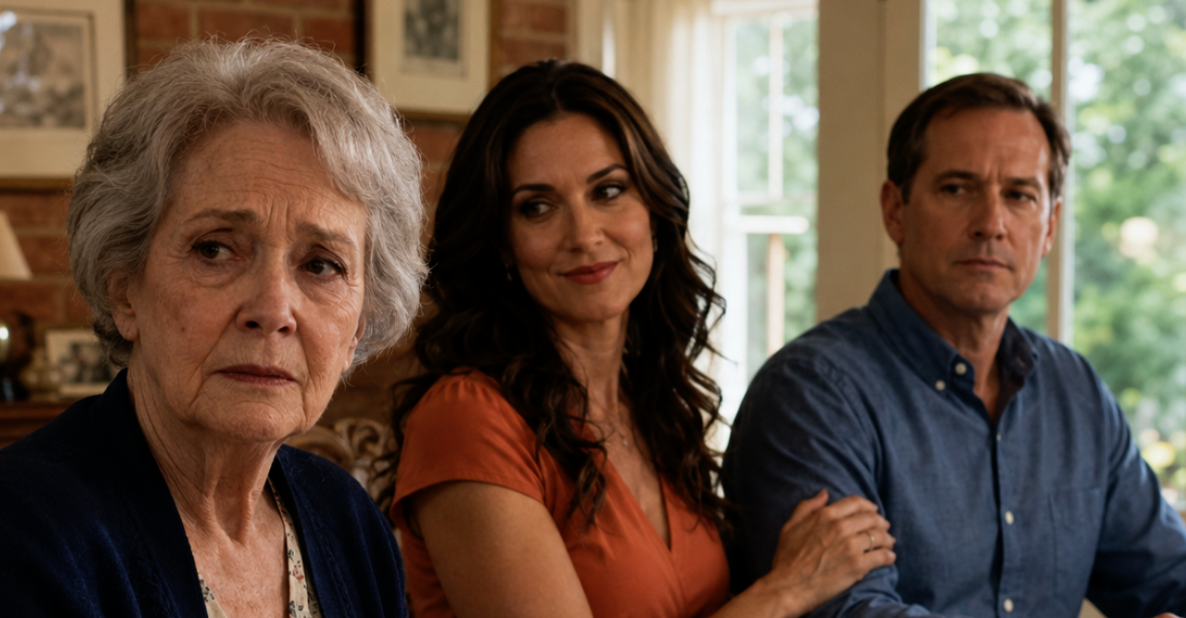
She sat in my dining room wearing a coral-colored dress that undoubtedly cost more than my monthly electric bill. Her dark hair was immaculately curled over one shoulder, her nails painted a pale pink by a professional. She rested one manicured hand near Daniel’s arm, projecting the aura of a woman presenting her husband and her ultimate victory simultaneously. Daniel, my only child, sat beside her. He was thirty-two years old, broad-shouldered and clean-shaven, wearing a blue button-down shirt I had ironed for him just that morning because he was running late.
He was smiling. It was not a grand, joyous smile, nor was it overtly cruel. It was simply a smile of deep, comfortable satisfaction. It was the expression of a man who had been eagerly waiting for this exact moment.
Outside, the late spring evening was settling gently over our quiet street just outside Columbus, Ohio. Inside, the house was devastatingly still. I could hear the faint, distant drone of a neighbor’s lawnmower, the low hum of my refrigerator, and the rhythmic ticking of the old clock over the hutch—a clock that had kept time in this house for twenty-eight years.
I looked at Vanessa. I looked at Daniel. Then, I set the dessert plate down on the table, moving with intense, deliberate care. I did not want the delicate caramel to slide. It might seem ridiculous to prioritize the structural integrity of a dessert in a moment of emotional slaughter, but that is precisely how shock operates. The human mind latches onto the smallest, most practical detail because the monumental reality of the moment is simply too ugly to hold.
Vanessa’s smile widened as my silence stretched. I assume she thought I was frozen in terror, or perhaps she hoped I was on the precipice of tears.
“Margaret,” she said, leaning back gracefully in her chair, “did you hear me?”
“I heard you,” I replied. My voice was startlingly calm, a fact that seemed to surprise all three of us.
Vanessa tilted her head, observing me with the detached curiosity one might reserve for an old dog attempting a new trick. “You understand what I mean, right? We are leaving. We bought our own place. Well, I bought it. We move in two weeks. And after tonight, we are completely done. No more phone calls. No guilt trips. No showing up unannounced at our door. Nothing.”
Daniel momentarily dropped his gaze to his plate, then looked back at me. He remained profoundly silent. That silence, heavy and complicit, wounded me far more deeply than Vanessa’s sharpened words. Vanessa was not my blood; she had walked into my life as a stranger and deliberately remained one. But Daniel was the child I had rocked through midnight fevers. He was supposed to know me. At the very least, he was supposed to possess enough moral compass to be ashamed.
Instead, I pulled out my chair, sat down smoothly, and smiled. “Funny coincidence,” I said. “I have news too.”
To fully comprehend the gravity of that dining room table execution, one must understand the foundation upon which my life had been built. I am Margaret Ellis, a sixty-three-year-old retired second-grade teacher. I have never known immense wealth. Instead, my life was defined by careful, methodical survival. I was the woman who meticulously clipped coupons, opted for store-brand cereals, and maintained a worn little notebook in my purse to track every single dollar spent at the local Kroger.
My late husband, Thomas, used to tease me relentlessly about that notebook, but he understood its purpose. We purchased our modest brick ranch house when Daniel was three. It was nothing spectacular—three bedrooms, two bathrooms, a cracked sidewalk, and a kitchen window overlooking a neighbor’s white fence—but it was ours. We paid that mortgage month by grueling month, sometimes counting the exact days until the next paycheck, but we never missed a single payment. When the house was finally paid off in full, we celebrated with iced tea and steaks at a downtown restaurant. Two years later, Thomas died of a sudden heart attack on a perfectly ordinary Tuesday.
At twenty years old, Daniel stood beside his father’s coffin in an ill-fitting suit. In that dark moment, I made a silent, desperate promise to be everything for him: enough mother, enough father, and enough financial safety net so he would never feel the ground give way again.
That promise seamlessly morphed into my central flaw. When Daniel finished college, he moved back in to “save money.” When he met Vanessa, I was thrilled to welcome her. She was beautiful, polished, and masterfully charming. She called me “Miss Margaret” and brought grocery store flowers. When they asked to move in after their wedding to save for a down payment, assuring me they would help with everything, I joyfully agreed.
The reality of their tenancy was a masterclass in slow, agonizing boundary erosion. Over the course of ten years, their contributions vanished entirely. They consumed every resource the house had to offer:
Vanessa’s initial sweetness curdled into open disdain. “Miss Margaret” became just “Margaret,” barked across the house like a summons to the help. She criticized my cooking, my furniture, and my “teacher clothes.” Through it all, Daniel remained silent, offering only a tired, “Don’t take it personally, Mom,” whenever I dared to express my exhaustion. I was no longer living; I was merely maintaining the infrastructure of their lives.
The illusion officially shattered on a mundane Thursday afternoon. While placing clean towels in their bathroom—a chore I had never agreed to but had somehow inherited—I noticed a piece of paper slipped behind a half-open dresser drawer.
It was Vanessa’s bank statement. The balance printed at the top was $184,632.17.
I carried the paper to the window, certain my aging eyes were deceiving me. But the numbers were absolute. There were massive, bi-weekly deposits, representing almost her entire salary, funneled into accounts labeled “home fund,” “furniture,” and most chillingly, “private.”
For a decade, I had skipped hair appointments, delayed dental work, and worn a fraying winter coat so my son could “get ahead.” Meanwhile, Vanessa had been systematically building an empire on my weary back. I placed the paper exactly where I found it. That evening, as Vanessa complained that my homemade spaghetti sauce tasted store-bought and Daniel chewed in silence, the anger did not arrive. Instead, a cold, crystalline awareness settled into my bones.
Once your eyes adjust to the dark, you hear everything. A few days later, I overheard Vanessa laughing on the phone in the laundry room, bragging about how perfectly she had manipulated me, noting that Daniel knew exactly how to look sad to make me fold. Days after that, I heard Daniel himself laughing with her upstairs, agreeing to keep their new address a secret so I wouldn’t show up “like some sad old widow.”
Money can occasionally be explained away by naive selfishness. Laughter cannot. Laughter at the expense of someone you are actively draining is a profound, incurable rot of the soul.
The very next morning, I sat in a diner with Rebecca, my fiercely intelligent, sharp-tongued lawyer friend who had warned me about Vanessa years ago. I laid out the entire miserable truth. Rebecca listened patiently, let the silence hang, and then asked the only question that mattered: “Are you ready to stop protecting Daniel from the consequences of his own choices?”
I was.
We formulated a quiet, impeccably legal strategy. I placed my house—which was entirely in my name—into a protective trust. I ruthlessly updated my will, removing Daniel entirely and leaving my assets to literacy charities and a local food pantry. For three grueling months, I lived a double life. The old Margaret continued to cook meatloaf and wash their premium bedsheets. The new Margaret meticulously photographed closing documents, gathered a decade of utility bills, and prepared to detonate my old life.
This brings us back to the Sunday dinner table, the ticking clock, and the heavy silence following my announcement.
Vanessa’s confident frown deepened. Daniel’s satisfied smile completely dissolved. I stood up, walked steadily to the antique china cabinet, and retrieved a thick manila envelope I had hidden beneath a stack of table runners that morning.
“You know,” I said, taking my seat, “I spent all week wondering if either of you would exhibit even a trace of gratitude tonight. Or perhaps shame.”
Vanessa crossed her arms defensively. “Shame for what? We did nothing wrong. You offered to help.”
“I offered to help,” I corrected smoothly, “not to be financially and emotionally drained.”
When Daniel attempted to intervene, pleading for me not to make things “ugly,” I swiftly silenced him. I opened the envelope and began laying out the architecture of their ruin.
To ensure ultimate clarity, I presented the documents in a specific, undeniable sequence:As the final property deed slid across the table, the alliance between husband and wife violently fractured. Daniel stared at the paper, his eyes frantically scanning for his own name, finding nothing but blank space.
“Why is only your name on this?” he demanded, his voice thick with sudden realization.
“It was easier for financing,” Vanessa snapped, her carefully curated composure finally cracking.
“No,” Daniel replied, the weight of a wasted decade crashing down on him. “That is ownership.”
I delivered the final blow with surgical precision. “The house you are currently sitting in is no longer yours to wait for, Daniel. It is in a trust. You are disinherited. The property is being sold, and you both have thirty days to vacate my home.”
Vanessa shrieked about fairness. Daniel stared hollowly at the table, realizing he had traded his mother’s unconditional love for a wife who viewed him merely as a useful, temporary asset.
“You let me sit here like an idiot while you thanked my mother for paying our way,” Daniel whispered to his wife.
“This is your fault,” Vanessa hissed, turning her venom back to me. “You will be alone.”
I stood up, gathering my empty dessert plate. “I was alone with both of you in this house for ten years, Vanessa. Do not threaten me with peace.”
The ensuing thirty days were a chaotic, bitter symphony of packing tape and slammed doors. Vanessa and Daniel moved through the house like hostile strangers trapped in a confined space. Their marriage was actively bleeding out in my hallways.
On moving day, the air was remarkably clear. By two in the afternoon, their furniture was gone, and the house echoed with a beautiful, hollow resonance. Vanessa left first, offering one final, venomous promise that I would regret my actions. I offered her absolutely nothing in return. Daniel lingered, staring at the indentations his sofa had left in the carpet. He asked if he could call me. I told him he could, but that I might not answer, and forbade him from ever asking for money. He accepted the terms, closed the door softly, and vanished into the life he had earned.
I immediately listed the house. It sold quickly to a young, vibrant couple who cried tears of joy at the sight of the backyard. I moved into a sunlit, two-bedroom condo near the city library. It possessed no stairs to trouble my knees and, crucially, no guest room large enough to accommodate extended stays.
Healing is not a linear, triumphant march. It is a quiet, uneven process. There were mornings I woke up steeped in anger, and evenings I missed the sweet, earnest boy Daniel used to be so fiercely that my chest physically ached. But the pain was remarkably clean. It was no longer being infected daily by ambient disrespect.
Three months later, Daniel called. He informed me that he and Vanessa were divorcing—she had kept the house, naturally—and that he was renting a cramped apartment and attending therapy. He confessed to his therapist the full extent of what he had allowed to happen to me, admitting that saying the words out loud was excruciating.
He asked if we could get coffee.
The old Margaret, the woman desperate to fill the quiet voids in her life, would have agreed instantly. But I am no longer that woman. I told him, “Maybe someday. But I need to see who you become when you are not actively asking me to save you.”
Today, I am sixty-three years old. I possess gray hair, occasionally sore joints, and a life that is entirely, unapologetically my own. Every utility bill I pay belongs to me. Every quiet morning on my balcony is mine. And on Sunday evenings, when the light turns a soft gold and the building settles into absolute stillness, I still bake that caramel cheesecake.
I slice one perfect piece, sit by the window, and eat it slowly. No one complains about the texture. No one audits the cost of the ingredients. No one demands my silence. I just sit in the quiet aftermath of the storm, profoundly grateful that I finally allowed the old world to burn.