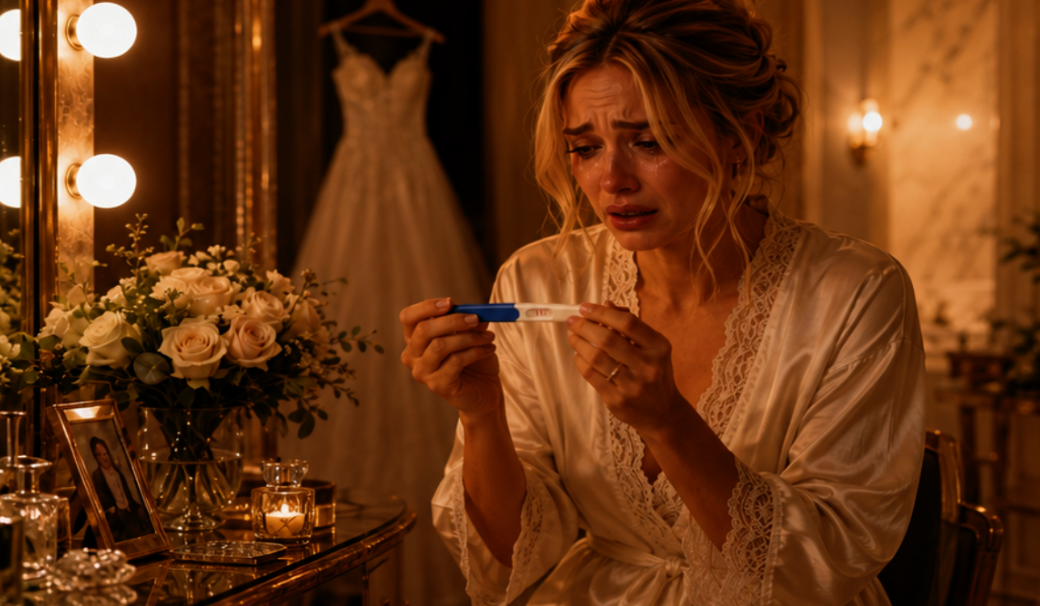
I discovered the pregnancy test on the morning of my wedding.
There were two pink lines. Two fragile, impossible lines that, in another life, would have sent me running barefoot down the carpeted hallway of the bridal suite, eager to tell the man I loved that our future had arrived ahead of schedule.
Instead, I remained frozen in the marble bathroom, the test heavy in my trembling hand, while the laughter of my groom echoed from the adjoining room. And the words that followed his laughter irrevocably shattered the foundation of my reality.
My name is Savannah Blake. Until that precise moment, I possessed the quiet, steadfast belief that I was about to marry a good man. His name was Preston Hale.
He was handsome in a way that commanded immediate, unearned trust—possessing a warm smile, an immaculately tailored suit, and a soft, deferential voice. He was the archetype of a gentleman who remembered names, held open doors, and prompted older women in our congregation to whisper, “That one was raised right.”
Our paths first crossed at a charity auction in Charleston, South Carolina. I was not a patron; I was the hired help, standing behind a dessert table in an uncomfortable black dress and drugstore hair clips, assisting a friend’s understaffed catering company. Preston, conversely, was a guest of honor. The Hale family empire was built on luxury hotels, waterfront real estate, and controlling interests in the very rooms where Charleston’s elite gathered to feel important.
He approached my table, studied the pastries, and asked, “Which one would you choose if no one was watching?”
“The peach cake,” I replied instantly.
“Why?” he asked, a genuine smile breaking across his face.
“Because lemon tarts are for people trying to look controlled. Peach cake is honest.”
He laughed—a sudden, surprised sound. That was the very first thing I loved about him: he appeared to be a man starved for authenticity. For months, he meticulously maintained that illusion. He visited the community art center where I taught painting, sitting quietly in the back as children turned paper plates into turtles. He carried heavy supply bins to my car. He asked piercing, seemingly genuine questions about my life.
When I confessed that I did not belong to his affluent world, he kissed my forehead and whispered, “Good. My world needs yours.” I believed him, perhaps because careful women are often the most desperate to be hopeful.
My mother, Diane, remained cautiously observant. “He is polished,” she noted while folding towels in my small apartment.
“That’s not a flaw,” I defended.
“No,” she replied gently, “But polish can hide cracks. Just make sure he loves the real you, not the version of you that makes him feel like a better man.”
Preston’s family treated me with the conditional politeness reserved for temporary guests. His mother, Caroline Hale, called me “darling” with the warmth of a winter frost. During our engagement, she consistently marginalized my family, exiled my aunt to a corner table, and politely insulted my mother’s heirloom jewelry. Preston’s perpetual defense was always the same: “She means well.”
The week leading up to the wedding, my body betrayed strange new symptoms. I wept at mundane television commercials, possessed a supernatural sense of smell, and craved pickles at midnight. My best friend, Callie, noticed my avoidance and silently placed a paper pharmacy bag on my dresser. It sat unopened for two days.
Now, on the morning of my wedding at the historic Rosemont Estate, with my ivory satin gown hanging in the window and the scent of hairspray and nervous expectation filling the air, I finally took the test.
Two pink lines. A baby. Our baby.
I pressed a hand to my mouth, overwhelmed by a sudden, terrifying joy. I visualized the nursery, the laughter, the life we were about to build. Then, through the slightly ajar door connecting the bridal and groom suites, Preston’s voice drifted in.
“Can you believe she still wants to include those little art-center kids in the reception slideshow?” he asked.
His best man, Nolan, chuckled. “Come on, man. It’s sweet.”
Preston laughed. It was a cold, unfamiliar sound. “Sweet, sure. But everything with Savannah is like that. Kids, handmade cards, community projects… It’s adorable, but exhausting.”
My breath hitched.
“Look, she’s good for me,” Preston continued, his tone shifting to sheer pragmatism. “People like seeing me with her. She makes me look grounded. My mother hates admitting it, but even she knows Savannah softens the Hale image.”
Grounded. Softens the image. The words were a physical blow.
Nolan hesitated. “That sounds cold.”
“It’s not cold. It’s practical,” Preston argued. “Savannah wants the home, the kids, the sweet little life. She’s not going to compete with me. She’ll be grateful.”
I looked down at the test in my hand. My joy evaporated, replaced by a sharp, crystalline clarity.
“You better not say that in your vows,” Nolan joked awkwardly.
“No chance,” Preston scoffed. “I’ll say she made me believe in love or something.”
Or something. My future irrevocably split into two distinct paths. In one, I walked down the aisle to become a public relations strategy, a useful softness to buffer a ruthless man. In the other, I chose myself and the tiny, unspoken life growing inside me.
When Callie knocked on the door, she took one look at my face, the pregnancy test, and the open hallway door, and understood. She locked us in, and I recounted every word.
She sat beside me, held my hand, and asked the only question that mattered: “What do you want to do?”
Not what about the guests? Not what about the deposit? “I’m not walking down that aisle,” I whispered.
At 8:14 AM, my mother entered the room. She surveyed the scene, crossed the floor, and pulled me into her arms. “Tell me what you need.”
“I can’t marry him,” I sobbed.
“Then you won’t,” she replied, her voice an absolute fortress. There was no panic, no lecture. She chose her daughter over the family name and the waiting ballroom.
The bridal suite transformed into a quiet command center. At 9:37 AM, Preston texted:
Can’t wait to see you at the altar.
I typed back:
You won’t.
The hallway erupted into hurried footsteps. Caroline Hale began rapping sharply on the door, demanding entry, insisting this was merely “bridal nerves.”
Then, Preston arrived. “Baby, open the door,” he called out, his polished donor-voice attempting to mask his panic.
I opened the door. He stood there, handsome and pale. “What is this?” he demanded, taking in Callie packing my overnight bag.
“Clarity,” I answered.
When I confronted him with his exact words—asking if I made him look “grounded” and if I would be “grateful”—his charm finally failed him. He tried to dismiss it as a joke, a clumsy moment of pre-wedding nerves.
“No,” I corrected him, my voice steady. “Nervous men say clumsy things. Honest men reveal what they think when they believe the woman they’re marrying can’t hear them.”
My father arrived shortly after, holding the keys to his battered pickup truck. He looked at the man who had just shattered his daughter’s heart. “Let’s go,” my father said softly.
We exited through the service corridor. As we drove away, my phone flooded with calls and messages, but I turned it off. I was leaving a beautifully constructed lie to return to a painful, necessary truth.
The fallout was swift and brutal. Preston left thirty-six missed calls and a series of voicemails that transitioned from polished damage control to panicked anger, and finally, to exhausted pleading.
“Don’t do this to us,” he had texted. Even in the wreckage, he framed my departure as the weapon, completely ignoring the fact that his words had been the catalyst.
Two days later, I sat in the downtown office of Meredith Cole, a fiercely intelligent attorney who specialized in canceled weddings and dismantled illusions. She reviewed the unsigned prenuptial agreement that Preston’s family had pressured me to formalize after the honeymoon.
“Did you sign this?” she asked, adjusting her gold-rimmed glasses.
“No,” I replied.
“Good. Because it contains language that would have placed you in a severely compromised financial and legal position if you initiated a divorce within the first three years.”
A cold realization washed over me. The betrayal was not just a hallway conversation; it was codified in legal ink. How many warnings had I ignored?
“You are not foolish for trusting someone you loved,” Meredith told me gently. “But you are responsible for what you do after you see clearly.”
When I returned home, Preston was waiting outside my parents’ house. Stripped of his tuxedo, he looked like the man I had fallen in love with. But I knew better now.
“I made a stupid joke,” he pleaded.
“No, Preston. You revealed a belief,” I countered. “You loved that I made you feel grounded. You loved that I wanted a home. But you did not respect those things as strength. You treated them like proof I would be grateful for whatever fraction of respect you offered me.”
I did not tell him about the baby that day. The cancellation was about the marriage I refused to enter; the child deserved an introduction free from the toxicity of a broken negotiation.
At eight weeks, after confirming the health of the pregnancy with a specialist, I sent Preston a formal, attorney-reviewed letter.
Preston, I am expecting. I learned on the morning of the wedding. I am sharing this because you have a right to know and because this child deserves honesty. This does not change my decision not to marry you. All future communication should be respectful, written when possible, and focused on the child’s well-being.
His immediate response was a frantic attempt to rewrite history. If I had known, I never would have said those things.
I replied only once: “You should not have needed to know.”
I established strict, uncompromising boundaries to protect my peace and my child’s future:
Consistency over Grand Gestures: No unannounced visits, no extravagant gifts meant to buy forgiveness.
Mediated Communication: Discussions regarding the baby were to remain strictly logistical and respectful.
Protection from Family Politics: Caroline Hale’s demands for “family meetings” were firmly rejected until she could demonstrate basic respect for my autonomy.
For three months, Preston genuinely tried. He adhered to the written communication. He attended parenting classes. He started therapy. He sent me a message admitting that image had been the language of his family for so long, he had confused it with identity. Growth is a beautiful thing, but it does not automatically restore a shattered trust.
In early autumn, our daughter, Willa Grace Blake, was born.
When Preston arrived at the hospital, he walked in quietly, washed his hands, and waited for my nod of approval. When I placed Willa in his arms, the polished veneer completely broke. I saw him look at a human being without a single calculation of how she benefited his public image.
“She’s perfect,” he whispered.
“She’s herself,” I corrected him softly. “Do not make her carry perfection. Let her be herself.”
He nodded, a tear slipping down his cheek. “You’re right.”
Years passed in beautifully ordinary ways. Willa grew into a vibrant, stubborn child who loved painting and demanded assigned seating at her tea parties. Preston became a steady, reliable father. He learned to braid hair, attended preschool events, and systematically dismantled the toxic interference his mother had previously wielded.
We built a co-parenting structure that ruthlessly protected Willa from adult pride.
When Willa was nine, she found my wedding dress hidden in the back of a closet.
“Why do you have a princess dress if you didn’t get married?” she asked, her fingers tracing the ivory satin.
“Because sometimes things don’t go as planned,” I explained.
“What are you going to do with it? You could make something new.”
With the help of a seamstress, we dismantled the gown. It became a christening outfit, ribbons for Willa’s memory box, and a long strip of fabric used in a community art project at the center. I told my students, “Sometimes something does not become what we expected. That does not mean it cannot become something meaningful.”
Preston visited the art installation. He stared at the piece of my dress fluttering in the courtyard.
“It became something beautiful,” he noted quietly.
“It was always beautiful,” I replied. “It just needed a different purpose.”
When Willa turned sixteen, Preston asked for my permission to take her to Charleston to see the Hale family history, including the Rosemont Estate. He asked me before he asked her—a profound testament to the respect we had painstakingly built over a decade and a half.
When Willa returned, she handed me a photograph of herself standing outside the estate, holding a white tulip.
“Dad told me everything,” she said, sitting close to me on the couch. “He said he loved you badly at first. Then he said you loved yourself well enough to leave. He told me to remember that if anyone ever makes me feel grateful for less than respect.”
Tears blurred my vision. Preston had not sanitized his own villainy to look like a hero to his teenage daughter. He had offered her the unvarnished truth.
At Willa’s high school graduation dinner, surrounded by our beautifully fragmented, fiercely loyal family, she raised a glass of lemonade.
“I used to think my story began with a canceled wedding,” she told the table, looking directly at me. “But now I think it began with a choice. Mom chose peace before I was even born. That choice gave me a home where love did not have to look perfect to be honest.”
Later that evening, she gifted me a painting. It depicted a bridal gown hanging in a window, a pregnancy test on a counter, and through the glass, a small green house with warm light spilling from the windows.
The inscription read: The day you walked away, you were walking toward me.
People often assume that the defining moment of my life was the dramatic cancellation of an elite wedding. They are wrong.
The most pivotal moment was the quiet, terrifying second in the bridal suite when I realized that I possessed the agency to halt a catastrophe before it consumed me. Too many women hear the warning bells and walk down the aisle anyway—paralyzed by the weight of expectations, financial sunk costs, and the blinding beauty of the dress.
But embarrassment is temporary. A life built upon a foundation of fundamental disrespect is a permanent, suffocating cage.
Love is not measured by the volume of pain you can endure before shattering. Sometimes, the most profound act of love for your future is violently refusing to cross a threshold that requires you to shrink.
If you ever find yourself standing in a beautiful room with a heavy heart, holding evidence of how someone truly views you, pause. Listen to the quiet, internal voice that knows the truth. Do not marry potential while willfully ignoring the empirical evidence of their character. Do not construct a home with a partner who treats your tenderness as a strategic vulnerability.
The right love will never reduce you to a public relations asset. It will never mock your purest dreams from behind a closed door.
On the morning of my wedding, I believed two pink lines had impossibly complicated my existence. In retrospect, they provided the ultimate clarity. They forced me to confront the only question that truly mattered: What kind of love do I want my child to learn from me?
I chose a love rooted in truth, and in doing so, I didn’t just save myself. I built a world where my daughter could thrive.