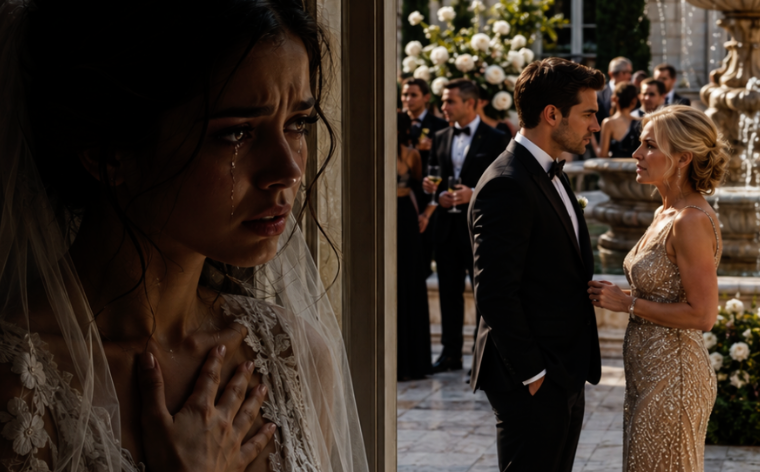
She always believed the Magnolia Courtyard was solely a picturesque backdrop designed for wedding photography. It was a space defined by its immaculate white stone, towering architectural windows, the gentle cascade of soft sunlight, and a murmuring fountain situated perfectly at its center. The overarching magnolia trees bloomed furiously over the walkway, creating the beautiful illusion that the entire world had draped itself in bridal ivory just for her. That was the facade everyone witnessed: a flawless Southern wedding hosted at the prestigious Bellamy House in Charleston, South Carolina. But Elise Parker was about to learn that breathtaking places are entirely capable of concealing ugly, unvarnished truths.
At four o’clock on that balmy afternoon, Elise was scheduled to marry Colin Westbrook, a man she had deeply loved for three years. By a quarter past three, her intricate dress was fastened, her veil expertly pinned, and her mother, Joanne, was already weeping softly into a crumpled tissue, whispering that Elise looked like the manifestation of every prayer she had ever uttered. Her father, a proud but quiet man, lingered near the window, feigning a deep interest in the weather to mask the gathering tears in his eyes. Outside, an elegant assembly of guests congregated beneath the ancient magnolias. Inside the bridal suite, the chorus of bri
That final item was the only outright lie. Colin hailed from the Westbrooks, a polished, aristocratic Charleston dynasty that treated social tradition as if it were a revered, living relative. His father, Warren Westbrook, commanded a lucrative commercial real estate empire. His mother, Celeste, reigned over museum boards, elite charity committees, and the sort of high-society circles where individuals smiled brightly with their teeth, yet rarely with their hearts. Elise’s lineage was starkly different, a reality that the two families experienced in entirely opposite ways.Colin had often claimed he adored that contrast. He told Elise her family made him feel profoundly normal, warm, and unapologetically free. However, as the wedding date approached, she watched him subtly regress into the molded version of himself his parents demanded—the careful, obedient son who merely smiled when his mother delivered veiled insults, and who remained silently compliant when his father patronized hers. Celeste’s insults were never overt; they were cloaked in suffocating Southern politeness. She would dismiss Joanne’s lifelong vocation as having “sweet little-school energy,” and Warren would feign polite surprise that Martin’s profession of repairing old chairs still existed in a disposable modern world. Through it all, the wedding planning was slowly usurped by Celeste. She selected Bellamy House, dictated the floral arrangements, curated the menu, and vetoed Martin’s heartfelt offer to restore an antique bench for the courtyard photos, citing the venue’s requirement for “approved pieces.” When Elise sought reassurance from Colin, he promised to speak to them, but the suffocating status quo never wavered.
At the rehearsal dinner, the tension crystallized. Warren delivered a toast fixated on legacy, rigid standards, and family expectations, culminating in a backhanded compliment directed at Elise: “You bring a certain sincerity to Colin’s life. A grounding influence. We welcome that.” He welcomed her utility, not her humanity. That night, beneath the hotel awning, Elise confronted Colin’s passivity. She demanded to know if his family actually respected her, or merely tolerated the space she occupied. His hesitant, prolonged silence was a damning answer. “I’m trying,” he had pleaded. Elise’s response was a chilling mandate for the next day: “I need you to do more than try tomorrow.”
The morning of the wedding unfolded in a surreal, hazy dreamscape of hairspray, makeup palettes, fragrant blooms, and flashing cameras. When her father saw her fully dressed, his emotional reaction momentarily transported Elise back to her childhood, standing on his dusty workbench as he promised she could become anything if she learned to stand steady. The profound love in his whispered, “My girl,” nearly fractured her composure.
Shortly before three o’clock, seeking a solitary moment to breathe, Elise volunteered to fetch her bouquet from the Magnolia Courtyard for the detail shots. The courtyard was even more ethereal in person—sunlight piercing through thick branches, white petals carpeting the ancient stone, and the gentle murmur of the fountain creating a deceptive sanctuary. It appeared to be a space immune to tragedy. But then, drifting over the ambient water sounds, she heard Colin’s voice.
He was standing just beyond the ornate fountain, flanked by Warren, Celeste, and his older brother, Everett. Concealed behind a thick magnolia trunk, Elise froze.
“The documents are ready,” Warren’s baritone voice declared. “It only requires Colin’s signature before the ceremony.”
Colin’s response was strained. “I told you I don’t want to discuss this today.”
Celeste’s tone was predictably sharp and calculated. “Today is exactly why we must discuss it. Once you are married, Elise will expect influence.”
When Everett half-heartedly suggested a delay, Warren ruthlessly shut him down, revealing the devastating truth: “The Parker shop sits inside the redevelopment zone. Martin’s lease is old. If we secure Colin’s consent today, the acquisition board moves forward cleanly.”
Elise’s knuckles turned white around the stems of her bouquet. The Parker shop. Her father’s sanctuary, the very foundation of her childhood and the business that had funded her college education, was merely a strategic acquisition to the Westbrooks. Colin refused to sign without consulting Elise, yet Warren dismissed his reluctance as pathetic sentimentality, while Celeste callously predicted Elise would simply adjust once her life became “larger.”
Unable to endure another syllable of their treachery, Elise stepped out from the shadows. “No,” she stated, her voice slicing through the humid air. “Some of us know what is sacred before someone tries to buy it.”
The confrontation that followed was a seismic rupture of the Westbrook family’s pristine veneer. Elise systematically dismantled their excuses, her quiet fury exposing their plot to manipulate her father’s livelihood before she officially entered the family. When Celeste accused her of being overly emotional, Elise delivered a cold, soft laugh, embracing her humanity in the face of their corporate sterility. She turned her devastation toward Colin, condemning his cowardice for prioritizing quiet protection over public respect.
Her piercing words catalyzed a profound shift within him. When Warren authoritatively declared the conversation finished, Colin finally rebelled. In a definitive, irreversible motion, he took the acquisition folder from his father’s hands and tore the documents to shreds. The crisp white paper fluttered like falling snow across the stone, mingling with the magnolia petals.
“You just made a very serious mistake,” Warren hissed.
“No,” Colin replied, his gaze locked agonizingly on Elise. “I almost did.”
Tearing up the contract was a dramatic gesture, but Elise knew it was infinitely easier to destroy paper than to resurrect shattered trust. As the ceremony hour arrived, the traditional script of the day had been irrevocably burned. When the chapel doors swung open, the congregation gasped. Elise and Colin walked down the aisle together before the music even commenced—both unsmiling, their faces etched with a gravity that defied wedding conventions.
Before Reverend James could utter a single syllable of the liturgy, Colin stepped forward and addressed the bewildered crowd. He publicly exposed his family’s attempted business maneuver against the Parkers, taking full accountability for his near-complicity in their silence. The chapel descended into a shocked, breathless hush. Warren’s jaw clenched furiously, and Celeste looked as though she had been physically struck, while Martin Parker stood up slowly, demanding clarity. When Colin swore he would never authorize the acquisition without full disclosure and Martin’s absolute consent, Elise’s father offered a profound, grace-filled directive: “Then keep speaking.”
Emboldened, Colin confessed his profound love for Elise and her family’s restorative nature, apologizing for nearly allowing his elitist upbringing to diminish their inherent worth. Then, it was Elise’s turn to speak her unvarnished truth to the silent room.
“I thought the Magnolia Courtyard was only for photos. Today it became the place where I learned whether this wedding was about appearances or truth. I will not marry into a family by letting mine become smaller. I will not begin a life by pretending I did not hear what I heard. If Colin and I continue today, we continue with honesty first.”
When Reverend James asked if she wished to proceed, she agreed, but explicitly stated she was stepping forward not as the passive bride who adjusts, but as the empowered woman who chooses. One by one, in a moving display of solidarity, the guests stood up—first her parents, then Everett, and eventually, reluctantly, Celeste herself. The wedding commenced upon a bedrock of radical truth rather than superficial pageantry.
During the vow exchange, Colin discarded his neatly prepared, overly romantic promises. Instead, he offered a raw, improvised pledge. He vowed to love Elise loudly, to speak out before silence mutated into permanent damage, and to never ask her to shrink herself to accommodate his family’s inflated egos. Elise, too, abandoned her quaint booklet. She vowed to love him honestly, to reject the role of a silent guest in his family’s narrative, and to demand a marriage of absolute equals. When Reverend James finally pronounced them husband and wife, the applause that erupted was not the polite, golf-clap approval of high society; it was a messy, thunderous, profoundly human ovation.
The reception that followed was stripped of its previous superficiality; the air was thick with an uncharacteristic, humbling authenticity. Old social hierarchies had been visibly disrupted. When the photographer attempted to orchestrate the family portraits using Celeste’s meticulously curated VIP list, Colin firmly vetoed it. They gathered in the Magnolia Courtyard once more, this time as a fractured but genuinely merging family. The tension was palpable until Martin Parker broke the ice, dryly asking the photographer how to stand to avoid ruining another “elite composition.” The resulting photograph—capturing genuine, surprised laughter from everyone, even a reluctant twitch from Warren’s mouth—became Elise’s absolute favorite image of the night.
The evening’s toasts further cemented this new reality. Everett surprised everyone by abandoning his planned comedic speech, instead thanking Elise for holding up a mirror to their family’s toxic exceptionalism. He raised his glass to a marriage “brave enough to interrupt perfection whenever truth requires it.”
Martin Parker followed, delivering a masterful, metaphor-rich speech about his upholstery work. He equated a strong marriage to a well-built chair: demanding honest labor, robust joints, a solid foundation, and an absolute refusal to cover fundamental cracks with expensive, deceptive fabric. He praised Colin for finding the crack before the house was built, bringing the entire room to a joyous, tearful uproar.
The climax of the reception, however, was Celeste’s unexpected toast. Rising with her champagne glass, she delivered a stiff but undeniably sincere public apology.
It was a staggering concession from the Westbrook matriarch. The reception eventually mellowed into a joyous, unburdened celebration, highlighted by Joanne Parker confidently taking over the grand piano to play a soulful love song, thoroughly unbothered by the deviation from the schedule. Later that night, standing alone with Colin back in the moonlit courtyard, Elise realized the profound significance of the space. It was no longer a backdrop for a fairy tale; it was the crucible where their genuine partnership had been forged.
The years that ensued were not magically devoid of conflict, for no authentic marriage ever is. The threat to Martin’s shop did not evaporate overnight, but the battle was now waged in the transparent light of day. Armed with independent legal counsel arranged by Colin, the Parkers and their fellow business owners successfully lobbied to establish a community preservation district. Warren Westbrook, humbled by the fierce, dignified resistance of the working-class community, eventually conceded that the block’s true value lay in its people, not just its developmental potential.
The family dynamics shifted in beautifully unexpected ways. Celeste, initially overcorrecting by anxiously consulting Elise on every trivial matter, eventually learned the difference between frantic micromanagement and genuine inclusion. She even forged an unlikely bond with Elise’s parents, sending antique estate finds to Martin for restoration and recruiting the formidable Joanne to ruthlessly organize corporate charity events. Colin and Martin developed a quiet, profound mutual respect, often found shoulder-to-shoulder in the dusty upholstery shop, discussing the delicate balance of tension in both furniture frames and human relationships.
On their first anniversary, Colin and Elise returned to Bellamy House, specifically to the Magnolia Courtyard, seeking to reclaim the space entirely. Over a quiet dinner, Colin handed her a letter that crystallized his growth:
“One year ago, this courtyard became the place where I nearly lost your trust and finally found my voice. I wish I had found it sooner. I wish you had never had to hear the truth by accident. But I am grateful that truth came before our vows. Thank you for choosing marriage with your eyes open… Thank you for teaching me that love is not proven by avoiding difficult rooms, but by becoming honest inside them.”
Fifteen years later, they stood in that same courtyard once again. The magnolias had grown taller, casting longer shadows over the pristine stone. Their lives had expanded beautifully to include their daughter, Amelia, who had grown up thoroughly educated in the concept of “Magnolia truth”—a familial shorthand for unapologetic, sometimes uncomfortable honesty that prevented resentment from taking root.
Looking back, Elise knew exactly what she would tell the frightened, devastated bride she had been on that fateful afternoon. She would tell her never to fear ruining a perfect day, because a perfection that demands your silence is inherently broken. She would tell her not to be afraid if the room gets uncomfortable, for comfort is not always synonymous with peace.
To the outside observer, the Magnolia Courtyard at Bellamy House remained merely a stunning architectural feat, a place of tall windows, white petals, and perfect, dappled light. But to Elise Parker Westbrook, it was a hallowed sanctuary. It was the battleground where an obedient boy became a fierce husband, where a marginalized daughter claimed her absolute equality, and where a polite, fragile illusion was mercifully destroyed to make way for a magnificent, enduring truth.