
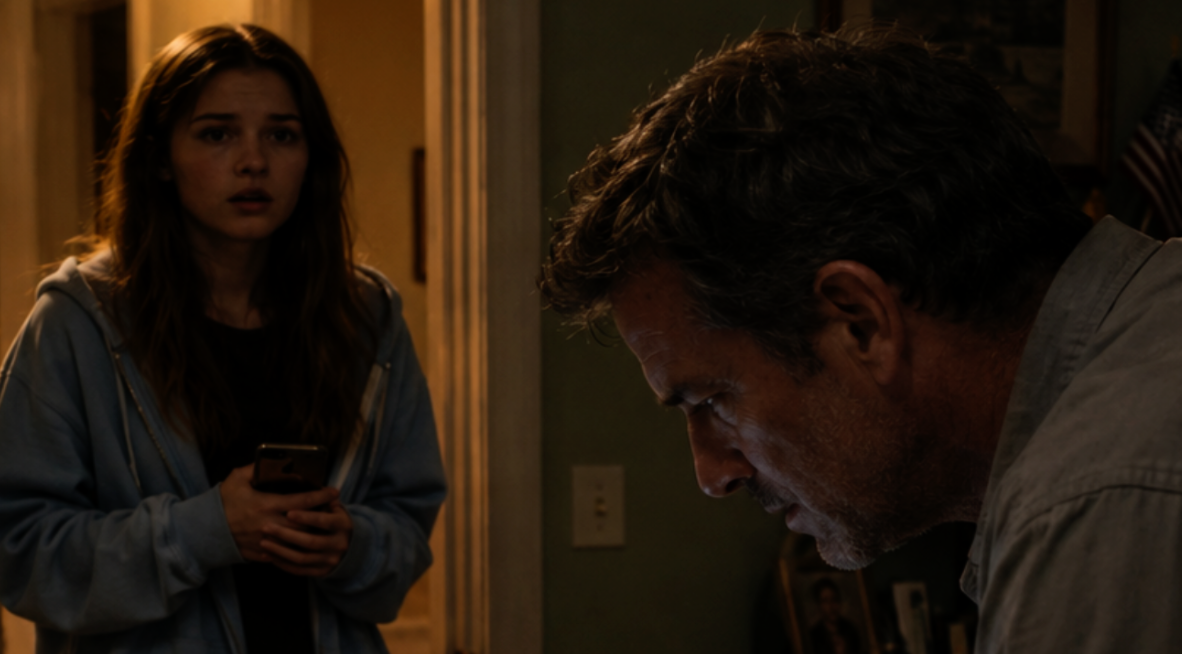
The genesis of my family’s collapse did not arrive with the roar of a sudden catastrophe, nor was it heralded by shattered glass or shouting in the dead of night. It arrived silently, resting delicately between the trembling fingers of my fifteen-year-old daughter.
It was a Thursday evening, cloaked in the kind of relentless, driving rain that turned the world outside my home office into a blur of gray. My desk was a chaotic testament to the life I believed I was successfully maintaining. It was covered in the mundane architecture of adulthood:
Blueprint Schematics: Site plans for a warehouse renovation on Marshall Street.
Subcontractor Schedules: Grids of dates and names, calculating the labor of plumbers and electricians.
The Residue of Routine: A ceramic mug holding coffee that had gone cold hours ago.
These were the familiar, tactile objects a man uses to convince himself his foundation is solid. But the small, black flash drive Emma placed on top of those blueprints looked utterly foreign. Across its plastic casing, Clare’s name—my wife’s name—was etched in silver marker.
Emma’s voice was a fragile whisper, barely audible beneath the hum of the HVAC vent. “Dad. Please watch this.”
Her eyes betrayed the devastation before the digital files ever could. They were bloodshot, swollen with the corrosive weight of holding back tears for too long. Whatever resided on that drive had already fractured her innocence. Before I could interrogate her, she turned on her heel and vanished down the hallway, leaving me to face the digital abyss alone.
I inserted the drive into my laptop. A single video file materialized. Nineteen minutes.
The initial frames were innocuous enough to be deceptive. The harsh, unflattering light of a mid-tier hotel room. Beige wallpaper. Wrinkled white sheets. Then, Clare walked into the frame. She wore a black dress I had never purchased for her, her auburn hair cascading freely over her shoulders, her ears adorned with unfamiliar jewelry. She was laughing—a radiant, unburdened laugh I hadn’t heard directed at me in half a decade.
Seconds later, the catalyst of my ruin stepped into view. Derek Mitchell. A polished, expensive-looking executive from Clare’s marketing firm. The man whose name had been casually sprinkled into our dinner conversations like harmless seasoning.
As they toasted their glasses, the audio captured Clare’s voice with agonizing clarity. Derek chuckled, asking if her husband still believed she was at a conference.
Clare’s response dismantled fifteen years of my life with casual precision: “Tom believes what I tell him. He’s too busy with his construction sites to notice anything.”
I sat paralyzed in the blue glow of the monitor. I watched the physical intimacy, the easy shorthand of two people who had cultivated a private universe at my expense. But the fatal blow was psychological, delivered near the end of the recording.
Derek made a dismissive comment about me paying the mortgage. Clare’s retort was a blade to the ribs: “Let him think he’s useful.”
Not loved. Not respected as an equal partner. Useful. Like a load-bearing wall. Like a reliable appliance. By the time the screen faded to black, the sun had surrendered to the night, and my office was submerged in darkness. The cursor blinked on the empty media player—a tiny, patient pulse in a room where a marriage had just flatlined.
When Emma reappeared in the doorway, the darkness of the room mirrored the chilling realization settling into my bones. “There’s more you don’t know,” she whispered.
Those six words bypassed anger entirely and plunged me into an icy, calculated clarity. She sat in the leather armchair opposite my desk—the very chair Clare occupied when she patronizingly asked for my thoughts on marketing mockups. Emma’s knuckles were stark white as she gripped her own hands.
“I’ve known for three months,” she confessed.
The mathematics of her suffering hit me with the force of a physical blow. For ninety days, while I was fixing cabinet hinges, reviewing supplier invoices, and asking my wife how her day went, my teenage daughter was suffocating under the weight of a grotesque secret.
Emma laid out the methodology of her discovery. It began with an overheard phone call while I was working late at a job site. From there, she became an unwilling detective, cataloging the inventory of her mother’s deception:
Financial Anomalies: Digital receipts for boutique dresses and expensive dinners at downtown restaurants Clare claimed to despise.
Geographic Inconsistencies: The Lexus parked in upscale neighborhoods far from her office or alleged client meetings.
Digital Footprints: Photographs on social media where Clare was tagged and hastily untagged, capturing her hand lingering on Derek’s wrist.
The most agonizing revelation was not Clare’s infidelity, but Emma’s observation of my complicity in my own degradation. “She was lying to both of us,” Emma sobbed, her voice finally breaking. “And you kept trying so hard.”
She handed me her phone, scrolling through the undeniable proof. To obtain the video, she had tracked them to the hotel and left her phone recording in the room before they returned. She had crossed moral boundaries she never should have encountered, all to protect a father who had been blindly absorbing his wife’s casual cruelty.
For years, I had rationalized Clare’s sharp comments, her condescension regarding my calloused hands, and her jokes about me smelling like drywall. I had internalized the belief that absorbing these micro-aggressions was the price of keeping the peace. But peace, I suddenly realized, is not the same as dignity.
“What do you want me to do?” I asked the young woman who had been forced to mature far too quickly.
“Stop being nice,” she pleaded. “I want you to stop making excuses for her. I want you to stop letting her make you small.”
The numbers hung in the air between us. Nineteen minutes. Fifteen years. Three months.
“Okay,” I agreed, my voice devoid of tremor. “But we do it smart. No yelling. No smashing doors. We move clean.”
Clare arrived home at 9:12 PM, sighing theatrically about her exhausting day, dropping Derek’s name with the practiced nonchalance of a seasoned liar. I stood with my back to her, pouring the coffee I had made for us down the drain. I went to bed, listened to the rhythmic breathing of a stranger, and did not sleep a wink.
The dismantling of my old life required precision, not passion. At 5:40 the next morning, sitting in the cab of my truck as the sky turned a bruised purple, I began to sever the structural ties.
The Blueprint of Separation:
Legal Counsel: I called an industry contact who connected me with Patricia Vance, a notoriously ruthless and meticulous family law attorney in Richmond.
Financial Securitization: I contacted my bank, opening a solitary account and redirecting a calculated portion of my direct deposit—not enough to trigger immediate alarms, but enough to establish a secure beachhead.
Investigative Documentation: I hired Kyle Mason, an ex-subcontractor turned private investigator, to transform Emma’s amateur sleuthing into admissible, court-solid evidence.
I proceeded to my construction sites and managed my crews with the detached efficiency of a ghost. I argued about window deliveries and inspected electrical framing, projecting the illusion of normalcy while my internal landscape was entirely scorched earth.
By the end of the week, Kyle had delivered a devastatingly thorough dossier. Time-stamped photographs of Clare and Derek checking into the Marriott off Sixth Street. License plates. Dinner receipts. The nineteen-minute video was the gaping wound; Kyle’s dossier was the undeniable pattern of infection.
When I met with Patricia Vance in her glass-paneled, mahogany-furnished office overlooking the city, she was impressed by the sheer volume of evidence. “Virginia allows fault-based divorce,” she explained. “This gives us absolute leverage.”
I didn’t want a circus. I wanted a surgical extraction.
The perfect opportunity materialized when Clare casually announced a “mandatory weekend strategy session” in Richmond. She delivered the lie smoothly, standing at the kitchen island. I asked none of my usual questions, offering zero resistance, which clearly unsettled her.
As soon as her Lexus pulled out of the driveway, Kyle confirmed she was parked at Derek’s apartment complex. Emma, standing beside me, noted the bitter truth: “She didn’t even wait an hour. She thinks we’re stupid.”
“She used to,” I corrected.
The legal strike was executed with flawless timing. Patricia arranged for Clare to be served at her marketing firm at exactly 12:16 PM. It was not done to be cruel; it was done because Clare had built her entire identity on polished public surfaces while rotting the foundation in private. It was time the surface cracked.
My phone erupted with a frantic barrage of calls and texts from my suddenly panicking wife. I ignored them all, sending a single text: Speak to your lawyer. I’ll speak to mine.
That evening, I executed the physical eviction. The house was a premarital asset, solely in my name, maintained entirely by my physical and financial labor. I changed the deadbolts. I packed her immediate essentials into two suitcases and left them by the door.
When Clare’s key failed to turn the lock at 7:06 PM, the illusion shattered entirely.
The confrontation on the porch was a study in shifting power dynamics. Clare attempted to rely on her old tactics—the commanding tone, the feigned outrage, the manipulative softening of her voice. She demanded entry, accusing me of embarrassing her in front of the neighbors.
“There it is,” I noted coldly. “Not sorry. Embarrassed.”
When Emma stepped onto the porch to stand beside me, Clare’s mask slipped. She tried to play the victim, accusing me of poisoning our daughter’s mind. But Emma delivered the final, crushing blow.
“I gave him the flash drive,” Emma stated, her voice steady. “And the photos. I’ve known for three months. You involved me when you made me watch Dad get treated like a joke in his own house.”
Bereft of leverage, her lies laid bare before the two people she had underestimated most, Clare took her suitcases and walked away into the night. The sound of her heels retreating down the driveway was the sound of reality finally setting in.
The aftershocks were swift. Derek, cloaked in unearned arrogance, attempted to intimidate me into a private settlement by summoning me to a bar. He claimed they had “something real.” I looked at him not with anger, but with profound pity. I warned him that a woman who could effortlessly lie to the man paying her mortgage for over a year was not a prize, but a liability.
The ultimate reckoning occurred when Clare’s parents, Richard and Patricia, arrived at my home demanding answers. Richard had always viewed me as a blue-collar interloper in their refined family. But when Emma placed the dossier on the coffee table and I played the abbreviated hotel video, their superiority evaporated. Watching their daughter mock her husband and flaunt her infidelity broke them.
Richard, a man of rigid pride, apologized to me with tears in his eyes. They immediately severed financial ties with Clare, guaranteeing their resources would only support Emma.
Mediation was a bloodless massacre. Clare arrived trying to project wounded dignity, but against the sheer density of the documentation—the video, the PI’s logs, the financial records proving I carried the household—her lawyer was utterly defenseless. She admitted fault. I retained the house, primary physical custody of Emma, and paid zero spousal support.
In the parking garage afterward, she asked if I hated her.
“Hate still has a pulse,” I told her, looking at the wreckage of the woman I had once loved. “I’m past that. I had to get cold. Warm kept burning me.”
The universe has a peculiar way of balancing its ledgers. Shortly after the divorce was finalized, Clare’s corporate facade crumbled. Her firm terminated her employment due to “culture and judgment concerns.” Derek, true to the nature of a man who builds his ego on stolen foundations, abandoned her for a younger subordinate within weeks.
Clare found herself living in an extended-stay motel, stripped of her career, her lover, and the family she had taken for granted. At her mother’s desperate behest, I visited the motel once to ensure she was physically safe. I found her diminished, surrounded by takeout containers, drowning in the consequences of her hubris. I offered no rescue, only a harsh truth: she hadn’t lost everything; she had merely lost the version of her life that relied on everyone believing her lies.
Over the next two years, the dust settled, and a new, stronger foundation was poured.
I learned the subtle but vital distinction between loneliness and peace. Loneliness is the absence of company; peace is the absence of deception. Emma and I navigated our new reality with a quiet, profound grace. We ate dinners without waiting for someone who was always running late with a fabricated excuse. We breathed air that didn’t smell like hidden resentment.
Clare eventually found humble employment at a local bookstore and committed to therapy. She and Emma began the agonizingly slow process of rebuilding a relationship, entirely on Emma’s terms. At Emma’s high school graduation, Clare and I sat on opposite sides of the auditorium. When Emma crossed the stage, radiant and resilient, she reached out for me first. We were no longer the family we had been, but we were fundamentally honest, and that held infinitely more value.
One afternoon, cleaning out my desk, my fingers brushed against the small, black flash drive. The silver marker spelling Clare had begun to fade. I held the artifact of my ruin in the palm of my hand. I no longer needed it as a talisman of my vindication. The lesson was permanently etched into my character. I carried it out to the trash bin and discarded it, refusing to keep touching the blade that had cut us open.
When it was time to move Emma into her college dormitory, I drove the truck back home alone. The passenger seat was empty, but the silence in the cab was majestic. My phone buzzed with a rare text from Clare: Thank you for raising such an incredible daughter.
I pulled over, staring at the screen. I could have sent a dozen bitter replies. I could have reminded her of her absence, of the burden she placed on a fifteen-year-old girl. But peace is an expensive commodity, and I saw no reason to spend it on petty vindication.
You’re welcome, I typed, and put the phone away.
I spent that evening on my back porch, listening to the hum of the Virginia cicadas. I thought about the man I used to be—the builder who believed that endless patience could patch over fundamental contempt, who mistook the swallowing of pride for the maintenance of love. I didn’t hate him, but I was profoundly grateful I no longer had to wear his skin.
A structure built on lies will inevitably collapse. The nineteen minutes of video had simply triggered the demolition. But collapse is not always a tragedy. Sometimes, the destruction of a compromised edifice is the only way to clear the land, dig deep into the bedrock, and finally build something that can stand the test of time.