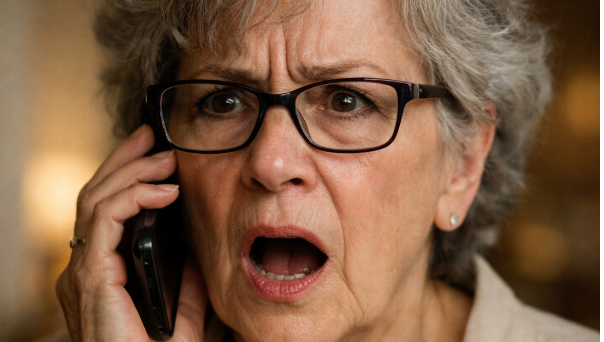
“I don’t care what plans your wife has for this weekend, son! Both of you had better be at the dacha on Saturday by six in the morning! If she doesn’t come, I’ll go get her myself and drag her there by the hair!”
“Mom, I already explained to you,” Anton’s voice was obsequious, but with distinct notes of irritation that he tried in vain to hide. He stood in the middle of the kitchen, phone pressed to his ear, his back taut as a string. “It’s Veronika’s sister’s birthday. A milestone. They planned everything in advance, booked a restaurant. We can’t just cancel everything.”
Veronika silently wiped the already spotless kitchen table, her movements slow and measured. She didn’t look at her husband, but her whole being had turned into listening. She knew that tone in Anton’s voice perfectly well—the tone of a guilty schoolboy trying to justify himself before a strict principal. The principal’s name was Tamara Igorevna.
“Yes, I understand the potatoes need to be dug up!” Anton paced across the kitchen, as if trying to escape the invisible pressure radiating from the phone. “I’m not refusing. I’ll come. Alone. I’ll help, we’ll get it all done. But why can’t she come? Because it’s her sister, Mom!”
He fell silent, listening to the reply. Veronika froze with the rag in her hand. She saw the muscles in his jaw twitch, and his face slowly drain of color. The conversation clearly wasn’t going according to his plan. He had expected nagging, reproaches, but apparently had run into something more. Instinctively, he pulled the phone slightly away from his ear, and the shrill, metallic voice of his mother became distinctly audible even at a distance.
“I don’t care what plans your wife has for this weekend, son! Both of you had better be at the dacha on Saturday by six in the morning! If she doesn’t come, I’ll go get her myself and drag her there by the hair!”
The phrase sounded like a verdict. A short, hollow pause, and then—the abrupt dial tone. Tamara Igorevna had hung up.
Anton slowly lowered his hand. His face was gray, like an unwashed pillowcase. He didn’t slam the phone down on the table in anger, didn’t curse. He gently, almost tenderly, placed it on the countertop, as if it were not a piece of plastic, but some venomous insect that could bite. He froze, staring at a single spot on the wall. He didn’t dare look at his wife. He knew she had heard everything.
The rag slipped soundlessly from Veronika’s hand onto the floor. But she didn’t notice. She stood completely still, her mother-in-law’s last words echoing in her head. It wasn’t the threat itself that struck her. It was the casualness, the utter conviction of her right to say such a thing. As if she weren’t talking about an adult, independent woman, but a stubborn goat that needed to be driven into the pen by force.
She slowly raised her eyes to her husband. He still wasn’t looking at her. He was studying the wallpaper pattern with such intense concentration, as if trying to unravel the greatest mystery of the universe. And in that moment, Veronika felt something inside her click and freeze. The tension was gone, the budding resentment vanished. They were replaced by cold. Piercing, crystalline cold of realization.
She was not looking at her husband Anton, her protector, the head of their small family. She was looking at frightened little Tosya, who had just been scolded by his all-powerful mother. And he wasn’t outraged. He was scared. Scared of her anger, her threats, her power. And that fear of his mother was a thousand times stronger than any sense of duty or respect toward his own wife. He stood in the middle of their kitchen, pitiful, confused, and his whole figure was a silent plea—not to her, but to the void: “Just don’t let there be a scandal.”
Anton finally tore his gaze from the wall and looked at his wife. He tried to force a reassuring smile, but the muscles in his face wouldn’t obey, and what emerged was a crooked, pathetic grimace. He took a step toward her, reaching out a hand to touch her shoulder, but stopped halfway, colliding with her stare.
Veronika’s gaze was calm. Frighteningly calm. There was no resentment, no anger, not even surprise in it. It was the gaze of a pathologist studying a lifeless body—cold, focused, and absolutely detached. She looked right through him, and he felt transparent, as if all his fears, indecision, and cowardice were exposed under the bright light of an operating lamp.
“Veronika…” he began, and his own voice sounded foreign to him. “You know her. It’s just words. She would never really do that. It’s just her character, fiery. She yells and then cools down.”
He spoke, and with every word felt himself sinking deeper. He was spouting nonsense, trying to paper over, to talk away the ugly truth that had come from the phone. He expected her to explode, to start shouting, accusing him—then he could shout back, turn it into an ordinary marital quarrel where they could yell and then make up. But she was silent. Her silence was heavier, thicker than any scream.
“What did she say, Anton?” Veronika asked. Her voice was level, almost without inflection. She wasn’t demanding, but stating the necessity of an answer. She forced him to say it out loud, to clothe the humiliation in words, to acknowledge its reality.
“She… she just really wants us to come,” he dodged again, feeling a cold bead of sweat slide down his back. “You understand, it’s hard for her alone. The potatoes… Let’s just go? For one day. What’s the big deal? We’ll do our duty and that’s it. Why do we need a scandal? So she can torment us for a month afterward?”
And at that word—“scandal”—something in her face changed. Barely noticeable, but the corners of her lips twitched in a semblance of a smile, devoid of any joy. She took a step back, withdrawing from him, as if he had suddenly become a carrier of some repulsive disease.
“Scandal?” she repeated quietly but with lethal clarity. “There will be no scandal, Anton. Here’s what will happen.”
She straightened, and steel entered her posture. The cold, detached observer vanished, replaced by another woman—resolute and unfamiliar.
“On Saturday, as I planned, I am going to my sister’s birthday. And you”—she paused, hammering each word like a nail—“are going to your dacha. Alone. You can dig potatoes, you can paint the fence, you can listen to how worthless your wife is. That’s your choice. And tell your mother that if she so much as comes within a meter of my home intending to carry out her threat, I will forget that she’s an elderly woman. And that is not a threat. It’s just information.”
She spoke, and Anton looked at her, not recognizing her. Where was his gentle, understanding Veronika? Before him stood a stranger with eyes of gray ice.
“And as for you, Anton,” she finished, and her last look crushed him completely, “I think we’re done.”
She didn’t wait for a reply. She simply turned, walked past him, and disappeared into the bedroom. The door didn’t slam. It closed softly, with the quiet click of the lock that sounded to Anton louder than a funeral bell. He was left alone in the kitchen, in deafening silence, suddenly and with complete clarity realizing that in trying to avoid one scandal, he had just caused the collapse of his entire life.
The night passed in thick, suffocating silence that was worse than any shouting. Anton didn’t sleep. He approached the bedroom door several times, listening, but there was only muffled quiet behind it. He hoped that by morning Veronika would cool down, realize the absurdity of her ultimatum, and they could return to the familiar scenario: he would apologize, she would sigh, and together they would go appease his mother. But the morning brought no relief.
He got ready in oppressive silence. Put on old jeans and a work jacket. Veronika emerged from the bedroom as he was lacing his shoes in the hallway. She looked fresh, rested, in a simple robe. Her face bore no trace of yesterday’s drama. She walked to the kitchen and turned on the coffee machine, not even glancing at him. Her detachment frightened him more than any quarrel.
“Veronika, maybe you could still…” he began, his voice breaking.
She turned. Her gaze was as cold and clear as the morning air outside. She said nothing, just looked at him. And in that look he read his final sentence. He was no longer her husband. He was just a man who, for some reason, still happened to be in her apartment. Realizing that further pleading was pointless and would only humiliate him more, he silently took his backpack, turned, and left.
Left alone, Veronika didn’t drink coffee. She stood for a minute in silence, then decisively went to the bedroom. Her movements were precise, deliberate, devoid of fuss. She opened the wardrobe and took out not just any dress, but the dress—her favorite, the one the color of summer sky that matched her eyes so well. She showered, styled her hair carefully, applied makeup. This wasn’t just getting ready for a party. It was a ritual. A farewell to the woman she had been yesterday, and the assertion of the woman she had become today. That calm was her new skin, her armor.
The sharp, demanding ring of the doorbell came just as she was fastening a thin silver bracelet on her wrist. She didn’t flinch. She expected it. With the same unshakable grace, she walked to the hallway and looked through the peephole. On the landing stood Tamara Igorevna.
Veronika drew a deep breath and opened the door.
Her mother-in-law stood on the threshold not like a guest, but like a natural disaster that had arrived right on schedule. Dressed in a practical jacket and dark trousers, ready for country chores, she looked at her well-dressed, perfumed daughter-in-law with open disdain.
“I knew it,” she hissed without even saying hello. Her stare drilled into Veronika like a screw. “Decided to put on a show, did you? Get your things. The car’s downstairs. Anton’s waiting.”
“Good morning, Tamara Igorevna,” Veronika said evenly, not moving from her spot, her body blocking the entrance. “I’m not going anywhere. I’ve already told Anton my plans.”
“I don’t care what you told that weakling!” her mother-in-law’s voice rang with steel. “I told you you’re coming. So you’re coming. Don’t make me say it twice.”
She stepped forward, intending to simply push Veronika aside and enter. But Veronika didn’t budge an inch. She put her hand against the doorframe. It was a calm, absolute barrier.
“You will not enter my home,” she said just as quietly, but her voice carried steel equal to her mother-in-law’s. “And I am not going anywhere with you.”
For a moment, Tamara Igorevna froze, stunned by such resistance. She was used to her daughter-in-law lowering her eyes, keeping quiet, giving in. But now, before her, stood an enemy.
“You little…” she hissed, her face contorting with fury. She stepped closer, her hand clamping down on Veronika’s forearm, wrapped in thin silk. “Don’t make me, you wretch! I’ll drag you out of here by the hair this instant, just like I promised!”
Continued in the comments