My name is Myra Summers. I was forty-one years old when the sister who had surrendered her child to me nineteen years prior decided she was finally ready to be a mother.
My parents had always been governed by panic and appearances. When my sister, Vanessa, became pregnant at sixteen, they decreed that a baby would irrevocably shatter the family name, decimate Vanessa’s golden future, and ruin everything they had meticulously built. So, they turned to the only person they deemed expendable: me. I was twenty-two, single, and had never so much as cradled a newborn. Yet, I took him. I raised him entirely alone, worked two jobs during his toddler years, wrapped his meager Christmas presents in the Sunday comics, and sat as an island of one in every parent-teacher conference. Meanwhile, my sister moved to Boston, secured her degrees, married twice, and never once found the time to pick up the telephone to ask about the boy she left behind.
Then, he graduated from high school, and Vanessa strutted into that stifling gymnasium carrying a grocery-store cake that read: Congratulations from your real mom. What transpired at that graduation forced my mother into tears, prompted my sister’s wealthy boyfriend to walk away forever, and brought two hundred strangers to their feet for a woman most of them had never met.
To understand that afternoon, you have to understand the nineteen years that preceded it.
I grew up in Willow Creek, Ohio, a town of barely eleven thousand people where the grocery clerk knew your grandmother’s medical history and neighbors tracked your report cards. My sister Vanessa is six years my junior. She was the baby, the fragile beauty, the one who could walk into a room and elicit smiles simply by existing.
I was the other one. I was the one who set the table, scrubbed the linoleum, and drove Vanessa to dance class every Tuesday and Thursday because our mother, Rita, insisted it was “good practice for when you have your own.” I loved my sister, truly—with that complicated braid of irritation and fierce tenderness unique to older sisters. But our mother operated on a rigid philosophy: Vanessa was fragile and required protection; I was a workhorse who required nothing. Our father, Gerald, was a quiet ghost who agreed with whatever Rita decreed, present at the dinner table but entirely absent from every conversation of consequence.
The spring everything changed, I was twenty-two. I had just finished my bachelor’s degree in education at Ohio State and had been accepted into a master’s program on a full scholarship. I had a timeline. I had a studio apartment with a single window facing a concrete parking lot, which I adored because it was unequivocally mine.
Vanessa was sixteen, a high school sophomore with a boyfriend who drove a Mustang and worked at the local cinema.
Then came a Tuesday in March. My phone rang at two in the morning. It was Rita. I drove the forty minutes back to Willow Creek in pitch darkness. I found my mother sitting rigidly at the kitchen table beside a cup of tea she wasn’t drinking. Gerald stood by the refrigerator, arms crossed, staring intently at a scuff on the linoleum. From the floor above, I could hear Vanessa’s muffled sobs.
Rita pushed a crinkled thermal paper across the table. It was an ultrasound printout. Four months. Vanessa had known for a third of a year and suffered in silence.
My mother’s first words were not of concern for her frightened teenager, nor for the life growing inside her. Her first words were, “The neighbors cannot know.”
She laid out the options with the cold precision of a military tactician. Adoption was possible, but agency paperwork meant a paper trail, which meant whispers. Keeping the baby was out of the question; Rita would not tolerate a teenage mother under her roof. “It would ruin everything we have built,” she stated, as if she had constructed a dynasty rather than a manicured lawn and a fragile reputation.
Rita walked to the hall closet and returned with a small, yellow cotton blanket, faded at the edges.
“This was yours,” she said, thrusting it into my hands. “When you were born. You have to help. You are her sister.”
By the next morning, the ultimatum was set: if I did not take the baby, they would surrender him to strangers by Friday. Vanessa would return to geometry class, and the family would never speak of the aberration again.
I looked at my sister, huddled on the couch in an oversized hoodie, her mascara smeared into dark bruises under her eyes. She was a terrified child. “Vanessa,” I asked gently, “What do you want?”
She stared at the floor. “I want it to go away,” she whispered.
Rita pointed a triumphant finger at me. “There. She has school. She has her whole life ahead of her.”
I drove back to my apartment that morning with the yellow blanket resting on the passenger seat. I withdrew from my master’s program the very next day.
Dylan was born on July 14th at 3:17 in the afternoon. He weighed six pounds, nine ounces, possessed a thick shock of dark hair, and had lungs that could strip paint from the walls.
The delivery room held three spectators: Vanessa, gripping the rails in silent agony; Rita, watching the wall clock with crossed arms; and me. When the nurse finally cleaned the screaming infant, wrapped him tightly, and held him out, she asked, “Who is taking him home?”
The silence in that room was absolute. Vanessa turned her face to the cinderblock wall. Rita remained entirely motionless.
“I am,” I said.
Three days later, I carried my son into my one-bedroom apartment on East Willow Street. I had a borrowed crib, a bulk box of dollar-store diapers, and the faded yellow blanket. The first year nearly broke me down to the marrow. Dylan suffered from severe colic, screaming for four hours every night between eight and midnight. I paced the narrow floors of my apartment, humming half-remembered lullabies, operating on four hours of fractured sleep. I worked as a teaching assistant from dawn to mid-afternoon, surviving on coffee and sheer willpower.
When I called my mother once, weeping in formula-stained sweatpants at midnight, begging for just one night of help, her response was characteristically arctic: “You chose this, Myra. You are an adult. Figure it out.”
So, I did. I figured it out.
While Vanessa moved to Boston, joining a sorority and spending our parents’ savings on a private college tuition, I quietly filed for legal guardianship in Franklin County. Vanessa signed the voluntary relinquishment forms by fax during rush week. I locked those papers in a small fireproof safe under my bed, right next to the yellow blanket and a photograph of Dylan sleeping peacefully on my chest.
The next five years were a tapestry of exhausted triumphs. At one, Dylan took his first steps across my tiny living room. At two, his first word was a brisk, efficient “Ma.” By four, he was reading the nutritional information on cereal boxes. When he marched into his first day of kindergarten with his Spider-Man backpack, never once looking back, I sat in my used Honda and wept from a potent mixture of pride and profound loneliness.
No one from the Summers family visited during those five years. No Christmas presents. No birthday cards.
When Dylan was six, Vanessa finally called. She didn’t ask if her biological son was healthy, happy, or reading above his grade level. She called to ask if her 2003 Toyota Camry was still in our parents’ garage because she needed the cash for an apartment deposit. The phone call lasted exactly forty-two seconds.
The trajectory of my life changed when Dylan was eight. I had finally secured a full-time position as a special education aide with a salary that felt like a king’s ransom: $43,000 a year, with benefits.
That same year, while I was washing dishes, Dylan sat at the kitchen table doing his homework. Out of nowhere, he asked, “Aunt Myra, how come I don’t have a mom and dad like the other kids?”
A plate slipped from my soapy hands and clattered in the sink. I dried my hands, sat across from his dark, impossibly perceptive eyes, and told him the gentlest truth I could muster. “I love you more than anything. Your birth mom loves you too, in her own way. But I’m the one who’s here. I’m always going to be here.”
He studied my face, an eight-year-old boy reading my soul like large-print text. “I know,” he said quietly. “I just wanted to call you Mom instead of Aunt Myra. Is that okay?”
I hadn’t cried when my mother abandoned me to single parenthood. I hadn’t cried when my sister treated me like a long-term storage facility. But at that moment, I broke. He wrapped his small arms around my neck, smelling of grape juice and pencil shavings, and whispered, “It’s okay, Mom.”
When Dylan was thirteen, I told him the unvarnished truth. We sat on the porch, and I explained the two A.M. phone call, the ultimatum, the faxes sent from Boston, and the silence that followed. I didn’t editorialize or paint my family as villains; I simply laid out the timeline. He retreated to his room for two days. When he emerged, he sat down to a plate of scrambled eggs and said simply, “I’m not angry at her. I’m just sad for her. She missed everything.”
While Dylan grew into a remarkable, brilliant young man—stacking AP classes, captaining the debate team, volunteering on weekends—Vanessa collected corporate promotions and short-lived marriages in Chicago. With every divorce, Rita would call to warn me not to “stress” Vanessa, as if I had spoken to my sister in the last decade.
I completed my master’s degree through grueling night classes. Not a single blood relative attended my graduation. Just my colleague, Claire, who cheered from the third row.
Then came Dylan’s junior year of high school. He was on track to be valedictorian. One Wednesday afternoon, he quietly placed his phone on the kitchen counter. It was a family group text he had been accidentally added to by Rita.
I scrolled through two years of messages between my parents, my sister, and my aunt.
Rita: When Vanessa is ready, she will take Dylan back. Myra is just keeping him for now. Vanessa: Give me a couple more years. I’m getting my life together. Uncle Dale: Myra should be grateful she got to have a kid at all.
For two years, they had discussed my son as if he were a borrowed lawnmower waiting in my garage until the rightful owner had space for it. Dylan, at seventeen, had kept the thread a secret to protect my feelings. I didn’t scream. I didn’t call them. I simply opened my fireproof safe, verified the notarized relinquishment papers, touched the soft edges of the yellow blanket, and went back to cooking dinner for my son.
Six weeks before the ceremony, Rita called to announce that Vanessa had a new, wealthy boyfriend named Harrison. Harrison wanted a “real family.” According to Rita, this was Vanessa’s chance to step into the role of mother. “Do not ruin this for her,” Rita hissed.
Vanessa even had the audacity to send Dylan an Instagram direct message: Hey handsome. I’m your bio mom… Can’t wait to see you at graduation. Dylan politely acknowledged the message, devoid of any warmth, and went back to writing his valedictorian address.
The morning of graduation, the air smelled of cut grass and blooming magnolias. I ironed Dylan’s navy blue cap and gown. Before we left, I caught him slipping the frayed yellow baby blanket into the inside pocket of his vest. “For good luck,” he smiled.
The Willow Creek High School gymnasium was packed with four hundred sweltering people. Claire and I found seats in the third row. And then, the Summers family made their entrance.
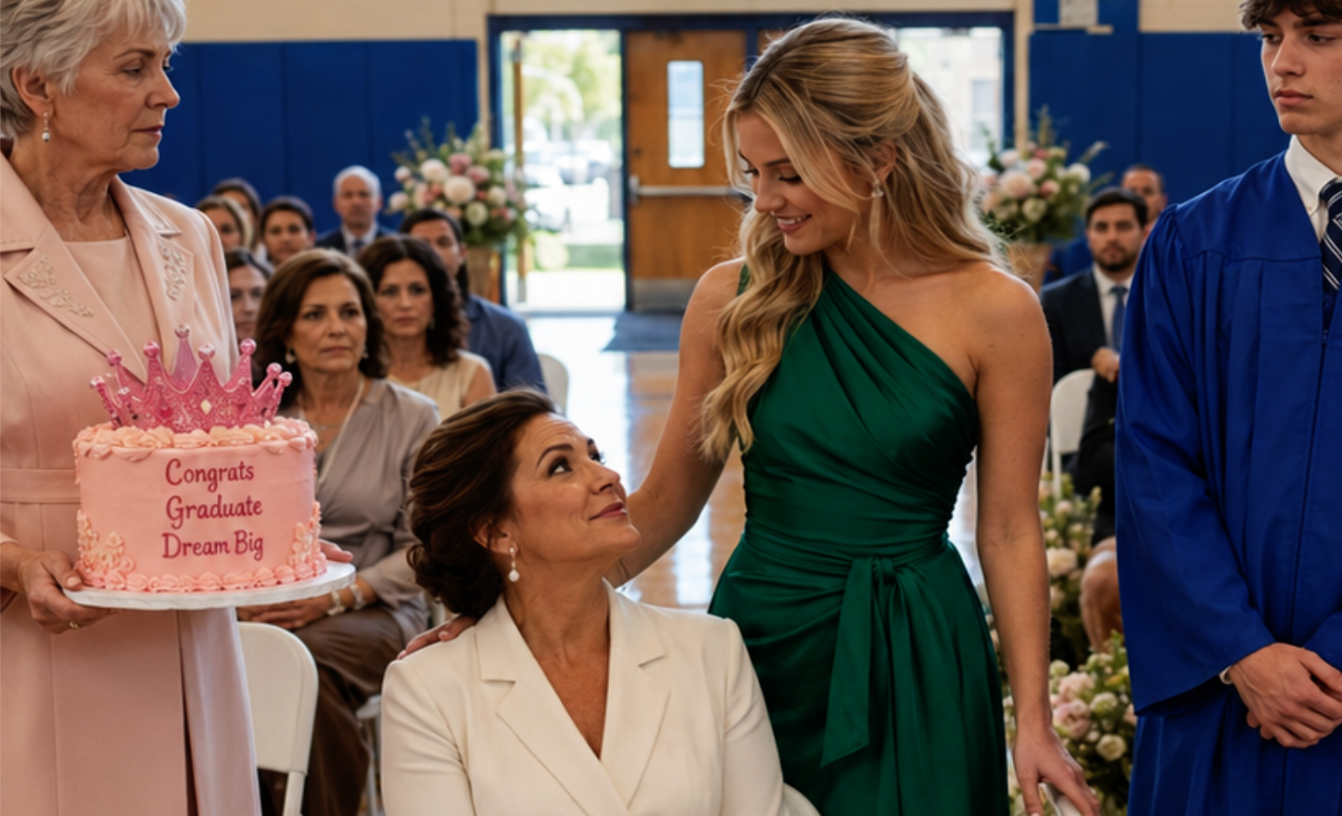
Vanessa looked as though she were walking the red carpet at a gala. She wore an emerald green wrap dress and clicking heels, holding the arm of the impeccably tailored Harrison. Behind them trailed my parents. Rita was carrying a bakery cake balanced on a paper doily. The pink frosting screamed: Congratulations from your real mom.
Before the ceremony began, Vanessa bypassed the security volunteers by declaring herself Dylan’s mother. She marched up to my son, threw her arms around his rigid, unyielding body, and smiled for an invisible camera. Then, she strutted over to my row, leaned down, and delivered a line that will echo in my mind until the day I die.
“Myra, thank you so much for taking care of my son all these years. You have been an incredible babysitter. But I’m here now. I’ll take it from here.”
Nineteen years. Four thousand packed lunches. A master’s degree deferred. Thousands of hours of feverish rocking in the dark. Babysitter.
I caught Dylan’s eye across the room. He was staring right at me, his jaw clenched, his eyes sending a silent, desperate command: Wait for me.
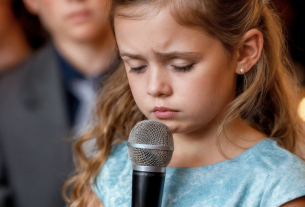
The ceremony droned through the requisite musical numbers and administrative speeches. When Dylan was called, he crossed the stage with calm authority, accepted his diploma, and stepped up to the podium for the valedictorian address. The gymnasium hushed. Vanessa leaned forward, her phone recording, a preening smile plastered across her face. She was ready for her tribute.
Dylan spoke warmly of the school, the teachers, the janitorial staff. Then, he paused. He took his meticulously typed, nine-draft speech, folded it deliberately, and set it aside.
“The person I want to thank most today,” his voice rang out, steady and clear, “is not a teacher or a friend. It’s a woman who was twenty-two years old when she was handed a newborn baby and told: This is your responsibility now.”
Vanessa’s smile froze.
“She had never changed a diaper. She had just been accepted into a master’s program on a full scholarship, and she gave it up the next morning without hesitation. She lived on four hours of sleep. She wrapped my Christmas presents in newspaper because she couldn’t afford wrapping paper. She helped me with my homework every night for thirteen years. She never missed a single parent-teacher conference.”
In the second row, Vanessa slowly lowered her phone. Harrison was staring intently at the stage, then back at his girlfriend, his brow furrowed as the math of the last nineteen years began to violently clash with the narrative he had been fed.
Dylan looked directly at me.
“She is not the woman who gave birth to me. But she is the woman who chose me every single day for nineteen years without asking for anything in return. Her name is Myra Summers. She is my mother.”
The gymnasium erupted. Two hundred people rose to their feet. Claire was sobbing openly, squeezing my hand until my knuckles turned white. Even the school principal had her hand pressed to her heart. I sat frozen in my plastic chair, tears tracking down my face, completely overwhelmed by the profound grace of the boy I had raised.
Two rows ahead, Rita sat with the real mom cake trembling on her lap, the pink frosting now a monument to her own delusion.
When the families spilled out onto the sunlit school lawn, the confrontation was inevitable. Vanessa stormed toward me, her heels sinking into the turf, Harrison trailing behind with a deeply analytical expression.
“What did you tell him to say?” Vanessa shrieked, drawing the eyes of dozens of parents. “You coached him! You turned my own son against me!”
Dylan materialized beside me, tall and immovable in his gown. “Nobody coached me. I wrote it myself.”
Vanessa spun to him, her voice cracking. “Baby, I’m your mother. I gave birth to you. I carried you for nine months.”
“And then you signed a piece of paper and faxed it from a sorority house during rush week,” Dylan replied, his tone devoid of malice, heavy only with fact. “You went to school and to two marriages and to Chicago. You don’t get to walk into my graduation with a cake that says ‘real mom’ and pretend those nineteen years didn’t happen.”
Harrison finally stepped forward. The wealthy real estate developer looked at Vanessa with glacial clarity. “You told me you were forced to give him up,” he said quietly. “Did you sign away your rights voluntarily?”
Vanessa stammered, looking to Rita for a lifeline. “I… I was sixteen. It was complicated…”
Harrison looked at me. “You raised him from birth? Alone?” I nodded. He adjusted his silver watch, turned his back on the woman who had lied to him, and walked straight to his luxury sedan. We watched him drive away, leaving Vanessa utterly alone on the lawn in her emerald dress.
In the ensuing silence, Rita glared at me. I thought, for a fleeting second, I saw regret in her eyes. But then her defenses slammed shut. “If you hadn’t poisoned him against his own mother, none of this would have happened,” she spat.
Dylan looked at the grandmother who had mailed him a single check in nearly two decades. “Grandma, no one poisoned me. I have eyes, I have ears, and I have nineteen years of memories. Do you know how many include Mom?” He pointed to me. “All of them. Every single one.”
He then turned to his biological mother. He didn’t yell. He didn’t shame her. He simply set the boundary of a grown man. “If you want to be in my life, you can be. But you have to start from now. Not from a cake. Not from pretending.”
Then, my son reached into his vest. He pulled out a small, faded square of fabric—the yellow blanket that had bundled me in infancy, and him on his first terrified night in my apartment. He walked over, gently took my trembling hand, and pressed the frayed cotton into my palm.
“This is yours, Mom,” he smiled softly. “It was always yours.”
I stood under the Ohio sun holding the thinnest, most valuable fabric in the world, smelling the faint echoes of cedar and baby shampoo. I watched my parents walk away toward the parking lot, leaving the untouched grocery-store cake sitting awkwardly in the grass. I didn’t call after them. I didn’t need to. I turned to my son, took his arm, and together, we walked forward into the rest of our lives.