The pen rests in my hand, practically weightless, yet drawing my name across the heavy parchment feels akin to moving a mountain. Across the expanse of a polished mahogany desk sits Roger Pemberton, my estate attorney for the better part of two decades. He watches me with those carefully calibrated lawyer’s eyes—the sort of eyes that have witnessed families immolate themselves over money more times than he would ever comfortably admit.
“Are you entirely certain about this, Margaret?” he asks.
His voice is remarkably soft. It carries the practiced professionalism he likely employs when guiding couples through the bitter division of assets in divorce proceedings.
I lower my gaze to the pristine legal documents spread before me. My entire estate—the $3.2 million that my husband, Harold, meticulously built from nothing through sheer brilliance and unyielding sacrifice—will now be distributed among three entities. It will go to the Alzheimer’s Association, the county library system, and a designated scholarship fund for first-generation college students whose parents work three jobs just to keep food on the table. My son Derek’s name appears exactly zero times in these pages.
“I have never been more certain of anything in my entire life,” I reply.
When I sign my name, my hand does not tremble. I expected a quiver, a moment of maternal hesitation, but my grip is absolute.
Roger clears his throat, a subtle break in his composure. “He will contest this, you know. Your son will fight it.”
“Let him.” I set the pen down, listening to the small, definitive click it makes against the wood. “Every financial record Harold kept illustrates exactly where that money came from and how it was saved. Any judge possessing half a brain will see this for exactly what it is.”
“And what is it?” Roger asks quietly.
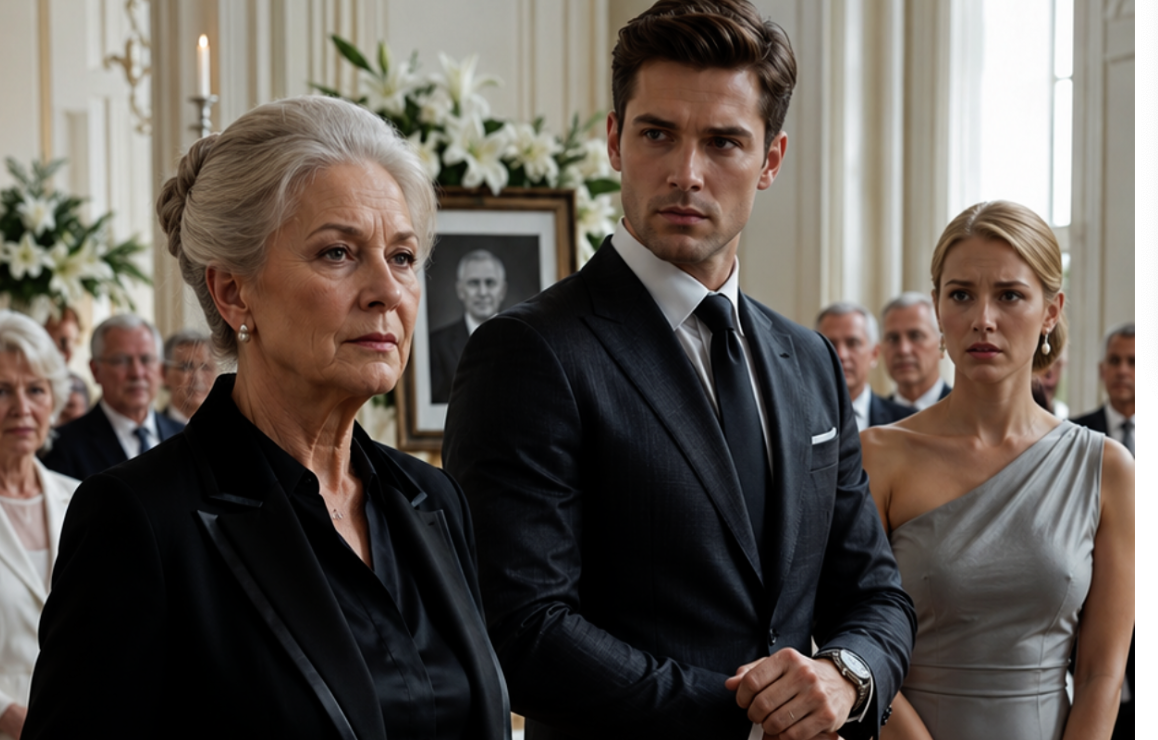
I think about Saturday. Just four days ago. I think about my husband’s funeral. I vividly recall sitting completely alone in the front pew of the First Presbyterian Church, bathed in the harsh glare of fluorescent lights, watching Harold’s casket gleam. I remember the sharp, distinct sound of heels clicking against the tile floor seventeen minutes after the service had already begun. I remember the whispered, breathless apology as my only child—my miracle baby—slipped into a back row with his wife, putting as much physical distance between himself and his grieving mother as the church’s architecture would allow.
I think about watching them quietly prepare to leave before the reception had even truly begun, before the neighbors could set out the egg salad sandwiches, before anyone could offer me an embrace or whisper their condolences. During our hasty, fifteen-second goodbye hug, Derek checked his watch twice. Twice. His wife, Vanessa, lightly touched his arm, reminding him that the winter gala started at seven o’clock, and if they beat the traffic, they could still make cocktail hour.
My husband of fifty-one years was dead, and my son had a cocktail party to attend.
“It is being practical,” I tell Roger, echoing the exact word that fractured my heart. I gather my purse from the leather chair beside me. “That is what Derek called it when I called to tell him his father had passed. He told me Harold wouldn’t want them to derail their lives. He said we should all be practical.”
Roger’s expression shifts. A flicker of genuine anger crosses his face before he wrestles it back behind a mask of professional decorum. He is a father, too. The framed photographs of his three daughters have graced this desk since they were wearing pigtails.
“The documents are filed,” he says softly. “Legally, everything is in perfect order.”
I stand up. My knees ache, a dull, persistent throbbing that has plagued me for three years—the physical toll of spending eighteen hours a day lifting, turning, and cleaning a husband whose mind had slowly erased his own existence. I never told Derek about the pain. I never begged for his help, because I knew, with the terrifying certainty that settles deep in your marrow, that he would not come. He proved me entirely right.
Walking out of Roger’s office, the October sunshine feels aggressively bright, almost inappropriately cheerful. The world continues to turn, entirely indifferent to the fact that I have just erased my only child from my legacy.
To truly comprehend why a mother disinherits the child she prayed for, you must understand the exact cost of creating him.
I was twenty-two years old in November of 1974, standing on the pavement outside Brennan Manufacturing in Pittsburgh. The air tasted of diesel exhaust and dying autumn leaves. I had just secured a secretarial position paying thirty-five dollars a week. It was modest, but it was mine. That was where I first saw Harold Holloway. He was thirty, a junior accountant carrying a battered briefcase, wearing a brown suit that sat awkwardly on his shoulders. But his eyes possessed a profound, unfeigned kindness.
We married just a few months later in a modest ceremony. We bought a small, ranch-style house with yellow siding and a roof that leaked during heavy storms. We were happy in a quiet, unremarkable way that rarely makes for compelling stories. There was no grand drama, just the steady rhythm of a shared life.
Then, in 1980, Derek arrived. He was a colicky infant who screamed for hours on end, stretching our sanity to its absolute limits. I remember standing in the doorway of the nursery at three in the morning, watching Harold—exhausted, wearing pajama pants stained with spit-up—pacing the floor and humming off-key to soothe our miracle child. The doctors had told me there would be no more children. Derek was our only chance at parenthood, and we poured every ounce of our souls into him.
When Harold’s father passed away in 1982, leaving us a modest inheritance of $35,000, it felt like an unimaginable fortune. It could have bought a new car, or fixed the leaky roof, or funded a vacation away from our grueling routines. Instead, sitting at our chipped, yellow Formica kitchen table while four-year-old Derek colored with broken crayons, we made a choice.
“College fund,” I had suggested. Harold’s shoulders relaxed, a quiet agreement settling between us. We wanted Derek to have every opportunity we had been denied.
From that day forward, our lives became a monument to sacrifice. I took a job at the county library, shelving books for minimum wage until my back throbbed incessantly. Harold worked grueling weekends during tax season, returning home with ink-stained fingers and shadows under his eyes. We ate cheap meals, drove cars held together by duct tape and hope, and wore our clothes until the fabric was practically translucent. But Derek always had new shoes. Derek attended every field trip. Derek wanted for nothing.
The entitlement grew slowly, like damp rot in the walls of a house—imperceptible until the structure begins to bow. By the time Derek was accepted into Whitmore University, a prestigious institution costing $43,000 a year, the pattern was permanently set. He did not ask if we could afford it; we had meticulously trained him to assume we could.
We refinanced the yellow house. We took out crushing loans. I transitioned to full-time hours at the library, and Harold accepted a soul-draining promotion that required constant travel, turning his hair gray before he reached fifty. Derek joined a fraternity, called home once a month, and constantly demanded funds for textbooks, “networking symposiums,” and trips.
What Derek never knew—what I only partially understood at the time—was that Harold possessed a quiet, staggering brilliance for financial forecasting. While I shelved romance novels and our son squandered his tuition at college bars, Harold was quietly investing in nascent tech startups and obscure stock offerings. He moved money with the precision of a grandmaster. By the time Derek barely managed to graduate with a dismal GPA, Harold’s investments had quietly crossed into the seven-figure range.
We still clipped coupons. We still ignored the leaking roof. When I suggested telling Derek about the wealth, Harold refused.
“Not yet,” he had said, peering over his reading glasses in the dim lamplight of our bedroom. “When he learns to build something himself. We gave him every advantage. Now he needs to prove he can stand without us propping him up.”
It was the most devastating miscalculation we ever made. Derek moved to Philadelphia, married Vanessa—a woman whose cold elegance felt like a currency she traded on—and slowly excised us from his life. They hosted four-hundred-guest weddings where Harold and I were seated in the third row. They vacationed in Tuscany and Bali, displaying a lavish lifestyle built on the foundation we had provided, yet we were relegated to an afterthought. Thanksgiving became an inconvenience; Christmas became a burden. When Harold experienced a minor heart scare, Derek promptly canceled their one scheduled visit, claiming the “stress” would be too much for Vanessa.
When the Alzheimer’s diagnosis finally came, it felt as though the earth had fractured beneath my feet. I called Derek from the clinic parking lot, my hands trembling violently.
“That’s really tough, Mom,” he had said, his voice carrying the detached sympathy one might offer a colleague whose flight was delayed. “I’m about to step into a meeting. Let’s figure out a time to visit soon.”
“Soon” took six months. When he finally arrived, he stayed for precisely ninety minutes, spending the majority of his visit answering work emails on his phone. Harold, whose mind was rapidly unspooling, looked at our son and politely asked if the “nice young man” was there to fix the roof. Derek looked profoundly relieved to leave. Watching his taillights disappear down Maple Street, a chilling realization washed over me: we had not raised a son. We had engineered a consumer. By sacrificing continuously when we should have demanded responsibility, we had built a man who took instinctively and gave absolutely nothing in return.
The final months were an agonizing descent. Harold stopped eating solid food. I learned to administer nutrition shakes, to rotate his fragile body to prevent bedsores, to comfort a man who no longer recognized the woman who had loved him for half a century. And I did it entirely alone. When I called Derek to tell him the doctors gave Harold only weeks to live, he cited a “crazy work schedule” and a new marketing campaign.
When Harold passed away on a frigid Tuesday morning in January, the sun had not yet risen. I held his hand as his breathing slowed and finally ceased. The man who had built a hidden fortune and hummed off-key lullabies to our colicky child was gone.
I called Derek. I told him his father was dead.
“Oh,” he breathed, sounding strange and distant. “When is the funeral?”
“Saturday,” I replied. “Two o’clock.”
A long, suffocating silence followed. “Mom, that’s really short notice. Vanessa and I have the Hendersons’ winter gala. It’s critical for my career. Dad wouldn’t want us to put our lives on hold, right? He’d want us to be practical.”
Practical. That single word became the anvil that shattered my remaining illusions.
Now, six months have passed since I sat in Roger Pemberton’s office and signed away the Holloway fortune. Spring has washed over Maple Street, and the house with the yellow siding feels fundamentally transformed.
I hired a contractor to properly fix the roof. It cost two thousand dollars, and the house no longer weeps when it rains. I planted a sprawling garden in the backyard—tomatoes, herbs, and vibrant flowers—simply because I desired them, not because I was rushing to complete a chore between caregiving shifts. On Thursdays, I meet my former library colleagues for tea. On Tuesdays, I volunteer at an Alzheimer’s support group, helping other exhausted spouses navigate the labyrinth of grief and exhaustion.
Derek called twice after the funeral. The first time was to ask for his father’s vintage watch—an item he had never once admired when Harold was alive. The second call was to inquire about the timeline for settling the estate, noting that he and Vanessa were “planning some investments.” I calmly informed him that the estate was being handled and that he would be notified of any relevant details through my attorney. He has not called since.
He will find out eventually. Perhaps when I am gone, or perhaps sooner if he pushes his inquiries with the law firm. He will undoubtedly feel betrayed. He will curse my name and claim I was suffering from diminished capacity. But he will lose. The financial ledger is an undeniable testament: parents who sacrificed everything, and a son who valued absolutely nothing.
The profound tragedy of Derek is not that he will lose his inheritance. The tragedy is that we taught him to believe inheritance was an unconditional right, regardless of his actions. We taught him that love meant acquiring exactly what you wanted without ever having to earn what you received. We failed him by succeeding far too well at our own self-denial.
But I am no longer failing myself.
At seventy-three years old, after spending fifty-one years dissolving my own needs to serve others, I have discovered a beautiful, quiet truth. It is never too late to choose yourself. It is never too late to brew the chamomile tea you actually prefer, rather than the Earl Grey you made for decades simply out of habit. It is never too late to redirect your legacy toward people who will treat it as a blessing rather than an entitlement.
I sit on my back porch, savoring the silence. It is not the heavy, terrifying silence of Harold’s final days, nor the hollow echo of waiting for a phone that refuses to ring. It is a peaceful, sovereign quiet. I am a woman who buried her husband alone, and in the aftermath, decided she would never again allow herself to be used by those who viewed her pain as a scheduling conflict. Sometimes, the most powerful and liberating action a person can take is to quietly, permanently remove themselves from the altar of someone else’s expectations.
If this story resonated with you, if Margaret’s quiet strength served as a reminder that it is never too late to reclaim your life and choose yourself, I invite you to subscribe to this channel. Turn on notifications so you do not miss future narratives that challenge our perspectives and remind us of what truly matters in this world. Please share your thoughts in the comments below—tell us about your own journeys with familial boundaries, sacrifice, and the moments you finally found the courage to step away. True wealth is never measured by the balance in a bank account. It is measured in presence, in showing up, and in having the courage to walk away from those who only value what they can take from you.