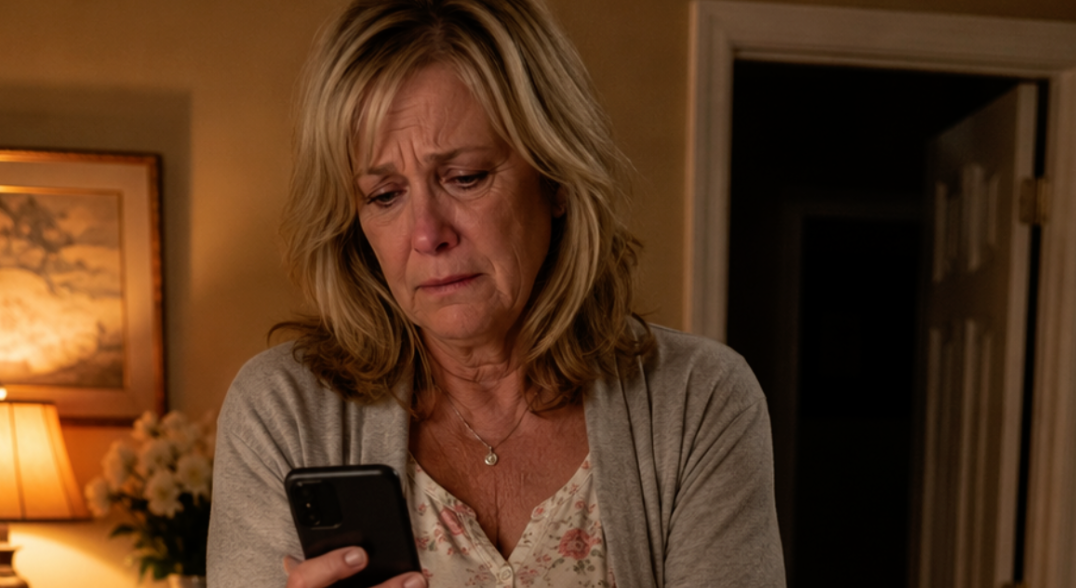
At exactly 11:02 p.m., Gillian Mercer stood motionless beside her meticulously packed suitcase, her eyes fixed on a glowing digital message that neatly cleaved her life into a definitive “before” and “after.”
You’ve already done your part by paying. The rest is a matter for our family.
For a suspended, agonizing second, the bedroom seemed to tilt completely off its axis. The bedside lamp cast a soft, forgiving amber circle across the quilt, illuminating the sad, hopeful contents of her luggage. Her sandals sat perfectly aligned on the floor—the exact way her late husband, Russell, used to tease her for arranging her shoes as though they were awaiting military inspection. Inside the suitcase, three cotton sundresses were folded with the delicate, fragile optimism of a woman who had not allowed herself a genuine vacation in years. Resting gently on top of them was a new straw sun hat she had purchased just that afternoon at Belk, its crisp paper tag still dangling from the brim like a foolish little flag of surrender.
Gillian read the message a second time. Then a third.
The blood drained from her fingertips, leaving her hands entirely cold. What made Douglas’s words so fundamentally unbearable was the sheer absence of emotion. There was no fiery anger, no stammering apology, no awkwardness, and absolutely no visible shame. It was delivered with the sterile, clean, efficient cruelty of a man confirming a brief delivery window or canceling a redundant subscription service.
He wrote to her as if she were not his mother.
He wrote as if she had not birthed him, had not sat awake through the terrifying midnight fevers of his childhood, had not packed a thousand brown-bag lunches, or sacrificed to pay for his braces. It was as if she had not stood shivering in the freezing sleet, clapping until her hands were raw at every single one of his high school football games, despite the fact that he almost never left the bench. It was as if she had not buried his father alone and stubbornly kept a dedicated place set for him at every single holiday table since.
For a very long time, Gillian did not move an inch. She remained rooted in the quiet bedroom of her modest Raleigh home, her phone heavy in her palm, listening to the rhythmic hum of the air conditioner pushing air through the ceiling vents and the steady, indifferent ticking of the old wall clock above her dresser. Beyond her window, the neighborhood had settled into that deep, heavy suburban silence she had once found so deeply comforting. Porch lights glowed like small beacons over perfectly manicured lawns. A dog barked twice, a hollow echo down the cul-de-sac. Across the street, the Hendersons’ decorative flag lifted lazily in the warm May darkness.
Everything outside looked entirely normal. Everything inside her was utterly shattered.
At sixty-three years old, Gillian was intimately acquainted with heartbreak. She had survived the breathless, world-ending phone call from WakeMed Hospital informing her that Russell, her devoted husband of thirty-eight years, had unexpectedly collapsed on the floor of his office. She knew the suffocating, plush carpet of the funeral home, the nauseatingly sweet aroma of white lilies, and the strange, helpless kindness of neighbors who aggressively pressed heavy casseroles into her hands because they simply had no other vocabulary for grief.
She had survived that first, terrible Sunday after the funeral, when she had blindly made coffee for two out of pure muscle memory, standing in the kitchen clutching Russell’s favorite ceramic mug until the dark liquid went completely cold. She had painstakingly taught herself how to eat dinner alone at a large table built for a bustling family, learning precisely how a heavy silence could eventually morph into a permanent roommate.
But this specific pain was entirely different. Death was a merciless thief, but it was indiscriminate; it did not choose its victims out of malice. This, however, was a deliberate, calculated choice. And the cruelty had not begun with a late-night text message.
The trap had been set back in March, on a thoroughly mundane Wednesday afternoon while Gillian sat at her kitchen table grading notebooks. Since her formal retirement from teaching, she continued to tutor middle schoolers three afternoons a week—mostly sweet, chaotic sixth graders who chronically confused “their” and “there,” forgot their punctuation, and smelled perpetually of cedar pencil shavings and artificial fruit snacks.
The yellow daffodils outside her kitchen window had just begun to enthusiastically bloom. Her red grading pen was hovering decisively over a brutally misspelled paragraph when her phone screen lit up with Douglas’s name.
Before she could deploy any logical defenses, her heart leaped. It was the humiliating, inescapable reality of motherhood, she often thought: a grown son could easily forget to call for three consecutive weeks, only to send a minimalist text asking Got time this weekend?, and the mother’s hopeful heart would still click on like an automatic porch light.
“Hi, honey,” she had answered.
“Mom,” Douglas replied, injecting a manufactured warmth into his voice that she had missed so desperately it almost brought her to tears. “I had an idea.”
“That sounds dangerous,” Gillian had smiled into the receiver.
He laughed—a bright, genuine sound. For one fleeting, dangerous second, he sounded exactly like the little boy who used to run recklessly through their backyard with dark grass stains on both knees and a melting cherry popsicle clutched in his fist, possessing absolute, unwavering faith that his mother was capable of fixing the entire world.
“What if we all went away this summer?” Douglas asked smoothly. “A real trip. Key West, maybe. You, me, Audrey, Parker, Cooper. All of us.”
All of us. A real trip.
The carefully chosen words slipped cleanly into a tender, bruised place in Gillian’s psyche that she had tried very hard to pretend did not exist. Since Russell’s death three years prior, her life had contracted in painful ways she refused to admit out loud. Holidays ended earlier. Birthdays felt incredibly thin and obligatory. Sunday afternoons stretched endlessly across her house like a long, vacant hallway. She still saw Douglas, her polished daughter-in-law Audrey, and her two grandsons, but their interactions were parceled out in clipped, transactional pieces: a heavily rushed dinner, a school recital where Audrey inevitably “forgot” to text Gillian the correct row, or a frantic ten minutes on the driveway after soccer practice while the boys were already strapped into the back of the SUV.
She had slowly devolved from a matriarch into a logistical stop on their busy schedule. She was a gift card at Christmas. She was a woman loved abstractly in theory, but rarely actually included in practice. Somewhere along the terrible march of time, she had stopped feeling central to her son’s life and started feeling entirely optional.
So when Douglas uttered the phrase “All of us,” Gillian heard far more than a simple vacation pitch. She heard a heavy, locked door suddenly swinging wide open.
“That would be wonderful,” she breathed softly.
Then came the pause. It was small. It was careful. It was the exact, calculated silence a mother learns to decode even when she prays she is wrong.
Douglas cleared his throat. “The thing is, Audrey and I have been really looking at the numbers, and things are just incredibly tight right now. The mortgage, groceries, the boys’ endless school expenses, summer camps, swim lessons… You know how it is.”
Gillian did know exactly how it was. She intimately remembered purchasing graying ground beef on clearance and creatively stretching it across two separate dinners. She remembered carefully sewing a stray button back onto Douglas’s only good church shirt because buying a new one was simply out of the question that month. She remembered Russell working grueling Saturdays during tax season, dragging himself home with a wilted collar, yet still asking if Douglas wanted to throw a football in the twilight.
Douglas pressed on, his tone artificially brightening. “But maybe if we all pitched in together, we could actually make it happen. Just once. Before the boys get older and don’t want to do things with us anymore.”
I should have heard the cold calculation, Gillian would berate herself later. Instead, she heard his need, and because she loved him with a blinding totality, she eagerly translated his financial need into a profound declaration of emotional love. She promised to look at her finances, fueled by the terrifying, intoxicating hope in his voice.
For the following week, Gillian transformed her quiet house into a dedicated travel agency. She sat at her kitchen table surrounded by a yellow legal pad, her glowing laptop, stacks of old bank statements, and printed travel confirmations. She meticulously researched flights from Raleigh-Durham to the Florida Keys. She analyzed beachfront rental houses. She stared longingly at digital photos of crystalline turquoise water, sprawling white balconies, and laughing children with snorkel masks pushed up on their wet foreheads. She vividly imagined Parker discovering exotic shells and little Cooper insisting on sitting right next to her at dinner. She imagined Audrey finally softening in the tropical weather, perhaps touching her arm and genuinely whispering, “I’m so glad you came, Gillian.”
That was the entirety of Gillian’s ambition. She did not seek luxury or endless praise; she merely wanted three days where she did not feel like an outsider pressing her face against the cold glass, watching her own family live beautifully without her.
The financial toll, however, was devastating.
When she sat across from Sylvia Bennett, her sharp, thirty-nine-year-old financial advisor at a tidy office near North Hills, Sylvia’s professional frown caused Gillian to physically shrink into her chair. Sylvia was far too honest to sugarcoat fiscal recklessness.
“Gillian,” Sylvia sighed, removing her reading glasses and massaging the bridge of her nose. “This is not a small, casual withdrawal.”
“I know.”
“It won’t completely bankrupt you,” Sylvia continued gently, “but it takes a massive, meaningful bite directly out of your liquid savings. If your roof gives out, if you need emergency dental work, if the transmission drops out of your car—”
“I understand,” Gillian interrupted firmly.
Sylvia leaned back, her eyes softening with a deep, empathetic sadness. “Then I have to ask you as a friend: Why on earth are you doing this?”
Gillian looked down at her hands. Her gold wedding band remained firmly in place. She had attempted to remove it once, six months after Russell’s funeral. She had placed it on her dresser and walked to the kitchen, only to turn around in a blind panic and shove it back onto her finger before the tea kettle even whistled. Taking it off felt akin to abandoning him in the dark.
“Because,” Gillian whispered, her voice cracking with an embarrassing vulnerability, “I am so incredibly tired of being invited into their lives only when I am useful.”
Sylvia offered no further lectures. She simply helped process the paperwork.
But Gillian was already operating far beyond the realm of financial caution. She hired a broker to sell the massive antique walnut dining set her beloved mother had left her. It was a table polished by decades of boisterous Sunday dinners, spilled birthday cake, furious homework sessions, theological arguments, and the quiet, steady weight of Russell’s hand resting over hers. A trendy young couple bought it, casually discussing how they planned to harshly sand down the historic finish for a “rustic farmhouse” aesthetic. Gillian had smiled a dead, polite smile as they loaded her family history into a rented truck, then retreated inside to sit on the cold linoleum floor until the glaring empty space in her kitchen stopped feeling like a freshly extracted tooth.
She did not stop there. She sold Russell’s entire vintage watch collection to a meticulous dealer in Cary. She kept only the battered, scratched Timex he had worn every day, hiding it in her nightstand. The rest—the elegant timepieces he had wound with such loving, rhythmic patience—were traded for cash. She had always envisioned passing them down to Douglas, then to Parker and Cooper, a tangible lineage of time. Instead, she signed a sterile receipt, violently forcing herself to believe that memories were not tethered to physical objects.
She took on four extra tutoring students. She ruthlessly clipped grocery coupons at Harris Teeter. She quietly canceled her cherished monthly lunches with her fellow retired teachers, inventing phantom dental appointments to hide her sudden poverty. Every single sacrifice she made became another heavy brick paving the desperate road back to her family’s center.
And she paid for it all.
She paid for the sprawling beachfront villa with the white wrap-around balcony. She paid for all five checked bags and round-trip flights. She paid for the private snorkeling lessons Parker had casually mentioned at Thanksgiving. She paid for the sunset catamaran tour Audrey insisted upon for her social media feed. She paid for the expensive waterfront dinners, the aquarium passes, the golf cart rental, and the entire week’s grocery delivery. She even carefully assembled two small, perfect gift bags for her grandsons, hiding them in her canvas beach tote with little handwritten cards that declared, Grandma loves you to the moon and back.
In return, Audrey sent aggressively polite text messages. Thank you for everything, Gillian. We appreciate your support.
Support. The word stung like iodine. Audrey never used the word generosity. She never used the word love. She deployed the vocabulary of a non-profit acknowledging a corporate sponsor. Audrey treated Gillian not as a grieving mother or a beloved matriarch, but as a highly convenient scholarship fund draped in a cardigan.
Yet, Gillian relentlessly swallowed the indignity, mistaking her own repeated emotional injuries for a noble test of maternal devotion.
The illusion completely unraveled on the evening before their scheduled departure.
At seven o’clock, while Gillian was excitedly debating between two pairs of pearl earrings, Douglas called. His voice was instantly, terrifyingly wrong. It was flat. It was excessively controlled.
“Mom, can we talk?”
Gillian sank onto the edge of her mattress, her hand hovering over the half-zipped suitcase. “Did something happen? Was the trip canceled?”
“No, no,” Douglas replied far too quickly. “Everything’s still on. It’s just… there’s been a slight change of plans.”
The ambient air in the bedroom suddenly sharpened into glass. “What kind of change?”
Silence. The heavy, suffocating kind of silence that precedes a devastating storm.
“Audrey and I have been talking,” Douglas began, adopting a defensive, bureaucratic cadence, “and we think it would be vastly better if this trip were reserved strictly for our immediate family. Just the four of us.”
Gillian blinked rapidly, her brain aggressively rejecting the syntax. “Douglas… I am your family.”
“Yes, Mom, of course you are,” he placated, though his tone was laced with intense annoyance. “Nobody’s saying you aren’t. You know what I mean.”
“No,” Gillian whispered, the floor seemingly dropping out beneath her. “I don’t think I do.”
Douglas exhaled a sharp, theatrical breath. “Audrey feels like this vacation really needs to be an exclusive bonding experience for our core unit. She strongly believes that bringing extended family fundamentally changes the dynamic.”
Extended family. The sanitized, psychological jargon struck Gillian with a horrific physical force. It was so impossibly clean. So utterly bloodless.
“I organized this entire trip,” Gillian managed to say, her voice shaking violently as she stood up and walked to the window. Outside, the sky was bruising into a deep violet above the sturdy maple tree Russell had planted two decades ago. “I paid for every single piece of it.”
“And we are immensely grateful,” Douglas parried swiftly, clearly reading from a mental script. “Truly. But you’ve already done your part. You made this possible for us. That is what truly matters.”
In the background, Gillian could clearly hear Audrey’s voice, low and distinctly sharp, directing him. Douglas covered the receiver, muttering a muffled reply before returning to the line, smoother and more arrogant than before.
“Look, Mom. We will absolutely bring you back something nice. And we can totally do dinner when we get back to town.”
A cheap souvenir. A rushed dinner. That was the exchange rate for a vacation she had gutted the artifacts of her entire life to provide.
“I sold your father’s watches,” she stated flatly, the truth finally breaking through her absolute denial. “I sold my mother’s dining table. I did those things solely because you asked me to come with you. Because you explicitly said all of us.”
Douglas’s voice hardened into a defensive armor. “You are making this sound incredibly ugly.”
“It is ugly, Douglas.”
“Mom, I’m trying very hard to handle this respectfully.”
“No,” Gillian fired back, a dormant, fierce dignity finally flaring to life in her chest. “You are trying to force me to accept profound disrespect quietly.”
The sheer accuracy of her accusation startled him into a rare, breathless silence. Before he could recover, Audrey’s voice pierced through the line, entirely unbothered by the facade. “Douglas, just tell her this isn’t up for debate.”
Douglas echoed his wife dutifully. “Mom, this isn’t up for debate. We’ll talk after the trip.”
“No,” Gillian said softly, staring at her useless sun hat. “We’ll talk before.” She severed the connection, plunging the house back into its cavernous silence.
For nearly four hours, she drifted through her home like an untethered ghost. She unpacked absolutely nothing. She did not cry. She stared endlessly at the barren space in her kitchen. And then, at exactly 11:02 p.m., Douglas sent the final text, ensuring her financial subjugation was in writing.
You’ve already done your part by paying. The rest is a matter for our family.
Reading those words in the amber light of her bedroom, the absolute last shred of Gillian’s maternal excuse-making finally perished. The love she held for her son remained—love, tragically, does not evaporate upon logical command—but the desperate, weeping part of her soul that believed she could purchase a seat at his table finally went completely silent.
Gillian looked into her dresser mirror. She saw a sixty-three-year-old widow with silver hair cut sharply at the jaw, red-rimmed eyes, and a mouth trembling with the violent aftershocks of profound humiliation. Then, she thought of Russell.
“When someone shows you they love the gift vastly more than the giver,” Russell had warned her years ago, “believe them the absolute first time.” He had spoken those words when Douglas was a careless nineteen-year-old who had lied to extract money from them. Gillian had stubbornly dismissed it as youthful indiscretion. But Russell had always possessed a terrifying clarity regarding his son’s character. Douglas had cultivated a dangerous, parasitic talent for making other people entirely responsible for his personal comfort.
Gillian walked to her bottom dresser drawer, pushing aside thick winter scarves, and extracted a weathered leather folder she had not touched in years. Inside was the crisp business card of Harold Wynn, Attorney at Law, and a sealed cream envelope containing a letter in Russell’s familiar, steady handwriting.
If there ever comes a day when Douglas mistakes your unconditional love for a financial obligation, call Harold immediately. Then, you must decide exactly what you want to keep—and what you are finally ready to let go.
Clutching the note to her chest in the dark room, Gillian wept, whispering a belated apology to her dead husband for her blinding naivety.
At 11:21 p.m., she dialed Harold’s number. He answered on the fourth ring, his voice gravelly with sleep.
“Gillian?” “I am so sorry to wake you,” she said, her composure cracking. “What happened?” Harold asked. He did not ask if it could wait. He asked the only question that mattered.
Gillian recounted the entire horror story, eventually reading Douglas’s text message verbatim. The silence on the line was profound before Harold finally exhaled a heavy, weary breath.
“This is exactly what Russell was terrified of,” Harold said gently. “Not this specific vacation, but this exact pattern of emotional extortion. The way Douglas asks, assumes, extracts, and then violently punishes you if you hesitate.”
“What can I legally do?” Gillian asked, the tears stopping as a fierce, cold resolve took root.
“First,” Harold commanded, suddenly entirely awake, “you are going to stop letting them weaponize your money to exclude you.”
Because Gillian was the sole architect of the trip, every reservation belonged exclusively to her. At 11:46 p.m., she initiated a systematic, scorched-earth dismantling of Douglas’s stolen paradise. She called the airline, speaking to a sympathetic agent, and methodically canceled four of the five tickets. She called the property manager in Key West, a man with a soft drawl who was intimately familiar with polite family warfare, and explicitly removed Audrey and Douglas from the security gate access list. She ruthlessly canceled the golf cart, the sunset cruise, the restaurant reservations, and the grocery delivery.
By 1:30 a.m., the luxurious vacation no longer belonged to Douglas Mercer.
At 2:15 a.m., a set of headlights swept across Gillian’s driveway. Harold Wynn arrived wearing wrinkled khakis and the grim, determined expression of a lawyer who had witnessed far too many families immolate themselves over money. He carried a slim black folder and a legal pad.
They sat at Gillian’s cheap, temporary kitchen table. As the hours ticked toward dawn, Harold opened the black folder, sliding the dense documents of the Mercer Family Trust toward her.
“You knew Russell placed the house and the business proceeds into this trust,” Harold explained, his voice echoing in the dark kitchen. “What you glossed over was the explicit distribution clause regarding Douglas’s inheritance.”
Gillian stared at the complex legal jargon. “What does it say?”
“Douglas’s entire future distribution is highly conditional,” Harold tapped the paragraph. “It is legally contingent upon your explicit certification, acting as trustee, that he has consistently demonstrated care, honesty, and respect toward you in the wake of Russell’s death.”
The sheer brilliance and protective ferocity of her late husband washed over Gillian like a tidal wave.
“If I don’t certify that?” she whispered.
“Then Douglas’s share bypasses him completely,” Harold stated with brutal finality. “It is legally redirected into ironclad, protected trusts exclusively for Parker and Cooper, designated for education, medical care, and housing. Douglas cannot access a single cent. Audrey cannot borrow against it. They are entirely locked out.”
For the first time that horrifying night, Gillian let out a sharp, breathless laugh. It was not born of joy, but of the staggering realization that Russell had spent his final days building an impenetrable fortress to protect her from their own son’s greed.
Harold slid Russell’s handwritten letter across the table.
My Gill, If you are reading this, I am gone, and Douglas has likely done exactly what I prayed he would outgrow. Your love is simply too generous for your own survival. You are not a bank. You are not a safety net to be carved up and handed out. If he does not care for you with basic decency, protect yourself and protect those boys from learning that love means taking until nothing is left. And Gill—take the trip. Whatever trip it is. Take it. Do not spend the remainder of your life waiting to be chosen.
As a faint, bruised blue line appeared on the horizon, signaling the dawn, Gillian carefully folded the letter. For sixty-three years, she had been a deeply obedient daughter, a steady wife, and a relentlessly forgiving mother. That morning, she forged herself into something entirely new: a woman who could profoundly love her son while utterly refusing to be consumed by him.
“Where do I sign?” she asked Harold.
Gillian dressed with the tactical precision of a general preparing for a siege. She wore a tailored navy blouse, crisp cream slacks, and the elegant silk scarf Russell had bought her in Charleston, tying it flawlessly at her neck. She packed the small gift bags for her grandsons into her tote, refusing to let the children suffer for the profound poverty of their parents’ character.
At 6:40 a.m., she drove to Raleigh-Durham International Airport. The early morning roads were bathed in silver light, humming with the steady rhythm of commuters. By the time she strode through the sliding glass doors of the departure terminal, her hands were steady, her spine forged of steel.
She spotted them near the baggage scales. Parker was dragging a brightly stickered suitcase; Cooper was leaning sleepily against his father’s leg. Audrey stood over a towering mountain of expensive luggage, radiating effortless, manicured superiority while scrolling on her phone. Douglas looked deeply annoyed by the physical inconvenience of travel, completely unburdened by the emotional devastation he had inflicted the night before.
“Grandma!” Parker shrieked, his face erupting in unbridled joy as he sprinted toward her.
Gillian knelt, catching him in a fierce hug, tears pricking her eyes as Cooper joined the embrace. “I brought you both something special,” she whispered, touching their faces.
Douglas finally noticed her. The absolute panic that struck his features was instantaneous. “Mom? What are you doing here?”
Audrey spun around, her meticulously practiced composure violently cracking.
“I am seeing my family off,” Gillian replied, rising to her full height.
Douglas darted forward, frantically lowering his voice as if terrified of an invisible audience. “Look, I know last night was hard, but showing up here is unhinged. You are putting everyone in a highly awkward position.”
“Awkward is a tremendous gift compared to accurate, Douglas,” Gillian said, her voice carrying a terrifying, quiet authority. “You surgically removed me from my own family and used my life savings to fund the operation.”
Audrey, recovering her footing, stepped into the fray, weaponizing her sickly-sweet church-lunch voice. “Gillian, this vacation is critical for our household’s mental health. I’m sorry your feelings are hurt, but setting healthy boundaries is important.”
“I agree completely,” Gillian nodded serenely.
Before Audrey could process the trap, a visibly uncomfortable gate agent approached the group. “Mr. Mercer? I am so sorry, sir, but the system is showing your tickets are completely invalid.”
Audrey froze, her perfectly contoured face draining of all color. “What exactly does that mean?”
“The reservation was entirely modified at midnight by the primary cardholder,” the agent explained, stepping back nervously.
Douglas whipped his head toward his mother, genuine horror dawning in his eyes. “What did you do?”
“I simply corrected the guest list,” Gillian said softly. “I canceled the tickets that I paid for. There is a vast difference between the two.”
“You can’t legally do that!” Douglas shouted, his composure shattering.
“She absolutely can,” a deep, calm voice echoed behind him.
Harold Wynn stepped out from the bustling crowd, gripping his leather briefcase. He looked exactly like a man who possessed all the power and absolutely none of the patience for an argument. Without a word of preamble, he thrust a thick legal envelope directly into Douglas’s shaking hands.
“These are your formal trustee notices,” Harold declared loudly enough for Audrey to hear every devastating syllable. “Pursuant to the explicit terms of the Mercer Family Trust, and based upon your documented, predatory conduct toward your mother, Mrs. Mercer has formally declined your certification.”
Douglas ripped the envelope open, his eyes scanning the dense legal text. Audrey leaned over his shoulder, her irritation swiftly morphing into sheer terror.
“How much money are we actually talking about here?” Audrey demanded, her true priorities exposed under the harsh fluorescent airport lights.
Harold adjusted his glasses. “More than enough that basic human kindness would have been an infinitely wiser investment, ma’am.”
Harold meticulously laid out the ruin: The house, the investment accounts, the massive business proceeds—all of it was permanently locked away, redirected entirely to Parker and Cooper.
Douglas looked at Gillian, a profound, desperate fear replacing his arrogance. He tried to deploy the old, rusty keys to her heart. “Mom, please. Come on. You’re upset. Last night was just handled badly.”
“You didn’t phrase it badly,” Gillian countered, her voice ringing with the clarity of a tolling bell. “You phrased it perfectly. You told the absolute truth by accident.”
Audrey sneered, attempting a final offensive. “You’re punishing an entire family because you got your feelings hurt. This is insane.”
“It is not punishment, Audrey. It is protection,” Gillian said, locking eyes with her daughter-in-law. “From you. Both of you. I didn’t cut you out. You stepped out. I simply stopped paying the rent on the room you left me standing in.”
When little Parker tugged her sleeve, asking if they were still going to the beach, Gillian’s heart fractured, but she knelt and handed him the gift bag. “You will see the beach someday, my sweet boy. I made absolute sure of that. But not today.”
She stood up and turned her back on her son. Outside, idling by the curb, was a massive navy SUV. Leaning against it was Sylvia Bennett, laughing brightly. Beside her stood Marianne and Ruth—two fiercely joyful widows from Gillian’s grief group, sporting oversized sun hats. And in the backseat sat the two young, underprivileged girls Gillian tutored, wearing matching plastic sunglasses, buzzing with the pure, unadulterated ecstasy of seeing the ocean for the very first time.
Douglas followed her gaze through the glass, his jaw dropping in disbelief. “You gave our trip away?”
“No,” Gillian said, adjusting the strap of her handbag. “I gave my trip to people who never once made me purchase my way into feeling wanted.”
She walked out the automatic doors, the scent of jet fuel and warm morning rain washing over her, leaving Douglas clutching a worthless envelope and the ashes of his entitlement.
The ensuing week in Key West did not magically cure everything. Real life rarely offers such neat, cinematic resolutions.
There were quiet, agonizing moments when Gillian felt the profound ache of the bruise. Sitting on the sprawling white balcony during her first night, watching the sun melt like a blood orange into the Gulf, she instinctively reached for her phone to send Parker a picture, only to force herself to set it back down. When she wandered into a vibrant souvenir shop and purchased two authentic shark-tooth necklaces, she stood paralyzed in the aisle for ten minutes, silently weeping as oblivious tourists pushed past her.
Yet, the trip granted her a radical, expansive space inside her own mind.
She watched her young students sprint toward the crashing Atlantic surf with uncontainable joy. She watched her friends laugh, read, and exist without demanding anything from her. And, for the first time in over three years, Gillian slept deeply, untormented by 3:00 a.m. anxieties over how to make her son love her.
She sat in a tiny café with blue wooden shutters, eating a thick slice of key lime pie for breakfast, and wrote beautiful postcards to her grandsons. She wrote of diving pelicans and glass-blue waters, ensuring they knew she loved them fiercely. She mailed the necklaces, fundamentally deciding that her love for the children would remain permanently open, even if her access to them was temporarily restricted.
When she finally returned to Raleigh, she ignored the dozen frantic, alternatingly furious and terrified voicemails from Douglas and Audrey. When she was entirely ready, she instructed Harold to schedule a formal meeting, explicitly demanding it take place at his law office. Boundaries, Gillian was learning, were not merely spoken; they were geographical. They required witnesses, wood-paneled rooms, and the absolute absence of a kitchen table where she might accidentally offer grace to someone who only wanted a handout.
Douglas arrived at Harold’s office alone, looking haggard and profoundly diminished. He stared at his trembling hands, admitting his cowardice. He confessed he had hidden behind Audrey’s cruelty because he lacked the spine to defend his own mother.
“I love you, Douglas,” Gillian told him across the sprawling mahogany table, refusing to lean forward to comfort him as he began to openly weep. “But love is not the same thing as trust. And you spent mine.”
She let his tears fall, finally breaking the lifelong habit of making his emotional regulation her personal assignment.
Over the next year, Gillian’s existence rearranged itself in quiet, magnificent ways.
She changed the locks on her doors. She purchased a sturdy, handcrafted kitchen table from a local artisan in Apex—a table possessing no heavy ghosts or antique expectations. Slowly, she began to fill the empty chairs around it. Marianne and Ruth became regular fixtures. Her tutoring students left eraser shavings and joyous laughter in their wake.
When Thanksgiving arrived, Gillian did not sit by the phone waiting for a conditional invitation to her son’s house. Instead, she hosted a sprawling, chaotic feast for the widows, her financial advisor, her students, and an elderly neighbor. She placed framed photographs of Parker and Cooper on the sideboard, refusing to erase her grandsons from her life, but adamantly refusing to erase herself to be near them.
Douglas began a slow, grueling crawl toward redemption. He called on Sundays. He learned to apologize without caveats, dropping the cowardly phrase “Audrey felt” and replacing it with the agonizing truth of “I chose.” Audrey remained bitterly distant, offering only a single, corporate-style apology card that Gillian immediately dropped into the recycling bin.
A full year after the airport confrontation, Gillian returned to Key West with her chosen family. Standing ankle-deep in the impossibly warm tide, wearing the exact same straw hat, her phone vibrated.
It was a text from Douglas. A picture of Parker and Cooper grinning wildly, holding academic awards. They asked if they could send this to Grandma first, Douglas wrote. And Mom… I’m still so sorry.
Gillian stared at the golden horizon. The light was arriving steadily, not with dramatic fanfare, but with the quiet inevitability of dawn. She did not instantly text back a blanket forgiveness. Instead, she typed, Keep becoming someone who understands why.
That evening, surrounded by the raucous laughter of her friends on the balcony, Gillian raised a glass of iced tea to the darkening sky. She toasted the memory of Russell, who had loved her deeply enough to legally force her eyes open, and she toasted herself, for finally possessing the sheer courage to look.
She realized then the ultimate truth of the final gift Russell had left her. It was not the money, nor the ironclad trust. It was the unassailable reality that the people who genuinely deserve your love will never, ever ask you to purchase a place beside them.
They will simply pull out a chair for you before you even reach the table.