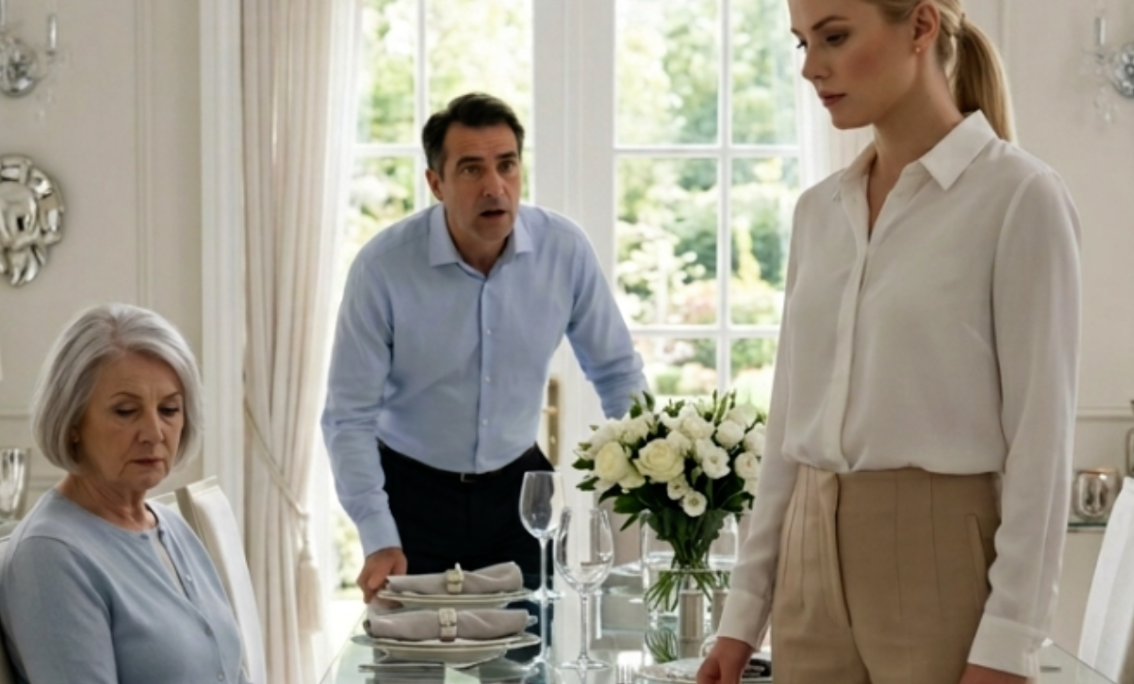
The damp cleaning cloth hit my sweater with a muted, insulting thud before sliding in slow motion down to the pristine, polished kitchen floor.
For one singular, breathless second, the entire room was frozen in a tableau of sudden violence—not physical violence, but a profound violence of the spirit. Nobody moved. Not my son, Kevin, who stood perfectly still beside the massive marble island, his knuckles turning white as his fingers gripped the delicate stem of his wine glass. Not Victor and Elaine, my daughter-in-law Crystal’s parents, who sat comfortably beneath a sprawling modern chandelier that cast cold, geometric shadows across the long dining table.
And certainly not Crystal herself.
Crystal stood enveloped in a cream silk blouse, her makeup completely flawless, her posture impossibly rigid. She looked at me not as a mother-in-law, not even as an invited guest, but as if she had casually tossed a soiled napkin to a hired servant who had somehow forgotten her place.
“Wipe the floor, Margaret,” she commanded.
Her voice was horrifyingly calm. That deliberate calmness is what made the moment so deeply sinister. Had she shouted, it would have been a recognizable ugliness, a sudden outburst of temper that everyone in the room could quickly categorize, judge, and condemn. But this was polished cruelty. It was a precise, calculated strike masquerading as simple instruction, the kind of terrible, lacerating behavior that effortlessly slips past the boundaries of polite society simply because no one possesses the raw courage to identify it aloud.
The inciting incident had been utterly trivial: a thin ribbon of red pasta sauce had splattered near the lower cabinets after Crystal accidentally knocked a serving spoon off the counter. Any functioning adult standing two feet away could have bent down, swiped it up, and forgotten the entire matter in ten seconds. Instead, she chose to weaponize the accident.
She did not reach for the cloth. She threw it directly at me.
I turned my eyes to my son. Kevin, my only child—the sweet-natured boy I had carried through childhood fevers, the crushing grief of his father’s early death, the terrifying mountain of school loans, and endless lonely Christmas mornings—stood entirely paralyzed. His mouth opened slightly.
“Crystal,” he whispered.
It was a plea, not a defense. It was the pitiful sound of a man asking for permission to object and being decisively denied before the sentence even finished. I looked at his face and saw deep shame bloom in his eyes long before sorrow or anger ever arrived. That realization cut me far deeper than the damp cloth ever could.
Slowly, deliberately, I bent down. I picked up the rag and wiped the bright red sauce from the expensive tile. I did not do this because she had the right to order me around, nor because I believed for one fractured second that my proper place was on my knees in her kitchen. I did it because experience had taught me a profound lesson: some rooms and some situations will reveal the absolute truth of a person’s character when they believe you possess absolutely no power over them.
What Crystal Martinez failed to understand in her moment of manufactured triumph was a reality securely documented in a quiet attorney’s office just twenty-four hours earlier. I had signed the final binding papers that gave my modest family investment company controlling ownership of BrightGate Solutions.
Her company. The absolute cornerstone of her identity.
By Monday morning, the stable earth beneath her high heels was going to crack wide open.
My name is Margaret Ellis. I am sixty-one years old, and my invisibility is my greatest asset. Most people who pass me in the grocery store or the library do not look twice, and that dynamic has always suited me perfectly.
I reside in a humble, two-bedroom apartment positioned directly above an independent pharmacy on the quieter side of downtown Millbrook, Ohio. My life is defined by small, deliberate choices: a narrow balcony adorned with three pots of vibrant geraniums in the summer, yellowing kitchen cabinets that have seen decades of honest use, and a sturdy oak table purchased secondhand when Kevin was merely nine years old. I drive a fifteen-year-old Toyota Camry, marked by a noticeable dent near the passenger door, which starts faithfully every morning—a reliability that far exceeds that of many people I have encountered in my lifetime.
I do not dress like money. I do not speak like money. I consciously choose not to broadcast wealth because I despise the way financial leverage warps human interaction.
My late husband, Robert, shared this fundamental philosophy. He was an extraordinarily capable man who could dissect a complex corporate balance sheet, repair a broken furnace, and balance a spoon on his nose to make a weeping child laugh. Together with his older brother, Robert owned a manufacturing firm producing unglamorous but essential security sensors for nursing homes. When he passed away and his shares were eventually acquired by a larger conglomerate, the financial windfall was substantial.
Society automatically assumed the money had vanished into the abyss of medical bills and widowhood. I permitted that convenient illusion to flourish. The capital was quietly funneled into a trust, growing steadily in conservative, resilient investments managed by M.E. Holdings. I continued to clip coupons, kept my beloved job at the local library, and instilled in Kevin the belief that while physical comfort is a blessing, personal dignity is a non-negotiable requirement for a life well-lived.
However, in my fierce dedication to shielding him from the devastation of loss, I may have inadvertently failed to equip him for conflict. Kevin was born with a profoundly tender heart. As a boy, he possessed a deep, almost painful empathy, shrinking from confrontation the way others recoil from fire. If a classmate forgot their lunch, Kevin split his sandwich without ever needing to be asked.
This inherent sweetness became his greatest, most tragic vulnerability when he married Crystal.
Crystal was the grand architect of her own perfection. She was a woman of expensive, tightly controlled beauty—tall, sharp-cheekboned, her conversations entirely structured like aggressive corporate pitch decks. As the chief growth officer at BrightGate Solutions, a tech firm servicing the elderly, she viewed the world strictly through a merciless lens of utility and acquisition.
In the beginning, I desperately tried to find genuine affection for her. I truly did. But her cruelty was insidious, constantly delivered wrapped in layers of polite tissue paper. She would softly mock my homemade casseroles for arriving in Pyrex, casually discard my handmade Christmas gifts into side-table oblivion, and subtly belittle Kevin’s upbringing directly in front of me. Kevin noticed every single slight; his shoulders would tense, his eyes would dart away. Yet, he repeatedly chose the false peace of silence over the turbulent necessity of defending his mother. “She doesn’t mean it that way,” he would rationalize in the driveway, and I, bound by a mother’s instinct to protect her child’s fragile reality, would falsely agree.
The invitation for that fateful Saturday dinner had been extended by Kevin, his voice brimming with a desperate, familiar eagerness. I responded by baking Robert’s favorite chocolate chip cookies—an old, heavy recipe featuring a defiant pinch of cinnamon. I carefully packed them in a pristine white bakery box to appease Crystal’s disdain for anything overly “homemade.”
Upon arriving at their immaculately staged home in the sterile, manicured subdivision of Pine Valley, the evening’s true nature quickly revealed itself. It was not an intimate family gathering. Crystal’s parents, Victor and Elaine, had descended upon the house, transforming the atmosphere into an exclusive country club lounge where I was merely an unwanted interloper.
Crystal greeted me with the artificial warmth of a corporate hostess facing a minor inconvenience. When I offered the warm cookies, she dismissed them instantly, noting they already possessed dessert from a high-end French bakery. The cookies were relegated to the counter—a symbolic rejection of my presence and effort.
The dinner itself was a masterclass in psychological diminishment. Elaine scanned my worn navy cardigan and simple pearl earrings with practiced disdain, while Victor regaled the table with tedious stories of country club board disputes. Crystal dominated the conversation, steering it toward their lavish plans for a bathroom remodel, explicitly stating that “cheap updates cost more in the long run”—a barb clearly directed at my frugal lifestyle.
I attempted to inject a note of genuine familial warmth, reminiscing about Kevin’s childhood love for baked macaroni and cheese. Crystal immediately suffocated the memory. “Luckily, I’ve expanded his palate,” she declared, her laughter tinkling like breaking glass.
“There is nothing wrong with expanding,” I countered evenly, finally setting down my fork. “As long as you do not become ashamed of where you started.”
The ensuing silence was thick and heavy, only broken by the buzzing of Crystal’s phone.
She retreated to the kitchen, but the open-concept architecture betrayed her. Her panicked, hushed voice echoed into the dining room. BrightGate Solutions was in severe financial jeopardy. She berated her colleague, Sarah, over the phone, complaining bitterly about an impending board review and the desperate need for bridge financing.
“And don’t mention M.E. Holdings again,” she hissed contemptuously. “It’s probably some retired dentist playing investor. We need serious money, not sentimental small-town people who want a tour of the office.”
My hands folded quietly in my lap. M.E. Holdings was my namesake. Margaret Ellis.
Months prior, BrightGate’s aging founder, Henry Caldwell—a man who once did honorable business with my late husband—had reached out to me in deep despair. His company, originally designed to provide vital, dignified scheduling and security tools for senior care facilities, had been corrupted by aggressive executives like Crystal chasing unsustainable valuations. I had spent weeks scrutinizing the financials, employing seasoned analysts to peel back the glossy layers of corporate deceit. BrightGate possessed inherent value, but its current leadership was driving it toward a sheer cliff.
I had executed the purchase agreement the previous afternoon. Monday’s board meeting was destined to be a brutal reckoning.
When Crystal returned to the table, her composure was visibly fractured. Minutes later, the serving spoon fell, the red sauce splattered across the floor, and the damp cleaning rag was hurled into my chest.
In that crystallized moment of humiliation, as Kevin murmured her name in a pathetic whisper, a profound shift occurred within me. The lingering hopes I harbored for their marriage evaporated. I wiped the floor, folded the cloth with meticulous precision, and retrieved my purse.
Kevin chased me to the front porch, begging me not to leave, offering hollow apologies for his own paralysis.
“I love you more than any person on this earth,” I told him, standing under the amber glow of the neighborhood streetlights. “But love does not require me to stand in your house and be treated like a servant so your wife can feel powerful.”
Monday morning arrived cloaked in a crisp, unforgiving light. I dressed with deliberate simplicity: a tailored charcoal dress, practical low heels, and the pearl earrings Robert had gifted me on our tenth anniversary. I steered my battered Toyota into the parking lot of BrightGate’s sleek, renovated warehouse headquarters.
The young receptionist initially regarded me with the polite, dismissive uncertainty reserved for women who do not fit the expected aesthetic profile of important corporate visitors. But when she cross-referenced my name with the morning’s executive schedule, the sudden, terrified widening of her eyes was the very first ripple of the impending earthquake.
Henry Caldwell greeted me at the elevator. “Ready?” he asked, his voice rough with exhaustion.
“No,” I replied truthfully. “But I am here.”
The boardroom was an expansive cathedral of glass and steel overlooking the river. I took my seat next to my attorney, David Langford, who meticulously arranged the legal bindings of my absolute authority on the table.
At exactly 8:58 a.m., Crystal marched into the room. She was armored in a pale blue suit, carrying a tablet, projecting an aura of absolute invincibility. Then, her eyes locked onto me.
For the very first time in our tumultuous history, her meticulously curated mask shattered entirely.
“What is this?” she demanded, completely ignoring Henry’s polite greeting. “Why is my mother-in-law here?”
David’s voice was as steady and relentless as a metronome. “Mrs. Ellis is here as the managing member of M.E. Holdings. As of the close of business Friday, she represents the majority voting shareholder of BrightGate Solutions.”
Crystal’s face drained of color, a slow, horrifying realization pulling the features tight across her sharp cheekbones. She turned wildly to Henry. “You sold control of this company to Kevin’s mother?”
“I sold control to someone who believes it can still be saved,” Henry corrected softly.
Shock rapidly morphed into fury. Crystal pointed an accusatory finger at me. “This is because of Saturday night. You are doing this out of spite.”
The room plunged into an absolute, ringing silence. I leveled my gaze at her, feeling a profound, chilling clarity.
“No, Crystal,” I stated, my voice echoing evenly off the glass walls. “Saturday night did not magically manifest the abysmal reports in this folder. It did not create your missed support targets, your drastically inflated client acquisition forecasts, or the massive employee turnover you have overseen. Saturday night simply confirmed my worst fears: the profound rot within this company’s culture originates at the very top.”
The meeting proceeded with brutal, clinical efficiency. Crystal was summarily stripped of her executive authority pending an extensive independent review. She was relegated to a non-leadership advisory role, utterly devoid of all operational control. She attempted to argue, invoking the supposed loyalty of her staff, only to be immediately silenced by a damning stack of anonymous, highly critical exit interviews produced by her own colleague, Sarah.
Finally, entirely devoid of leverage, she resorted to the personal. “You didn’t even tell your own son?”
“I protected my son from an impossible conflict of interest,” I replied firmly. “I did not use my child as a messenger in a business transaction.”
She left the boardroom a diminished figure, her boundless ambition dismantled not by malice, but by the undeniable, heavy consequences of her own arrogance.
When the corporate dust settled, the personal fallout began. Kevin called me, his voice trembling with a chaotic mixture of shock, betrayal, and awe. He arrived at my apartment that evening, still in his work clothes, clutching the very same box of chocolate chip cookies from the disastrous dinner—a physical artifact of our fractured dynamic.
He broke down right there in my hallway. At twenty-nine years old, he wept with the unrestrained, desperate sorrow of a man realizing the world is far darker than he had been led to believe. I pulled him inside and held him while he shook.
When we finally sat at my weathered oak table, I refused to let him offer vague, blanket apologies. I forced him to articulate exactly what he was sorry for.
“I’m sorry I let her talk down to you for two years,” he confessed, staring deep into his coffee mug. “I kept calling it stress. Or high standards. But I knew what it was. It was cruelty.”
“Cruelty is confusing when it is inconsistent,” I told him gently, reaching across the table to take his hand. “If someone is awful every minute, leaving is easy. It’s the nice mornings and the quiet apologies that keep people doubting themselves.”
The following morning, Crystal arrived at my door, hiding behind oversized sunglasses, armed with a carefully scripted, entirely superficial apology. She attempted to compartmentalize her toxic behavior, begging me to separate her personal disrespect from her professional status.
“Pushing people off a ledge is not leadership,” I informed her coldly. “A company designed to serve the elderly should not be commanded by a woman who views older individuals as disposable unless they serve her immediate ambitions.”
Her facade cracked, revealing raw, unadulterated fear. But the true turning point of the morning did not belong to me; it belonged to Kevin, who suddenly appeared on the stairwell behind her.
When Crystal commanded him to intervene and silence his mother, Kevin finally found the immense strength that had been buried beneath years of capitulation.
“No,” he said, his voice trembling but undeniably resolute. “I am not doing that anymore. I am not cleaning up what you break and calling it peace.”
He chose, in that vital moment, to step out from beneath the crushing weight of her expectations. He moved into my spare bedroom, and they eventually began counseling before deciding to separate. It was not a joyous occasion—divorce is always a tragedy of failed hopes—but it was a necessary excision of poison from his life. Slowly, beautifully, he began to laugh again at ordinary things: burnt toast, bad weather, the simplicity of a quiet Saturday.
Months later, Kevin and I sat in a bustling, unpretentious local diner near the courthouse. He looked remarkably lighter, unburdened by the constant, exhausting need to manage his wife’s volatile ego.
“I wish I had known you were that powerful,” he murmured over a shared slice of cherry pie.
I offered a gentle smile. “You did know. I raised you alone. I fought through immense grief and financial terror to keep a roof over our heads. I made Christmas happen when I wanted to disappear under the covers. Money is merely a useful tool, Kevin. It was never the primary source of my power.”
He understood then. The power was never located in the bank account; it was anchored in the quiet, unyielding refusal to be broken.
I still drive my fifteen-year-old Toyota. I still reside in the modest apartment above the pharmacy, tending to my geraniums and baking in a kitchen with fading yellow cabinets. I am still Margaret Ellis, a woman most people pass on the street without a second glance.
But in the spaces that truly matter, everything has irreversibly transformed. Never again will I be handed a rag and told to scrub another person’s floor, and never again will my son stand in silence while the people he loves are diminished.
A person can spend years being underestimated so quietly that they begin to mistake it for invisibility. But the quietest people often hold the most profound power; they are simply waiting for the right moment to wield it.