
Morning light angled through the yellowed curtains of my Leander, Texas living room, illuminating the framed photographs that anchored me to a vanished life. I am seventy-three. My name is Weston Peton. Once, I taught philosophy at a small college outside Austin; now, I am merely the quiet custodian of the silence my wife, Alma, left behind. My fingers brushed the glass over her smile, searching for the young man she had loved, finding only the topography of age on my own face.
This modest one-story house, built with my own hands, used to brim with the scent of cooling bread and the warm cadence of arguments over literature. Now, it was a mausoleum of books. They were stacked on tables, lining the hallways, rising like paper stalagmites beside my favorite reading chair. “My bookworm,” Alma would whisper, kissing my temple as she found me dozing over a heavy text. They were my only remaining companions.
The ache in my knees was a daily reminder of time’s quiet theft as I navigated the kitchen. The ritual of tea—porcelain cup, stringed bag, boiling water—offered a fragile illusion of order in a world that had lost its center. Through the window, I often saw Abby, the Bridgers’ young daughter from next door. She was the only one who listened to my retellings of Plato with wide-eyed wonder, treating ancient dialogues like fairy tales.
I deeply wished my own son, Keith, possessed even a fraction of that wonder. Born Katon, he had adopted the sharper, more pragmatic moniker in college. At forty-five, he was a corporate strategy consultant in Austin—calculating, polished, and perpetually embarrassed by his father’s gentle existence in the realm of ideas. Alma had warned me that my softness might ill-prepare him for reality, especially after she passed when he was still young enough to need her voice at bedtime.
Three years ago, Keith married Violet Hyde, an image consultant whose smile was as manicured and superficial as her wealthy clientele. She systematically distanced him from me. I became an “old-fashioned” relic. Their visits dwindled to begrudging holiday drop-ins, culminating in a Christmas where Violet ran a judgmental, assessing finger over my dusty shelves. They had casually suggested a “budget-friendly” senior living facility, their eyes darting around my home, clearly tallying its market value. I had firmly refused. I assumed my house was my only asset of worth. I was entirely, fundamentally wrong.
The revelation arrived in a crisp white envelope. It was from Roland Pierce, the executor for my old graduate-school friend, Edmund Rochester. Edmund and I had bonded over philosophy and literary history; while I remained in Texas, he had built a brilliant academic career on the East Coast, a lifelong bachelor devoted entirely to his scholarship and his collection of rare editions.
I unfolded the thick paper, my eyes scanning the formal type.
Dear Mr. Peton, I regret to inform you of the passing of Professor Edmund Rochester on April 3 of this year. In accordance with the terms of his will, Professor Rochester has bequeathed to you his personal collection of first editions of nineteenth-century British poetry, comprising thirty-seven volumes. The collection will be delivered to your address within one month of receiving your written confirmation of acceptance.
I stood by the window, a habit honed from decades of teaching when a profound thought required the horizon to anchor it. I had seen only glimpses of Edmund’s collection at conferences—handmade leather bindings, gold embossing, immaculately preserved pages. I was no antiquarian, but even I knew thirty-seven such volumes could represent a staggering sum. My pension forced a deeply frugal existence, where every dollar was weighed against utility bills and medication.
“What would you say, Alma?” I whispered into the empty room. I could almost hear her low, warm laugh: See, Weston? Your love of books finally paid off.
The shock of the letter was quickly followed by an even stranger occurrence: the phone rang, displaying Keith’s number. He rarely called, let alone on a weekday.
“Dad,” his voice was strained with artificial cheer. “Violet and I were thinking. My birthday is coming up. Why don’t we take you out to dinner? The Azure, downtown.”
Keith’s birthday was May 25th. Historically, this meant a brief phone call and a mailed gift card. An invitation to an expensive restaurant felt distinctly dissonant.
“The three of us?” I asked, suspicion tightening my chest.
“A change of scenery would do you good,” he insisted, impatience bleeding through the cheer, before quickly ending the call.
Had he found out? Alma used to claim I trusted too easily, seeing the good in everyone to a fault, but old age had cultivated a necessary layer of caution. I folded the attorney’s letter and slipped it into my copy of Marcus Aurelius’s Meditations—a philosophical sanctuary Keith would never breach.
Seeking counsel, I called Irene Foster, a retired colleague who consulted at an antiquarian bookstore. When I casually mentioned Edmund’s collection, her sharp intake of breath was audible through the receiver.
“First editions of Keats, Byron, Shelley?” she said, her voice laced with sudden awe. “Weston, collections like that are legendary. They can command six figures at auction. Sometimes much more. Take your time. Let me see them when they arrive.”
Six figures.
The phrase echoed in the quiet rooms of my house. Fate had suddenly handed me the means to erase every financial worry overnight. Yet, the gift came burdened with profound dread. Such wealth would inevitably attract the ravenous attention of my son and his wife, who had always been deeply interested in my finances and pointedly uninterested in my loneliness.
I prepared for the dinner with meticulous, albeit impoverished, care. I purchased a pair of silver and sapphire cufflinks for $199—nearly a tenth of my monthly income—ignoring the sharp sting of the expense in the desperate hope of bridging the chasm between us. I dry-cleaned my only suit, shined my weary shoes for an hour, and tried to quiet the anxiety fluttering in my ribs like a trapped bird.
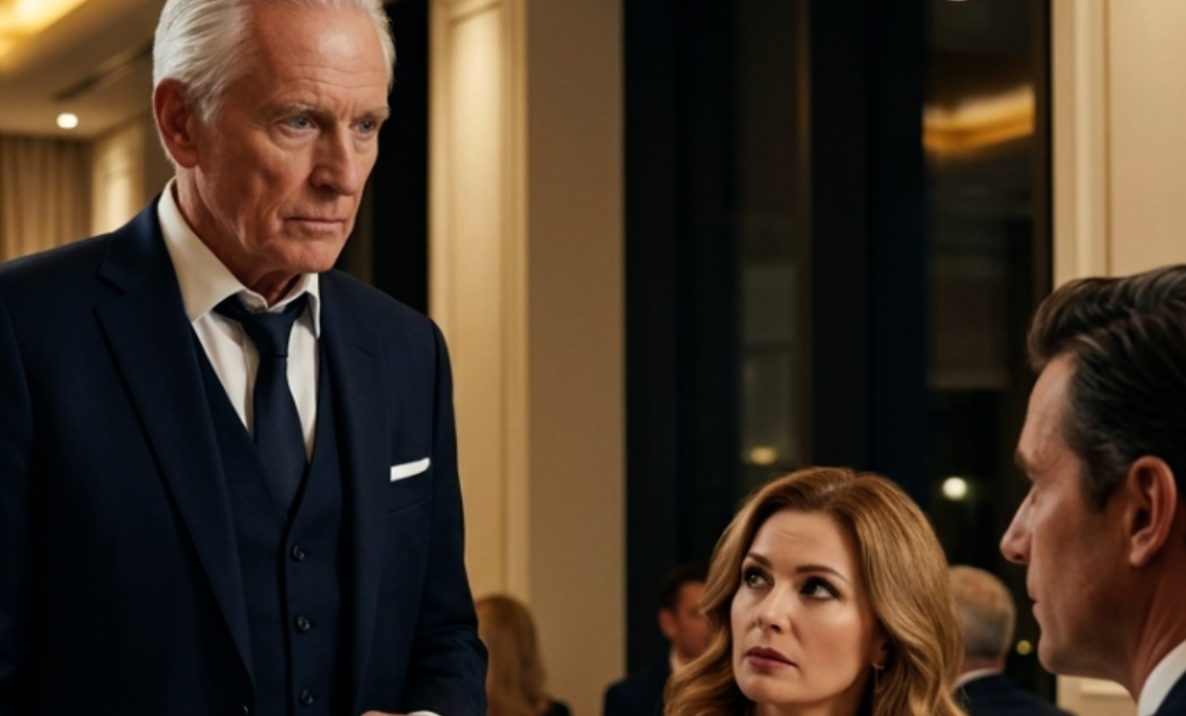
The Azure was a bastion of modern opulence, a place where crystal chandeliers reflected off the river outside, far removed from the dust of my library. Arriving early to avoid giving them a reason to criticize me, I found Keith and Violet already seated, immersed in their own polished, exclusive world. Violet looked immaculate in a burgundy dress; Keith wore a tailored suit that likely cost half my yearly pension.
“Happy birthday, son,” I said, offering the meticulously wrapped blue box.
He barely glanced at it, setting it aside as Violet murmured a condescending remark about how vintage accessories were quaint but modern aesthetics mattered more for Keith’s clients. They had already ordered an expensive bottle of wine and visually artistic, tiny appetizers. The conversation quickly devolved into a thinly veiled appraisal of my fragility. Violet probed about my health, seamlessly pivoting to a sales pitch for upscale senior communities, masking her greed as concern. They boasted of their prospective six-figure consulting contracts and their desires for a larger suburban home, casting a deliberate shadow over my modest, fixed-income existence.
Then, as the minuscule, overpriced main courses were cleared, the trap snapped shut.
“So, Dad,” Keith leaned forward, his casual tone utterly transparent. “You said you had some news. Received an important letter, didn’t you?”
I chewed a small piece of meat slowly. Let him wait.
“An old friend, Edmund Rochester, left me a memory. A few books.”
“First editions,” Keith pressed, exchanging a sharp glance with Violet. “They might be worth something. You should sell them. Extra money could help with medical expenses.”
“I may keep them,” I replied softly. “Books are not commodities to me.”
Violet scoffed, her veneer of patience cracking entirely. “Be practical, Weston. What will you do with rare books? Read them before bed? They should be useful to the family. Keith is your only son. We’re planning a big future. A house, maybe children.”
Children. In three years, they had never mentioned wanting a family. Now that money was in the room, unborn grandchildren were conjured as negotiating chips.
The check arrived in a heavy leather folio. Keith did not touch it. He pushed it toward me. “Do you mind, Dad? After all, it’s your birthday present to me.”
I opened it. The total was astronomical, nearly half my monthly pension. As I slowly withdrew my worn credit card, Keith smirked, thoroughly enjoying my hesitation.
“Prices here are steep,” he said, smiling wider. “But you can afford it now, right? Let’s face it, Dad. You’re seventy-three. How much time do you really have left? Ten years? Fifteen if you’re lucky? Violet and I are just starting our lives.”
He was openly, shamelessly calculating my depreciation. To them, I was already a ghost, an inconvenient obstacle delaying the transfer of property.
Keith watched my hand tremble as I signed the ruinous receipt. He leaned back and muttered to Violet, quiet enough for the restaurant but loud enough to ensure the blade struck my heart: “Why do I need a father like that?”
Decades of excuses evaporated in an instant. The man sitting across from me was not the little boy I had taught to read. He was an adult who had deliberately chosen his own character. I stood up slowly, squaring my hunched shoulders.
“I have always been proud that I raised you,” I said, my voice quiet but resonating with absolute firmness. “I tried to teach you knowledge, kindness, and dignity. Apparently, I failed.”
I looked down at their stunned, suddenly uncertain faces. “As for the books, I met with an expert. They are worth more than you will earn in ten years of your successful career. And I have learned something else tonight. Something you have no idea about.”
I left them sitting in the cold glow of their own stunned silence. The cab ride home in the rain felt less like an ending and more like a profound unburdening. I was no longer a victim.
The next morning, driven by a newfound, iron-clad resolve, I walked into Pages of Time, the antiquarian shop where Irene worked. Surrounded by the comforting scent of old paper and polished mahogany, she poured tea and revealed the results of her late-night research.
“Edmund was rumored to possess a first edition of Keats’s Lamia from 1820, signed by the author,” she explained, tapping a dense file of academic articles. “If true, Weston, that single volume could fetch hundreds of thousands. The whole collection? If the provenance is right, it might be worth millions.”
Millions. The word felt absurd, totally untethered from the reality of a retired philosophy professor. But when I recounted the dinner at The Azure, the cruel calculations of my son, Irene’s gaze hardened into fierce, protective solidarity.
“Edmund left those books to you. Not to Keith,” she stated unequivocally. “It is time to live for yourself.”
I acted swiftly. I rented a secure bank deposit box and consulted Gerald Hawkins, a former student turned sharp estate attorney. He assured me of my absolute legal right to the collection, suggesting an irrevocable trust to protect the assets from any future claims my son might attempt to mount.
When the six crates finally arrived, delivered by uniformed couriers, I opened the first one in reverent, profound solitude. Inside lay a dark green leather volume: Poems by George Gordon, Lord Byron, printed in London, 1817. I held two centuries of unbroken history in my trembling hands.
Soon after, Irene arrived with Harrison Phelps, a preeminent, meticulous rare-book appraiser. With white cotton gloves, magnifying loupes, and specialized measuring tools, they confirmed the impossible. The preservation was flawless; the provenance was impeccable.
“Three to four million dollars,” Harrison murmured hours later, carefully removing his glasses. “Perhaps significantly more at the right specialized auction.”
Within twenty-four hours, the books were transferred to a climate-controlled, highly secure vault. That evening, Keith appeared on my porch with a bottle of wine and a painfully strained smile, feigning concern while his eyes darted to my empty living room. He wanted to help “manage” the books. I told him I had already hired a respected expert.
“You didn’t come to me?” he asked, his eyes narrowing in offense.
“I remembered what you said at dinner,” I replied smoothly. He tried to backtrack, claiming the alcohol was to blame, but the conviction was gone. I simply closed the door on his excuses.
The months that followed fundamentally dismantled the architecture of my isolation. I kept only one Keats volume temporarily, and while reading it in a local park, I met Eleanor—Nora—a retired pediatrician with lively brown eyes and a sharp intellect. She noticed the poetry and invited me to a local book club. Suddenly, my life was populated by people who valued intellect over income. I joined a community garden; I engaged in debates about history; I rediscovered the cadence of genuine, unforced laughter.
When the Sotheby’s auction finally took place, I sat in the front row alongside Irene and Harrison as collectors worldwide fought over Edmund’s legacy. Keats’s Lamia sold for $780,000. Byron’s poems brought $450,000. The gavel fell again and again, culminating in a breathtaking total of $4.6 million. After taxes and commissions, my newly formed trust held over three million dollars.
I bought a beautiful, accessible first-floor apartment flooded with morning light. I funded scholarships for philosophy students, donated heavily to the library, and financed the community garden. Above all, I purchased my independence—the absolute liberty to exist without financial terror, without the humiliating necessity of begging for my son’s fractured, conditional attention.
Two weeks after the auction, Keith ambushed me at my old house as I prepared to finalize my move. He was frantic, furious that I had sold the collection without his oversight.
“I’m your blood!” he shouted, storming into the hallway, his face twisted in genuine rage. “Violet and I had plans!”
“You had plans for my money, Keith. Not for me,” I answered calmly.
When Violet arrived, immaculate but clearly panicking, I stood my ground. “I have placed the funds in a trust. You have no access.”
Keith threatened to sue, to prove I was manipulated by Irene and the experts. I calmly listed the medical evaluations of my capacity, the legal safeguards Gerald and I had installed, and the documented evidence of his financial predation.
“You know nothing about me,” I told them, staring down my only child. “Name my favorite book. Name one thing about me that isn’t intimately tied to my health or my property.”
They stood in echoing, devastating silence.
“I am leaving you enough in my will that you won’t starve, distributed in modest monthly stipends,” I continued, my voice unwavering. “But I will no longer buy crumbs of your affection. My door is open to a son who wants a relationship, but it is firmly closed to an heir waiting for a payout.”
Keith spat a final, bitter warning that I would die lonely with my wealth, but as their car pulled away from the curb, I felt no sorrow. I felt only a profound, crystalline peace.
In October, Nora and I traveled to Greece. We walked the sun-bleached stones of the Acropolis, the impossibly blue Aegean Sea glittering below us. Standing exactly where the philosophy I had taught for decades was born, accompanied by a woman who cherished my mind, I realized I had finally shed the suffocating skin of my past.
An email from Keith arrived upon my return. It was cautious, mentioning that he had begun therapy to address his relationship with money and family. He made a hesitant request for a phone call. I thought of the bright-eyed boy he had once been, and I replied simply:
Yes. You may call. I will listen. The rest is up to you.
In my new, sunlit study, surrounded by books I had chosen without consulting a rigid budget, I looked at the framed photograph of Alma. Her eyes seemed to dance with quiet, validating triumph. I had spent decades sacrificing, yielding, and making myself small. But at seventy-three, I had finally reclaimed the authorial rights to my own narrative. I had learned, at last, how to truly live.
