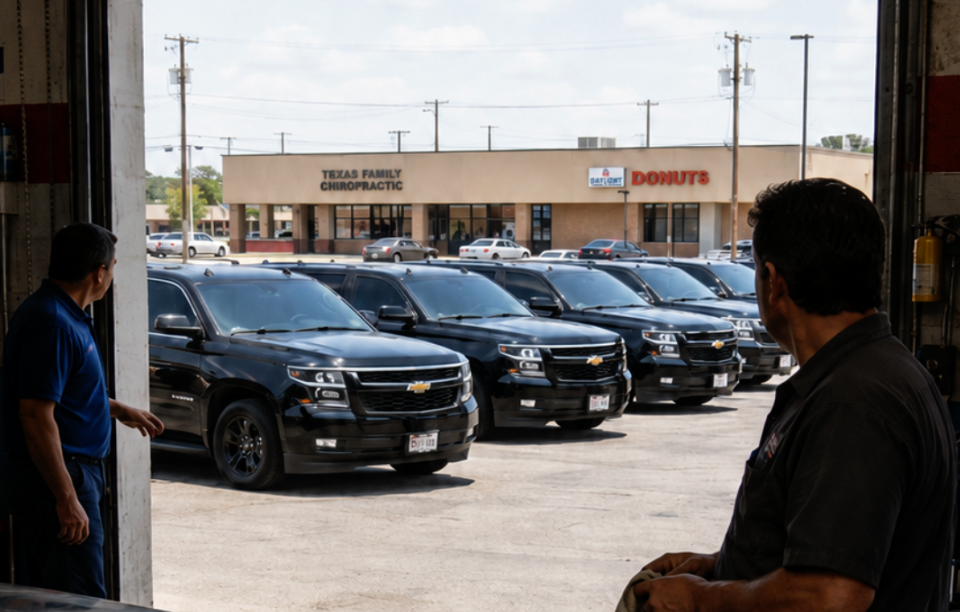
People in the sun-baked, wind-scoured town of Harlo called Isaac Merritt the junk mechanic because he possessed the rare, quiet grace of fixing what the rest of the world had summarily abandoned.
They had said it with a laugh at first, testing the syllables the way small towns test a nickname before deciding whether it will stick to a man’s ribs. Then, as the seasons turned and the dust settled, the laugh hardened into an unthinking habit. The junk mechanic. He was the solitary figure with the battered, sun-bleached garage at the frayed edge of Route 12, the one who patiently labored over cracked engine blocks, seized pistons, rusted agricultural equipment, and battered farm pickups that proper, air-conditioned shops turned away before the drivers had even finished articulating the nature of the rattle.
Isaac never bothered to correct them. He had learned years ago, in rooms far colder and vastly more expensive than his garage, that people who fundamentally needed to make you smaller were rarely asking for more information.
His garage sat on a dusty, unforgiving strip of asphalt just outside Harlo’s municipal limits, wedged stubbornly between a towering grain storage shed and Harlo Premier Auto. The latter was a polished, aggressively modern establishment complete with crisp blue uniforms, sliding glass doors, and a climate-controlled lobby that perpetually smelled of synthetic tire shine and corporate-roast coffee. Isaac’s place boasted no such lobby. There was no laminate customer counter. There was no flat-screen television mounted on a sterile wall, endlessly looping daytime news with the volume muted. There was only a rusted corrugated roll-up door, a cracked concrete floor permanently darkened by thirty years of spilled oil, heavy steel tool chests dented in places that held geographical memory only to him, and a battered transistor radio perched on a high, sagging shelf. Every morning, before the Texas sun began to push its oppressive, suffocating heat through the aluminum roof panels, that radio played low, scratchy jazz broadcast from somewhere deep in San Antonio.
The building had belonged to his father long before the deed ever carried Isaac’s name. Ray Merritt had constructed it with salvaged steel beams, secondhand industrial lumber, and an almost geological stubbornness. Ray was not a sentimental man, at least not in any outward vocabulary that declared itself to the world. When Isaac was ten years old, Ray taught him how to sort galvanized bolts purely by feel, blindfolded, reaching into an old Folgers coffee can. When Isaac turned thirteen, his father made him completely rebuild a gummed-up carburetor twice in a single afternoon because the first attempt merely “worked” and the second attempt “worked right.” When Isaac was sixteen, Ray had wiped his greased hands on a rag, looked his son dead in the eye, and delivered the only theology he knew: “An engine doesn’t need anybody to believe in it to run.”
Isaac had not fully understood the weight of that sentence then. He understood it intimately now.
At exactly seven o’clock on a Tuesday morning in late September, Isaac was flat on his back, wedged beneath the undercarriage of a 1995 Ford F-150. The truck belonged to Raymond Coker, a retired middle school teacher who had patiently taught half the population of Harlo how to do long division, and who still drove the exact same vehicle he had purchased the year his daughter entered high school. Harlo Premier Auto had inspected the vehicle the day before, quoted Raymond a repair figure that exceeded the truck’s Kelley Blue Book value by a thousand dollars, and smoothly suggested he “consider upgrading to a newer model.” Raymond had quietly taken his keys and driven directly across the road to Isaac.
Isaac had the heavy cast-iron exhaust manifold half-seated, his left arm reaching awkwardly around the rusted frame to thread a blind bolt, when Dale Hutchins arrived for work next door.
Dale owned Harlo Premier Auto, and he had spent the better part of the last six years meticulously polishing every aspect of his business that Isaac did not. His shop featured branded uniforms; Isaac wore faded flannel work shirts permanently darkened at the cuffs. Dale offered tiered, heavily marketed “service packages”; Isaac offered Folgers coffee simmering in an ancient pot and a wall calendar from a defunct parts supplier that was two years out of date. Dale employed eager technicians who reliably laughed whenever he laughed; Isaac employed silence.
“Merritt working on Raymond’s old death trap again,” Dale called out, his voice carrying easily across the low, rusted chain-link fence separating the two properties.
Three of Dale’s mechanics paused their diagnostic work on a pristine, late-model SUV and looked up.
Dale continued, projecting his voice loud enough to ensure the punchline landed. “Man spends more time under junk than a raccoon.”
The mechanics chuckled exactly on schedule, a practiced chorus of corporate loyalty.
Isaac heard every single word. Beneath the chassis, he tightened the blind bolt another quarter turn, feeling the threads bite and hold. He said nothing. There were a great many things he could have said. He could have calmly informed Dale that Raymond’s meticulously maintained engine block had another hundred thousand miles left in it, provided it was treated with respect. He could have pointed out that Harlo Premier Auto habitually replaced entire integrated systems simply because it was vastly faster than taking the time to understand why a specific component had failed. He could have noted that men who laughed at old, enduring machines invariably lacked the patience required to learn from them.
He said none of that. Over the course of his life, silence had served as a far superior armor than defense.
By eight-thirty, the Texas heat had already begun rising from the asphalt in shimmering, hallucinatory waves. Isaac had crawled out from beneath the Ford twice—once to check the manifold clearance from above, and once to drink a cup of coffee that had gone lukewarm in a ceramic mug sporting a chipped handle. The San Antonio jazz hissed softly from the overhead radio, a muted trumpet solo fighting through the static. A local delivery van rattled past on the highway. Somewhere closer to the town center, a dog barked with rhythmic persistence, sounding deeply offended by its own existence.
Isaac had just wiped a streak of lithium grease from his hand when he heard the heavy, synchronized shift of gravel.
It was not the lazy, meandering crunch of a single local pickup truck pulling in for an oil change. It was the sound of multiple vehicles. They were heavy. They were precise.
Isaac slowly turned his head. Three immaculate, black Chevrolet Suburbans rolled into his dirt lot in a flawless, staggered line. They parked horizontally across the entrance, blocking the exit entirely, as if the drivers had spent weeks rehearsing the geometric shape of their arrival. The massive engines remained running, a low, powerful hum vibrating the loose stones. The windows were tinted dark enough to reflect the pale, cloudless morning sky, revealing nothing of the interiors. There were license plates on the bumpers, but they were not the standard Texas issue Isaac saw every day. They were stark, unreadable government plates—objects of pure function utterly devoid of regional identity.
Across the chain-link fence, Dale Hutchins abruptly stopped talking mid-sentence.
Isaac carefully draped his rag over the edge of his tool cart.
A heavy door opened on the middle Suburban. A woman stepped down onto the unforgiving gravel. She wore low, sensible black heels that immediately sank a fraction of an inch into the soft, oily shoulder of the lot. She appeared to be in her early forties, possessing dark hair cut with severe precision precisely at her jawline. She wore a tailored, slate-gray suit that looked as though it did not belong within thirty miles of Harlo’s dust, and she carried herself with the rigid posture of someone intimately accustomed to being questioned long before she was ever heard. She walked directly across the lot without casting a single glance toward Dale’s pristine shop, without hesitating at the sprawling oil stains, and without demonstrating the slightest discomfort in the mounting heat.
Isaac remained standing beside Raymond’s battered truck. He had black grease smeared across one muscular forearm, and his hands hung loose and relaxed at his sides.
The woman stopped exactly three feet away. Without preamble, she opened a leather credential wallet and held it out.
“Mr. Merritt,” she said. Her voice was flat, carrying the unmistakable cadence of authority. “I’m Elena Voss.”
Isaac let his eyes drop to the credential. He saw a blue federal seal. He saw the stylized orbital arc logo. Federal Launch and Orbital Programs. Director of Systems Engineering.
He looked past her, studying the idling Suburbans. “You bring a tactical escort for everyone you ask to visit a garage?”
“I brought engineers,” Voss corrected smoothly.
“They always wait inside the vehicles with the engines running?”
“They wait when I explicitly ask them to.”
She did not offer a polite, disarming smile. Isaac fundamentally respected that. In his experience, people navigating deeply difficult or compromised situations often smiled far too much, operating under the desperate delusion that basic politeness could somehow render a catastrophic urgency less real.
Isaac leaned his weight back against the Ford’s dented front fender and slowly crossed his arms. “I signed an ironclad separation agreement six years ago.”
“I am aware of that.”
“Then you are also aware that anything involving Nexora Aerospace is completely off the table. I don’t consult. I don’t answer questions.”
“That specific agreement covers proprietary commercial material and trade secrets,” she countered, her gaze unwavering. “It does not legally prevent you from responding to a direct federal operational concern involving national assets.”
“That sounds exactly like something a corporate lawyer wrote.”
“It is.”
“I don’t like lawyers.”
“I’m not a lawyer.”
“That helps. Slightly.”
Elena Voss reached beneath her left arm and produced a thick, heavy manila folder. She stepped forward and placed it squarely on the hood of Raymond’s truck, directly between them. The folder was completely unmarked. It bore no classification stamps, no project titles, no warning labels. Isaac knew this was not because the contents lacked importance, but because the most dangerous pieces of information in the world often refused to announce themselves with bright red ink.
Isaac did not reach for it.
Elena kept her hand resting flat against the rough paper for one long second, a silent transfer of weight, before she pulled her arm back.
“I’m not here to relitigate the politics of what happened at Nexora,” she said, her tone softening just a fraction. “I’m here because one of our primary orbital systems is currently displaying a degradation pattern my entire engineering team cannot explain quickly enough to save it.”
Isaac’s expression remained carved in stone. But out of the corner of his eye, he noted that Dale Hutchins was now standing practically pressed against the chain-link fence, one hand resting on a metal post, the mocking jokes entirely forgotten.
“What system?” Isaac asked, his voice low.
“A next-generation satellite platform designated as Obsidian Seven.”
There it was.
It was not a name Isaac had ever expected to hear spoken aloud on a quiet Tuesday morning in Harlo, Texas. Truthfully, it was a name he had conditioned himself to never expect to hear again for the rest of his natural life.
He kept his eyes locked firmly on Elena. “What does a federal satellite platform have to do with me?”
“I personally dug through the archives and found a technical risk report you authored in the winter of 2017.”
Isaac said nothing. The air between them seemed to grow heavier.
“The report detailed a catastrophic failure sequence localized in a high-pressure propulsion valve assembly, specifically occurring under repeated orbital transition conditions,” Elena continued, reciting the details from memory. “The bureaucratic language used to classify it was different. The overarching mission parameters were different. But the mathematical pattern of the failure was exactly the same.”
Overhead, the radio crackled with a burst of sudden static. Isaac slowly shifted his gaze downward, staring at the blank face of the manila folder. Then he looked back up at her.
“You read the entire report?”
“Yes. Cover to cover.”
“Nobody did back then.”
“I know.”
That simple, two-word affirmation landed with a physical heaviness Isaac had not been prepared for. For six long, quiet years, Isaac had rigorously trained himself not to desire validation or acknowledgment from the very people who had so richly benefited from dismissing his warnings. Wanting to be proven right was a profoundly dangerous emotion. It made a man look over his shoulder. It forced him to imagine hypothetical conversations that were never going to happen. It condemned him to endlessly rehearse bitter arguments with empty rooms that had already taken a vote and cast him out into the cold.
He deliberately broke eye contact and looked toward the open service bay where Raymond’s truck sat, a half-finished puzzle.
“I’m working,” Isaac said flatly.
“I see that.”
“Raymond needs his truck back. It’s his only reliable transportation.”
“This situation cannot wait, Mr. Merritt.”
“Everything waits.”
Elena’s jaw tightened, the first visible crack in her formidable composure. “Not this. Not anymore.”
For a long, stretched moment, neither of them moved. The idling hum of the Suburbans seemed to fill the entire lot. Finally, Isaac exhaled, reached out, picked up the unmarked folder, and flipped it open.
The very first page was raw, unfiltered telemetry. It was dense columns of tightly printed numbers. He saw high-resolution pressure readings, microsecond time stamps, automated orbital correction sequences, and thermal sensor temperature bands. He saw minuscule algorithmic deviations—anomalies so incredibly small that almost any rational engineer would have confidently categorized them as “manageable tolerances,” right up until the very moment the word manageable became a eulogy.
Isaac read down the first column. Then his eyes flicked to the second. Then the third.
Without consciously realizing he was doing it, he sat down heavily on the battered metal stool positioned beside the Ford’s front tire. One leg of the stool was a quarter-inch shorter than the others, and it rocked faintly, unsteadily beneath his sudden weight. He did not notice the physical imbalance. The mathematics printed on the page had already made his decision for him.
The numbers staring back at him were not a random clustering of data. They were not the result of harmless sensor drift caused by cosmic radiation. They were intimately, violently familiar. A mathematical pattern does not need to raise its voice to become utterly unmistakable to the man who discovered it.
Isaac turned to the second page. Then the third. His calloused thumb paused abruptly on a specific automated correction sequence that was being logged exactly every ninety-three minutes.
He felt something ancient and heavy wake up deep inside his chest cavity. It wasn’t fear, exactly. And it certainly wasn’t the sweet relief of vindication. It was something far uglier and infinitely more complicated. It was the dark recognition of inevitable disaster mixed with a profound, sickening dread.
He looked up from the paper. “How long do you have?”
Elena did not waste time asking him to clarify what he meant. She knew he already understood the terminal velocity of the math. “Thirty-one days, counting from this morning.”
After six grueling years of willfully refusing to check the sky to see whether he had been right, the grim answer was currently standing in the center of his greasy garage, wearing a slate-gray federal suit.
Isaac closed the heavy folder halfway, resting it on his knee. “Where is the platform located right now?”
“Low Earth orbit, currently holding a polar track directly above the Indian Ocean,” Elena answered rapidly, her professional detachment returning. “We still maintain primary flight control, but we do not have enough operational margin to sustain it for long. If the pressure authority within the valve assembly continues degrading at the current algorithmic rate, initiating a controlled atmospheric descent becomes mathematically difficult. Ten days after that, it becomes entirely impossible.”
Isaac looked back down at the telemetry streams. “You assume the problem is the pressure regulator.”
“I know the pressure regulator is the specific location where the catastrophic symptom is appearing.”
“Recognizing a symptom is not the same thing as identifying the root cause.”
“No,” she agreed quietly. “It isn’t. That’s why I’m standing here.”
That was the second thing Isaac Merritt genuinely respected about the Director. She did not bother to pretend she held answers she did not possess.
He stood up, placed the manila folder back on the hood of the truck, and turned his back on her, walking deep into the shadowy recesses of the garage without uttering another syllable. At the far end of the shop, positioned precariously beside a sagging wooden shelf stacked high with meticulously labeled plastic parts bins, sat his ancient, stained coffee maker. It had been running continuously since five o’clock that morning, and the liquid it had produced carried the harsh, biting bitterness of burned electrical wire insulation. He poured himself half a mug, leaned against the workbench, and stood there in complete silence for a full sixty seconds.
He waited to see what she would do. Elena did not nervously check her smartphone. She did not call out orders to the waiting vehicles. She did not attempt to fill the heavy silence with meaningless corporate platitudes. When Isaac finally turned back around, she was standing in the exact same spot where he had left her, perfectly still.
He walked back to the front of the Ford and picked up his heavy ratchet.
“Let me finish what I’m working on,” he said.
Elena blinked once, processing the delay. “Mr. Merritt—”
“Isaac.”
“Isaac. We have precisely thirty-one days before a multi-billion dollar asset becomes a kinetic threat.”
“Raymond Coker has a truck sitting on a hydraulic lift.”
“This situation is exponentially bigger than Raymond’s truck.”
Isaac met her eyes. “Not to Raymond.”
He selected a socket from his tray. Elena studied his face intently, her eyes darting over his features as if trying to calculate whether his response was born of petty stubbornness or rigid, unbreakable principle. In her world, the difference mattered deeply. One merely wasted precious time; the other definitively told her exactly what kind of man she was dealing with.
Finally, she nodded once. “How long?”
“Two hours.”
“Two hours?”
“Maybe less, provided nobody else tries to talk to me.”
For the very first time since she had stepped out of the Suburban, the Director almost smiled.
Then Isaac slid effortlessly back onto his creeper and rolled beneath the rusting chassis of the Ford, while three armored government vehicles idled relentlessly outside, and the gossiping town of Harlo watched their resident junk mechanic become the undisputed center of a narrative they did not yet possess the vocabulary to understand.
Exactly six years earlier, Isaac Merritt had stood at the absolute head of a vast, polished mahogany conference table on the twelfth floor of Nexora Aerospace headquarters in downtown Houston. He had stood there and calmly informed eleven highly paid executives that their crown-jewel propulsion assembly was going to fail in the vacuum of space.
He was thirty-eight years old then, though the sheer, bone-deep exhaustion of the project and the harsh, unforgiving glare of the fluorescent lighting made nearly everyone in that particular building look a decade older than their driver’s licenses claimed. He had been the senior propulsion systems engineer. He held twelve distinct patents in fluid dynamics. He had fifteen unblemished years of obsessive, brilliant work behind him. It was a sterling professional reputation built the incredibly slow, painful way: through providing correct, scientifically sound answers delivered long before anyone in management possessed the foresight to appreciate them.
The boardroom was an intimidating theater of corporate power—all floor-to-ceiling architectural glass, highly polished veneer, sweeping panoramic views of the sprawling Houston skyline, and industrial air-conditioning tuned cold enough to preserve hanging meat. Cameron Ashford sat in the center seat at the far end of the long table. He was the vice president of technical programs, and he sat with one impeccably manicured hand folded neatly over the other, observing the room with the detached air of a man attending a tedious theatrical performance he fully expected to end poorly. Flanking Cameron were two nervous program managers, a lead budget analyst furiously tapping on a tablet, and a severe corporate legal representative whom Isaac had neither expected to see nor liked the look of.
Giselle Hartman, the formidable chief executive of Nexora, sat precisely to Cameron’s right. She wore a severe navy bespoke suit, devoid of any visible jewelry save for a heavy, mechanical watch strapped with a black leather band. She wore the closed, utterly unreadable expression of a woman who had already definitively decided the acceptable parameters of the conversation long before Isaac had even cleared his throat to begin speaking.
Isaac’s technical presentation had contained forty-seven highly detailed slides. He had spent six grueling, caffeine-fueled weeks building the mathematical models, and six subsequent, entirely sleepless nights desperately trying to prove his own math wrong.
He could not. The math was violently, stubbornly correct.
The newly designed propulsion assembly performed flawlessly when subjected to the approved laboratory profile. And that, Isaac argued, was precisely the fatal flaw. The approved laboratory profile was fundamentally incomplete. It cycled the sensitive mechanical system under isolated conditions that looked incredibly precise on a spreadsheet, but completely failed to simulate the brutal, compounding orbital environment that would punish the assembly every ninety-three minutes after it achieved launch orbit. The system would face searing, unfiltered sunlight. Then plunging, cryogenic shadow. Rapid thermal expansion followed by violent thermal contraction. And crucially, mechanical vibration from the ship’s own systems riding invisibly inside that aggressive thermal cycling, compounding over time until one microscopic material imperfection became a catastrophic, repeating stressor.
The numbers projected on the screen were not immediately dramatic. That was what made them so insidious. Engineering disasters of this magnitude rarely announce themselves with sudden, cinematic explosions. They almost always begin with microscopic decimals buried deep in a report that a manager somewhere decides are simply too statistically insignificant to worry about.
Isaac clicked the remote to slide thirty-two and used a laser pointer to trace the downward slope of the failure projection graph.
“The titanium valve housing begins to suffer micro-degradation between month eighteen and month twenty-four of deployment,” Isaac said, his voice echoing slightly in the large room. “Primary pressure authority begins to drift off baseline. By month twenty-eight, the material fatigue is such that the assembly can no longer reliably support the high-pressure correction sequences required for station-keeping.”
Cameron Ashford leaned back slowly in his ergonomic leather chair. “Our submitted laboratory tests cleared the design. With flying colors, I might add.”
“The submitted laboratory tests do not replicate the actual operational reality of low earth orbit,” Isaac countered without hesitation.
“They exactly replicate the validated government contract profile,” Cameron replied smoothly.
“Then the contract profile is physically incomplete.”
A heavy, suffocating silence rapidly spread around the circumference of the table. Giselle Hartman lowered her eyes and stared intently at her folded hands. The legal representative retrieved a silver pen and wrote something down on a legal pad with aggressive, scratching strokes.
Cameron’s professional expression did not outwardly change, but the micro-tensions around his eyes tightened, which was the only tell Isaac needed to know the vice president was furious.
“You are formally asking us to delay the final delivery of the asset,” Cameron said, clearly laying out the trap.
“I am asking for an extension of four months to completely redesign and machine the valve tolerance,” Isaac corrected.
“The federal customer has already accepted the preliminary test data.”
“The customer accepted the preliminary test data because we deliberately handed them a fractured, incomplete model.”
The room went dead still.
It was one thing for an engineer to cautiously suggest that a highly complex system might experience a failure under extreme edge cases. It was another thing entirely to stand in front of the CEO and explicitly state that the company was willfully withholding the full truth from a multi-billion dollar buyer. Isaac Merritt intimately understood the profound career difference between those two approaches.
He said it anyway.
Cameron stared at him for a long, calculating moment. “Your proposed model parameters fall entirely outside the validated testing range.”
“The narrowness of the validated range is the fundamental issue!” Isaac pushed back, his voice rising in volume for the first time.
“The internal peer review team strongly disagrees with your assessment.”
“The internal review team artificially separated the thermal testing and the vibration analyses into two different silos to save budget! They never once mathematically combined the transfer behavior to see how one stressor amplifies the other.”
To his left, one of the mid-level program managers shifted uncomfortably in his seat, his eyes darting toward the door.
Giselle Hartman finally raised her head and spoke. Her voice was quiet, calm, and utterly lethal. “Isaac. Nobody in this room is questioning your diligence.”
That was the exact second he knew it was over. In the corporate world, absolutely nobody goes out of their way to assure you that they are not questioning your diligence unless they are actively preparing to completely dismiss your ultimate conclusion.
“I am formally declining to sign the final design approval documents,” Isaac said, his voice dropping to a near whisper.
The legal representative instantly stopped writing. Cameron’s eyes sharpened into twin points of flint. Giselle sat back slightly, an apex predator assessing a wounded animal.
“You fully understand the contractual and professional implications of that refusal,” she said. It was not a question.
“Yes.”
“Do you really?”
Isaac looked past them, staring at the downward red line of the failure projection illuminated brightly on the screen behind them.
“Yes,” he said softly. “I do.”
Two weeks later, he was unceremoniously terminated. The official HR letter coldly cited a litany of vague infractions: internal security procedure violations, the improper handling of sensitive proprietary modeling files, and a failure to follow standardized peer review protocols. The accusations were carefully weaponized—kept incredibly vague, making them practically impossible to cleanly disprove in court, yet specific enough to completely poison his name inside a niche aerospace industry where reputation always moved significantly faster than fact.
He signed the mountain of separation documents because the alternative path would have cost far more money than he possessed, both financially and psychologically. He signed the restrictive non-disclosure agreement because decent men with mortgages and mounting legal bills sometimes have to choose simple survival over righteous dignity.
Then he packed a single cardboard box. He took his framed fluid dynamics patent certificate. Two battered reference books. An ancient, brass-bound slide rule that had belonged to Ray Merritt. He accidentally left a favorite ceramic mug in the lobby elevator and never went back inside to retrieve it.
He drove his truck south on the highway, watching the glass towers of Houston shrink into nothingness in the rearview mirror, and he deliberately forced himself to never look back.
That was the true, complete story the people in Harlo did not know when they casually called him the junk mechanic. When they looked at Isaac, they merely saw a quiet man who fixed old farm trucks. They did not see a brilliant mind whose entire chosen profession had violently turned its back on him simply for possessing the terrible burden of being right entirely too early.
Elena Voss walked back into the stifling heat of the garage at exactly eleven-forty-seven.
Isaac had flawlessly finished Raymond’s exhaust manifold, preemptively replaced a deeply cracked vacuum hose that he knew from experience would become a catastrophic failure point by November, and left the handwritten invoice tucked neatly beneath the Ford’s windshield wiper. The total amount on the paper was significantly lower than the actual labor was worth, and it was exactly the amount he knew Raymond Coker could afford to pay without losing sleep.
Elena was sitting on a small, wooden step stool near the cinderblock wall, silently reviewing an encrypted document on a slim tablet. Out in the dirt lot, the three black Suburbans had not moved an inch. Dale Hutchins had finally retreated to his own side of the chain-link fence, retreating into his air-conditioned lobby, pretending very hard that he was no longer watching the drama unfold.
Isaac stood at the deep utility sink, scrubbing the thick grease from his hands with abrasive pumice soap, and dried them on a shop towel that had once, decades ago, been white.
“The ninety-three-minute orbital cycle,” Isaac said abruptly, breaking the silence.
Elena immediately stood up, locking the tablet screen.
“One of our junior analysts initially flagged the timing. None of the senior staff could explain the mechanism.”
“It’s not the thermal heat alone,” Isaac said, turning to face her.
“I know.”
“No,” Isaac corrected softly, shaking his head. “You know that the heat matters. That is not the same thing as understanding how it acts as a trigger.”
He walked over to his scarred wooden workbench and effortlessly pulled a stubby yellow pencil from behind his right ear. The casual, fluid gesture was so incredibly old and automatic that Elena actively noticed it, though she wisely chose not to comment.
“The valve assembly vibrates under normal, everyday correction load,” Isaac explained, sketching rapidly on a torn piece of butcher paper. “But it’s not enough vibration to actually matter in a vacuum-sealed lab. The danger happens during the extreme thermal transition. The sudden shift from pure, unfiltered sunlight into the freezing shadow of the earth actually changes the physical tolerance of the titanium housing. Just a fraction of a millimeter. But it is just enough to shift the system’s baseline vibration directly into a critical resonance band. Every ninety-three minutes, the metal gets nudged. It doesn’t break instantly. It just gets aggressively nudged. Again, and again, and again. Like a tuning fork pressing against a wine glass.”
He drew two rough, intersecting sine waves on the scrap paper, one wide and undulating, the other tight and jagged, intentionally letting the peaks overlap.
“The engineers in Houston modeled the extreme heat. Then a completely different team modeled the kinetic vibration. They did it separately, working under different operational assumptions to save time. Nobody ever stopped to mathematically marry the two forces together to see what kind of monster they created.”
Elena stepped closer, looking down at the hand-drawn waves.
“So the primary valve isn’t actually overheating.”
“No. It’s literally shaking itself into pieces every time the temperature shifts enough to make the vibration frequency matter.”
She went perfectly still. The technical words had finally become simple enough to be utterly terrifying.
Isaac tapped the lead of the pencil against the paper once. “If your live telemetry data is as clean as it appears to be, there should be a secondary, smaller signal buried deep inside the main pressure deviation curve.”
“What kind of signal?”
“A secondary harmonic wave. It should peak at exactly about one-third of the primary cycle period.”
Elena’s fingers moved rapidly across the glass of her tablet, calling up the live feed. Isaac did not bother to look at the screen; he merely watched the micro-expressions on her face.
She scrolled down. She stopped. Her jaw tightened visibly.
“Thirty-one minutes,” she whispered.
He nodded slowly. “It’s there.”
“My team thought it was just background sensor noise.”
“It isn’t noise. It’s a countdown.”
For the very first time since she had arrived in Harlo, Elena Voss looked significantly less like a polished federal director and much more like a terrified engineer standing in front of an incredibly complex problem that had just opened a second mouth full of razor-sharp teeth.
“What exactly do you need?” she asked.
Isaac slowly looked around his dilapidated garage. He looked at the rusted tool wall, the sprawling oil stains on the floor, the battered transistor radio, and the old truck with its hood still propped open. He looked at the quiet, small life he had painstakingly built from the shattered wreckage of the one that had been taken from him.
Then he looked directly back at her.
“I need data. All of it. Not executive summaries. Not simplified PowerPoint slides. I need the raw, unfiltered telemetry streams. I need the entire command history since launch. The exact burn sequence timing. The localized temperature bands. I want any and all vibration modeling your team currently has, even if you already know it’s wrong.”
“We can easily get that securely routed here.”
“And I need direct software access to the diagnostic suite.”
“We can arrange that through a federal VPN.”
“I don’t hold active engineering licenses anymore,” Isaac warned.
Elena’s expression changed, softening just slightly. It was not a look of pity. It was a look of profound understanding.
“We can bring the necessary encrypted equipment to you.”
“I don’t want a bureaucratic circus setting up inside my garage.”
“Mr. Merritt, you already have a circus parked in your front lot.”
Isaac glanced toward the idling Suburbans shining in the afternoon sun. Dale Hutchins was definitely watching them through the blinds of his office window now.
“So I do.”
By the middle of the following afternoon, exactly half of Isaac’s rusted garage had been transformed into something it had never been designed to be: a cutting-edge, federally encrypted technical workstation.
Elena’s advanced engineering team arrived in an unmarked, heavy-duty cargo van dispatched directly from Houston. They unloaded high-resolution monitors, sealed shock-proof equipment cases, secure satellite communications gear, miles of fiber-optic cabling, and portable backup power generators. Accompanying the hardware was a single, intensely focused young engineer who looked at the dusty surroundings as if trying very hard to hide the fact that he had expected significantly less motor oil.
His name was Adrian Cole. He was twenty-six years old, possessed a freshly minted Master’s degree from MIT, and boasted a previous high-level internship at Jet Propulsion Laboratory. His hair was far too neatly styled to survive Harlo’s oppressive humidity, his backpack was stuffed with expensive gear, and his face was carefully arranged into a mask of obligatory professional respect.
Isaac recognized the expression instantly. It was the specific, guarded look incredibly smart young people wore when their superiors had assured them that a complete stranger might be a genius, but that stranger was currently standing in front of them with toxic solvent drying on his hands and a frayed shop rag tossed casually over one shoulder.
“Did you read my original report?” Isaac asked him, skipping any formal introduction.
Adrian blinked in surprise. “Yes, sir.”
“How many times did you read it?”
“Three times, sir.”
“And what is your conclusion?”
Adrian hesitated, weighing the politics of his answer. “It was highly technically sound.”
“Is that intended to be a compliment, or a medical diagnosis?”
Standing near the open bay door with her tablet, Elena Voss looked down quickly to hide the distinct edge of a smirk.
Adrian recovered his footing. “Both, maybe.”
“That’ll do. Boot the servers.”
Within the first hour, Isaac had entirely recalibrated young Adrian’s professional expectations without even seemingly trying. He didn’t rely on a single, cinematic, dramatic revelation. He simply delivered a relentless sequence of hyper-specific mathematical corrections, speaking flatly, like a seasoned carpenter pointing out misplaced tools on a pegboard.
“No, the automated burn timing isn’t the trigger mechanism. It’s the sheer physical load condition placed on the struts during the extreme thermal transition.”
“Do not run a smoothing algorithm on that data set. You’ll completely erase the exact harmonic frequency we need to isolate.”
“That reading isn’t an anomaly spike. It’s the physical valve begging you to notice the rhythm of its own destruction.”
At one particularly tense moment, Isaac stared intently at a printed pressure deviation chart, flipped over a grease-stained parts receipt from a local AutoZone, and casually wrote out a highly complex, non-linear corrective function using a dull pencil.
Adrian stared at the scribbled math in utter disbelief.
Isaac handed the receipt across the bench. “Send that exact function up the chain.”
“To who, exactly?”
“To whoever sitting in an air-conditioned office in Houston is still trying to pretend this is just baseline sensor drift.”
Adrian carefully photographed the oily receipt and transmitted it to mission control. Exactly twelve minutes later, an encrypted message pinged back asking for the name of the senior analyst who had successfully derived the formula.
Adrian rapidly typed a two-word reply: The mechanic.
He did not bother to add any corporate context. Nobody on the other end of the line asked him to.
By the third sweltering day, the garage had morphed into a chaotic nexus of federal panic that nobody in Harlo knew how to adequately describe. The imposing black Suburbans remained permanently parked in the dirt lot like sentinels. Technicians moved urgently in and out, carrying sealed pelican cases. Elena Voss took endless, hushed phone calls standing beside the dented tool chest. In the center of it all, Isaac sat cross-legged on the concrete, intensely working on streams of raw telemetry, while Raymond’s finished truck sat quietly in the corner, waiting for its owner.
Dale Hutchins had entirely stopped making jokes over the fence. Under different circumstances, the profound, unbroken silence from his rival might have deeply amused Isaac.
It did not amuse him now. Because the numbers bleeding across the monitors were getting worse by the hour.
The orbital valve was physically degrading significantly faster than even Isaac’s early, pessimistic model had suggested. The decay was not dramatic enough to trigger a public panic, nor was it clean enough to force bureaucratic urgency into actual courage. But it was more than enough to completely alter the atmosphere in the room with every newly downloaded packet.
The thirty-one-day timeline violently compressed. It became thirty. Then twenty-nine. Then twenty-eight.
On Wednesday afternoon, Elena walked into the garage, her face pale. Isaac was balancing a yellow legal pad on his knee, surrounded by yards of printed data. He didn’t bother to look up.
“The new Nexora remediation patch won’t work,” he stated flatly.
She stopped walking. “Good afternoon to you too.”
“They want to fundamentally alter the valve command sequence in an attempt to artificially reduce the activation frequency.”
“Yes, they do.”
“That desperate move temporarily reduces the vibration amplitude in the short term, but it heavily costs them total pressure regulation authority. Then the subsequent correction burns will begin to draw down the remaining chemical propellant vastly faster than the mission profile can financially afford. You buy yourself maybe ten extra days before the satellite entirely loses its ability to station-keep and drops out of the sky.”
Elena slowly set her heavy leather bag down on the concrete. “Their lead engineers strongly disagree with that assessment.”
“No,” Isaac said softly, looking up. “They don’t.”
Elena met his gaze. “You think they actually know it will fail?”
“I know that somebody high up knows.”
The sprawling, open-air garage suddenly felt incredibly claustrophobic. Elena carefully lowered herself onto the unbalanced metal stool.
“The federal oversight board just informed me that they may ask me to formally pause your active involvement while the legal department reviews the non-disclosure issue,” she said, her voice tight.
Isaac stared blankly at the telemetry printouts. “How long would a legal review of that magnitude take?”
“Three weeks. Minimum.”
“And exactly how much time do we have left before atmospheric entry is inevitable?”
She did not answer immediately. The silence was answer enough.
“Twenty-eight days,” she whispered.
Outside, a massive eighteen-wheeler roared past on Route 12, violently rattling the dirty glass in the south-facing window.
Isaac set the yellow notepad down on the floor. “What specific legal motion did Nexora file?”
“They filed a formal federal objection. Their corporate counsel is aggressively arguing that your current involvement relies heavily on proprietary mathematical analysis derived exclusively during your time under their employment.”
“They aggressively argued I was fundamentally wrong six years ago.”
“Yes. They did.”
“And now they are legally arguing that my wrongness belongs exclusively to them.”
Elena’s face remained a mask of professional control, but something incredibly cold and sharp moved deep behind her dark eyes. “That is certainly one way to phrase it.”
“It’s the accurate way.”
Isaac stood up slowly, his bad knees cracking loudly in the quiet room. He walked past the humming federal servers, past the astonished young Adrian Cole, and moved to the rusting filing cabinet sitting in the darkest corner of the shop.
It was his father’s old cabinet. The top drawer still held faded, handwritten registration records for cars Ray Merritt had repaired long before Isaac had ever left town for college. The bottom drawer held Isaac’s useless engineering licensing papers, old tax documents, faded invoices, and a handful of things he simply had never possessed the emotional strength to throw into a fire.
Reaching deep beneath a stack of brittle manila folders, Isaac pulled out an incredibly thick, ancient laptop.
Elena stood up, watching him carry the heavy machine to the workbench, carefully sweeping aside the federal monitors to make room.
“Does that thing still run?” she asked, a note of disbelief in her voice.
“It knows better than not to.”
The machine was encased in thick, scratched black plastic, heavy and stubborn. It took nearly a full, agonizing minute for the internal hard drive to spin up and wake. Isaac stood towering over it, one calloused hand resting heavily on the wooden bench, simply waiting.
Adrian stepped inside from the parking lot, immediately sensing the shift in the room’s atmospheric pressure. “What’s happening?” he asked nervously.
Isaac completely ignored him.
The old laptop finally chimed, a tinny, archaic sound. Isaac reached out and typed in a complex alphanumeric password he had not used in over half a decade.
The cluttered desktop slowly appeared.
For a long moment, Isaac did not move his hand. Six years of exile in Harlo—of quietly fixing broken trucks, of silent, solitary mornings, of enduring Dale’s petty jokes across the rusted fence, of furiously pretending he did not think about the Houston boardroom every time the radio went soft in the dead of night—all of it gathered heavily around the glowing borders of that small, scratched screen.
He moved his finger across the trackpad. He opened a buried file directory.
February 2017.
He clicked deeper. Another folder.
Drafts.
Elena took a hesitant step closer.
Isaac clicked the trackpad once more. A long, unorganized list of files appeared. At the very top was an old email draft that had never, ever been sent. Attached to that draft was the original technical report.
It was not the heavily redacted, compromised version he had eventually submitted. It was not the politely revised, watered-down version Cameron Ashford’s management team had actively pressured him to soften.
It was the very first one. The one containing the full, horrifying, unvarnished mathematical model.
Isaac’s greased hand hovered suspended over the trackpad.
Elena stepped up directly beside him, her voice dropping to a harsh, desperate whisper. “Isaac.”
He looked deeply into the glowing screen. Then he slowly turned his head to look at her. For the very first time since she had confidently marched into his dusty life, Isaac Merritt did not look guarded, defensive, or stoic.
He simply looked incredibly, overwhelmingly tired.
“I kept telling myself it didn’t matter anymore,” he said, the words carrying the weight of a confession.
Adrian took one careful, terrified step forward into the light of the monitors.
Isaac pressed down on the trackpad and clicked the file.
The heavy, data-rich document began to open, fighting the old processor, loading slowly onto the screen like a dormant, ancient beast finally waking up after being buried alive in the dark for six years.
And at the very bottom of the screen, a fraction of a second before the text of the report itself could fully render into view, a small, undeniable metadata panel loaded first.