The gate agent’s voice crackled through the sterile air of the airport terminal at precisely 3:01 a.m. To anyone else, it was merely a notification for Flight 442 to Maui, but to Isabella, it was the sound of a prison door swinging open. She clutched her boarding pass with fingers that wouldn’t stop trembling, the paper damp with a mixture of sea-salt sweat and the tears she had finally allowed herself to shed.
Behind her, forty minutes away in the silent, manicured suburbs, sat a house that had become a mausoleum of her own making. On the mahogany dining table, thirty-two place settings stood in perfect, haunting formation—an army of crystal and silver waiting for a commander who was no longer there. In the industrial-sized refrigerator, three turkeys remained frozen solid, their icy weight symbolic of the five years Isabella had spent in a marriage that had slowly, systematically, strangled her.
Her phone buzzed in her pocket. It was a text from Hudson:
“Hope you’re up cooking, babe. Mom’s already texting about the timing. Make sure the stuffing isn’t dry like last year. Love you.”
The casual “Love you” at the end felt like a barbed hook. Isabella didn’t reply. Instead, she powered the device down, the screen turning black—a mirror reflecting a woman she barely recognized. As she stepped onto the jetway, she wasn’t just leaving a holiday dinner; she was abandoning a life where her only value was her utility.
The collapse had begun three days earlier, signaled by the rhythmic, sharp click-clack of Vivien’s designer heels across the hardwood floor. To Isabella, that sound had always resembled a judge’s gavel—decisive, final, and inherently judgmental.
Vivien did not enter a room; she occupied it. She swept into the kitchen, her eyes immediately scanning the surfaces for a speck of dust or a misplaced utensil. Hudson followed behind her, already engrossed in his phone, a dynamic that had become the blueprint of their domestic life.
“Isabella, darling,” Vivien began, her voice carrying that artificial sweetness used by people about to ask for an outrageous favor. “We need to discuss the arrangements. I’ve made some slight adjustments to the guest list.”
Isabella was elbow-deep in dishwater, her hands raw from the scalding heat. She had learned long ago not to wear rubber gloves; Vivien once remarked that they made her look “unbecoming of a hostess.”
“Of course,” Isabella replied, her voice a practiced mask of cheer. “What can I do?”
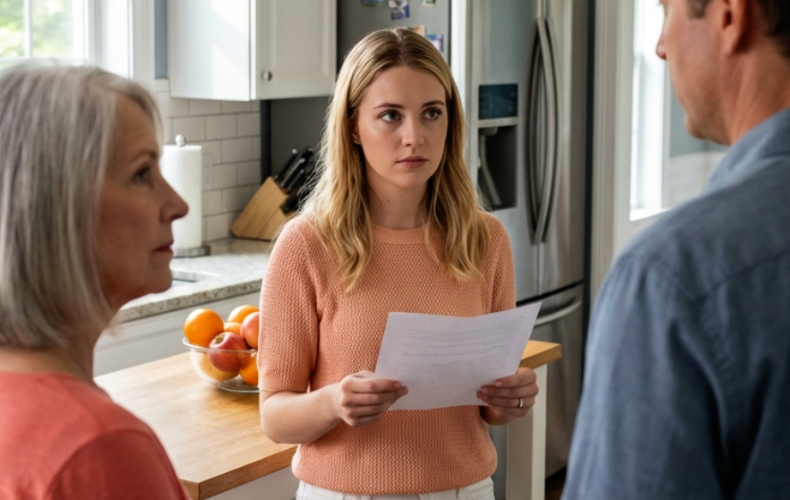
Vivien produced a folded piece of paper with the ceremony of a high priestess. As Isabella unfolded it, the names blurred. Cynthia, Uncle Raymond, the Sanders from the country club, distant cousins, business associates.
“Thirty-two people, Isabella. Little Timmy Sanders counts as a half-portion, but let’s prepare for thirty full plates. You know how boys grow.”
The sheer logistics were staggering. In previous years, fifteen guests had pushed Isabella to the brink of physical collapse. Doubling that number, while maintaining the “standard” Vivien demanded, was not a request; it was an act of psychological warfare.
“Vivien, I haven’t even shopped for thirty people. The oven space alone—”
“Nonsense, dear,” Vivien interrupted, waving a manicured hand. “You’re a machine. You always pull it off. And I’ve upgraded the menu. The Sanders expect a certain level of… sophistication.”
The “upgraded” menu was a list of culinary landmines:
Three types of artisanal stuffing (no store-bought bread).
Honey-glazed ham with a reduction that took four hours.
Seven distinct side dishes, including a soufflé that required precise timing.
Four homemade pies with hand-crimped crusts.
The sudden addition of a strict nut-allergy protocol for the Sanders child.
Hudson finally looked up, not to offer help, but to add his own weight to the burden. “Yeah, make sure it’s perfect this time, babe. Last year the stuffing was a bit… uninspired.”
III. The Math of Invisibility
By Tuesday evening, the kitchen had been transformed into a commercial production line. Isabella sat at the table with a calculator and a legal pad, trying to map out the “Impossible Timeline.”
It was during this calculation that Isabella noticed something devastating. She looked at the guest list again. There were thirty-two names, meticulously categorized by Vivien.
She was the chef, the maid, the coordinator, and the server—but she was not a guest. She was the invisible infrastructure upon which their “Old Money” aesthetic was built.
When she asked Hudson for help, he was already putting on his golf shoes. “I’d love to, babe, but I’ve got the pre-holiday round with the guys. Tradition, you know? Besides, you’re so much better at this than I am. I’d just be in the way.”
This was weaponized incompetence in its purest form. By praising her skill, he excused his own laziness. By calling her a “machine,” he stripped her of her right to be tired.
The final crack in the dam occurred on Wednesday night. Vivien called at 11 p.m. to remind her that the Sanders boy’s allergy meant she had to restart three of the side dishes she had already finished.
“You’ll figure it out, dear. You always do. See you at two p.m. sharp!”
Isabella hung up the phone. She didn’t cry. Instead, she felt a strange, cold clarity. She realized that she had trained them to treat her this way. Every time she had smiled through the exhaustion, every time she had apologized for a minor flaw, she had signaled that her boundaries were non-existent.
At 1:30 a.m. on Thanksgiving morning, while Hudson slept the deep, peaceful sleep of a man who has never had to worry about the logistics of his own comfort, Isabella packed a single suitcase. She didn’t take much—just the summer dresses Hudson called “too casual” and a swimsuit she hadn’t worn in years.
She sat at the kitchen table one last time and wrote a note. It was brief, devoid of the apologies that usually peppered her speech.
Hudson,
Something came up and I had to leave town. You’ll need to handle Thanksgiving dinner. The groceries are in the fridge. The instructions are on the counter.
Isabella.
She felt a rush of adrenaline as she drove to the airport. For the first time in five years, she wasn’t thinking about the internal temperature of a turkey or the crispness of a linen napkin. She was thinking about the Pacific Ocean.
By the time the sun began to rise over the wing of the plane, Isabella was thirty thousand feet above the life she was reclaiming. She watched the clouds turn pink and gold, and for the first time in a long time, she breathed without feeling like her ribs were a cage.
Back in the suburbs, the silence of the Fosters’ home was broken at 7:23 a.m. by Hudson’s alarm. He rolled over, expecting the house to smell like sage and roasting meat. Instead, it smelled of… nothing.
He wandered downstairs, expecting to find Isabella in her apron, perhaps a bit frazzled, but moving with her usual grace. When he saw the cold, dark kitchen and the raw turkeys still sitting in their plastic wrapping, a primal sense of dread took hold.
He found the note. He read it once. Twice. Five times.
“Gone? What do you mean, gone?” he whispered to the empty room.
The panic that followed was a masterclass in the realization of privilege. Hudson had no idea how to turn on the convection setting of the oven. He didn’t know where the roasting pans were kept. He didn’t even know how to make coffee without Isabella having already set the machine.
When Vivien arrived at 10 a.m., dressed in a pristine silk suit, she didn’t ask if Isabella was safe. She didn’t ask if there had been a tragedy.
“This is an embarrassment,” she hissed, surveying the raw ingredients. “Thirty-two people are coming, Hudson. The Sanders! What kind of woman does this?”
“Maybe a woman who was tired of doing it all alone?” Hudson snapped, the first spark of self-awareness finally igniting.
The next four hours were a descent into domestic hell. Hudson and Vivien attempted to “team up,” which resulted in Vivien barking orders and Hudson accidentally melting a plastic bowl on the stovetop. They tried to call caterers, but it was Thanksgiving morning; every professional in the city was either working a pre-booked event or home with their own families.
“We can’t cancel,” Vivien insisted. “We’ll just… we’ll do it ourselves. How hard can a turkey be?”
At 2:00 p.m., the doorbell rang. It was the Sanders.
The house did not smell of a feast. It smelled of scorched flour and desperation. Hudson opened the door, his shirt stained with cranberry juice, looking like a man who had been through a physical altercation.
“We’re… running a bit behind,” he stammered.
As the guests filed in, the disparity between the “Old Money” facade and the current reality became undeniable. The table was set beautifully—thanks to Isabella’s work two days prior—but there was no food to put on the plates.
In the kitchen, Hudson’s phone finally pinged. A notification from Isabella.
He opened it, and the entire room seemed to lean in. It was a photo. Isabella was sitting at a beachfront bar in Maui. The sun was golden on her skin, her hair was salt-tossed and free, and she held a Mai Tai with a tiny umbrella. She looked younger, lighter, and radiantly happy.
The caption read:
“Thanksgiving in paradise. Tell Vivien the turkey is her problem now.”
Hudson stared at the image. The realization hit him like a physical blow. She wasn’t at a funeral. She wasn’t in a hospital. She was exactly where she wanted to be, and she had chosen it specifically because it was far away from him.
The relatives erupted. Some were shocked, others—like Hudson’s sister-in-law Carmen—couldn’t hide a smirk.
“Good for her,” Carmen whispered, loud enough for Vivien to hear. “She finally stopped being the help and started being a human being.”
Isabella returned four days later. She didn’t sneak into the house; she walked in through the front door with a tan and a sense of calm that acted as a shield.
Hudson was waiting in the living room. He looked terrible. The house was still messy, a testament to his inability to maintain the standard Isabella had provided for years.
“We need to talk,” he said.
“No,” Isabella replied, sitting down and crossing her legs. “I’m going to talk. You’re going to listen. And then you’re going to decide if you want to stay married to me, or if you want to stay married to the version of me that doesn’t exist anymore.”
The conversation that followed was the most honest of their marriage. Isabella laid out the “Invisible Labor” she had performed. She explained the difference between hosting and servitude.
“I will never cook for thirty people alone again,” she stated. “I will never be uninvited from the guest list of my own home. If your mother wants a gala, she can hire a gala staff. If you want a wife, you have to start acting like a partner.”
Hudson tried to defend his mother. “She just has high standards, Isabella. She’s from a different generation.”
“And I am from a generation that doesn’t accept emotional abuse as a ‘high standard,’” Isabella countered.
The following Thanksgiving was a quiet affair. The house smelled of roasted chicken—not three turkeys—and the guest list was limited to eight people who actually loved Isabella.
Vivien was not there. She had spent the holiday at the country club, telling anyone who would listen that Isabella had “ruined” the family tradition. Hudson had stayed home. He had spent the morning in the kitchen, not “helping,” but participating. He peeled the potatoes. He made the salad. He even managed to set the table without being prompted.
As they sat down to eat, Isabella looked around the table. There were no Sanders. No business associates. Just friends and family who saw her.
“I’m grateful,” Hudson said, raising a glass, “for the woman who had the courage to leave me at the airport. Because without that, I never would have learned how to truly be with her.”
Isabella smiled. It wasn’t the practiced mask of a hostess. it was the smile of a woman who was finally, undeniably, home.
The protagonist’s transition from “The Machine” to “The Individual” is a classic study in the breaking of codependency. By removing her labor, she forced the system (the family) to acknowledge its reliance on her. This wasn’t a “temper tantrum,” but a necessary systemic shock to reset the power dynamics of the marriage.
How would you like to explore the psychological evolution of these characters further, or should we focus on a different narrative perspective?